Fruit IPM Updates Week of 3/30/2026

Tree Fruit Phenology Update

Tree fruit phenology is progressing across New Jersey, with development in southern counties remaining slightly advanced and northern regions beginning to catch up. Overall, the 2026 season is showing a more compressed phenology window than typical. Warm temperatures this week significantly advanced phenology.

In apples, most varieties have reached tight cluster across the state, with early varieties in southern counties at pink bud. In pears, most varieties are at early white bud to popcorn, with Asian pears more advanced and approaching bloom. Peach varieties have reached pink bud across New Jersey, with nectarines near or in bloom in South Jersey.

Apples
Apple Phenology Update

Apple phenology continues to progress across New Jersey. Observations indicate that northern counties are primarily at tight cluster, while southern counties are at pink bud in early varieties.

This stage marks a critical transition in disease management, particularly for apple scab, powdery mildew, and cedar apple rust, as well as key insect management timings.

Phenology Dates by County (earliest varieties)

County Green Tip Tight Cluster Pink Bud
Cumberland 3/22 3/28 4/3
Gloucester 3/22 3/28 4/3
Burlington 3/22 3/28 4/2
Mercer 3/22 3/28 4/2
Middlesex 3/22 4/1 TBD
Monmouth 3/22 TBD TBD
Hunterdon 3/22 TBD TBD
Morris 3/26 TBD TBD
Warren 3/30 TBD TBD
Sussex 3/31 TBD TBD
Bergen 3/22 4/1 TBD
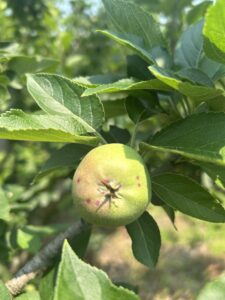
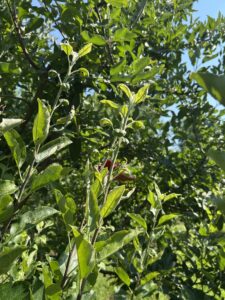
Pink Lady apple variety in pink bud. Gloucester County, NJ. Photo by Katrina DeWitt

Figure 1: Pink Lady apple variety in pink bud. Gloucester County, NJ. Photo by Katrina DeWitt

Apple Scab
Models

Apple scab models are available through NEWA and RIMpro. These models currently indicate that ascospore maturity is increasing and will continue to rise rapidly over the next several days. Apply fungicides before infection events.

Current Update using the Upper Deerfield Station
  • ~13% maturity on April 1
  • ~15% on April 2
  • Forecasted to reach 25–40% by April 4–8
Management Considerations

Now that we have reached the tight cluster stage, it is important to select fungicides that target both apple scab and powdery mildew. Manzate is ineffective against powdery mildew. Keep in mind that powdery mildew prefers warm, dry conditions and does not require rainfall to infect. For farms in southern counties that have reached pink stage, it is important to begin targeting cedar apple rust. Manzate is effective against cedar apple rust.

  • Manzate + single-site fungicide
  • DMI (FRAC 3) for high pressure
  • Vangard (FRAC 9; not effective on cedar apple rust)
  • FRAC 7 (save Aprovia for summer; not effective on cedar apple rust)
  • Axios (great for scab and powdery mildew; novel FRAC 52)
  • FRAC 11 (save for summer)
  • Topsin (limited uses; consider saving for summer; FRAC 1; not effective on cedar apple rust)

Monitor:

  • NEWA models
  • Weather/wetting events
  • Phenology

Early control is critical to avoiding season-long pressure.

Insect Update

Ambrosia Beetle:

  • Ambrosia beetles have been detected in Burlington, Salem, Gloucester, and Middlesex counties
  • Activity has not yet been observed further north at this time
  • Observed activity is low and is not a concern

Continue monitoring traps, particularly in stressed or newly planted blocks, as activity may increase with warming temperatures.

Mating Disruption Timing:

  • Codling moth (CM) mating disruption should be applied around pink
  • Growers should begin preparing materials and planning applications now
Summary
  • Apple phenology is progressing across New Jersey, with northern counties at tight cluster and southern counties at pink bud in early varieties
  • This stage marks a critical period for apple scab and powdery mildew management, as well as key insect timings
  • Apple scab ascospore maturity is increasing (~13–15%) and is forecasted to reach 25–40% over the next several days, increasing infection risk
  • Fungicide applications should be applied prior to infection events, with materials selected to target both scab and powdery mildew
  • In southern counties at pink, begin targeting cedar apple rust

Pears
Pear Phenology Update

Pear phenology has advanced rapidly across southern New Jersey over the past week. Observations made on April 2 indicate that most European pear varieties are now at early white bud, following cluster separation but prior to petal show, with some blocks progressing into popcorn stage.

Asian pear varieties are more advanced, with many blocks at popcorn stage and approaching bloom.

White bud/popcorn. Asian pear variety phenology. Salem County, NJ.

Figure 2. White bud/popcorn. Asian pear variety phenology. Salem County, NJ. Photo by Katrina DeWitt.

Pear Psylla

Pear psylla activity has been variable across southern New Jersey. Observations from April 2 indicate differences by county:

  • Salem County: adults and eggs observed
  • Gloucester County: none observed
  • Burlington County: no activity observed to date
  • Mercer County: no activity observed to date

Overall pressure remains relatively low in many orchards. This is likely due, in part, to recent oil applications, particularly where oil was combined with materials such as Esteem, which can suppress egg laying and early population development.

At this stage (white bud to popcorn):

  • Continue monitoring for adults, eggs, and the onset of nymph hatch
  • Use beating trays to assess adult activity
  • Examine developing shoots and leaves for egg presence

Management considerations:

  • In blocks without prior applications, or where psylla is present, consider a pre-bloom insecticide application
  • Consider applying particle films such as dormant oil or Surround to deter egg laying
  • With pre-bloom insecticide applications, softer materials should be used to avoid harming pollinator or beneficial insect populations
  • In blocks where adults are present at low pressure, insecticide options include Esteem (up to 2 applications 14 days apart), Centaur, or Aza-Direct
  • In blocks where adults are present at high pressure (more than 4 adults per beating tray), insecticide options include Apta, Assail, or AgriMek
  • Insecticides should be applied prior to bloom, as use during bloom is restricted due to pollinator protection

As bloom approaches (particularly in Asian pears):

  • Avoid applications that may impact pollinators
  • Management focus will shift to early nymph control post-bloom
Pear Diseases
Fire Blight and Early Season Management

As pears approach bloom, fire blight risk will increase significantly, especially given the recent wet conditions and continued rainfall through the weekend. These conditions are favorable for bacterial spread and infection.

As bloom approaches:

  • Begin planning for antibiotic applications, particularly if warm and wet conditions persist
  • Kasumin may be used at bloom and petal fall
  • Streptomycin and oxytetracycline remain key options, particularly post-bloom
  • Rotate chemistries to support resistance management
Pear Scab

RIMpro modeling for pear scab in Upper Deerfield has indicated low infection risk to date, but conditions are rapidly becoming more favorable for infection.

The primary infection model shows maturing ascospores present and available, with multiple wetting events occurring from late March through early April. These rain events are driving spore release and infection potential, with additional infection periods forecasted in the coming days.

From white bud to popcorn:

  • Protective fungicide programs should now be in place and maintained, particularly ahead of rain events
  • Applications of mancozeb or ziram tank-mixed with Procure, Cevya, or Vangard are effective options for scab control
  • Applications should be made prior to rainfall events, as infections occur during wetting periods
  • If 2 inches or more of rainfall occur following an application, a follow-up spray should be considered to maintain protection

As we move toward bloom:

  • Continue programs targeting pear scab, rust diseases, and Fabraea leaf spot
  • Particular attention should be paid to Asian pear varieties, which are further advanced and at greater risk
Summary
  • Observations from April 2 indicate most European pears are at early white bud, with some at popcorn stage
  • Asian pears are at popcorn and approaching bloom
  • Pear psylla activity remains variable across counties, with adults and eggs observed in Salem County
  • Reduced pressure in some blocks is likely due to oil applications, with or without Esteem
  • Where oil was not applied, or psylla is present, pre-bloom insecticide applications should be considered
  • Insecticide applications must be completed prior to bloom to protect pollinators
  • Recent and continued rainfall is increasing disease pressure, particularly for pear scab and fire blight
  • Fungicide programs should be actively maintained, with reapplication needed after significant rainfall (2 inches or more)
  • Fire blight risk will increase rapidly as bloom approaches, so antibiotic programs should be prepared

Continued scouting is critical over the next 7–10 days as phenology and pest pressure accelerate.

Peaches
Peach Phenology

Peach varieties across New Jersey were observed at the pink bud stage this week. Nectarines are more advanced, with the majority observed near or in bloom in South Jersey. Development is progressing steadily and will continue as temperatures warm.

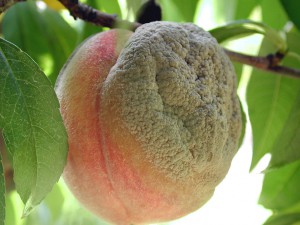
Brown Rot

Blossom infections from the brown rot fungus can occur whenever pistils are exposed, and favorable environmental conditions are present.

Infections can occur during any wetting period when temperatures are between 41 and 86°F. Optimum conditions occur with wetting and temperatures in the mid-70s. During extended wetting periods (several days or more), blossoms can be infected regardless of temperature. Infections under suboptimal conditions are generally less severe.

Blossoms and fruitlets remain susceptible until the pistil desiccates, which occurs sometime between petal fall and shuck split.

Management Considerations

  • Fungicides used for control at the blossom blight stage should not overlap with fungicides used in the pre-harvest stage of brown rot
  • Try to save fungicide options with low pre-harvest intervals for later in the season
  • Bravo Weather Stik + single-site fungicide
  • Vangard (applied at pink stage)
  • Rovral (applied at full bloom)
  • Flint Extra (applied at petal fall)

Initiate coverage for blossom blight starting at pink for short-petaled varieties and at 5–10% bloom for showy flowers. Refer to the NJ Commercial Tree Fruit Production Guide for recommended materials and rates.

Insect Update

Mating Disruption Timing:

  • Oriental fruit moth mating disruption should be applied at pink
  • Growers should begin preparing materials and planning applications now

Scale:

  • Oil applications may be safely applied up to pink on peach
  • Oil can be applied alone or in combination with insecticides, including Centaur, Sivanto Prime, and Esteem

Green Peach Aphid:

  • Scouting should begin at pink stage
  • Thresholds for treatment are 1 colony/tree in nectarines or 2–3 colonies/tree in peaches
Summary
  • Observations indicate peaches are at pink bud across New Jersey, with nectarines more advanced and approaching or in bloom in South Jersey
  • Development is progressing steadily and will accelerate with warming temperatures
  • Brown rot infection risk is present whenever blossoms are exposed under wet conditions, particularly between 41–86°F
  • Blossoms remain susceptible through petal fall to shuck split
  • Fungicide programs should be initiated at pink to early bloom, depending on flower type, while avoiding overlap with pre-harvest materials
  • Oriental fruit moth mating disruption should be applied at pink; growers should prepare materials now
  • Oil applications for scale can be made up to pink and may be tank-mixed with labeled insecticides
  • Green peach aphid scouting should begin at pink, with treatment thresholds of 1 colony/tree in nectarines and 2–3 colonies/tree in peaches

Continued scouting and timely applications will be critical over the next 7–10 days as phenology advances.

Vegetable IPM Update 6/5/25

Greetings from the Veg IPM team!

Sweet Corn

With the hot weather, we’re starting to see sweet corn really coming along. Some plantings of sweet corn are silking (especially in the south), so it’s time to think about corn earworm management. Moth captures in the Southern part of the state (see map) are indicating that 4 and even 3 day intervals are necessary in some areas. Rotation is important for avoiding resistance, and there are four IRAC groups that are registered in silking sweet corn: 1 (carbamates), 3 (pyrethroids), 5 (spinosyns), and 28 (diamides). Corn earworm is at least partly resistant to several pyrethroids, so a spray program should not rely solely on pyrethroids, although they can be useful in tank-mixes or as pre-mixed products, such as Besiege or Elevest (Group 28 + Group 3). For detailed information about resistance and potential spray programs, the University of Delaware has an excellent resource on corn earworm management.

Spray intervals based on nightly pheromone moth captures for the southern part of New Jersey. Note that not all locations in the IPM program are currently trapping. This map is based on the following thresholds: 0 moths = 6-7 day schedule, 1 moth = 5 day spray schedule, 2-20 moths = 4 day spray schedule, 20+ moths = 3 day spray schedule.

Cole Crops 

A shiny black beetle with straight antennae stands on a leaf surrounded by circular feeding holes.

Flea beetle surrounded by feeding damage. Picture by Maria Cramer.

Flea beetle activity seems to be slowing down some, but they are still active in various cole crops. This year, they have been especially prevalent in lacinato kale, Napa cabbage and bok choy. Young plants are especially vulnerable to attack from flea beetles. The treatment threshold for flea beetles in heading cole crops is 50% infestation.

Two caterpillars on brassica leaves. Diamondback moth caterpillar on the left is smooth and tapered at each end. Imported cabbageworm on the right is fuzzy.

Left: Diamondback moth caterpillar, showing characteristic tapering at each end. Right: Imported cabbageworm caterpillar showing characteristic fuzziness. Pictures by Maria Cramer.

We’re still seeing caterpillar activity in cabbage and other cole crops. Treatment thresholds vary between crops and growth stage, but for heading cole crops between early vegetative and cupping, the treatment threshold is 30%. At this stage, sprayable Bt products (IRAC 11A) such as Dipel, Xentari, or Javelin can be effective on young imported cabbage worm caterpillars. Other materials approved for caterpillar control include Entrust/Radiant (IRAC 5), Proclaim (IRAC 6), Torac (IRAC 21A), and Exirel (IRAC 28). Diamondback moth has resistance to many insecticide groups, and pyrethroids (IRAC 3A) are not effective for their management. For Bt products and contact insecticides, coverage on the undersides the leaves is essential.

Tomatoes

In high tunnels and field plantings of tomatoes, we’re seeing limited aphid, thrips, and spider mite activity. If dealing with primarily aphids, products such as Beleaf (IRAC 29) are recommended, especially if plants have reached the flowering stage. We have seen aphid populations decline over the last couple of weeks without spray, probably due to natural enemies predation. For thrips, Entrust, Radiant (IRAC 5) and Torac (IRAC 21A) can be used. For spider mites, Nealta (IRAC 25) is an effective material that is more friendly to beneficial insects, but Portal (IRAC 21A) and other materials can be used to manage populations. We’ve seen very few Colorado potato beetles (CPB) in tomatoes, so while no controls are needed yet, we’ll keep an eye out for increasing populations.

Eggplants

In eggplants we have seen some damaging populations of CPB. For plants under 6 inches, 2 small/1 large larvae per plant is the threshold, while for plants taller than 6 inches, the threshold is 4 small/2 large larvae per plant. Adults are hard to kill, so sprays should target the larvae, with younger/smaller larvae being more vulnerable than older larvae. CPB has resistance to many classes of insecticides and is notorious for quickly developing resistance to new ones, so plan to rotate IRAC groups if you’ve already treated or need to treat more than once. If you haven’t used a neonic (IRAC 4) at planting or in the drip, you can use a foliar neonic like Assail or a spinosyn like Entrust or Radiant (IRAC 5). Avoid IRAC 5 groups if you’ve already used a neonic, because there is risk of cross resistance. Diamide products like Coragen and Exirel (IRAC 28), Rimon (IRAC 15), and Torac (IRAC 21A) should all give good control.

On the left there are two orange beetle larvae on an eggplant leaf. On the right there is a large beetle with black and white striped wing covers and an orange head and abdomen, also on an eggplant leaf.

Left: Colorado potato beetle larvae and feeding damage on an eggplant leaf. Right: Adult Colorado potato beetle. Photos by Maria Cramer.

Diseases

We’ve detected bacterial diseases of tomatoes and peppers on a few farms in the central and northern parts of the state (see photos below). Copper may help mitigate symptoms, but some strains have developed resistance due to continued copper use. Other products that may help include Actigard and Quintec. Otherwise, properly managing nutrients and growing conditions for the plant will be crucial for reducing the severity of this disease.

Bacterial leaf spot on tomato. Photo by Amanda Quadrel

Bacterial leaf spot on pepper. Photo by Amanda Quadrel.


Please consult the Mid-Atlantic Commercial Vegetable Production Guide for a more comprehensive list of materials that are labeled for specific crops and pests. As always, be sure to follow label rates and application instructions.

Authors: Amanda Quadrel (Northern NJ Veg IPM coordinator) and Maria Cramer (Southern NJ Veg IPM coordinator)

Vegetable IPM Update 5/30/25

Greetings from the Veg IPM team! The program welcomes Martina Lavender and Coco Lin as the first two scouts of the season, servicing North and Central Jersey respectively.

Sweet Corn

We’ve put out corn earworm pheromone traps throughout the state. While silking corn is the main target of CEW activity, we set the traps early to detect overwintering moths. So far, we haven’t spotted any serious corn pests through visual inspection.

Cole Crops 

A shiny black beetle with straight antennae stands on a leaf surrounded by circular feeding holes.

Flea beetle surrounded by feeding damage. Picture by Maria Cramer.

Flea beetle remain active in various cole crops. This year, they have been especially prevalent in lacinato kale, Napa cabbage and bok choy. Young plants are especially vulnerable to attack from flea beetles. The treatment threshold for flea beetles in heading cole crops is 50% infestation.


Left: Smooth caterpillar, tapered at each end. Right: fuzzy caterpillar. Both are on brassica leaves.

Left: Diamondback moth caterpillar, showing characteristic tapering at each end. Right: Imported cabbageworm caterpillar showing characteristic fuzziness. Pictures by Maria Cramer.

We’re seeing caterpillar activity (imported cabbageworm in the North and diamondback moth in the South) in cabbage and other cole crops. Treatment thresholds vary between crops and growth stage, but for heading cole crops between early vegetative and cupping, the treatment threshold is 30%. At this stage, sprayable Bt products (IRAC 11A) such as Dipel, Xentari, or Javelin can be effective on young imported cabbage worm caterpillars. Other materials approved for caterpillar control include Entrust/Radiant (IRAC 5), Proclaim (IRAC 6), Torac (IRAC 21A), and Exirel (IRAC 28). Diamondback moth has resistance to many insecticide groups, and pyrethroids (IRAC 3A) are not effective for their management. For Bt products and contact insecticides, coverage on the undersides the leaves is essential.

Tomatoes

In high tunnels and the first field plantings of tomatoes, we’re seeing limited aphid, thrips, and spider mite activity. If dealing with primarily aphids, products such as Beleaf (IRAC 29) are recommended, especially if plants have reached the flowering stage. We have seen aphid populations decline over the last couple of weeks without spray, probably due to lady beetle predation and parasitism from wasps. For thrips, Entrust, Radiant (IRAC 5) and Torac (IRAC 21A) can be used. For spider mites, Nealta (IRAC 25) is an effective material that is more friendly to beneficial insects, but Portal (IRAC 21A) and other materials can be used to manage populations. We’ve seen very few Colorado potato beetles, so while no controls are needed yet, we’ll keep an eye out for increasing populations.

Colorado potato beetle adult in tomato

Diseases

With little break in the rainy weather, we’re seeing plants stressed by flooding and some bacterial and fungal diseases popping up in tomatoes, peppers, and cole crops. If you’re seeing disease symptoms and need a diagnosis, samples can be sent to Rutgers Plant Diagnostic Laboratory.

We’ve detected bacterial leaf spot of tomatoes and peppers on a few farms in the central and northern parts of the state (see photos below). Copper may help mitigate symptoms, but some strains have developed resistance due to continued copper use. Other products that may help include Actigard and Quintec. Otherwise, properly managing nutrients and growing conditions for the plant will be crucial for reducing the severity of this disease.

Bacterial leaf spot on tomato

Bacterial leaf spot on pepper


Despite the rain, we also saw some rhizoctonia in cole crops, which shows up when transplant plugs dry out. For more information on this disease, check out the recent update in the PPA.

Please consult the Mid-Atlantic Commercial Vegetable Production Guide for a more comprehensive list of materials that are labeled for specific crops and pests. As always, be sure to follow label rates and application instructions.

Authors: Amanda Quadrel (Northern NJ Veg IPM coordinator) and Maria Cramer (Southern NJ Veg IPM coordinator)

Vegetable IPM Update 5/15/25

Greetings from the Veg IPM team! No major changes have taken place between last week and this week, and with the rainy weather, scouting has been limited.

Sweet Corn

We’ve put out corn earworm pheromone traps throughout the state. While silking corn is the main target of CEW activity, we set the traps early to detect overwintering moths, which have become more common with warmer winters. As a reminder, we’re no longer using blacklight traps as of this year, and we’ll be reporting pheromone trap counts in the Plant Pest Advisory as the season progresses. So far, we haven’t spotted any corn pests through visual inspection.

Cole Crops 

A shiny black beetle with straight antennae stands on a leaf surrounded by circular feeding holes.

Flea beetle surrounded by feeding damage. Picture by Maria Cramer.

Flea beetle are active in various cole crops. This year, they have been especially prevalent in Napa cabbage and bok choy. Young plants are especially vulnerable to attack from flea beetles. The treatment threshold for flea beetles in heading cole crops is 50% infestation.


Two picture, the picture on the left shows a smooth caterpillar that tapers at both ends. The picture on the right shows a caterpillar that is fuzzy all over and does not taper at either end.

Left: Diamondback moth caterpillar, showing characteristic tapering at each end. Right: Imported cabbageworm caterpillar showing characteristic fuzziness. Pictures by Maria Cramer.

We’re seeing caterpillar activity (imported cabbageworm and diamondback moth) in cabbage and other cole crops. Treatment thresholds vary between crops and growth stage, but for heading cole crops between early vegetative and cupping, the treatment threshold is 30%. At this stage, sprayable Bt products (IRAC 11A) such as Dipel, Xentari, or Javelin can be effective on young caterpillars. Other materials approved for caterpillar control include Entrust/Radiant (IRAC 5), Proclaim (IRAC 6), Torac (IRAC 21A), and Exirel (IRAC 28). For Bt products and contact insecticides, coverage on the undersides the leaves is essential.


Tomatoes

In high tunnels and the first field plantings of tomatoes, we’re seeing limited aphid, thrips, and spider mite activity. If dealing with primarily aphids, products such as Beleaf (IRAC 29) are recommended, especially if plants have reached the flowering stage. For thrips, Entrust, Radiant (IRAC 5) and Torac (IRAC 21A) can be used. For spider mites, Nealta (IRAC 25) is an effective material that is more friendly to beneficial insects, but Portal (IRAC 21A) and other materials can be used to manage populations.


Please consult the Mid-Atlantic Commercial Vegetable Production Guide for a more comprehensive list of materials that are labeled for specific crops and pests. As always, be sure to follow label rates and application instructions.

Authors: Amanda Quadrel (Northern NJ Veg IPM coordinator) and Maria Cramer (Southern NJ Veg IPM coordinator)


Vegetable IPM Update 5/08/25

Sweet Corn

We’ve put out corn earworm pheromone traps throughout the state. While silking corn is the main target of CEW activity, we set the traps early to detect overwintering moths, which have become more common with warmer winters. As a reminder, we’re no longer using blacklight traps as of this year, and we’ll be reporting pheromone trap counts in the Plant Pest Advisory as the season progresses.

Cole Crops 

A shiny black beetle with straight antennae stands on a leaf surrounded by circular feeding holes.

Flea beetle surrounded by feeding damage. Picture by Maria Cramer.

Flea beetle are active in various cole crops. This year, they have been especially prevalent in Napa cabbage and bok choy. Young plants are especially vulnerable to attack from flea beetles. The treatment threshold for flea beetles in heading cole crops is 50% infestation.


Two picture, the picture on the left shows a smooth caterpillar that tapers at both ends. The picture on the right shows a caterpillar that is fuzzy all over and does not taper at either end.

Left: Diamondback moth caterpillar, showing characteristic tapering at each end. Right: Imported cabbageworm caterpillar showing characteristic fuzziness. Pictures by Maria Cramer.

We’re seeing caterpillar activity (imported cabbageworm and diamondback moth) in cabbage and other cole crops. Treatment thresholds vary between crops and growth stage, but for heading cole crops between early vegetative and cupping, the treatment threshold is 30%. At this stage, sprayable Bt products (IRAC 11A) such as Dipel, Xentari, or Javelin can be effective on young caterpillars. Other materials approved for caterpillar control include Entrust/Radiant (IRAC 5), Proclaim (IRAC 6), Torac (IRAC 21A), and Exirel (IRAC 28). For Bt products and contact insecticides, coverage on the undersides the leaves is essential.


Tomatoes

In high tunnel tomatoes, we’re seeing limited aphid, thrips, and spider mite activity. If dealing with primarily aphids, products such as Beleaf (IRAC 29) are recommended, especially if plants have reached the flowering stage. For thrips, Entrust, Radiant (IRAC 5) and Torac (IRAC 21A) can be used. For spider mites, Nealta (IRAC 25) is an effective material that is more friendly to beneficial insects, but Portal (IRAC 21A) and other materials can be used to manage populations.


Please consult the Mid-Atlantic Commercial Vegetable Production Guide for a more comprehensive list of materials that are labeled for specific crops and pests. As always, be sure to follow label rates and application instructions.

Authors: Amanda Quadrel (Northern NJ Veg IPM coordinator) and Maria Cramer (Southern NJ Veg IPM coordinator)


Take a quick survey to help with Field Equipment Sanitation Research!

In a Specialty Crop Research Initiative (SCRI) grant designed to guide future solution and resources centered around field equipment sanitation, collaborative team comprising pathologists, weed scientists, agronomists, and experts in agricultural equipment sanitation has crafted a questionnaire. This questionnaire is designed to gather growers’ input on their current practices and determine the necessity for implementing new ones.

The research will develop a more comprehensive understanding of the challenges associated with field equipment sanitation and work toward developing solutions that are effective, implementable and sustainable.

To introduce the survey and forthcoming research effort, Dr. Matt Grieshop, lead PI on this project indicates that “We are a group of agricultural research and extension professionals from across the United States that are curious about grower and agricultural professional perceptions about the importance of field equipment sanitation to mitigate the spread of organisms that pose human health, weed, plant pathogen or other risks.

Agricultural field equipment includes tillage implements, tractors, harvesters, cultivation equipment, trucks, trailers, sprayers, mowers, or any other piece of equipment that is shared across fields.

This information will be solely used to help frame future research questions and outreach activities.  It will not be published or distributed in any form. Answering should take 5 minutes or less and is completely voluntary and anonymous.

Your participation is invaluable to future developments in the industry regarding food safety and equipment sanitation. We need more inputs from New Jersey specialty crops growers so that they have a say on the direction that field equipment sanitation research will take in the future!

To contribute, visit here or scan the QR code below.


If you have questions, comments or concerns contact Dr. Matt Grieshop at mgriesho@calpoly.edu or Dr. Thierry Besancon at thierry.besancon@rutgers.edu.