The Rutgers Farm Health and Safety Working Group is conducting a survey to evaluate the priority needs of New Jersey farmers for training and resource development related to safety and health. As a New Jersey farmer, you are invited to complete this survey by Friday, May 1, 2026. Click here to access the survey and learn more. [Read more…]
April 28th Evening Webinar: Using Drones in Agriculture
Using Drones in Agriculture
Free Webinar
Date: April 28, 2026
Time: 7:00-8:30 PM

A 3-year USDA Sustainable Agriculture Research and Education Grant was awarded to a team of Agricultural Agents at Rutgers to study the use of drones in agriculture. Please join this team on Tuesday, April 28th at 7:00PM to learn about their work and the use of drones for agriculture. This program will highlight research projects, and real-world uses of drones in agricultural operations and will foster discussion and networking for anyone interested in using drones in their agricultural operation.
7:00 PM Drone Technology: A Tool for Crop Production and Management – Stephen Komar, ANR Agent /Rutgers SARE Coordinator
7:25 PM Getting Started with Drones: Regulatory Compliance and Other Practical Considerations – Adam Kyle, Warren Co. Com. College, Teaching Administrator, Precision Agriculture
7:50 PM Trusting the Data: Ground Truthing for Monitoring with Drones – Michelle Infante-Casella, ANR Agent/Rutgers SARE Co-Coordinator
8:15 PM Questions
To Join, please click the Zoom link below.
https://rutgers.zoom.us/j/95326725115?pwd=6JefhuSGbbBqjWdmDbKLXZ7exEr3la.1
This event is sponsored by a grant awarded by the USDA, Sustainable Agriculture Research and Education Program.
For questions contact Stephen Komar, Agricultural Agent and NJ SARE Coordinator via email at komar@njaes.rutgers.edu
Field Corn Planting Depth – New Jersey Quick Guidance
As corn planting gets underway across New Jersey with improving soil temperatures and field conditions, achieving a uniform stand remains critical for protecting yield potential. Planting depth plays a key role in ensuring even emergence and strong early growth.
Recommended Practices
- Aim for a planting depth of 1.5 to 2.0 inches under most conditions
- In dry surface soils (common in sandy South Jersey fields), planting can be adjusted slightly deeper, up to 2.5 inches, to reach moisture
- Ensure consistent depth across the field for uniform emergence
- In cool or wet spring conditions, consider staying closer to 1.5 inches to avoid delayed emergence
Points to Avoid
- Avoid planting shallower than 1 inch, which can lead to poor root development and drought sensitivity
- Avoid planting deeper than 2.5 inches, especially in cool soils, as emergence may be delayed
- Avoid inconsistent planting depth, which often results in uneven crop stands
- Avoid placing seed in dry soil without moisture contact
Key Message
Consistent planting depth, generally 1.5 to 2.0 inches in New Jersey conditions, helps ensure uniform emergence, which is the foundation for strong yield potential.
How Recent Fertilizer Price Increases Affect Your Per-Acre Costs
Recent increases in fertilizer prices, especially for nitrogen-based inputs, are raising production costs. This article summarizes recent price trends in our region and provides a simple worksheet for you to calculate your own cost of production.
1. Increase in recent fertilizer prices
March 30 vs. Mid-February
- Urea: +40%
- Liquid nitrogen 32%: +29%
- DAP (18-46-0): +5%
- MAP (11-52-0): +5%
- Potash: +3%
March 2026 vs. March 2025
- Urea: +38%
- Liquid nitrogen 32%: +53%
- DAP (18-46-0): +4%
- MAP (11-52-0): +8%
- Potash: +4%

2. Translating fertilizer prices into production costs
Fertilizer prices are typically reported in dollars per ton, but farmers apply fertilizer in pounds per acre. To translate market prices into on-farm costs, the price per ton is first converted to a price per pound by dividing by 2,000 (the number of pounds in a ton). This per-pound price is then multiplied by the application rate (in pounds per acre) to calculate fertilizer cost per acre.
- Fertilizer cost per acre = fertilizer price per ton / 2000 * application rate.
You can find a worksheet to calculate your total fertilizer costs on the Rutgers Farm Management website (Link here).
Salem County Agronomy Twilight Meeting-1 (May 1, 2026)
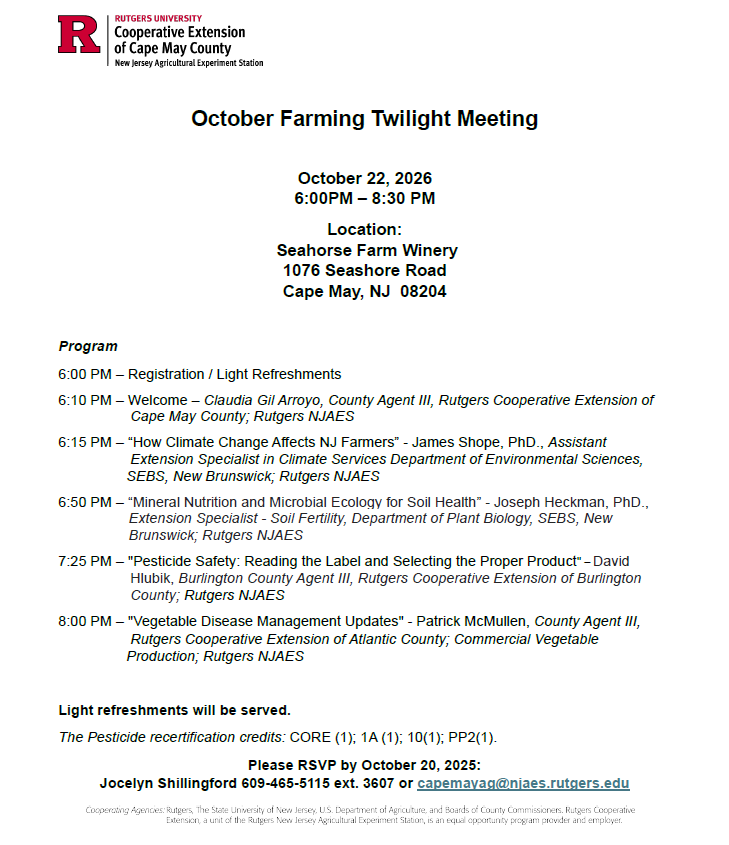
SALEM COUNTY AGRONOMY TWILIGHT MEETING-1
Date & Time: May 1, 2026 | 5:00 PM – 7:30 PM
(Program starts at 5:00 PM; please arrive a few minutes early)
Location: Rutgers Cooperative Extension Office, 51 Cheney Rd., Woodstown, NJ 08098
Registration:
Call: 856-769-0090
Email: molly.english@salemcountynj.gov
Credits Applied For:
- CORE: Basic Safety and Handling
- 1A: Agricultural Plant
- 10: Demonstration / Research
- PP2: Private Applicator
- 11: Animal (Livestock) Pest Control
Topics & Speakers:
- The 3R’s of Pesticide Use: Resistance, Rotation, and Regulation
Speaker: Janine Spies, Rutgers Cooperative Extension - The Endangered Species Act Changes to Pesticide Labels
Speaker: William J. Bamka, Rutgers Cooperative Extension - Nitrogen from Air to Soil using Sunlight
Speaker: Joseph R. Heckman, Rutgers University - Agronomist’s Field Guide to Drought Resilience
Speaker: Ramandeep Sharma, Rutgers Cooperative Extension
Visit to Clover Valley Farm – April 11
Field trip to Clover Valley Farm
Saturday, April 11, 10am
Register at: https://go.rutgers.edu/stf3j6x6