Salem County Agronomy Twilight Meeting-1 (May 1, 2026)

SALEM COUNTY AGRONOMY TWILIGHT MEETING-1

Date & Time: May 1, 2026 | 5:00 PM – 7:30 PM
(Program starts at 5:00 PM; please arrive a few minutes early)

Location: Rutgers Cooperative Extension Office, 51 Cheney Rd., Woodstown, NJ 08098

Registration:
Call: 856-769-0090
Email: molly.english@salemcountynj.gov

Credits Applied For:

  • CORE: Basic Safety and Handling
  • 1A: Agricultural Plant
  • 10: Demonstration / Research
  • PP2: Private Applicator
  • 11: Animal (Livestock) Pest Control

Topics & Speakers:

  • The 3R’s of Pesticide Use: Resistance, Rotation, and Regulation
    Speaker: Janine Spies, Rutgers Cooperative Extension
  • The Endangered Species Act Changes to Pesticide Labels
    Speaker: William J. Bamka, Rutgers Cooperative Extension
  • Nitrogen from Air to Soil using Sunlight
    Speaker: Joseph R. Heckman, Rutgers University
  • Agronomist’s Field Guide to Drought Resilience
    Speaker: Ramandeep Sharma, Rutgers Cooperative Extension
Allium Leafminer Update 3/20/2026

Greetings from the Veg IPM team, and happy first day of Spring! As we are slowly transitioning into warmer weather, now is a great time to be thinking about Allium Leafminer (ALM), a pest of many bulbous crops such as onions, scallions, chives, and garlic.

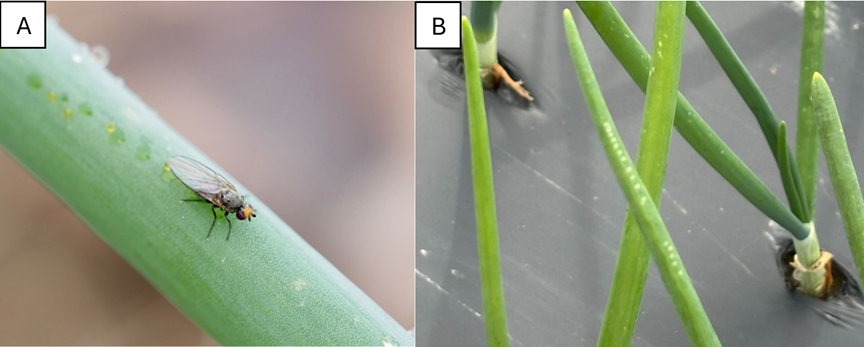
Allium Leafminer (Phytomyza gymnostoma) is a small grey-bodied fly with a yellow head (A). In warm, still weather, you may see adult flies settling on foliage. The females lay eggs in neat rows, leaving behind a line of white dots on the leaves (B). As the larvae hatch and begin to feed, they will tunnel downwards, causing damage to leaves and bulbs. ALM have two generations per year; the first in early spring, and the second occurring in the fall. Crops such as chives, scallions, garlic, onions and leeks are attacked by ALM, but leeks, and scallions seem to be the most affected. 

An Allium leafminer adult (A) and the characteristic oviposition scars left behind after females lay eggs (B)

An Allium Leafminer adult (A) and the characteristic oviposition scars left behind after females lay eggs (B). Photos by Maria Cramer and Amanda Quadrel


Be on the lookout for oviposition scars on both crop alliums and wild alliums such as wild onion/garlic and ramps. You can also use yellow sticky cards to monitor for adult presence in the field. However, another way to the predict the first generation’s activity is by using growing degree days (GDDs). The first emergence of ALM adults occurs around 250 GDDs (Base temperature: 39˚F). Below is a table that shows the number of GDDs that have accumulated from January 1st to March 19th (the date this post was written), as well as the number of GDDs predicted to accumulate by March 24th.

Location  GDDS for 3/19 GDDs for 3/24 (forecast)
Northern NJ (Chester) 102 129
Central NJ (Cream Ridge) 162 202
Southern NJ (Upper Deerfield) 187 231


While ALM risk is currently low for northern and central NJ, areas in southern NJ could reach 250 GDDs by the end of next week, thus being at a higher risk for ALM activity. To find out how many GDDs have accumulated in your specific area, the NEWA website: https://newa.cornell.edu/ has a helpful GDD calculator. From the NEWA home screen, select your nearest weather station from the drop down menu or map at the center of the page. Next, scroll down to the “Weather Tools” section on the lower right side of the page, and select “DD Calculator”. Select your start date (1/01/26) and end date (typically the day you check), as well as Degree Day Type (Base 39 F) from the menu at the left of the page.  The site will automatically generate a table of the number of accumulated GDDs for the specified date range and a forecast of predicted GDD accumulations over the next five days.

If you are concerned about crop injury due to ALM, you may want to prepare for control efforts. Floating row covers, kept on until the first flight ends (around the end of May) can restrict ALM’s access to vulnerable plants. Reflective mulches may also provide some additional crop protection. Adults and larvae can be targeted through well-timed insecticide sprays. Materials labeled for ALM control include spinosyns (IRAC 5- Radiant or Entrust (OMRI approved)), pyrethroids (IRAC 3A- Mustang Maxx, Proaxis, and Warrior II), neonicotinoids (IRAC 4A- Scorpion, Venom), the insect growth regulator Trigard (IRAC 17), and diamide products (IRAC 28- Exirel, Minecto Pro). The newly registered product Vertento (IRAC 30) may also be used for ALM control. However, growers who have trouble managing onion thrips may want to save this active ingredient for thrips sprays, as there is a limit of two applications per season. The first spray application of a material should be completed 2- 3 weeks after initial detection of ALM (either oviposition scars or the fly itself). Subsequent sprays should be completed in 1–2-week intervals. Two or three sprays should provide adequate control. As always, be sure to follow label rates and application instructions for any pesticide that you plan to use.

For more pictures and detailed information on the biology and management of ALM, Cornell has an excellent fact sheet that can be found here: https://cals.cornell.edu/integrated-pest-management/outreach-education/fact-sheets/allium-leafminer. In the meantime, we will keep our eyes open for any ALM activity in our respective areas and provide updates in the next coming weeks. We are looking forward to warmer weather and a productive season! 

~Amanda Quadrel and Maria Cramer, Senior Program Coordinators- Vegetable IPM

Questions or concerns? Get in touch with us by filling out the form below:

← Back

Thank you for your response. ✨

SOUTH JERSEY CALIBRATION GROWERS MEETING

March 25, 2026
2:30 pm – 6:00 pm
Rutgers Agricultural Research & Extension Center
121 Northville Road
Bridgeton, NJ

Program

Program Chair
Janine Spies, Rutgers Cooperative Extension
Statewide Program Leader in Fruit IPM

2:30 – Registration

3:00 – Welcome and Introductions

3:15 – Airblast Sprayer Calibration Techniques
Chris Lovenduski, Central Jersey Equipment

4:15 – Early season management in peaches
Anne Nielsen PhD, Professor & Extension Specialist in Entomology

4:45 – Light fare & refreshments (Pre-registration required)

5:00 – Coverage Counts: How to make the most of a pesticide application
Karly Regan PhD, Certis Biologicals

5:30 – Pesticide Safety and Regulations for Specialty Crops
Janine Spies PhD, Rutgers Cooperative Extension

6:00 – Pesticide Recertification Credits and Adjourn. Attendees must be present for the entire program in order to apply for NJDEP credits.

THE FOLLOWING NJDEP PESTICIDE RECERTIFICATION CREDITS WILL BE AWARDED

4 CAT-10     4 CAT-1A     3 CAT-3A     4 CORE     4 PP2

Click here to register: South Jersey Calibration Event Registration – Fill out form

PRE-REGISTRATION BY March 18, 2026

Registration cost per person is $10. Cash or check (made payable to Rutgers The State University) will be collected at the door.

If you have any questions please contact Janine Spies: (352)-231-6330, janine.spies@rutgers.edu

South Jersey Vegetable Integrated Crop Management Twilight Meeting

Vegetable Integrated Crop Management

Twilight Meeting

Wednesday, April 8, 2026

6:00 p.m. – 8:30 p.m.

East Vineland Fire Hall

4931 Landis Ave. across from the Savoy Restaurant

(park behind the building and enter conference room door in rear)


Hosted by RCE of Atlantic, Cumberland, and Gloucester Counties

6:00 pm        Soilborne Disease Identification and Control in Seedlings and Transplants

  • Patrick McMullen, RCE Atlantic

6:30 pm        Vegetable Disease Control Options for Spring Crops

  • Andrew Wyenandt, Extension Specialist, RAREC

7:00 pm        USDA Natural Resources Conservation Service Programs for Crop Production

  • Michelle Pedano, District Conservationist, NRCS

7:30 pm        On-Farm Food Safety and Food Safety Modernization Act Updates

  • Wesley Kline, RCE Cumberland

8:00 pm        Pesticide Regs & Worker Protection Standards Update for the Coming Season

  • Michelle Infante-Casella, RCE Gloucester

8:30 pm        Adjourn

Pesticide Recertification Credits offered include 1 CORE, 2 1A, 2 10, and 2 PP2.


Please call 609-625-0056 with any questions.

Hope to see you there!


Sincerely,


Patrick W. McMullen, Wesley L. Kline, and Michelle Infante-Casella

Agricultural Agents of Atlantic, Cumberland, and Gloucester Counties


Have a plan for managing thrips and TSWV in tomatoes and peppers in 2026

Thrips and tomato spotted wilt virus (TSWV) management were major challenges for multiple South Jersey growers in 2025, as well as in the previous few years. Several growers reported losing entire tomato plantings to the virus. Peppers were less impacted than tomatoes, but TSWV outbreaks did occasionally occur. As we move into pepper and tomato transplant production and the growing season for greenhouse tomatoes, having a multi-pronged approach for managing thrips and TSWV will give you the best chance of protecting your crop and avoiding losses. Below are key practices that can help keep thrips populations as low as possible:

Start clean. When transplants are infested with thrips prior to planting out, field infestations tend to occur early and be very difficult to control. To start clean:

  • Never produce transplants in the same greenhouse with ornamentals. Ornamentals can harbor thrips and many are asymptomatic hosts for TSWV.
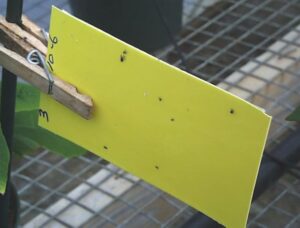
  • Monitor thrips in planthouse with sticky cards and scouting (Fig. 1). There are no established thresholds for thrips in the greenhouse, but many growers use the first appearance of thrips as an action threshold.
  • Keep greenhouses and high tunnels weed-free. Weeds can host both thrips and TSWV.
  • If buying in transplants, segregate and monitor incoming transplants to ensure that they are not bringing in thrips.
  • Treat transplants with imidacloprid (e.g. Admire) or Cyantriniliprole (Verimark) before setting in the field

A yellow rectangular sticky card held to a stake with a clothespin has caught several small insects.

Fig. 1. A sticky card being used to monitor greenhouse pests. Photo by S. Rettke.

 Manage plantings to prevent the spread of thrips and TSWV from alternative hosts into tomato plantings. Thrips are attracted to pollen-producing plants, so populations can build up on plants that flower early, such as strawberries and small grains, then move into tomato plantings. Additionally, thrips can also overwinter on weeds. Using these facts, reduce the movement of thrips into tomato plantings by:

  • Controlling weeds throughout the farm, especially in and around high tunnels
  • Separating field plantings from greenhouses/tunnels, strawberry fields, and small grains
  • Separating successive field plantings as much as possible. This way, if thrips and/or TSWV get out of control in one planting, they will not move directly into the next planting.
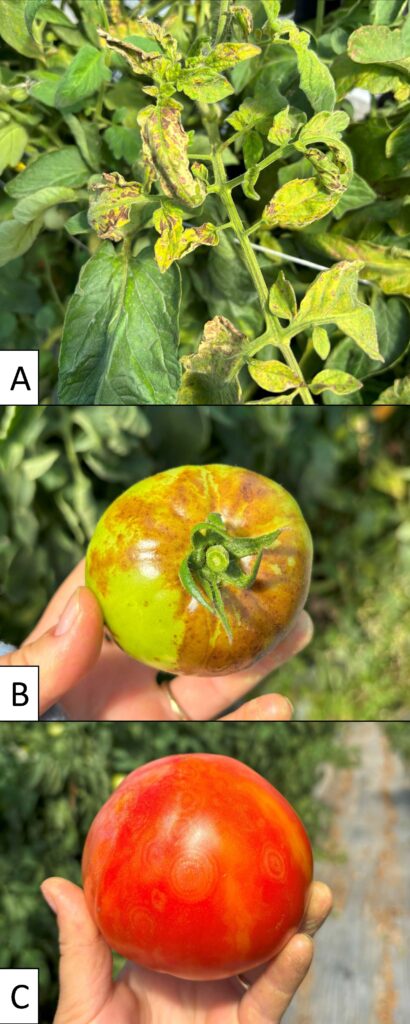
  • Scouting for tomato spotted wilt virus symptoms (Fig. 2). Immediately rogue symptomatic plants to avoid secondary spread within the field.

Fig. 2. TSWV symptoms in tomato: a) curling and yellowing foliage symptoms, b) distortion and brown shoulder symptoms on green fruit, and c) bulls-eye symptoms on ripe fruit. Photos by M. Cramer.

Use metallized plastic and resistant varieties.

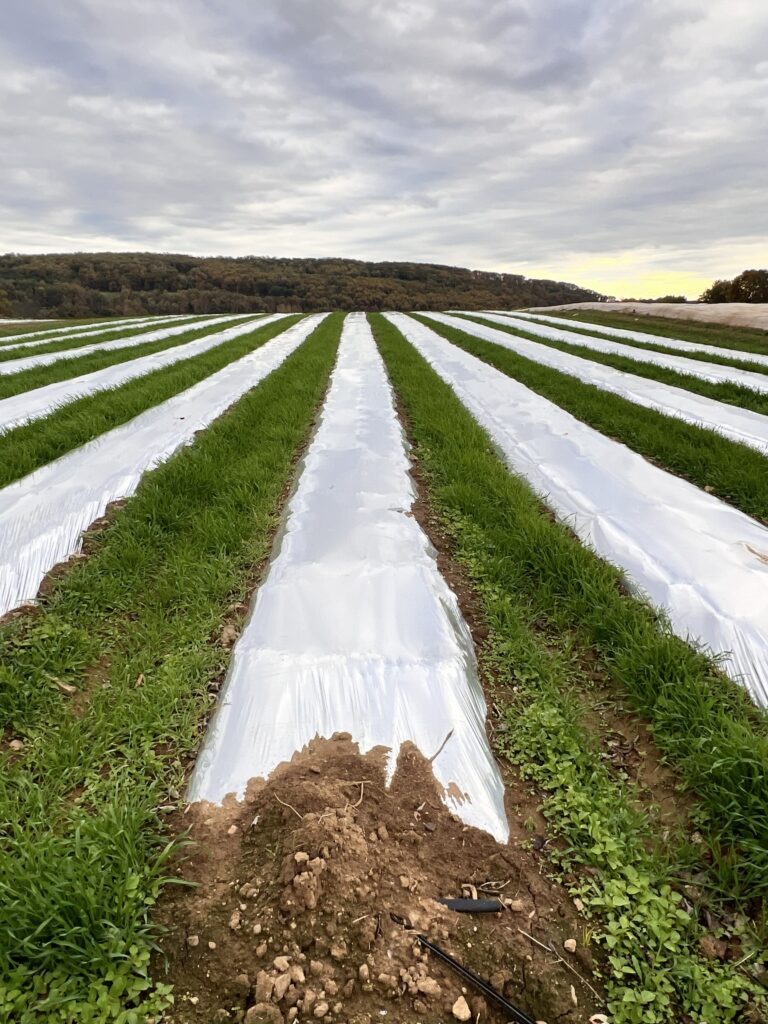
  • Use metallized plastic mulch when possible (Fig. 3). Metallized mulches reflect sunlight, disrupting thrips navigation and making it harder for them to colonize plants. These plastics are widely used in states like Florida that have historically had serious thrips problems. Because these mulches reflect solar radiation, they lower bed temperatures, and will slow down tomato growth early in the season. This should be taken into account when planning to use them.
  • Use TSWV resistant tomato and pepper varieties. While some farms have reported resistance-breaking TSWV, others continue to report that resistance is still holding up.

Fig. 3. Metallized plastic laid in the fall to control onion thrips in alliums. Photo by A. Quadrel.

Use best practices around insecticides. Thrips are difficult to manage with insecticides because they tend to hide in hard to reach parts of the plant or in the soil as well as their rapid ability to develop resistance. For example, many thrips populations in south Jersey are resistant to Radiant (IRAC 5), making this insecticide ineffective for management. Pyrethroid (IRAC 3) resistance is also widespread. Many of the insecticides labeled for thrips are only partly effective, and none are able to “knock down” high populations. To get the best efficacy out of insecticides:

  • Know what your populations are: Monitor thrips populations and treat when populations start building, but are still low.
    • Scout 5- 10 locations in field at least once a week
    • At each location in the field, pick a group of 5 consecutive plants and check 2 leaves on each plant (10 leaves total per location)
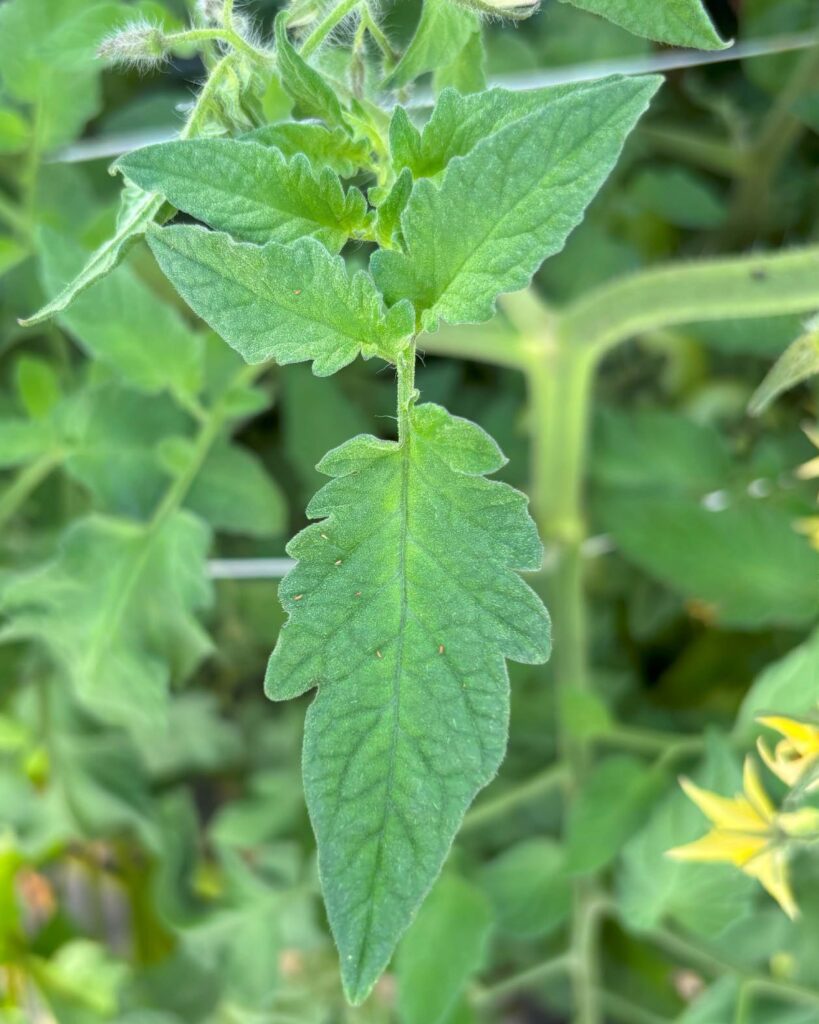
    • Count the number of thrips on the leaves (Fig. 4). Research from North Carolina shows that the species of thrips vectoring TSWV (western flower thrips) are most reliably found on the leaves rather than the flowers
    • Threshold: Action should be taken if counts are increasing towards ~ 5 thrips per 10 leaves on average
  • Rotate modes of action as much as possible. We believe that thrips populations tend to be highly localized, and thus you are managing insecticide resistance for your population of thrips specifically. The more you manage resistance, the more product options you will continue to have.
  • Monitor thrips populations after treatment to assess efficacy (some systemic products, such as Beleaf and Verimark may take several days to ~a week to impact thrips populations)

Note: The vegetable IPM program offers scouting services throughout New Jersey if you are unable to scout your plantings (you can find a description of services here). We also offer training for scouts employed by growers. Finally, private companies can also provide scouting services.

Fig. 4. Five thrips on a tomato leaf.

Plan what products you will use and when. The following table lists conventional products that can be used for tomato pest management. Choose products from a variety of IRAC groups to prevent resistance development and prolong efficacy.

IRAC group Product name Ai Efficacy

* = suppression only

Notes on use
1A Lannate Methomyl Good New EPA restrictions on annual applications (<13 lbs AI/acre/year) and mitigations for runoff and drift. Not labeled specifically for thrips in tomatoes, but can be used
1B Dimethoate Dimethoate Good Not labeled specifically for thrips in tomatoes, but can be used
4A Admire Imidacloprid Good Only labeled for tobacco thrips. For treating transplants before transplanting
5 Radiant/

Entrust

Spinetoram/

Spinosad

Excellent, except where resistant No more than 3 applications in a season. Widespread resistance issues in South Jersey
13 Pylon Chlorfenapyr Excellent Only for greenhouse tomato production– i.e., not for transplants or field production. Not to be used on tomatoes that are <1” diameter at harvest.
15 Rimon


Novaluron Good* Foliar. No more than 2 applications against thrips in a year. Can be used in greenhouses and high tunnels. Larvae only
21A Torac Tolfenpyrad Fair Foliar. No more than 2 applications in a season
23 Movento Spirotetramat ? Foliar. No more than 2 applications in a season (at 5 fl oz/A thrips rate). Larvae only
28 Harvanta Cyclaniliprole Fair* Limit of 3 applications per season (at 16.4 fl oz/A thrips rate)
28 Verimark Cyantraniliprole Fair* Tray drench just prior to planting or drip irrigation. No more than 2 applications per year. Limits when ai is being used foliarly (e.g. Exirel) as well
28 Exirel Cyantraniliprole Fair* Foliar. Recommend early in the season for new transplants. Limitations on ai use
29 Beleaf Flonicamid Excellent Only labeled for thrips when used through drip. No more than 2 applications per year
30 Incipio Isocycloseram Excellent New for 2026. No more than 2 applications per year

When using pesticides, the label is the law. Always make sure the product you use is registered in your state and for your crop(s). Follow all application restrictions.

Biological insecticides. There are many biological products that are labeled for tomatoes in the greenhouse, tunnel, and field. While we do not have efficacy information for these, some growers have reported good results in tunnels and greenhouses with Grandevo WDG (Chromobacterium subtsugae and spent fermentation media), LALGUARD M52 OD (active Metarhizium brunneum), and Bronte (inactivated Burkholderia rinojensis cells and spent fermentation media). Biological insecticides may have specific storage and handling instructions in order to achieve maximum efficacy.

In conclusion, use a multi-strategy approach for thrips and TSWV management. In particular, use resistant varieties and preventative practices to reduce thrips populations and TSWV spread on your farm. When using insecticides, time applications based on action thresholds, monitor efficacy, and rotate IRAC groups in order to prevent the development of insecticide resistance.

By: Maria Cramer, Amanda Quadrel, and Andy Wyenandt.


Produce Safety Rule Training Part of the Food Safety Modernization Act (FSMA)

When: Tuesday, March 17, 2026, from 9:30-4:30 PM.

Where: Rutgers Cooperative Extension of Mercer County, 1440 Parkside Ave., Ewing, NJ 08638

Cost:  $100.00 (lunch included) as part of registration process you will ask to pay by card.  Online ticket Sales end on Friday, March 6, 2026. If paying after the deadline or in person payment must be by check made out to Rutgers, the State University of New Jersey

 To sign up and information: https://rutgers.ca1.qualtrics.com/jfe/form/SV_2tP1FhE34sviJv0

Who Should Attend

  • Fruit Growers
  • Vegetable Growers
  • Growers who have farms that fall under the Produce Safety Rule
  • Growers who have farms that do not fall under the rule but will in the future.

 Benefits of Attending the Workshop

Individuals who participate in this course will gain a basic understanding of:

  • Requirements in the FSMA Produce Safety Rule and how to meet them.
  • Fulfills the requirement for at least one supervisor from a farm to complete food safety training at least equivalent to the standardized curriculum recognized by the FDA.
  • Microorganisms relevant to produce safety.
  • Where microorganisms may be found on the farm
  • How to identify microbial risks, practices that reduce risks and how to begin implementing produce safety practices on the farm.
  • Parts of a farm food safety plan and how to begin writing one
  • Cleaning and Sanitizing

Areas Covered Under the Produce Safety Alliance Grower Training:

  • Introduction to Produce Safety
  • Worker Health, Hygiene and Training
  • Soil Amendments
  • Wildlife, Domesticated Animals and Land Use
  • Agricultural Water (Part I: Pre Harvest Water; Part II: Postharvest Water)
  • Postharvest Handling and Sanitation
  • How to Develop a Farm Food Safety Plan

After attending the entire course and submitting the appropriate survey to their trainer at the end of the course, participants will be eligible to receive a certificate from the Association of Food and Drug Officials (AFDO) that verifies they have completed the training course. This course fulfills the FSMA Produce Safety Rule training requirement for at least one supervisor per farm is trained by an FDA-recognized Produce Safety Alliance curriculum.

Does your farm fall under the FSMA PSR? Find out at the link below.
https://rutgers.ca1.qualtrics.com/jfe/form/SV_4IagP1mbPyrp42N