Pesticide recertification credits will be given to those attending this Twilight Meeting. See details below:
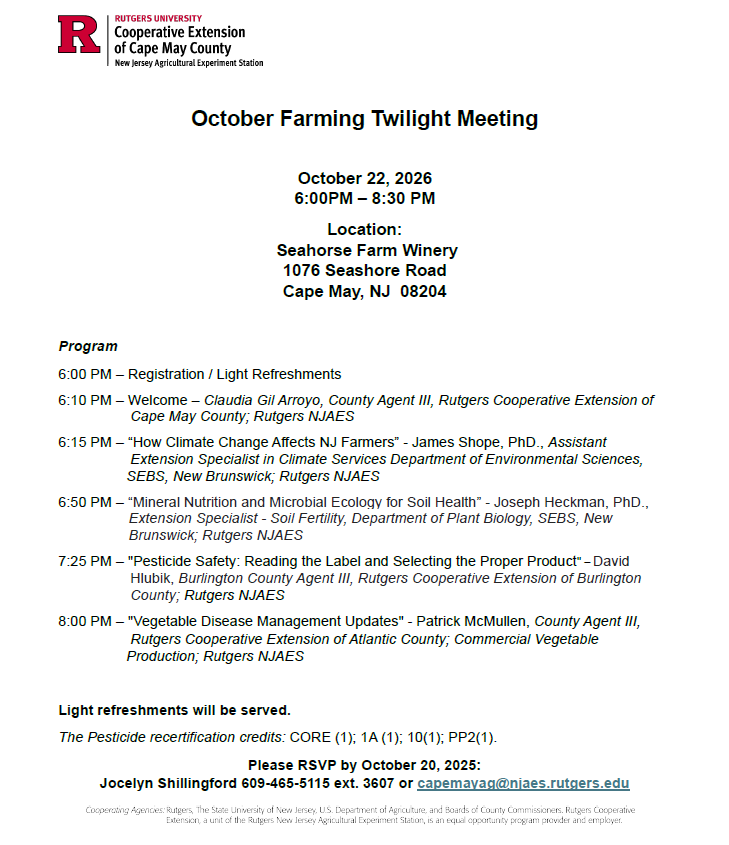
Please RSVP by October 20, 2026
Contact Jocelyn Shillingford at (609) 465 5115 ext. 3607 or capemayag@njaes.rutgers.edu
Rutgers Cooperative Extension
Pesticide recertification credits will be given to those attending this Twilight Meeting. See details below:
Please RSVP by October 20, 2026
Contact Jocelyn Shillingford at (609) 465 5115 ext. 3607 or capemayag@njaes.rutgers.edu
Vegetable Integrated Crop Management
Twilight Meeting
Wednesday, April 8, 2026
6:00 p.m. – 8:30 p.m.
East Vineland Fire Hall
4931 Landis Ave. across from the Savoy Restaurant
(park behind the building and enter conference room door in rear)
Hosted by RCE of Atlantic, Cumberland, and Gloucester Counties
6:00 pm Soilborne Disease Identification and Control in Seedlings and Transplants
6:30 pm Vegetable Disease Control Options for Spring Crops
7:00 pm USDA Natural Resources Conservation Service Programs for Crop Production
7:30 pm On-Farm Food Safety and Food Safety Modernization Act Updates
8:00 pm Pesticide Regs & Worker Protection Standards Update for the Coming Season
8:30 pm Adjourn
Pesticide Recertification Credits offered include 1 CORE, 2 1A, 2 10, and 2 PP2.
Please call 609-625-0056 with any questions.
Hope to see you there!
Sincerely,
Patrick W. McMullen, Wesley L. Kline, and Michelle Infante-Casella
Agricultural Agents of Atlantic, Cumberland, and Gloucester Counties
Proper greenhouse sanitation is important for healthy, disease-free vegetable transplant production.
Efforts need to be made to keep transplant production greenhouses free of unnecessary plant debris and weeds which may harbor insect pests and disease. Efforts need to be taken throughout the transplant production season to minimize potential problems.
Remember, disinfestants, such as Clorox, Green-Shield, or hydrogen dioxide products (Zerotol – for commercial greenhouses, garden centers and Oxidate – commercial greenhouse and field), kill only what they come into direct contact with so thorough coverage and/or soaking is necessary. The labels do not specify time intervals for specific uses, only to state that surfaces be ‘thoroughly wetted’. Therefore, labels need to be followed precisely for different use patterns (i.e., disinfesting flats vs. floors or benches) to ensure proper dilution ratios. Hydrogen dioxide products work best when diluted with water containing little or no organic matter and in water with a neutral pH.
Proper greenhouse sanitation is important for healthy, disease-free vegetable transplant production.
Efforts need to be made to keep transplant production greenhouses free of unnecessary plant debris and weeds which may harbor insect pests and disease. Efforts need to be taken throughout the transplant production season to minimize potential problems.
Remember, disinfestants, such as Clorox, Green-Shield, or hydrogen dioxide products (Zerotol – for commercial greenhouses, garden centers and Oxidate – commercial greenhouse and field), kill only what they come into direct contact with so thorough coverage and/or soaking is necessary. The labels do not specify time intervals for specific uses, only to state that surfaces be ‘thoroughly wetted’. Therefore, labels need to be followed precisely for different use patterns (i.e., disinfesting flats vs. floors or benches) to ensure proper dilution ratios. Hydrogen dioxide products work best when diluted with water containing little or no organic matter and in water with a neutral pH.
| Boxwood Blight Risk Assessment as of 4/10/2024 | |||||||||
| Region | Location | CODE | 10-Apr | 11-Apr | 12-Apr | 13-Apr | 14-Apr | 15-Apr | |
| Southern | Upper Deerfield | NJ50 | Very Low | Minor Risk | High Risk | Very Low | Very Low | Very Low | |
| Central | Howell / Freehold | NJ10 | Low | Low | High Risk | Very Low | Very Low | Very Low | |
| Northern | High Point | NJ59 | Very Low | High Risk | VERY High Risk | Very Low | Very Low | Very Low | |
| W | TH | F | S | Sun | M | ||||
| Please check YOUR LOCAL risk (click here) | |||||||||
There is a potential for boxwood blight infections this Thursday and Friday throughout ALL of NJ. Incoming rains, coupled with consistent temperatures may initiate boxwood blight infections this week.
