Soybeans at Full Pod (R4) Growth Stage: What Farmers Need to Know Now to Protect Yield Potential

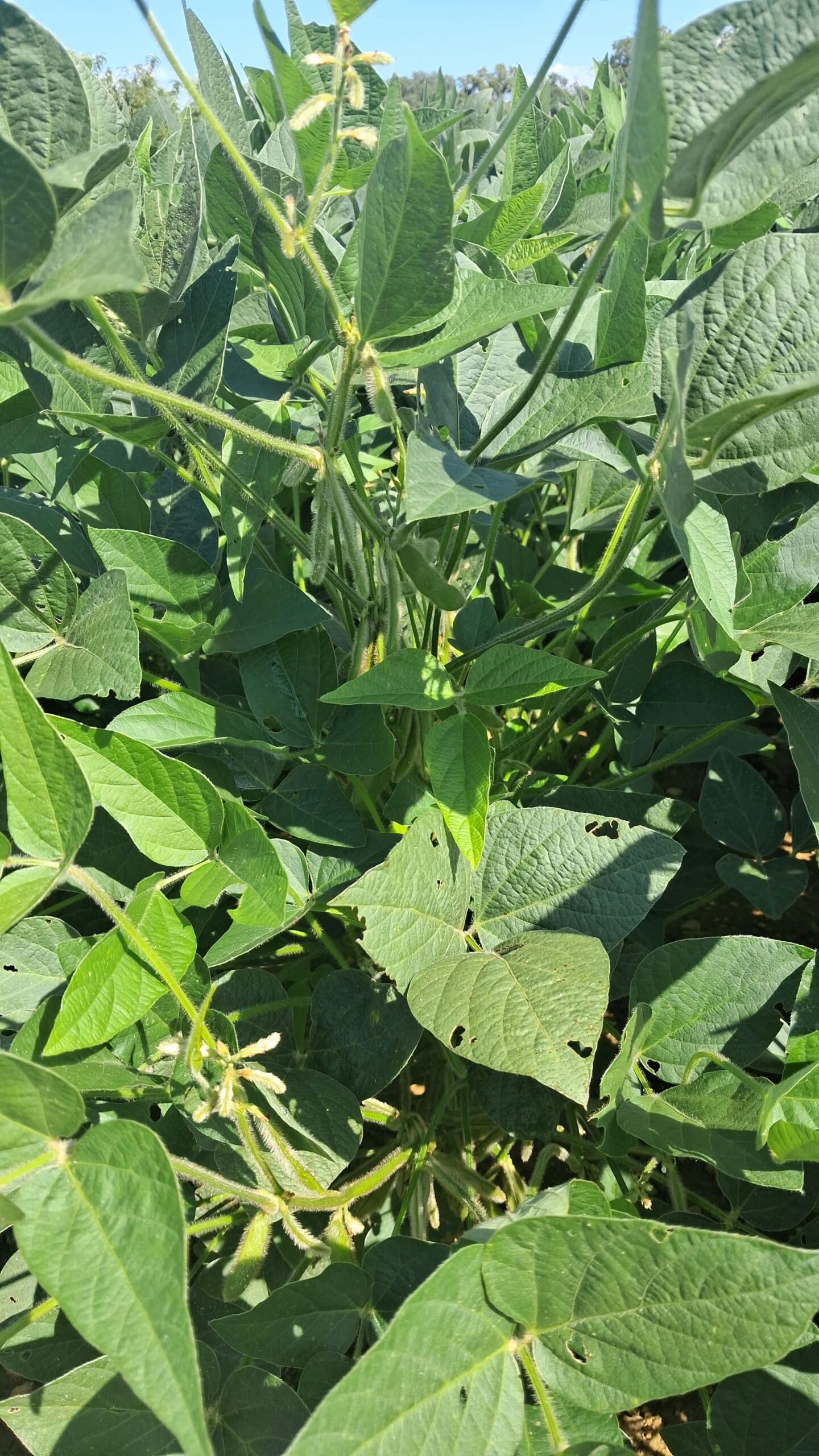
With the New Jersey soybeans reaching the R4 (full pod) growth stage, the crop is entering a crucial period for yield development. The plants shown below are at around R4 growth stage. For farmers in Southern New Jersey, this is a crucial time to scout fields closely and minimize stresses that can affect pod and seed development.


(Photo Credit: Ramandeep Kumar Sharma; Aug 24 2026)

How to identify R4 stage in soybeans?

Soybean is reached at the R4 (full pod) growth stage when a plant has a pod at least 3/4 of a inch long at one of the four uppermost nodes on the main stem, with a fully developed leaf at that node. To determine whether the crop has reached R5 (beginning seed), open a pod at one of these upper nodes. R5 begins when the seed inside the pod is at least 1/8 inch long.

Why R4 is so important for soybeans?

R4 marks the starting of one of the most critical periods for soybean yield determination. At R4 stage, pod growth is fast, and seed development is starting. From R4 through early seed filling, stresses such as moisture/nutrient deficiency, disease, insect injury, and excessive defoliation can reduce yield by increasing the abortion of flowers, pods, and developing seeds. The crop has some ability to compensate later through seed growth, but that compensation is limited.

What should soybean farmers do now?

  • Monitor soil moisture: Adequate moisture is particularly important from R4 through early seed development. This deserves close attention in Southern New Jersey’s sandy and coarse-textured soils, which can dry rapidly during hot, dry periods. Where irrigation is available, monitor soil and crop conditions and irrigate when needed.
  • Keep scouting for insects and diseases: Continue checking the canopy for defoliation, pod-feeding insects, and disease symptoms. Make pesticide decisions based on scouting, pest or disease pressure, crop stage, economic considerations where applicable, and the current product label but not simply because the crop has reached R4.
  • Check for nutrient stress: Continue watching for nutrient deficiency, especially in fields with low soil fertility or a history of nutrient loss. Rutgers recommends that soybean fertility management be based on recent soil tests and realistic yield goals. Rutgers also identifies potassium and sulfur as important considerations in New Jersey soybean production and notes that nutrient stress can occur in Southern New Jersey soils because of nutrient leaching.
  • Don’t stop scouting weeds: A closed soybean canopy suppresses many weeds, but late-season escapes can still produce seed and interfere with harvest. Any herbicide application must follow the current product label, including crops, weed, timing, rate, and preharvest restrictions.

Summary

R4 is not the time to stop scouting, it is the time to pay closer attention. Protecting adequate soil moisture, healthy foliage, developing pods, and seed formation during R4–R6 can help protect soybean yield potential. On checking pods, if a seed (at least 1/8 inch long) is found inside a pod at one of the upper four nodes, it means the plant has reached R5 (beginning seed).

References

  • Sharma, R. K., & Heckman, J. 2026. Nutrient and Management Tips for New Jersey Soybean Production. Rutgers Cooperative Extension, Plant & Pest Advisory, June 26, 2026.
  • Heckman, J. R. 2009. Soil Fertility Recommendations for Soybean. Rutgers Cooperative Extension, Fact Sheet E323.
  • Bravo, M. 2021. Soybean insect vectored, internal stem, root disease monitoring now through pod fill. Rutgers Cooperative Extension, Plant & Pest Advisory, July 9, 2021.
  • Bravo, M. 2021. Field crop progress mid-July, Salem County. Rutgers Cooperative Extension, Plant & Pest Advisory, July 17, 2021.

Corn Lodging Reported Following Extreme Heat and Storm Events in Southern New Jersey

Reports of corn lodging have been coming from multiple locations across southern New Jersey (NJ) since last Sunday (July 5, 2026). We had a period of extreme heat across much of central and southern NJ from July 2 to 4, witnessing daytime temperatures reached 95 to 100°F and heat index values ranged between 105 and 115°F. Right after that, we had weekend thunderstorms that caused locally heavy rainfall and strong winds, resulting in saturated soil and decreased root grip/anchorage in corn fields. The rapid transition from extended heat-induced stress to wet soil conditions and strong winds led to conditions conducive for root lodging, particularly in early planted (rapidly growing) corn with compromised root systems.


Figure 1: Severe lodging observed in taller, early planted corn following strong winds and heavy rainfall. Taller plants are more prone to wind-related lodging due to larger canopy size and increased leverage on the root system. (Photo Credit: Andrew Wyenandt, 2026)

Figure 1: Severe lodging observed in taller, early planted corn following strong winds and heavy rainfall. Taller plants are more prone to wind-related lodging due to larger canopy size and increased leverage on the root system. (Photo Credit: Andrew Wyenandt, 2026)


Figure 2: Less severe lodging observed in a comparatively shorter corn field after the same storm event. Decreased plant height and canopy development likely contributed to higher resistance to wind-induced root lodging. ((Photo Credit: Ramandeep Kumar Sharma, 2026)

Figure 2: Less severe lodging observed in a comparatively shorter corn field after the same storm event. Decreased plant height and canopy development likely contributed to higher resistance to wind-induced root lodging. ((Photo Credit: Ramandeep Kumar Sharma, 2026)

Assessing the Type of Lodging

Farmers are advised to wait for three to seven days (or until the field conditions allow) after the lodging event to check their fields to determine the type and extent of injury. Two types of wind injury are commonly seen in corn:

  • Root lodging: Plants get displaced from the vertical, but the stalk remains intact. Roots are partially displaced/lifted while staying attached to the ground. Generally, these plants recover naturally by bending upward over the following several days through normal gravitropic (against the direction of gravity) growth.
  • Green or Stalk Snap (breaking of stalk): Stalks are broken from below or near the ear. In this case, affected plants cannot recover so they directly contribute to the yield loss, which is generally in proportion to the percentage of broken plants.

Management Recommendations

There is no direct management practice that can reinstate corn to its pre-lodged position. Instead, management is mainly focused on minimizing additional stress, allowing the crop time to recover, and evaluating potential impacts on yield.

  • Farmers are advised to allow time (three to seven days) for recovery before making final evaluations on root-lodged corn fields. Corn expresses negative gravitropism, by which the plants that have their root systems still intact, will naturally stand back upright, often developing the characteristic “gooseneck” appearance.
  • It is not suggested to manually straighten lodged plants. Attempting to unbend or stand plants upright can damage root systems and increase plant stress, often causing more injury than benefit.
  • It is advised to delay non-essential field traffic/operations until soil is sufficiently dry to reduce additional root injury, soil compaction, and mechanical damage to lodged plants. Bringing equipment in lodged corn fields causes more yield loss than the lodging itself.
  • Farmers are encouraged to continue scouting their fields for foliar diseases and stalk rots. Lodged plants usually stay wetter for long durations, providing conditions conducive for diseases such as gray leaf spot, northern corn leaf blight, and tar spot (where present). Plants injured by wind are more prone to stalk rots later in the season. Routine disease scouting should continue. Fungicide applications should not be justified by lodging alone. However, fungicide decisions should be guided by i) what the growth stage of crops is, ii) how much the disease pressure is, iii) how vulnerable the hybrid is, iv) what the weather conditions are, and v) what is the expected yield goal.
  • Farmers are advised to evaluate the potential for nitrogen loss. For example, if heavy rainfall resulted in prolonged soil saturation, the likelihood of nitrogen loss should be assessed taking denitrification or leaching into account, which is very notable on southern NJ’s coarse-textured or poorly drained soils. Supplemental nitrogen should only be applied if field conditions, crop growth stage, and expected yield response justify additional applications.
  • Fields should be reassessed after one week. Fields that stay severely lodged even after five to seven days may have suffered more substantial root injury and should be monitored closely throughout the rest of the growing season.
  • It is advised to keep monitoring the stalk quality to help prioritize harvest (if and where needed). Wind-damaged fields should be scouted later in the season for stalk deterioration and increased lodging potential. Fields with decline in stalk quality should be prioritized for harvest to minimize additional yield losses.
  • Affected farmers are advised to document and report affected acreage and estimated losses to their local USDA Farm Service Agency (FSA) office. Accurate reporting will be helpful in documenting the extent of damage and in supporting the evaluation of potential disaster assistance (if applicable).
  • In case of suspected significant damage and if insured, it is suggested to make timely communication with the crop insurance provider (if warranted) and to follow policy requirements before making management decisions that could affect claim evaluation.

References

GovOneStop. (2026, July 2). New Jersey severe extreme heat warning effective 07/02/2026. https://govonestop.com/nws/new-jersey-severe-extreme-heat-warning-effective-07022026-0051-0

Merchantville. (2026). Dangerous heat through Saturday. Merchantville News. https://www.merchantville.com/index.php/news/local/new-jersey/10067-dangerous-heat-through-saturday

Quinn, D. (2024, July 11). “Flattened” or “Root Lodged” corn caused by heavy rain and wind – Now what? Purdue Extension Pest&Crop Newsletter, 2024(16). Purdue University. https://extension.entm.purdue.edu/newsletters/pestandcrop/article/flattened-or-root-lodged-corn-caused-by-heavy-rain-and-wind-now-what/

University of Kentucky, Department of Plant Pathology. (n.d.). Wind damage/lodging. University of Kentucky College of Agriculture, Food and Environment. https://veggiescout.mgcafe.uky.edu/wind-damagelodging

NE Agriculture Expo and Rutgers Educational Sessions Start Tuesday 1/20/26 to Thursday 1/22/26 in Atlantic City

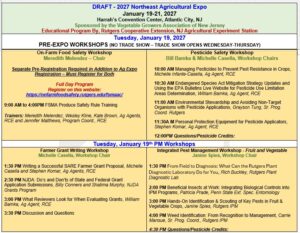
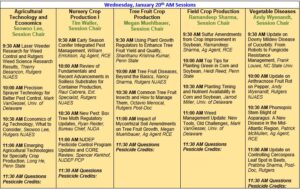
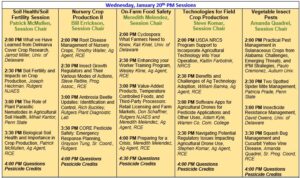
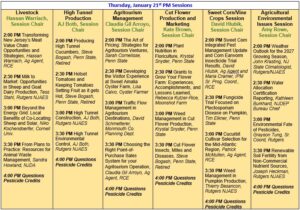
The NE Agriculture Expo and Rutgers Educational Sessions Start Tuesday 1/20/26 at Harrah’s in Atlantic City, 777 Harrahs Boulevard. The final day of educational sessions and trade show ends on Thursday at 5pm.

The weather may be cold, but no rain or no snow in the forecast, and warm times inside the conference center to network with others in the industry.  An afternoon Hospitality Room will be available 12-5pm on Wednesday and Thursday to relax and unwind in the trade show area. Come for the social aspects, education and gain pesticide recertification credits. Check out the Rutgers Educational Program to see what topics you would like to learn about. go.rutgers.edu/2026rutgerseduprog

What’s Happening

January 20 (Tuesday)

  • Pre–trade show workshops and sessions

January 21 (Wednesday)

  • Full day of educational sessions for all commodity groups • Year of the Women Farmer Luncheon
  • Packed trade show with vendor booths sold out
  • Live charity auction with FREE food

January 22 (Thursday)

  • More sessions
  • Another day packed trade show with vendor booths sold out
  • Special appearance by Temple Grandin book signing /meet and greet, then her special session (additional cost)

Registration Options On-Site at the Regitration Counter (hallway of conference center) or On-line https://vganj.com/convention-tickets“>https://vganj.com/convention-tickets

✔️ VGANJ Membership – $100

Includes 2 Expo passes

Additional passes just $25 each

✔️ One-Day Pass – $60

Access to sessions + trade show

Register On-Line to

  • Save time at registration
  • Walk in, grab your badge
  • Enjoy FREE breakfast (8am-10am Wednesday and Thursday in Trade Show)
  • Head straight to learning, growing, and catching up with friends

This event under one roof, packed with education and energy, and celebrating New Jersey agriculture at its best.

Plus, buy your tee shirt or hoodie at the registration desk to “Support New Jersey Farmers” and tout “No Farmers No Food” – new this year.


NEED PESTCIDE RECERTIFICATION CREDITS? REGISTER TODAY

4 CORE Credits – Pesticide Safety Workshop

A Tuesday, January 20, 2026 Workshop for Pesticide Applicators to gain CORE Credits towards their license will be held at the NE Agriculture Expo at Harrah’s in Atlantic City to start of this year’s event. This workshop will take place from 10:00AM to 12:00PM. Licensed applicators must accumulate 8 CORE Credits over a 5-year period to maintain their NJDEP Pesticide Applicators License. This workshop will offer 4 CORE Credits. Pre-registration is requested and can be found on the VGANJ website at https://vganj.com“>https://vganj.com. Registration cost is $25 per person and non-refundable. Registration for this workshop is separate from the convention registration and attendees must also register for the expo at https://vganj.com/convention-tickets. The topics include: Pesticide Safety – Personal Protection Equipment for the Pesticide Applicator; Update on US EPA Worker Protection Standards; Storage, Tank Mixing, Tank Cleaning, and Disposal; Pesticide Record Keeping and Notification. For more information contact Bill Bamka (bamka@njaes.rutgers.edu) or Michelle Infante-Casella (minfante@njaes.rutgers.edu).

For the full program (January 20-22nd) of Rutgers Educational Workshops and Sessions that offer more credits and diverse topics, see https://go.rutgers.edu/2026rutgerseduprog

Ornamental IPM Webinar – Next Session Tuesday 8/26 plus upload from 8/12 RU PDL guest

Still time to Sign up for the remaining 2025 sessions- Rutgers Ornamental IPM Program

Please visit our new –Rutgers Ornamental IPM Program Website (click here)

Join us for the next session Tuesday 8/26/25 

Topics covered:

  • 1.Beneficial insect: Dragonflies​
  • 2. Leafcutter bees                   ​
  • 3. Fleahopper​
  • 4. Nostoc​
  • 5. Nickel deficiency in River Birch​
  • 6. Tulip tree & Magnolia soft scales​
  • 7. Douglas-fir needle midge​
  • 8. Slugs/snails​
  • 9. Banded ash clearwing moth borer​
  • 10. Verticillium wilt

Previous webinars:


Rutgers to Host Afternoon Cover Crops Field Day – August 5

Rutgers Cover Crops Field Day
*The program may be rescheduled in the event of inclement weather*
Date: August 5, 2025
Time: 3:00PM to 6:00 PM
Where: Snyder Research Farm, 140 Locust Grove Rd, Pittstown, NJ 08867

REGISTRATION REQUIRED:

Please register by calling RCE of Sussex County: 973-948-3040
*First 20 registrants will receive a FREE copy of the USDA SARE book: “Managing Cover Crops Profitably”

This event will highlight several cover crop research projects and foster discussion and networking on drone use in agriculture and cover crop management.
Please join us for this summer event. 

We will also discuss an upcoming drone pilot certification training we will be hosting this winter.

3:00 PM Registration and Welcome – Stephen Komar, ANR Agent /Rutgers SARE Coordinator
3:15 PM Go to the Field – Calibrating a Drone for Agricultural Applications – Adam Kyle, Warren Co. Com. College, Teaching Administrator, Precision Agriculture, Stephen Komar
4:00 PM Summer Cover Crop Planting Comparison: Drone vs. Drill – Bill Bamka, ANR Agent
4:30 PM Row Middle Cover Crops vs Herbicides for Weed Management in Vegetable Culture – Kate Brown, ANR Agent
RC&D Cover Crop Programs- Laura Tessieri, Executive Director, North Jersey RC&D
Drone Seeding Cover Crops into Pumpkins – Peter Nitzsche, ANR Agent
5:30 PM Update on Worker Protection Standards and Pesticide Recordkeeping – Michelle Infante-Casella, ANR Agent
6:00 PM Pesticide Credits and Adjourn

This event is sponsored by a grant awarded to Stephen Komar (Principal Investigator), Michelle Infante-Casella, and William Bamka Agricultural Agents/Professors, Rutgers Cooperative Extension, by the USDA, Sustainable Agriculture Research and Education, Professional Development Program.