Greetings from the Veg IPM team! This will be our last regular post for the 2026 season. If an urgent pest issue arises, we will send out a specific P&PA post.
Vegetable Crops Edition
Seasonal updates and alerts on insects, diseases, and weeds impacting vegetable crops. New Jersey Commercial Vegetable Production Recommendations updates between annual publication issues are included.
Subscriptions are available via EMAIL and RSS.
Quick Links:
 NJ Commercial Vegetable Production Recommendations
Rutgers Weather Forecasting - Meteorological Information important to commercial agriculture.
October 6, 2026 Michelle Infante-Casella
Agricultural Drone Training Opportunity for New Jersey Commercial Farmers
Rutgers Cooperative Extension is offering a valuable training opportunity for New Jersey commercial farmers on Friday, November 6, and Friday, November 13, 2026, at the Rutgers Snyder Research Farm, 140 Locust Grove Road, Pittstown, NJ.
Through a USDA Sustainable Agriculture Research and Education (SARE) Professional Development Grant, the Rutgers Agricultural Drone Team, led by Agricultural Agent Stephen Komar, is offering a two-day agricultural drone training at no cost to participating farmers. Grant funding for this course is specifically intended to provide drone training to commercial farmers in New Jersey.
The course will prepare participants to learn how to obtain their FAA Remote Pilot Certificate (Part 107), which is required to operate drones for commercial agricultural purposes. Training will include information and resources to help participants prepare for the Part 107 certification examination. On the second day, participants will also receive hands-on instruction and have the opportunity to fly drones at the Rutgers Snyder Research Farm.
Limited Enrollment — Please Commit to Both Days
Enrollment is limited to 10 participants. Those pre-registered prior to the class being filled, will receive access to training materials for studying and practice tests to help prepare for the Part 107 certification exam.
Because space and training materials are limited, please register only if you are able to attend both November 6 and November 13. If you register and do not attend, you may prevent another New Jersey farmer from participating in this training opportunity.
To ensure that the training is available to as many farms as possible, registration is limited to one person per farm. Participants must also be 18 years of age or older.
Please see the bulletin below for additional information.
Registration:
https://forms.cloud.microsoft/r/EU6CBcmpBG
Questions Contact:
Stephen Komar, Agricultural Agent
Rutgers Cooperative Extension of Sussex County
Email: komar@njaes.rutgers.edu
Phone: 973-948-3040, ext. 3

October 2, 2026 Amanda Quadrel and Maria Cramer
Vegetable IPM Update 10/02/26
Greetings from the Veg IPM team!
October 2, 2026 Patrick McMullen
Sustainable Agriculture Seminar Series
Sign up today! The first seminar is Tuesday, 10/6 at 12 pm.
Are you interested in improving the sustainability of your farm while also increasing your farm’s productivity and success? Join us to explore topics in sustainable agriculture through this virtual seminar series! This initial offering of four sessions will be held on Zoom from 12-1 pm ET on the below dates and cover an introduction to sustainable agriculture and soil health management.
This series is intended for any farmers looking to enhance their production systems by adopting new sustainable practices. Additional information can be found on the attached flyer. Seminars will be recorded and shared afterwards for those unable to attend live.
Please register at this link to receive the Zoom link for the seminar: Sustainable Agriculture Seminar Series Registration
Sustainable Ag Seminar Series Flyer 2026 (2)
- What is sustainable agriculture, and how can it help my farm?
- Tuesday, October 6th 12 – 1 p.m.
- Starting from the ground up: physical properties of soil health
- Tuesday, October 20th 12 – 1 p.m.
- Cover crops to improve soil health and farm profitability
-
- Thursday, November 5th 12 – 1 p.m.
- Soil as an ecosystem: microbial soil biology and crop health
- Tuesday, November 17th 12 – 1 p.m.
October 1, 2026 Michelle Infante-Casella
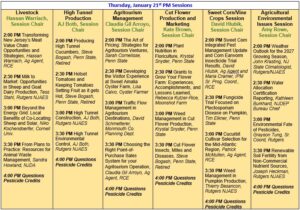
2027 Rutgers Educational Sessions at NE Agricultural Expo in Atlantic City
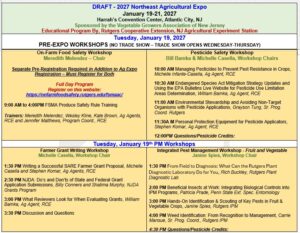
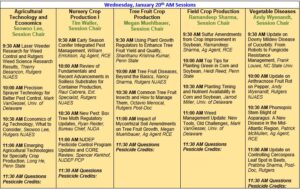
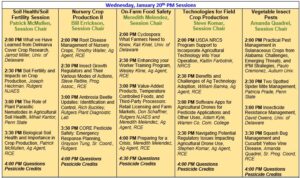
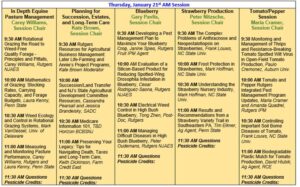
Everyone should be very excited for this event in 2027. The NE Agriculture Expo and Rutgers Educational Sessions will begin on Tuesday, January 19, 2027 at Harrah’s in Atlantic City, 777 Harrahs Boulevard. The final day of educational sessions and trade show ends on Thursday, January 21, 2027. The trade show already has an abundance of vendors signed up for booths in 2027.
The planning committee for the expo is looking forward to providing many new opportunities, and Rutgers has confirmed many new speakers to offer excellent information, covering various topics from the 2026 growing season and research results to help farmers improve their practices. The Harrah’s conference center offers the best layout in Atlantic City for this convention. Come for the opportunity to network with others in the industry, to learn from over 72 presenters on a diversity of topics, and to gain pesticide recertification credits to keep your applicator’s license current. To register and for more information from the organizing association, go to the Vegetable Growers Association of NJ’s website at https://vganj.com.
Please see the DRAFT Rutgers Educational Program below. Pesticide credits have been applied for with NJ DEP. When the credits are assigned this program will be republished and promoted with credits.
September 25, 2026 Amanda Quadrel and Maria Cramer
Vegetable IPM Update 9/25/26
Greetings from the Veg IPM team!

