Greetings from the Veg IPM team!
Vegetable Crops Edition
Seasonal updates and alerts on insects, diseases, and weeds impacting vegetable crops. New Jersey Commercial Vegetable Production Recommendations updates between annual publication issues are included.
Subscriptions are available via EMAIL and RSS.
Quick Links:
 NJ Commercial Vegetable Production Recommendations
Rutgers Weather Forecasting - Meteorological Information important to commercial agriculture.
September 24, 2026 Andy Wyenandt
Managing the different downy mildews in vegetable crops
The weather over the past few weeks has been ideal (e.g., isolated heavy rainfalls, high RH, extended dew and leaf wetness periods, and cooler temperatures) for downy mildew to develop in multiple crops. Important factors to remember are that downy mildews are obligate biotrophic (oomycete) pathogens that need a living host, and more importantly, are specific in the hosts or crops groups they can infect. Therefore, downy mildew on lettuce caused by Bremia lactucae won’t infect brassica crops, and visa versa. Downy mildew on brassica crops is caused by another downy mildew, Hyaloperonospora brassicae (formerly, Peronospora parasitica), which is broken down into a complex of distinct species with narrower host range(s). Spinach downy mildew is caused by Peronospora effusa, and of course, cucurbit downy mildew, caused by Pseudoperonospora cubensis, only causes downy mildew in cucurbit crops. It’s important to remember that downy mildews only sporulate on the undersides of infected leaves. Symptoms on the top sides of leaves often appear as an irregular chlorosis and browning with tufts of white sporangia developing on the bottom sides of leaves under ideal conditions. Conditions that favor downy mildew development in one crop also means favorable conditions for its development in other crops. The use of downy mildew resistant varieties also plays an important role in mitigating losses to downy mildew. In spinach, for example, there are over 20 races of the pathogen and there are a number of recommended varieties that carry significant resistance packages to multiple races of the pathogen. The same is true in lettuce, where multiple recommended varieties have downy mildew resistance as well as in a few cucumber varieties and crops such as broccoli and cabbage. What doesn’t change between the downy mildews are the need to regularly scout for them and be proactive in their control during favorable weather conditions. Importantly, the options for downy mildew control are often the same across crops, applying and rotating downy mildew specific fungicides as long as conditions are favorable for its development. For more information on downy mildews and their control, please see specific crops in the 2026/2027 Mid-Atlantic Commercial Vegetable Productions Recommendations Guide.
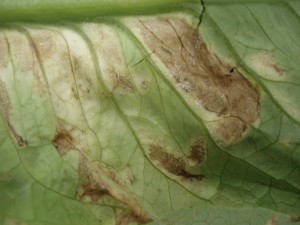
Symptoms of downy mildew on lettuce. Note the small, white tufts of sporangia developing on the lower side of the leaf.
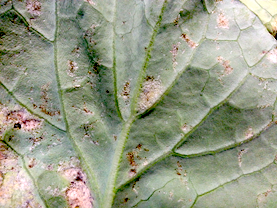
Symptoms of downy mildew on the underside of infected collard leaves.
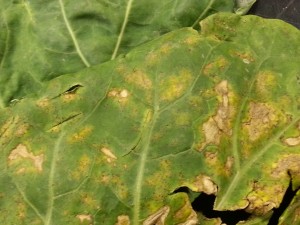
Symptoms of downy mildew on infected chinese cabbage leaf. Note the irregular chlorosis and browning of upper leaf surface. Under ideal conditions the pathogen will produce white spore masses only on the undersides of the leaf.
September 24, 2026 Claudia Gil Arroyo
Farm to Stay Grant
Airbnb and American Farmland Trust (AFT) have joined through AFT’s Brighter Future Fund to launch the Farm to Stay Grant Program. This national grant aims to support farmers and ranchers in creating or scaling up farm stays and agritourism experiences, providing a welcome diversification of income and fostering meaningful visitor connections with working farms.
Grant amounts: Up to $10,000 per recipient
Number of grants: Approximately 25–30
Purpose:
- Help farmers renovate or adapt properties for hosting
- Launch new agritourism experiences—think farm-to-table dinners, pick-your-own produce, animal interactions, and more
Grant applications open in late November 2026—practical guidelines and eligibility will be announced ahead of time. Airbnb and AFT are offering webinars to guide participants through the grant application process and onboarding to hosting.
For more information visit: https://farmland.org/farm-to-stay
September 22, 2026 Patrick McMullen
Managing Alternaria in Brassicas
Managing Alternaria in Brassicas
Alternaria leaf blight, head rot, or black spot are primarily caused by the fungus Alternaria brassicicola. This disease primarily develops in cool, wet weather.
On leaves, symptoms start with round brown spots that develop concentric circles. A yellow halo often extends around the outside of the lesion. More lesions will develop across the leaf surface. Black, sooty rot can develop on broccoli and cauliflower heads and can progress quickly.
Alternaria can be seedborne, so always buy seed from a reputable source. If not already treated by the supplier, seed can be heat treated to kill pathogens (See Mid-Atlantic Commercial Vegetable Recommendations 2026/2027 pg 220 for details). Choose resistant cultivars whenever possible.
Remove or bury diseased crop residue at the end of the season. Use a 3-year crop rotation before planting another Brassica crop in the same location to allow overwintering spore populations to decrease. This includes cover crops in the Brassica family that can also serve as hosts. Control weed species in the Brassica family such as mustards and shepherd’s purse.
Fungicide applications should begin prior to the onset of disease development and continue under environmental conditions favorable for disease. Because this pathogen infects the heads, pay particular attention to PHIs when sprays are needed near the harvest window. Rotate FRAC groups to reduce the chance of resistance development. Resistance to azoxystrobin, QoI group 11 fungicide, and boscalid and penthiopyrad, SDHI group 7 fungicides, has been reported in some regions. If applications seem to be ineffective, contact your Extension agent, and use a different FRAC group.
Research trials at the University of Georgia by Kaur et al. (2025) evaluated two conventional spray programs on ‘Emerald Crown’ broccoli to control Alternaria leaf blight and found both to significantly reduce disease severity compared to non-treated plots.
Program 1: Luna Sensation 7.6 fl oz/A, Inspire Super 20 fl oz/A, Aprovia Top 13.5 fl oz/A, Bravo Weather Stik 1.5 pts/A, and Priaxor 8 fl oz/A.
Program 2: Bravo Weather Stik 1.5 pts/A, Luna Sensation 7.6 fl oz/A, Inspire Super 20 fl oz/A, Aprovia Top 13.5 fl oz/A, and Priaxor 8 fl oz/A.
Additional fungicide recommendations can be found in the Mid-Atlantic Commercial Vegetable Recommendations Cole Crops: Broccoli, Brussels Sprouts, Cabbage, Cauliflower, Collards, Kale, and Kohlrabi – 2026/2027 Mid-Atlantic Commercial Vegetable Production Recommendations
*Product labels supersede all recommendations provided in this article. The label is the law. Follow all instructions and ensure the product is labeled for your location.
References:
Hoidal, N. Alternaria leaf spot and head rot of Brassica crops. 2023. University of Minnesota Extension. https://extension.umn.edu/agriculture/specialty-crops/vegetable-farming/disease-management/alternaria-leaf-blight#cultural-controls-3119561
Humpherson-Jones, F. M., Phelps, K. 1989. Climatic factors influencing spore production in Alternaria brassicae and Alternaria brassicicola. Ann. Appl. Biol. 114:449-458.
Kaur, N., Foster, M. J., Donahoo, W. M., and Dutta, B. 2025. Evaluation of fungicide programs for the management of Alternaria leaf blight and head rot in broccoli in Tift County, Georgia, 2024 to 2025. Plant Health Progress 26(4):757. https://doi.org/10.1094/PHP-06-25-0173-PDMR.
Kaur, N., Malik, A. A., Cerritos-Garcia, D. G., Koch Bach, R. A., Everhart, S., and Dutta, B. 2025. Cross-resistance in Alternaria brassicicola from naturally infested broccoli seeds against two succinate dehydrogenase inhibitor fungicides ed. Gladys Alexandre. Appl Environ Microbiol 91(10). https://doi.org/10.1128/aem.01083-25.
September 18, 2026 Amanda Quadrel and Maria Cramer
Vegetable IPM Update 9/18/26
Greetings from the Veg IPM team!
September 11, 2026 Amanda Quadrel and Maria Cramer
Vegetable IPM Update 9/11/26
Greetings from the Veg IPM team!

