Apples
Disease Management Considerations
- Apple scab symptoms are now appearing in some orchards as secondary infections (Figure 1).
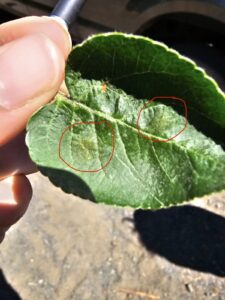
Figure 1. Early onset of scab symptoms on apple leaves. Photo by Kaitlin Quinn.
- Primary scab season is coming to an end or has ended.
- Rust and powdery mildew infections are also a risk during this time.
- These diseases need to be managed, even if you have little to no apple crop, to maintain healthy trees and keep inoculum low going into next season. A conservative spray program can focus on broad-spectrum fungicides, such as mancozeb, captan, ziram, and sulfur. Mancozeb is the only broad-spectrum product to control rust, while sulfur is the only broad-spectrum product to control powdery mildew.
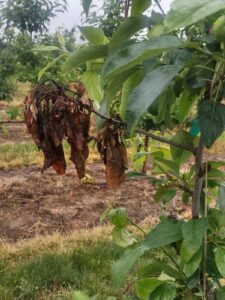
Figure 2. Fire blight strike in apple. Photo by Karlton Raines-Neidigh.
- Marssonina Blotch, Glomerella Leaf Spot, and Frogeye Leaf Spot should be managed, as they will cause defoliation and provide a source of inoculum for black rot and bitter rot next season. Maintain coverage of captan, manzate, or ziram prior to rain events through the growing season according to the cover spray rule of applications every 2” of rain or 14 days, whichever comes first.
- For those who have fruit on their trees, there are additional fungicide options to consider, particularly to manage bitter rot, sooty blotch & flyspeck. Products such as Merivon, Luna Sensation, Inspire Super, Omega, and Aprovia are effective and can be combined or rotated with broad-spectrum fungicides such as captan and ziram for sustained control.
- Fire Blight:
- Fire blight strikes are developing in orchards statewide (Figure 2).
- Products such as Apogee or Kudos are highly recommended to help slow the spread of infections. Repeated applications may be necessary to help control shoot blight from previous blossom infections or leftover cankers in the trees.
- If there is still some bloom, apply antibiotics when infection events are forecasted using the NEWA fire blight model.
- Remember to rotate streptomycin and oxytetracycline products.
- If symptoms appear, it is generally recommended to cut out infected limbs and remove them from the orchard when possible; however, this is a practical decision that must be made on a case-by-case basis.
Insect Update
Insect management programs should be adjusted this season to account for reduced crop load in many orchards. In blocks with little to no fruit, many early-season insect pests will not require treatment; however, monitoring should continue, and management should be maintained where pests threaten tree health or next year’s crop.
- Rosy apple aphid activity has been very low to start this season. RAA can feed extensively on foliage and terminals, causing leaf curling and stunting. This can impact next year’s fruit that will be set this season. Without fruit, the trees may tolerate a higher threshold of these pests, but they should still be managed.
- Monitor for colonies during bloom and use a treatment threshold of 1 colony/tree at petal fall.
- Green Apple (Spirea) Aphids (GAA) colonies are being observed in some apple blocks. GAA is generally a pest that can be tolerated because it causes little direct damage.
- Treatment thresholds for GAA are met if 50% of the shoots are infested with no beneficial insects present.
- Movento will control GAA and should control scale when applied in mid-May, and suppress scale when applied in late May or early June.
- Ambrosia Beetle
- Trap captures have decreased across NJ, indicating peak flight has ended or is coming to an end.
- Infested trees should be showing signs of stress or will soon.
- If you have had a history of this pest in your orchard, you should begin scouting for damage and flag any trees that have been attacked for continued monitoring.
- Codling Moth (CM)
- A codling moth biofix was set in Southern counties on 4/20 and in Northern counties on 5/5. See the NJ Commercial Tree Fruit Production Guide for recommended materials and rates. Where Mating Disruption has been employed, supplemental Madex applications should be made at the timings listed below.
-
Codling Moth Degree Day Timing Application and Insecticide Type County Area Biofix Rimon: 75-100DD + 14-17 days later
Intrepid 150 + 450 DD
Diamides – Altacor, Voliam mixes: (150-200 DD)
Madex 250 DD + 7-10 days during brood hatch (later if first spray is an IGR)
Standard Insecticides – Delegate, Avaunt, OP’s, carbamates, pyrethroids 250 DD + 550 DD
DD 75 100 150 450 250 250 550 Southern April 20 Past Past Past 6/1 5/18 5/18 Too far off Northern May 5 5/12 5/14 5/17 Too far off 5/21 5/21 Too far off
- Plum curculio, tarnished plant bug, stink bugs, BMSB, TABM, and OBLR:
- In most blocks, treatment is not necessary where little to no fruit is present
- The timing to treat plum curculio has passed.
- Mites:
- Continue to use standard thresholds through June
- Maintaining healthy foliage is important for return bloom next season
Traps
Average Trap Captures in Apple – Southern Counties
| Week | STLM | TABM | CM | OFM | DWB | AMBROSIA BEETLE |
| 5/11/2026 | 18 | 11 | 6 | 3 | 25 | 2 |
Average Trap Captures in Apple – Northern Counties
| Week | STLM | TABM | CM | DWB | AMBROSIA BEETLE |
| 5/11/2026 | 13.7 | 1.5 | 1.8 | 12.8 | 1.1 |
Pears
Disease Management
- Fire blight remains a concern during warm and wet periods. Continue to protect actively growing shoots, particularly during warm, wet, or stormy conditions. In high-risk situations, oxytetracycline (e.g., Mycoshield, FireLine) may be used post-bloom to suppress shoot blight.
- Maintain protectant fungicides (e.g., Mancozeb, Ziram) to control rust, scab, and Fabraea leaf spot, protecting foliage.
- Use FRAC 3 and 7, and premix fungicides (e.g., Inspire Super, Merivon, Luna products) as needed for foliar disease control.
- In blocks with little to no fruit, fungicide programs can often be reduced and focused on maintaining healthy foliage rather than fruit protection.
Insect Update
- Second generation pear psylla adults and eggs have been observed in southern counties. Options for control include Actara, Assail, and Belay (IRAC group 4A); Sivanto Prime (IRAC group 4D); Delegate (IRAC Group 5); and products containing abamectin (IRAC group 6). Other options include Movento (IRAC Group 23). The addition of 0.25-1 gal of summer oil may improve control. Be sure to read and follow the label instructions for adding penetrants to these products.
Peaches
Disease Management
Given the widespread crop loss in many orchards, disease management programs should be adjusted accordingly. With little to no fruit present in most blocks, emphasis should
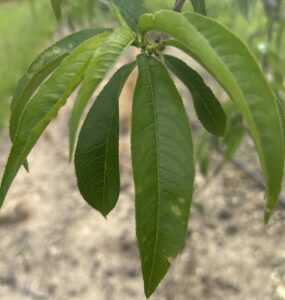
Figure 3. Bacterial leaf spot on peach
shift away from fruit protection and toward maintaining tree health and reducing inoculum for next season.
- Peach scab:
- In orchards without a history of high disease pressure, scab is generally not a concern in the absence of fruit
- In blocks with a history of scab, lesions can still develop on current-season shoots and serve as inoculum for next year
- In these situations, a reduced program may be warranted, with Captan applications timed ahead of significant rainfall events (e.g., ~2.5 lb/A)
- Bacterial spot:
- Leaf symptoms are showing in orchards (Figure 3).
- Maintain low-rate copper programs to protect foliage and reduce inoculum for future seasons
- Particularly important in blocks with a history of bacterial spot or under warm, wet conditions
- Avoid combining copper with captan, especially following extended cloudy or slow-drying conditions
- Rusty spot and brown rot:
- Not a concern in blocks with little to no fruit
- Fungicide applications targeting these diseases can be eliminated in most orchards this season unless there is a crop to protect.
Insect Update
Insect management programs for peaches and nectarines should be adjusted this season due to reduced crop load. In blocks with little to no fruit, many fruit-feeding pests will not require treatment; however, monitoring should continue, and management should focus on pests that impact tree health or future production.
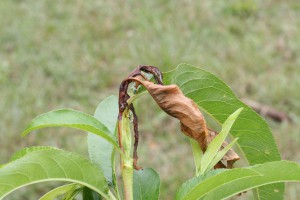
Figure 4. Terminal flagging due to Oriental fruit moth.
Oriental Fruit Moth (OFM)
-
- A biofix point for OFM was set on 4/7 for southern counties and 4/15 in northern counties.
- The second insecticide timings for the first generation Oriental Fruit Moth have passed.
- No insecticides are needed for OFM when mating disruption is implemented.
- We have seen very few flagging in new leaf tissue where OFM larvae have bored into (Figure 4).
OFM 1st Generation Timing Insecticide Type County/Region Degree Days by 5/18 base 45 Conventional 170-200, 350-375
Diamide 100-150, 300-350
Gloucester – Southern 556 1st –past 2nd – past
1st –past 2nd –past
Middlesex – Northern 456 1st –past 2nd –5/13-5/15
1st – past 2nd –5/10-5/13
Scale
- Beneficial insects may help suppress populations in many blocks
- In orchards with a history of infestation, plan to target the crawler stage starting the third week of May and continue emergence until about the middle of June
- Control options include materials such as Esteem or Centaur
- Where scale is a recurring problem, Movento should be applied between petal fall and shuck split. A penetrant must be included with Movento as per the product label. Applications should be made at optimal temperature conditions. Movento will also control green peach aphid when used at this time.
- Continue monitoring historically infested blocks and plan crawler management for later in the season if populations persist.
Green Peach Aphid
- Activity has been low to start this season, but is starting to increase.
- Examine trees for the presence of aphids by counting the number of colonies on ten trees and use a treatment threshold of 2 colonies/tree at petal fall for peach, and 1 colony/tree for nectarine. See the NJ Commercial Tree Fruit Production Guide for recommended materials and rates.
Plum Curculio
- Injury to fruit has been observed on developing peaches and apples in southern counties.
- Management in NJ typically requires weekly sprays for 3-4 weeks, beginning at petal-fall and continuing through approximately 300 DD50 after petal-fall.
- Materials that cover PC and other key pests encountered at this time include Asana, Avaunt, Imidan, and Voliam Flexi.
Tarnished plant bugs and other catfacing insects
- Activity has been low and is considered a low priority for management, where fruit is not present. If you plan to retain a crop, you must continue to manage insect pests intensively as you would in a normal season.
Lesser and Greater Peach Tree Borers
- Growers using mating disruption for borer control should have them in place by mid-May.
- Even in orchards with little fruit, borers will need to be managed to maintain healthy tree stands for the next season. If this has been a historical pest in your orchard, mating disruption is recommended.
- Continue monitoring and managing as usual in problem blocks
Traps
Average Trap Captures in Peach – Southern Counties
| Week | OFM | TABM | LPTB | PTB |
| 5/11/2026 | 5 | 10 | – | – |
Average Trap Captures in Peach – Northern Counties
| Week | OFM | LPTB | PTB |
| 5/11/2026 | 4.4 | 24 | 0 |
Blueberries
Blueberry Phenology
Early varieties are in the green fruit stage – the flowers have been pollinated, the petals are off, and the tiny green fruit are expanding.
Insect Update
Scouting activities were conducted last week across 139 commercial blueberry fields in Burlington and Atlantic Counties. Field evaluations focused on monitoring pest activity and crop development, including assessments of leafrollers, spongy moth, plum curculio, and thrips using beating tray samples, as well as fruit inspections for pest injury and developmental progress. All target pests were detected during scouting activities (Table 1).
Plum curculio numbers of adults on bushes has decreased over the past week, but some adults are still present. The average count was 0.117 per bush with a high of 3.5 adults per bush.
Thrips numbers increased from previous weeks. The main concern comes from the potential for thrips injury to flowers and developing fruit. After bloom, thrips can feed on young blueberry foliage causing curling of leaves; however, the risk of injury to developing leaves and fruit from thrips is low at this point.
In addition, monitoring of developing fruit indicated increasing feeding and/or oviposition activity by these pests (Table 2).
Table 1. Beating Tray Sampling Data
| Leafrollers | Spongy Moth | Plum Curculio | Thrips | |||||
| Avg | High | Avg | High | Avg | High | Avg | High | |
| 4/17 | 0.0649 | 2 | 0.0001 | 0.1 | 0.0686 | 2.5 | 0.5547 | 9 |
| 4/25 | 0.0801 | 0.8 | 0.0001 | 0.1 | 0.1156 | 3 | 1.0383 | 26 |
| 5/1 | 0.1 | 0.8 | 0.0007 | 0.1 | 0.15 | 3 | 2.38 | 39 |
| 5/9 | 0.08 | 0.7 | 0 | 0 | 0.245 | 4.5 | 1.89 | 37 |
| 5/16 | 0.04 | 0.7 | 0.0007 | 0.1 | 0.117 | 3.5 | 5.02 | 99 |
Table 2. Fruit Sampling Data
| % Leafroller Berry Infestation | % Plum Curculio Berry Infestation | |||
| Avg | High | Avg | High | |
| 5/9 | 0.125 | 1 | 0.235 | 2.6 |
| 5/16 | 0.22 | 1.5 | 0.67 | 6.5 |
Trap Monitoring
Scale traps targeting Putnam and terrapin scale were monitored last week and captured very low numbers; therefore, no treatment is recommended at this time.
Cranberry and cherry fruitworm traps were also checked last week. No cranberry fruitworm activity was detected; however, captures of cherry fruitworm increased, indicating that adults are actively flying and mating (Table 3).
Table 3. Trap Sampling Data
| Cranberry Fruitworm (AC) | Cherry Fruitworm (AC) | Cranberry Fruitworm (BC) | Cherry Fruitworm (BC) | |||||
| Avg | High | Avg | High | Avg | High | Avg | High | |
| 5/1 | 0 | 0 | 2.5 | 5 | 0 | 0 | 3.5 | 7 |
| 5/9 | 0 | 0 | 4.4 | 6 | 0 | 0 | 6.25 | 10 |
| 5/16 | 0 | 0 | 7.7 | 11 | 0 | 0 | 9 | 15 |
| AC: Atlantic County, BC: Burlington County | ||||||||
Management recommendations can be found on the current Blueberry Bulletin and Commercial Blueberry Pest Control Recommendations for New Jersey.
Grapes
Grape Phenology
Grape development across New Jersey has progressed, with most vineyards in southern counties moving through to pre-bloom. In many areas, shoots are now between 1–6 inches, depending on variety and site conditions.
Damage is most apparent in low-lying or frost-prone sites, where primary shoots may have been injured or killed. In these situations, secondary buds are beginning to push (Figure 5) and may help compensate for some crop loss, though overall yield may still be reduced depending on the extent of primary bud injury.
At this stage, vineyards should be assessed for primary and secondary bud viability and uniformity of growth. Blocks with uneven development may require adjustments in management timing over the coming weeks.
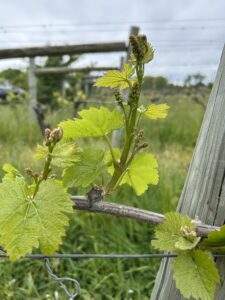
Figure 5. Grapevines with secondary bud break.
Diseases
- The most important diseases to manage at this time are Phomopsis, black rot, and powdery mildew.
- More information on early-season disease control can be found in this blog post by Dr. Mizuho Nita at Virginia Tech.
Insect Update
- Insect pests to monitor are the grape flea beetle and the climbing cutworms. Controls for these insects are rarely needed.
- Spotted lanternfly nymphs are emerging in southern counties and will continue to hatch over the next few weeks (Figure 6).
- Insecticide applications are generally not recommended to control SLF nymphs. Due to the April freeze, the vines are under stress; therefore, a well-timed insecticide application to manage other key pests can knock down nymph populations.

Figure 6. Spotted lanternfly nymphs on grapevines.
- Insecticide applications are generally not recommended to control SLF nymphs. Due to the April freeze, the vines are under stress; therefore, a well-timed insecticide application to manage other key pests can knock down nymph populations.
- Grape berry moth adults continue to be trapped in pheromone traps in vineyards where there is surrounding pressure from wild grapes.
- Insecticide timings will target control of later generations of grape berry moth in vineyards infesting developing fruit bunches.
- Using January 1st as a biofix, insecticide timing to target second generation will be 1200-1400 DD base 47°F. Use the NEWA model for grape berry moth to inform timing of management for local populations, and refer to the Commercial Grape Pest Control recommendations for New Jersey.