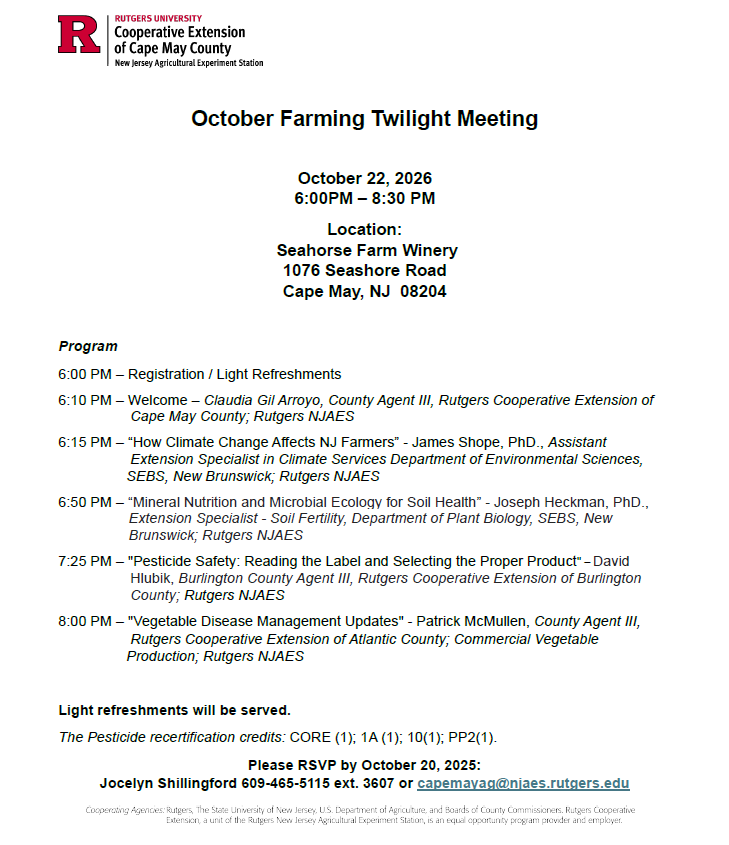
Pesticide recertification credits will be given to those attending this Twilight Meeting. See details below:

Please RSVP by October 20, 2026
Contact Jocelyn Shillingford at (609) 465 5115 ext. 3607 or capemayag@njaes.rutgers.edu
Rutgers Cooperative Extension
Growers who are interested in using disease forecasting models should chose the location from the report that is closest in proximity to their farming operation.
In addition, regularly check the Cornell NEWA website @http://newa.cornell.edu/ where this information is compiled from. From the NEWA site menu click on Pests Forecasts, select your weather station, and click on the specific disease, set accumulation start date, and a table of daily and total DSVs will be generated.
Pesticide recertification credits will be given to those attending this Twilight Meeting. See details below:

Please RSVP by October 20, 2026
Contact Jocelyn Shillingford at (609) 465 5115 ext. 3607 or capemayag@njaes.rutgers.edu
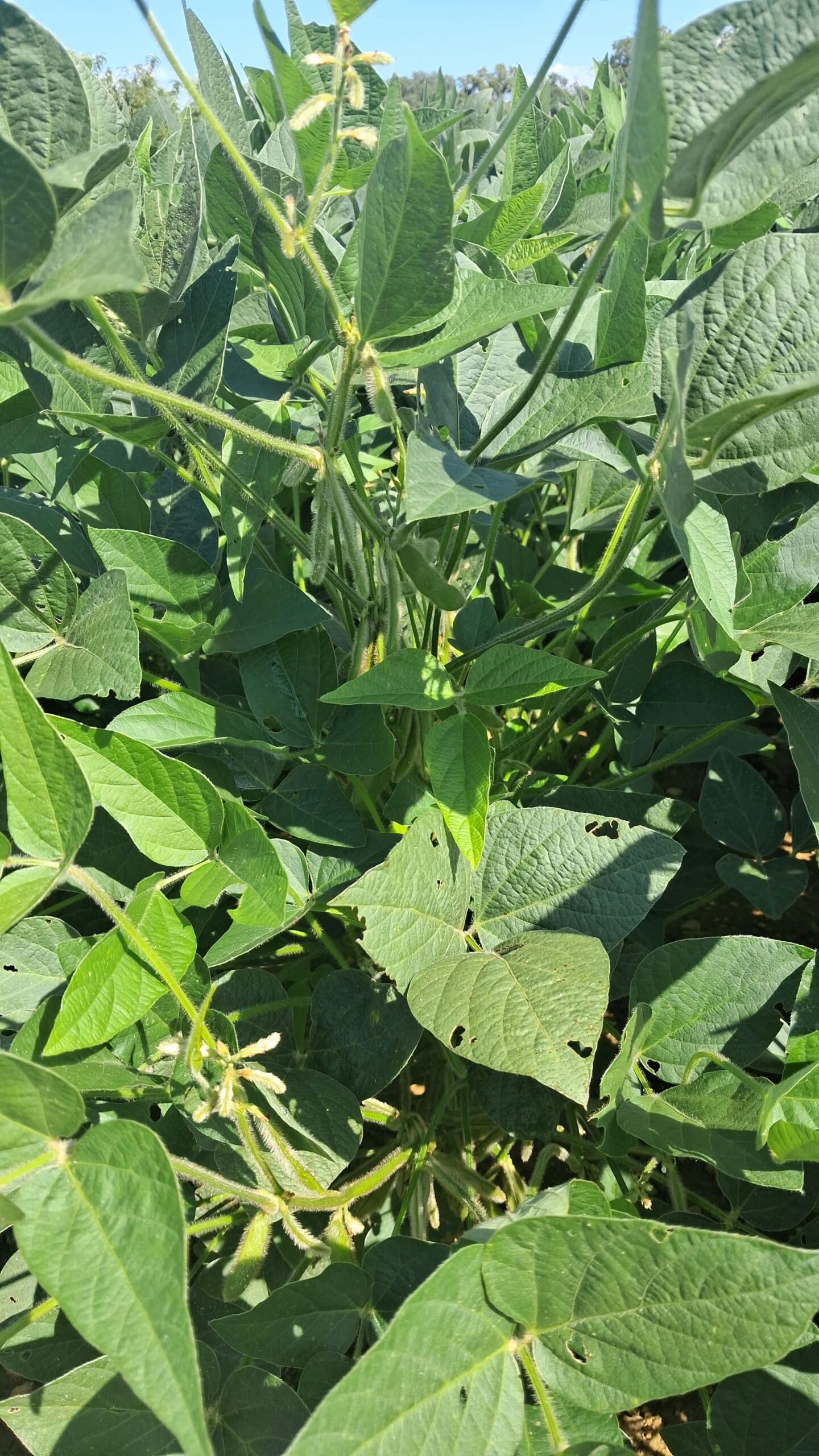
With the New Jersey soybeans reaching the R4 (full pod) growth stage, the crop is entering a crucial period for yield development. The plants shown below are at around R4 growth stage. For farmers in Southern New Jersey, this is a crucial time to scout fields closely and minimize stresses that can affect pod and seed development.

(Photo Credit: Ramandeep Kumar Sharma; Aug 24 2026)
How to identify R4 stage in soybeans?
Soybean is reached at the R4 (full pod) growth stage when a plant has a pod at least 3/4 of a inch long at one of the four uppermost nodes on the main stem, with a fully developed leaf at that node. To determine whether the crop has reached R5 (beginning seed), open a pod at one of these upper nodes. R5 begins when the seed inside the pod is at least 1/8 inch long.
Why R4 is so important for soybeans?
R4 marks the starting of one of the most critical periods for soybean yield determination. At R4 stage, pod growth is fast, and seed development is starting. From R4 through early seed filling, stresses such as moisture/nutrient deficiency, disease, insect injury, and excessive defoliation can reduce yield by increasing the abortion of flowers, pods, and developing seeds. The crop has some ability to compensate later through seed growth, but that compensation is limited.
What should soybean farmers do now?
Summary
R4 is not the time to stop scouting, it is the time to pay closer attention. Protecting adequate soil moisture, healthy foliage, developing pods, and seed formation during R4–R6 can help protect soybean yield potential. On checking pods, if a seed (at least 1/8 inch long) is found inside a pod at one of the upper four nodes, it means the plant has reached R5 (beginning seed).
References
NJDEP pesticide recertification credits approved for this meeting are: CORE (1), PP2 (4), 1A (4), and Category 10 (4).
Agri-Technology, Nursery, Agronomy, Fruit and Vegetable Research Twilight Meeting at RAREC
Wednesday August 26th, 2026 (4 pm until dark)
Location: Rutgers Agricultural Research and Extension Center (RAREC), 121 Northville Road, Bridgeton, New Jersey 08302
Hosted by: Ramandeep Kumar Sharma, Patrick McMullen, and Andy Wyenandt
Questions? Contact: Andy Wyenandt (wyenandt@njaes.rutgers.edu)
This year’s twilight meeting at RAREC will showcase advances in crop production, integrated pest management, soil fertility, weed management, and innovative agricultural technologies for growers and stakeholders across the state.
NJDEP pesticide recertification credits approved: CORE (1), PP2 (4), 1A (4), and Category 10 (4).
Salem County Agronomy Twilight Meeting- 2
Monday, August 31, 2026
6:00 pm – 8:30 pm
Rutgers Cooperative Extension
51 Cheney Rd, Woodstown, NJ
(program starts at 6 pm; please arrive earlier)
Please Save the Date!
To register
856-769-0090
e_dehart@salemcountynj.gov
Schedule & Topics to be Covered
6:00 pm Welcome & Introduction
– Salvatore Mangiafico and Ramandeep Sharma, Rutgers Cooperative Extension (Salem County)
6:15 pm Planting Timing and Nutrient Availability in Corn and Soybean Systems
– Jarrod Miller, University of Delaware
6:45 pm Sweet Corn Pest Management Updates: Scouting, IPM Strategies, and Responsible Pesticide Use
– Amanda Quadrel, Rutgers Cooperative Extension
7:15 pm Assessment of Agricultural Crop Damage by Black Bear in New Jersey
– Salvatore Mangiafico, Rutgers Cooperative Extension (Salem County)
7:45 pm Corn Lodging Insights and Agronomic Research Updates
– Ramandeep Sharma, Rutgers Cooperative Extension (Salem County)
8:15 pm Wrap-Up, Evaluations, & Pesticide Credit Submissions
– Salvatore Mangiafico and Ramandeep Sharma, Rutgers Cooperative Extension (Salem County)
Pesticide Recertification Credits Applied for:
CORE (1), 1A (2), PP2 (2), and 10 (1). Credits are pending NJDEP approval.
Agri-Technology, Nursery, Agronomy, Fruit and Vegetable Research Twilight Meeting at RAREC
Wednesday August 26th, 2026 (4 pm until dark)
Location: Rutgers Agricultural Research and Extension Center (RAREC), 121 Northville Road, Bridgeton, New Jersey 08302
Hosted by: Ramandeep Kumar Sharma, Patrick McMullen, and Andy Wyenandt
Questions? Contact: Andy Wyenandt (wyenandt@njaes.rutgers.edu)
This year’s twilight meeting at RAREC will showcase advances in crop production, integrated pest management, soil fertility, weed management, and innovative agricultural technologies for growers and stakeholders across the state.
NJDEP pesticide recertification credits are pending approval. Expected credits include CORE (1), PP2 (4), 1A (4), 3A (2), and Category 10 (3).
Recent detection (on June 3, 2026) of New World screwworm in Texas (Zavala County) have renewed attention to a livestock pest that was eradicated from the United States more than 50 years ago. While the current detections are far from New Jersey, they serve as a reminder of the importance of animal health surveillance and routine livestock inspections.
References
Our reports track accumulating Disease Severity Values (DSVs) for Late blight development and calculating P-days for initiating the first early blight fungicide application.
The first late blight fungicide application is recommended once 18 DSVs accumulate from green row. Green row typically occurs around the first week in May in southern New Jersey. An early season application of a protectant fungicide such as mancozeb (Dithane, Manzate, Penncozeb) or Bravo (chlorothalonil) as soon the field is accessible is suggested. Please be vigilant and keep a look out for suspect late blight infections on young plants.
Remember the threshold for P-days is 300! Once 300 P-days is reached for your location early blight fungicide applications should be initiated.
Disease severity values (DSVs) for early blight, septoria leaf spot, and tomato anthracnose development are determined daily based on leaf wetness (due to rainfall, dew) and air temperature.
On a daily basis DSV values can range from 0 to 4 where 0 = no chance for disease development to 4 = high chance for disease development. DSVs accumulate daily during the production season.
Fungicide applications are based on an individually determined DSV threshold. The first fungicide application for the control of these three diseases is not warranted until 35 DSVs have accumulated from your transplanting date. After that, growers can base fungicide applications on different DSV thresholds ranging anywhere between 15 (more conservative) and 25 DSVs (less conservative). Growers can compare accumulating DSVs to their standard weekly (7 day) fungicide maintenance programs.
For example, if 15 DSVs or more have accumulated between the time of the last fungicide application and the next regularly scheduled weekly fungicide application, recognize that conditions have been more conducive for disease development and a tighter fungicide program might be followed. If less than 15 DSVs have accumulated in the last 7 days since the last fungicide application, then conditions have not been as ideal for disease development and the next fungicide application could be stretched out until 15 DSV threshold is reached.
Cooperating Agencies: Rutgers, The State University of New Jersey, U.S. Department of Agriculture, and Boards of County Commissioners. Rutgers Cooperative Extension, a unit of the Rutgers New Jersey Agricultural Experiment Station, is an equal opportunity program provider and employer.
Rutgers University is an equal access/equal opportunity institution. Individuals with disabilities are encouraged to direct suggestions, comments, or complaints concerning any accessibility issues with Rutgers web sites to: accessibility@rutgers.edu or complete the Report Accessibility Barrier or Provide Feedback Form.
Copyright © Rutgers, The State University of New Jersey, an equal opportunity, affirmative action institution
Copyright © 2026 · Generate Child Theme on Genesis Framework · WordPress · Log in