Managing Alternaria in Brassicas

Managing Alternaria in Brassicas

Alternaria leaf blight, head rot, or black spot are primarily caused by the fungus Alternaria brassicicola. This disease primarily develops in cool, wet weather.

On leaves, symptoms start with round brown spots that develop concentric circles. A yellow halo often extends around the outside of the lesion. More lesions will develop across the leaf surface. Black, sooty rot can develop on broccoli and cauliflower heads and can progress quickly.

Alternaria can be seedborne, so always buy seed from a reputable source. If not already treated by the supplier, seed can be heat treated to kill pathogens (See Mid-Atlantic Commercial Vegetable Recommendations 2026/2027 pg 220 for details). Choose resistant cultivars whenever possible.

Remove or bury diseased crop residue at the end of the season. Use a 3-year crop rotation before planting another Brassica crop in the same location to allow overwintering spore populations to decrease. This includes cover crops in the Brassica family that can also serve as hosts. Control weed species in the Brassica family such as mustards and shepherd’s purse.

Fungicide applications should begin prior to the onset of disease development and continue under environmental conditions favorable for disease. Because this pathogen infects the heads, pay particular attention to PHIs when sprays are needed near the harvest window. Rotate FRAC groups to reduce the chance of resistance development. Resistance to azoxystrobin, QoI group 11 fungicide, and boscalid and penthiopyrad, SDHI group 7 fungicides, has been reported in some regions. If applications seem to be ineffective, contact your Extension agent, and use a different FRAC group.

Research trials at the University of Georgia by Kaur et al. (2025) evaluated two conventional spray programs on ‘Emerald Crown’ broccoli to control Alternaria leaf blight and found both to significantly reduce disease severity compared to non-treated plots.

Program 1: Luna Sensation 7.6 fl oz/A, Inspire Super 20 fl oz/A, Aprovia Top 13.5 fl oz/A, Bravo Weather Stik 1.5 pts/A, and Priaxor 8 fl oz/A.

Program 2: Bravo Weather Stik 1.5 pts/A, Luna Sensation 7.6 fl oz/A, Inspire Super 20 fl oz/A, Aprovia Top 13.5 fl oz/A, and Priaxor 8 fl oz/A.

Additional fungicide recommendations can be found in the Mid-Atlantic Commercial Vegetable Recommendations Cole Crops: Broccoli, Brussels Sprouts, Cabbage, Cauliflower, Collards, Kale, and Kohlrabi – 2026/2027 Mid-Atlantic Commercial Vegetable Production Recommendations

*Product labels supersede all recommendations provided in this article. The label is the law. Follow all instructions and ensure the product is labeled for your location.

References:

Hoidal, N. Alternaria leaf spot and head rot of Brassica crops. 2023. University of Minnesota Extension. https://extension.umn.edu/agriculture/specialty-crops/vegetable-farming/disease-management/alternaria-leaf-blight#cultural-controls-3119561

Humpherson-Jones, F. M., Phelps, K. 1989. Climatic factors influencing spore production in Alternaria brassicae and Alternaria brassicicola. Ann. Appl. Biol. 114:449-458.

Kaur, N., Foster, M. J., Donahoo, W. M., and Dutta, B. 2025. Evaluation of fungicide programs for the management of Alternaria leaf blight and head rot in broccoli in Tift County, Georgia, 2024 to 2025. Plant Health Progress 26(4):757. https://doi.org/10.1094/PHP-06-25-0173-PDMR.

Kaur, N., Malik, A. A., Cerritos-Garcia, D. G., Koch Bach, R. A., Everhart, S., and Dutta, B. 2025. Cross-resistance in Alternaria brassicicola from naturally infested broccoli seeds against two succinate dehydrogenase inhibitor fungicides ed. Gladys Alexandre. Appl Environ Microbiol 91(10). https://doi.org/10.1128/aem.01083-25.
Edema development in brassica crops

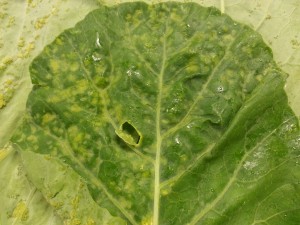
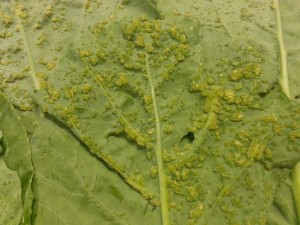
Edema is often expressed as off-color swellings or galls that appear on leaves and stems. Edema develops when epidermal cells hold excessive water due to a slowing of evapotransporation when hot, muggy days are followed by cooler, wetter weather. Edema develops because the plant takes in more water (due to a high soil moisture content) faster than it can get rid of it through evapotranspiration causing cells to rupture which results in the blistering of the leaves. Edema is strictly caused by environmental factors and can appear whenever these conditions are met. Properly monitor soil conditions, irrigation cycles, and the weather to avoid over irrigating on warm, hot early spring days, especially when quick cold fronts/temperature drops and cloudy weather are expected.

Symptoms of edema on collard leaf. Note the off-color appearance of leaf surface.

Symptoms of edema on top side of
collard leaf.
Note the off-color appearance of leaf surface.

Edema, bottom side of collard leaf. Note the irregular, 'corky appearance caused bythe rupture of leaf cells.

Edema, bottom side of collard leaf.
Note irregular, “corky” appearance due to leaf cell rupture.

Edema development in brassica crops

Edema is often expressed as off-color swellings or galls that appear on leaves and stems. Edema develops when epidermal cells hold excessive water due to a slowing of evapotransporation when hot, muggy days are followed by cooler, wetter weather. Edema develops because the plant takes in more water (due to a high soil moisture content) faster than it can get rid of it through evapotranspiration causing cells to rupture which results in the blistering of the leaves. Edema is strictly caused by environmental factors and can appear whenever these conditions are met. Properly monitor soil conditions, irrigation cycles, and the weather to avoid over irrigating on warm, hot early spring days, especially when quick cold fronts/temperature drops and cloudy weather are expected.

Symptoms of edema on collard leaf. Note the off-color appearance of leaf surface.

Symptoms of edema on top side of
collard leaf.
Note the off-color appearance of leaf surface.

Edema, bottom side of collard leaf. Note the irregular, 'corky appearance caused bythe rupture of leaf cells.

Edema, bottom side of collard leaf.
Note irregular, “corky” appearance due to leaf cell rupture.

Edema development in brassica crops

Edema is often expressed as off-color swellings or galls that appear on leaves and stems. Edema develops when epidermal cells hold excessive water due to a slowing of evapotransporation when hot, muggy days are followed by cooler, wetter weather. Edema develops because the plant takes in more water (due to a high soil moisture contant) faster than it can get rid of it through evapotranspiration causing cells to rupture which results in the blistering of the leaves. Edema is strictly caused by environmental factors and can appear whenever these conditions are met. Properly monitor soil conditions, irrigation cycles, and the weather to avoid over irrigating on warm, hot early spring days, especially when quick cold fronts/temperature drops and cloudy weather are expected.

Symptoms of edema on collard leaf. Note the off-color appearance of leaf surface.

Symptoms of edema on top side of
collard leaf.
Note the off-color appearance of leaf surface.

Edema, bottom side of collard leaf. Note the irregular, 'corky appearance caused bythe rupture of leaf cells.

Edema, bottom side of collard leaf.
Note irregular, “corky” appearance due to leaf cell rupture.

Edema Developing in Some Brassica’s

Edema is being reported in some brassica crops. Edema is often expressed as off-color swellings or galls that appear on leaves and stems. Edema develops when epidermal cells hold excessive water due to a slowing of evapotransporation when hot, muggy days are followed cooler, wetter weather. Edema develops because the plant takes in more water (due to a high soil moisture content) than it can get rid of causing cells to rupture which results in the blistering of the leaves.

Symptoms of edema on collard leaf. Note the off-color appearance of leaf surface.

Symptoms of edema on top side of
collard leaf.
Note the off-color appearance of leaf surface.

Edema, bottom side of collard leaf. Note the irregular, 'corky appearance caused bythe rupture of leaf cells.

Edema, bottom side of collard leaf.
Note irregular, “corky” appearance due to
leaf cell rupture.
