Orangestriped Oakworm (Anisota senatoria) (1917 GDDs = Egg hatch)
Overview and Host Plants: Orangestriped Oakworm larvae are summer caterpillars. They feed & cause damage primarily during August & September. Host plants include oaks (primarily within the red oak group) & can occasionally be found feeding on birch, maple, chestnut, & hickory trees.

Orangestriped Oakworm mid-instar larvae defoliating pin oak leaves. Photo Credit: Steven K. Rettke, Rutgers Coop. Ext.
Adult Moths: Female adult moths can have a wingspan of up to 2 inches & are orange to brown in color (each wing has a white spot near the middle of the wing with dark stripes that dissect them). Adult moths are first seen during the summer in early July & begin laying eggs before the end of the month. There is a single generation per year in the northeastern regions of the country. Further south, there can be 2 generations per year.

Orangestriped Oakworm adult with a single white spot on each wing. Also a dark diagonal line runs along the length of each wing. Photo Credit: Mike Raupp, UMd Coop. Ext.
Eggs: Bright, yellow-colored eggs are laid in July on the undersides of leaves. As many as 100 or more eggs are often laid on each leaf. The eggs hatch 7-10 days after being laid & become dark red before hatching. Females can potentially lay as many as 500 eggs during a lifetime. Most eggs will be laid on the underside of leaves, near the terminal ends of lower branches.

Orangestriped Oakworm egg mass. More than 100 individual eggs can be laid under a single leaf. Initially yellow in color, the eggs become a dark red 7-10 days later just before hatching. Photo Credits: Erich G. Vallery, USDA & J.R. Baker, NC State Univ.
Caterpillar Larvae: Orangestriped oakworm larvae will be actively feeding on tree leaves during the second half of the season (August & September). Young instar caterpillars are light yellow in color & darken as they become older instars. The final 5th larval instar eventually becomes black with eight orange stripes that run longitudinally along the length of the body. These caterpillars are gregarious & feed in clusters, on one branch at a time. They can defoliate an entire branch before moving on to another one. Mature, late-instar caterpillar larvae can reach 2.2 inches in length. A pair of black flexible spines or horns is present near the back of the head area. When close to pupation, mature caterpillars become solitary & can wander many yards away from the tree they fed upon to find a place to pupate 3-4 inches down into the soil.

Orangestriped Oakworm larval instars. 1st instar is nearly white in color, while the mid-instar is yellow-green & the final 5th-instar is black with orange stripes. Photo Credit: Steven K. Rettke, Rutgers Coop. Ext.

Orangestriped Oakworm 4th-instar is greenish with yellow stripes. Photo Credit: Steven K. Rettke, Rutgers Coop. Ext.

Orangestriped Oakworm final, 5th-instar larva is black with 8 orange stripes running down the length of the body. Two prominent, flexible black spines or horns project from behind the head of the caterpillar. Photo Credit: Steven K. Rettke, Rutgers Coop. Ext.

Orangestriped Oakworm final, 5th-instar larvae become solitary & move off the tree onto the ground to find a suitable area to tunnel into the soil & pupate. Photo Credit: Steven K. Rettke, Rutgers Coop. Ext.
Symptoms & Harm: This caterpillar can potentially completely defoliate small trees. On smaller trees, individual branches are fed upon by clusters of young caterpillars, one branch at a time. The small caterpillars will skeletonize leaves, while the larger ones will defoliate leaves almost completely, leaving only the primary leaf veins.

Orangestriped Oakworms are gregarious caterpillars during early larval development & will feed only on one branch at a time & then move together to the next branch. Photo Credit: Steven K. Rettke, Rutgers Coop. Ext.
Since most of the leaf feeding is done in the late season, these defoliators are less harmful to larger trees. Healthy trees will be capable of accumulating a lot of photosynthates & reserved carbohydrates during the 1st half of the season. The loss of leaves, later in the season, has a lower negative impact on the trees. Therefore, unlike with spring defoliators , the trees do not have to re-foliate and use up a lot of stored carbohydrates.

Orangestriped Oakworm young larvae will skeletonize leaves, but the older instars will nearly completely defoliate the branches & leave only the primary leaf veins. Photo Credit: Steven K. Rettke, Rutgers Coop. Ext.
The orangestriped oakworm is primarily a nuisance pest. They become annoying pests as their feeding produces frass pellets that can rain down onto decks, patios, sidewalks, or driveways. The times when the health of oak, or other trees, can potentially be threatened by Orangestriped oakworm infestations are when the late-season defoliations occur over many consecutive years. Also, during the same year, if the trees were also defoliated by spring feeding caterpillars, such as spongy moths or forest tent caterpillars, then the trees can be seriously harmed. This results from the depletion of the tree’s reserved carbohydrates & causes increased vulnerability to other opportunistic insects or diseases. Also, branches can potentially experience sunscald injuries when leaves are suddenly removed during the middle of summer.

Orangestriped Oakworms are late season defoliators, & therefore if trees are defoliated it is less harmful to tree health & recovery is more likely. Photo Credit: Steven K. Rettke, Rutgers Coop. Ext.

Orangestriped Oakworms are generally not a threat to the health of oak trees when leaf defoliation is less than 25%. Photo Credit: Steven K. Rettke, Rutgers Coop. Ext.
Controls: Insecticide sprays are rarely justified to protect the health of large trees. With smaller trees, the branches can be shaken to cause the infesting caterpillars to fall to the ground, where they can be squashed underfoot. Small, infested twigs/branches can also be pruned out.

Orangestriped Oakworm mid-instar larvae. With smaller trees, infested branches can be shaken to make caterpillars fall to the ground where they can stomped underfoot. Or small branches can simply be pruned off. Photo Credit: Steven K. Rettke, Rutgers Coop. Ext.
Since the Orangestriped oakworm is a native caterpillar, numerous different native beneficials can suppress them, such as birds, paper wasps, insects (predators & parasitoid wasps), & diseases. These beneficials alone can prevent outbreak populations or prevent them from maintaining high numbers for more than 2 or 3 years.
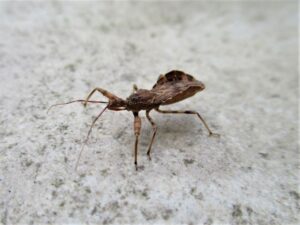
Orangestriped Oakworms are native caterpillars & can often be suppressed by predators such as the Assassin Bug. Photo Credit: Steven K. Rettke, Rutgers Coop. Ext.
The need to apply insecticides is often unnecessary, but when required, some biorational materials include Bacillus thuringensis (Bt), horticultural oils, & azadirachtin (Neem oil). These materials only work well against younger instar caterpillars. Other reduced-risk materials include Conserve (Spinosad) (which can kill larger caterpillars), Acelepryn (chlorantraniliprole), and Dimilin (diflubenzuron), an insect growth regulator. Effective contact insecticide sprays include pyrethroids, acephate, & carbaryl. The translaminar material Avid (Abamectin) is also labeled.
If this caterpillar is feeding on a large tree in a key location & causing a severe nuisance with frass droppings, then an acephate trunk implant can be applied. Also, trunk injections of Emamectin benzoate can be effective.
A Case Study in Landscape IPM: Using thresholds for egg mass counts, defoliation %, tree health threats & tree aesthetics
Orangestriped oakworm studies by Mark Coffelt & Pete Schultz at Virginia Tech in the 1990’s established some valuable guidelines to help manage this pest using IPM methods. Homeowner surveys done by authors Coffelt & Schultz state that 15% defoliation is acceptable to 70% of respondents, while 42% stated 25% defoliation is acceptable.

Orangestriped Oakworms having mild infestations & causing less than 25% defoliation is not a threat to a tree’s health. Photo Credit: Steven K. Rettke, Rutgers Coop. Ext.
Studies have found that 25% defoliation will not reduce starch reserves in roots. Starch root reserves are a measure of tree vigor. For example, a fifteen-foot tree with a DBH (diameter at breast height) of 5 inches will reach 25% defoliation with only one egg mass. Four egg masses on a similarly sized tree will reach 100% defoliation. Larger trees, having a DBH of 7-8 inches, will require 5 egg masses to reach 25% defoliation. A tree with a DBH of 10 inches will require 7 egg masses to reach 25% defoliation. A tree with a DBH of 14 inches will require 9 egg masses to reach 25 % defoliation.

Orangestriped Oakworms infesting this branch all hatched from the same egg mass. Photo Credit: Steven K. Rettke, Rutgers Coop. Ext.
After egg hatch, these gregarious young caterpillars feed in groups, and a partially defoliated branch will occur from a single egg mass. Therefore, using the threshold percentages stated above, if a 5-inch DBH tree shows 4 branches with partial defoliation early after egg hatch, then it can be assumed there were 4 egg masses laid within this tree. As a result, by the end of the season, a tree of this size will be completely defoliated. This information is important to know if this tree is an important feature in the landscape. Early intervention to protect it will then be needed.
References:
Identification and Management of Orangestriped Oakworm; Natan W. Siegert and Deborah G. McCullough, Dept. Of Entomology & Dept. of Forestry, Michigan State University, May 1998.
Orangestriped Oakworm – Anisota senatoria, Sturnidae; Rose Hiskes, Dept. of Horticulture, The Connecticut Agricultural Experiment Station.
Orangestriped Oakworms – A great case study of Landscape IPM; Steven Frank, NC State University, August 2015.