Apples
Disease Management Considerations
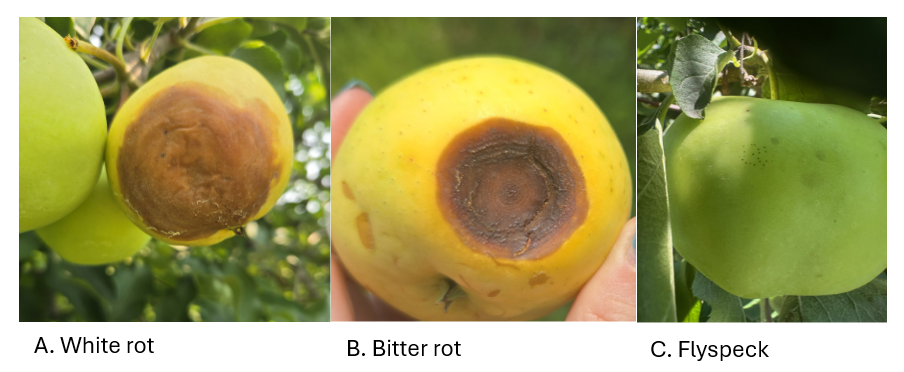
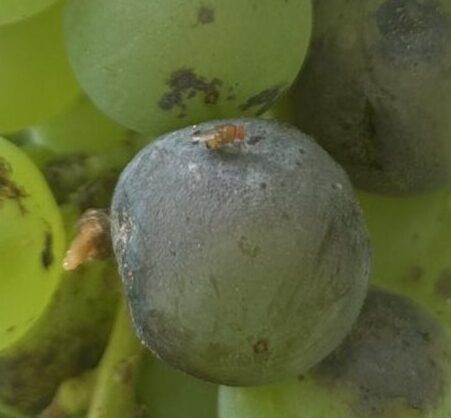
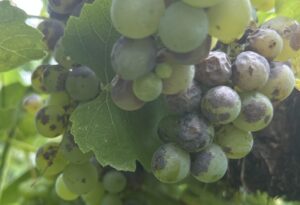
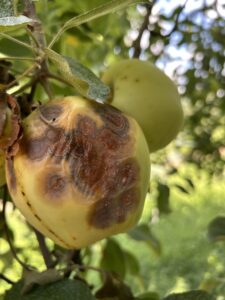
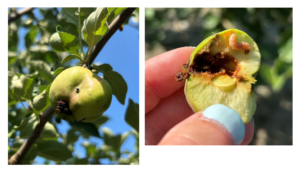
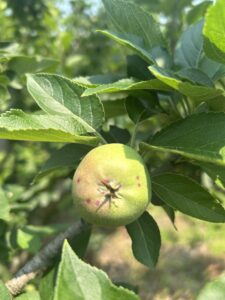
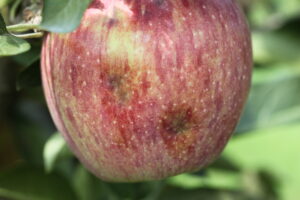
- Rots have been observed on fruit in southern and northern NJ counties (Figure 1).

Figure 1. Bitter rot infection on maturing apple fruit.
Broad-spectrum fungicides, such as captan and ziram, are effective. Captan alone may not adequately suppress severe summer disease pressure. Adding single-site products such as Merivon, Luna Sensation, Pristine, Omega, and Aprovia may improve control. The addition of phosphonate products such as ProPhyt or Rampart to captan sprays can improve control of rots and other summer diseases, including sooty blotch and flyspeck.
- Time applications ahead of the next rain event, where your fungicide coverage may be depleted.
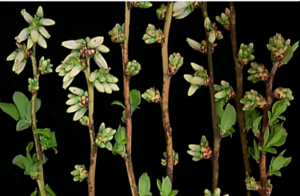
- Where fire blight is present, it is appropriate to prune out infected shoots. Do not cut out infections during wet weather, as bacteria can spread through water. The recommendation is to cut back to last year’s growth, at least 12” back into healthy tissue, and to sterilize pruners between cuttings.
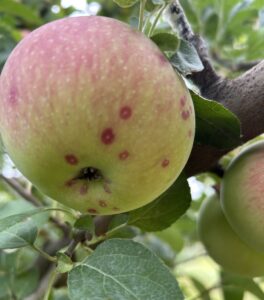
- Maintain coverage of captan, manzate, or ziram before rain events through the growing season according to the cover spray rule of applications every 2” of rain or 14 days, whichever comes first, to reduce the spread of foliar diseases, including Marssonina Blotch, Glomerella Leaf Spot, and Frogeye Leaf Spot. Foliar diseases can contribute to inoculum build-up in the orchard and significant defoliation of the canopy if left untreated.
Insect Update
Codling Moth (CM): Trap captures are increasing in some orchards, but on average, counts remain low for the second generation of codling moth. If you have applied your 2nd-generation insecticides and your trap counts are low (less than 5 moths per trap), additional treatments are not needed.
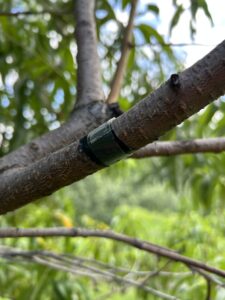
Scale: Second-generation San Jose scale typically emerges about mid-July. We have observed an increase in crawler activity at some locations. Monitor crawler activity by wrapping black electrical tape covered with double-sided sticky tape around branches with previous scale infestations (Figure 2).

Figure 2. Monitoring San Jose scale crawlers using electrical tape and double-sided sticky tape on a peach tree branch.
Use a hand lens to detect crawlers on the tape. Control options during crawler emergence include Esteem (2 applications/year; 45-day PHI); Centaur (1 application/year; 14-day PHI); Diazinon 50W (2 applications/year; 21-day PHI); and Venerate (0-day PHI; Make two applications 7 days apart starting a week after crawler emergence). Neonicotinoids will have some suppression.
Woolly Apple Aphid (WAA); Green Apple (Spirea) Aphids (GAA): Populations on average remain below treatment levels. A treatment threshold is set at 50% of the terminals infested with live colonies. Predation by lady beetles and other predators and parasitoids has been observed and can help to maintain pest populations below damaging thresholds. Scout in known hotspots for WAA colonies now. Minimize the use of pyrethroids to manage insect pests, as they can knock down beneficial organisms and predators. Research from Dr. Monique Rivera at Cornell University has demonstrated good control of Sefina for WAA in late summer.
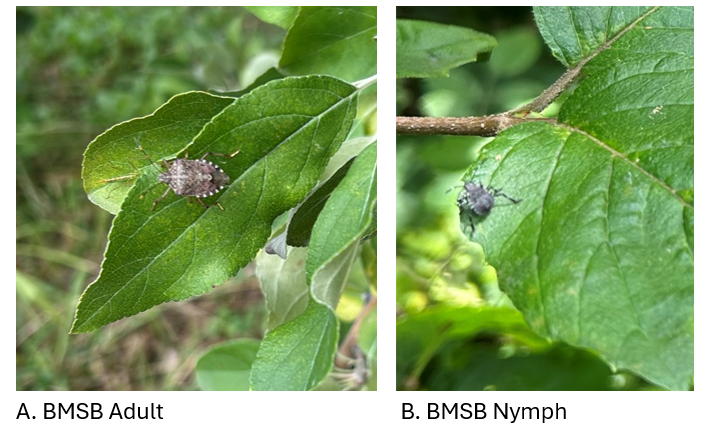
Brown Marmorated Stink Bugs: Brown Marmorated Stink Bugs are being captured in orchards statewide. Both adults and nymphs are present. See the NJ Tree Fruit Production guide for effective materials on harvesting fruit.
Dogwood borer: On average, moth captures in pheromone traps continue to decrease. If trap captures continue to be high in your orchard blocks, consider a coarse trunk application of Assail before August.
Traps
Average Trap Captures in Apple – Southern Counties
| Week | STLM | TABM | CM | OFM | DWB | AMBROSIA BEETLE | BMSB |
| 5/11/2026 | 18 | 11 | 6 | 3 | 25 | 2 | – |
| 5/18/2026 | 16 | 21 | 3 | 10 | 54 | 13 | – |
| 5/25/2026 | 1.3 | 23 | 2 | 2 | 71 | 7 | – |
| 6/1/2026 | 378 | 33 | 3 | 2 | 49 | 6 | 0.4 |
| 6/8/2026 | 258 | 11 | 2 | 1 | 61 | 21 | 1.2 |
| 6/15/2026 | 355 | 4 | 0.6 | 1.5 | 57 | 13 | 0.8 |
| 6/22/2026 | 178 | 5 | 0.6 | 2 | 54 | 8 | 1.2 |
| 6/29/2026 | 504 | 0.3 | 0.1 | 0.5 | 27 | 12 | 0.8 |
| 7/6/2026 | 202 | 1.1 | 1.6 | 0.6 | 25 | 7.5 | 0.6 |
| 7/13/2026 | 226 | 0.9 | 1 | 1 | 33 | 1 | 1.6 |
Average Trap Captures in Apple – Northern Counties
| Week | STLM | TABM | CM | DWB | AMBROSIA BEETLE | BMSB |
| 5/11/2026 | 13.7 | 1.5 | 1.8 | 12.8 | 1.1 | – |
| 5/18/2026 | 8.3 | 13.25 | 2.4 | 18.5 | 10.8 | – |
| 5/25/2026 | 2.2 | 13.75 | 1.2 | 24.5 | 5.1 | – |
| 6/1/2026 | 25.1 | 24.3 | 3.4 | 23.8 | 9.4 | 0.3 |
| 6/8/2026 | 94 | 22.3 | 0.3 | 24.6 | 18 | 1.4 |
| 6/15/2026 | 68 | 22.3 | 1 | 22.6 | 14 | 1.1 |
| 6/22/2026 | 105.9 | 35 | 0.7 | 27.2 | 8.2 | 0.5 |
| 6/29/2026 | 100 | 11.5 | 0.3 | 28.9 | 5.3 | 0.3 |
| 7/6/2026 | 50.2 | 7.3 | 0.6 | 26.4 | 5.2 | 0.2 |
| 7/13/2026 | 52.4 | 7 | 0.5 | 24.8 | 5.3 | 0.2 |
Pears
Disease Management
- Foliar diseases should be managed with Mancozeb or Ziram, plus a single-site fungicide, to maintain pressure and inoculum at low levels, protecting fruit and maintaining a healthy orchard going into the next season.
- Where fire blight is present, it is appropriate to prune out infected shoots. Prune out strikes on dry, cooler days, cut back 8-12” back into healthy tissue, and sterilize pruners between cuts.
Insect Update
Pear psylla: Adult populations have decreased compared to previous weeks. If adult psylla are present, options for control include Actara, Assail, and Belay (IRAC group 4A); Sivanto Prime (IRAC group 4D); Delegate (IRAC Group 5); and products containing abamectin (IRAC group 6).
Peaches
Disease Management
-

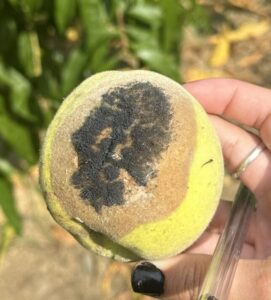
Figure 3. Declining peach trees due to environmental stress.
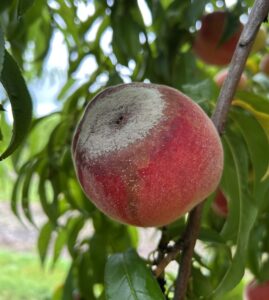
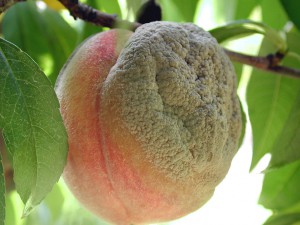
Brown rot is appearing in ripening fruit throughout the state. Highly effective rot materials include DMI’s Indar, Cevya, Orius, Quash, and Tilt (FRAC group 3), and Strobilurin materials including Merivon, Luna Sensation, Pristine, and Quadris Top (FRAC group 11), which should be applied beginning 3 – 4 weeks prior to harvest.
- There have been reports of declining peach trees exhibiting yellowing foliage, gummosis, and bark splitting. Several samples have been submitted to the Rutgers Plant Diagnostic Laboratory. There has been one report of Cytospora canker and some insect borer injury observed, but overall the damage and decline have been attributed to weather extremes, including drought and significant fluctuations in temperature that have made certain varieties or trees in certain low-lying locations more vulnerable to abiotic stress, and insect and disease injury (Figure 3). The recommendation is to maintain proper irrigation and fertilization and prune out any visible cankers. Be mindful of pruning practices and avoid mechanical damage to trees to minimize injury.
Insect Update
Oriental Fruit Moth (OFM): A biofix point for OFM was set on 4/2 for southern counties and 4/15 in northern counties. See below for timings for the third generation. Consider treatment if trap captures are above threshold (>8 moths per trap).
|
|||||||||||||||||||||||||
Japanese Beetles: Japanese beetles have been observed feeding significantly on foliage and fruit. Products containing imidacloprid (Admire Pro, Leverage 360) are effective and may be warranted to protect fruit through to harvest.
Scale: Second-generation White Peach Scale crawlers should emerge sometime this week or next. Second-generation San Jose Scale crawlers emerge about 7/17 +/- 8 days. Esteem is a good scale material that has a 14-day PHI for stone fruit. Centaur is also effective, has a 14-day PHI, and can be used only once during the growing season. Venerate has shown efficacy as a pre-harvest treatment against scale and has a 0-day PHI. If using Venerate to control scale insects, make 2 applications 7 days apart, starting a week after crawler emergence.
Tarnished plant bugs and other catfacing insects: Insects are active, but new fruit feeding injury has been minimal.
Brown Marmorated Stink Bugs: Nymphs are active, and numbers continue to increase in orchards statewide. See the NJ Tree Fruit Production guide for effective materials.
Mites: Outbreaks of mites have been observed in a few orchards as a result of hot and dry weather from the previous week. If left unchecked, mites can build up to the point where leaf bronzing is visible by mid- to late July. If leaf damage is heavy enough, next year‘s crop can even be affected. Consider treatment if more than 10 mites per leaf are observed. Control options include Apollo, Savey, Envidor, Nealta, and Nexter. Try to limit miticide use to one application per material class per season.
Traps
Average Trap Captures in Peach – Southern Counties
| Week | OFM | TABM | LPTB | PTB | BMSB |
| 5/11/2026 | 5 | 10 | – | – | – |
| 5/18/2026 | 4 | 20 | – | – | – |
| 5/25/2026 | 2 | 20 | 31 | 1 | – |
| 6/1/2026 | 4 | 46 | 28 | 3 | 0 |
| 6/8/2026 | 8 | 13 | 25 | 3 | 0.75 |
| 6/15/2026 | 5 | 6 | 13 | 3 | 0.75 |
| 6/22/2026 | 6 | 4 | 23 | 7 | 1 |
| 6/29/2026 | 3 | 0.2 | 16 | 6 | 2 |
| 7/6/2026 | 5 | 0.6 | 16 | 4 | 1.3 |
| 7/13/2026 | 9 | 1.4 | 18 | 7 | 3.5 |
Average Trap Captures in Peach – Northern Counties
| Week | OFM | LPTB | PTB |
| 5/11/2026 | 4.4 | 24 | 0 |
| 5/18/2026 | 2.4 | 16.5 | 0.2 |
| 5/25/2026 | 0.7 | 8.75 | 0.1 |
| 6/1/2026 | 1.8 | 11 | 0.5 |
| 6/8/2026 | 0.6 | 8.5 | 0.05 |
| 6/15/2026 | 3.5 | 9.7 | 1.2 |
| 6/22/2026 | 3.4 | 7.4 | 1.6 |
| 6/29/2026 | 2 | 4.6 | 1.1 |
| 7/6/2026 | 1.7 | 8.5 | 1.8 |
| 7/13/2026 | 0.5 | 2.8 | 3.7 |
Blueberries
Insect Update
Scouting was conducted last week across 75 conventional and organic blueberry fields in Burlington and Atlantic Counties. Monitoring of developing fruit indicated an overall decrease in pest activity, including feeding and oviposition by leafrollers, plum curculio, and cherry and cranberry fruitworms.
Aphids: Populations have declined significantly compared with previous weeks, likely due to recent weather conditions and the hardening of new shoot growth.
Spotted-wing drosophila: Trap captures slightly decreased in both Atlantic and Burlington Counties. SWD remains the primary target for insecticide applications (Table 1). For management recommendations for SWD in blueberry and other berry crops, reference Rutgers Cooperative Extension Factsheet FS1246 and SWD Insecticides for Berries.
Blueberry maggot: Adults are also present at low numbers, particularly in fields where picking and pesticide applications have slowed down.
Table 1. Spotted-Wing Drosophila and Blueberry Maggot traps
| Spotted-Wing Drosophila | Blueberry Maggot | |||||||
| Atlantic County | Burlington County | Atlantic County | Burlington County | |||||
| Avg | High | Avg | High | Avg | High | Avg | High | |
| 6/6 | 8.99 | 35 | 2.86 | 7 | 0.03 | 1 | 0 | 0 |
| 6/12 | 9.9 | 46 | 3.7 | 25 | 0 | 0 | 0 | 0 |
| 6/20 | 10.24 | 48 | 8.22 | 35 | 0 | 0 | 0 | 0 |
| 6/27 | 6.96 | 78 | 3.6 | 18 | 0 | 0 | 0 | 0 |
| 7/3 | 29.78 | 273 | 50.9 | 81 | 0.33 | 27 | 0 | 0 |
| 7/10 | 31.2 | 130 | 86.1 | 177 | 0.15 | 12 | 0 | 0 |
| 7/18 | 28.3 | 110 | 59.3 | 125 | 0.07 | 5 | 0.16 | 1 |
Sharp-nosed leafhopper: Trap counts remain low (Table 2).
Oriental beetle: Adults are actively in flight (Table 2).
Table 2. Sharp-nosed Leafhopper and Oriental Beetle traps
| Sharp-nosed Leafhopper | Oriental Beetle | |||||||
| Atlantic County | Burlington County | Atlantic County | Burlington County | |||||
| Avg | High | Avg | High | Avg | High | Avg | High | |
| 6/6 | 1.42 | 16 | 1.25 | 7 | 5.78 | 35 | 2.57 | 14 |
| 6/12 | 0.56 | 12 | 4.8 | 46 | 62 | 340 | 47 | 170 |
| 6/20 | 0.88 | 6 | 1.44 | 12 | 411 | 2025 | 403 | 2025 |
| 6/27 | 0.77 | 9 | 0.37 | 2 | 243 | 2025 | 458 | 2025 |
| 7/3 | 1.5 | 15 | 0.55 | 2 | 466.7 | 2025 | 182.7 | 510 |
| 7/10 | 1.40 | 14 | 0.33 | 2 | 396 | 1970 | 393 | 2025 |
| 7/18 | 0.98 | 13 | 0 | 0 | 191.1 | 2025 | 235 | 1350 |
Scales: Crawler activity of both terrapin scale and Putnam scale declined over the past week (Table 3). Monitoring will continue throughout the fall to detect the emergence of the second crawler generation and determine the appropriate timing for pesticide applications. Continued monitoring will help ensure that management recommendations are based on current pest activity and that insecticide applications are made when crawlers are most susceptible. Scale infestations on fruit also decreased last week (Table 4). For scale management, target the second generation of crawlers with post-harvest applications of diazinon or pyriproxyfen (Esteem).
Table 3. Scale Traps
| Putnam Scale | Terrapin Scale | |||
| Avg | High | Avg | High | |
| 5/23 | 36.85 | 230 | 1.8 | 8 |
| 5/29 | 65.17 | 352 | 21.2 | 41 |
| 6/6 | 136.25 | 402 | 75.25 | 84 |
| 6/12 | 164 | 639 | 96 | 202 |
| 6/20 | 102 | 288 | 85 | 167 |
| 6/27 | 45 | 193 | 32 | 119 |
| 7/3 | 41.7 | 315 | 27.5 | 46 |
| 7/10 | 16.26 | 74 | 24.6 | 61 |
| 7/18 | 6.06 | 25 | 12 | 24 |
Table 4. Scale Infestation on Fruit
| Scale % infestation on fruit | ||
| Avg | High | |
| 6/12 | 0.13 | 2.1 |
| 6/20 | 0.19 | 5.7 |
| 6/27 | 0.06 | 1.5 |
| 7/3 | 0.06 | 1.8 |
| 7/10 | 0.07 | 3.1 |
| 7/18 | 0.02 | 0.9 |
Diseases
The IPM team continues to observe anthracnose and Alternaria, likely associated with mechanical damage caused by picking machine activity.
For recommendations on fungicide products, refer to:
- the 2026 Commercial Blueberry Pest Control Recommendations for New Jersey
- https://extension.rutgers.edu/sites/default/files/2026-03/bb-v42n01.pdf
| % Mummy Berry Infested Fruit | % Anthracnose Infested Fruit | % Alternaria Infested Fruit | ||||
| Avg | High | Avg | High | Avg | High | |
| 6/20 | 0.03 | 0.9 | 0.06 | 2.5 | 0.004 | 0.7 |
| 6/27 | 0.007 | 0.3 | 0.08 | 2.2 | 0.07 | 3 |
| 7/3 | 0.005 | 0.2 | 0.227 | 4.1 | 0.07 | 1.2 |
| 7/10 | 0.002 | 0.1 | 0.20 | 2.5 | 0.13 | 3 |
| 7/18 | 0.001 | 0.1 | 1.23 | 13.1 | 0.43 | 9.3 |
Grapes
Insects
Grape berry moth (GBM): Third-generation GBM is actively flying and laying eggs. The next timing to apply control for GBM is 1620-1710 DD from the biofix date of wild grape bloom (5/19 for Gloucester County). As of July 20, we are currently at 1659 DD (base 47.14°F) in Gloucester County. Consult the Grape berry moth NEWA model for the most accurate forecasting for your area. Consider treatment when 10% or more of the bunches show berry webbing and GBM larval feeding injury. To determine the percent injury, examine 10 bunches on 5 vines in 4 locations. Often, the greenish-brown larvae can be found inside the berry. See the Commercial Grape Pest Control Recommendations for New Jersey for management options.
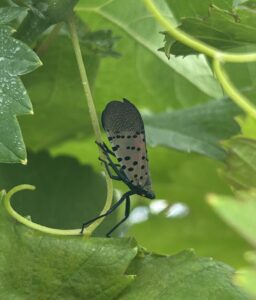
Spotted lanternfly (SLF): Adult SLF were observed in southern county vineyards this week (Figure 4).

Figure 4. Spotted lanternfly adult in vineyards in South NJ.
See this previous Plant & Pest Advisory post on Management of Spotted Lanternfly in New Jersey Vineyards.

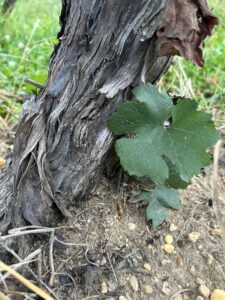
Figure 5. Grape root borer pupal case at the base of a grape vine where the adult moth emerged.
Japanese beetle (JB): Pressure remains high throughout the state with considerable defoliation at some vineyards. See the NJ Commercial Grape Production Guide for more information on insecticides effective for JB.
Grape root borer (GRB): Adults are active and flying in vineyards. Monitoring traps indicate the presence of GRB in the area, but only scouting around the bases of vines will indicate the presence of GRB in the vineyard (Figure 5).
Adult moths will lay eggs July-August. Larvae will enter the soil and migrate to the roots, where they feed and cause damage. Dr. Anne Nielsen and the IPM team will be monitoring vineyards throughout the state to assess GRB population pressure in NJ.
Diseases
- Botrytis has been observed in developing bunches.
- Incidence of downy mildew and powdery mildew has been low in NJ vineyards.
- See the NJ Commercial Grape Production Guide for more information on disease management options.


Figure 1. Fire blight strike in apple. Photo by Karlton Raines-Neidigh.
Figure 2. Frogeye leaf spot on apple.