Search Results for: spotted lanternfly

Landscape Pest Notes: Some Late Summer Pests & Concerns

SPOTTED LANTERNFLY (Lycorma delicatula)(1st Flying Adults = 1700 GDD): There are still some red-colored 4th instar nymphs being observed but most areas of NJ are now seeing the adult stage of this invasive planthopper. Adult spotted lanternflies will initiate a migration period beginning in late August that will continue into the weeks of September. It is during this time that this insect will become a major nuisance in residential sites & also within more urban areas. Although spotted lanternfly adults are better hoppers than flyers, they are proficient gliders & are capable of traveling a few miles. Throughout these late weeks of summer, the insects are searching for ideal trees to feed on & then potentially lay overwintering egg masses.
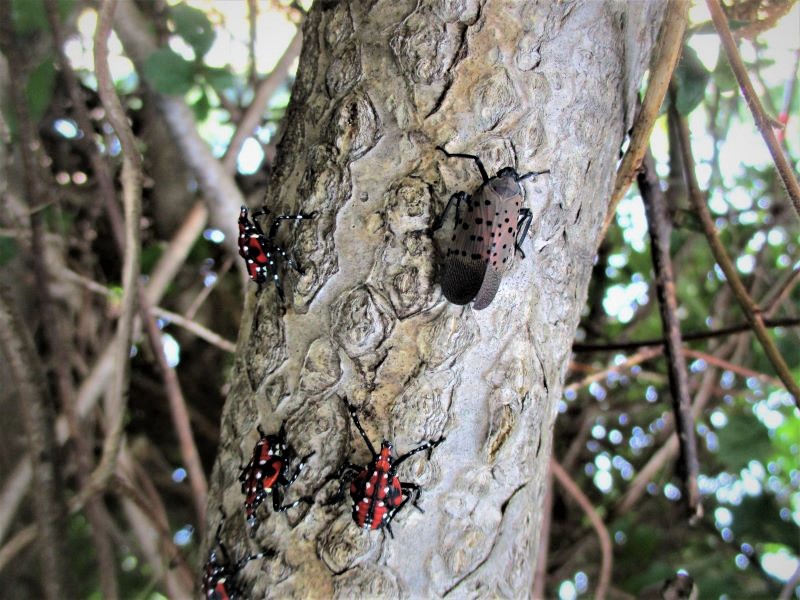
Spotted lanternfly adult & 4th instar nymph

Spotted lanternfly adult & 4th instar nymphs. By late August, NJ will have these stages active. (Photo Credit: Steven K. Rettke, Rutgers Coop. Ext.)
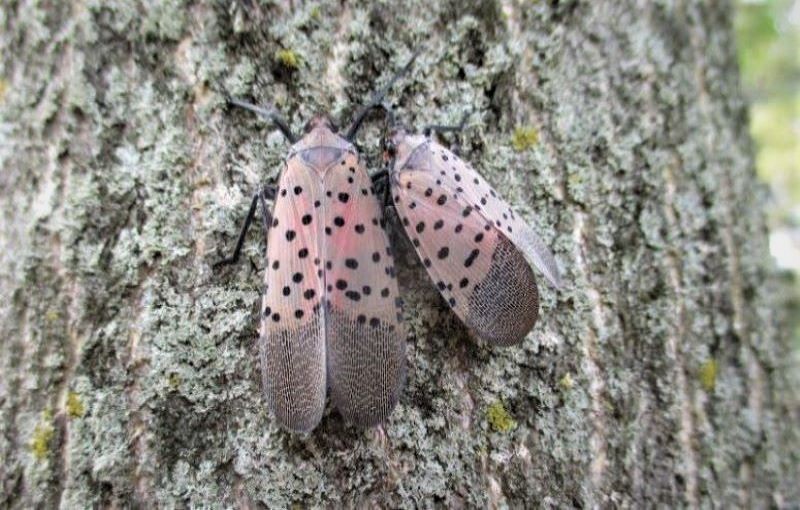
Adult female & male spotted lanternflies.

Adult female & male spotted lanternflies. Females will typically be 20% larger than males. They will pair-up & be side-by-side during the mating weeks of the fall. Sometimes an additional male or two will also be close by, “seeking the attention of the female.” (Photo Credit: Steven K. Rettke, Rutgers Coop. Ext.)


Some of the most common trees selected will include tree-of-heaven, red maple, black walnut, willow, birch, & grapes. Eggs Masses can potentially begin to be laid in mid-September, but the majority of adult females will not start egg-laying until the end of the month & will continue into the month of November. The majority of the egg masses are laid during October. With large deciduous trees, between 85-90% of eggs will be found above 10 feet off of the ground. Typically, they are laid in clusters underneath larger scaffold branches & at branch collars. Each female will usually lay two egg masses that contain 30-50 eggs each. Most adults will be killed with the onset of colder temperatures in late November. The NJ winters are rarely cold enough to kill the overwintering eggs.
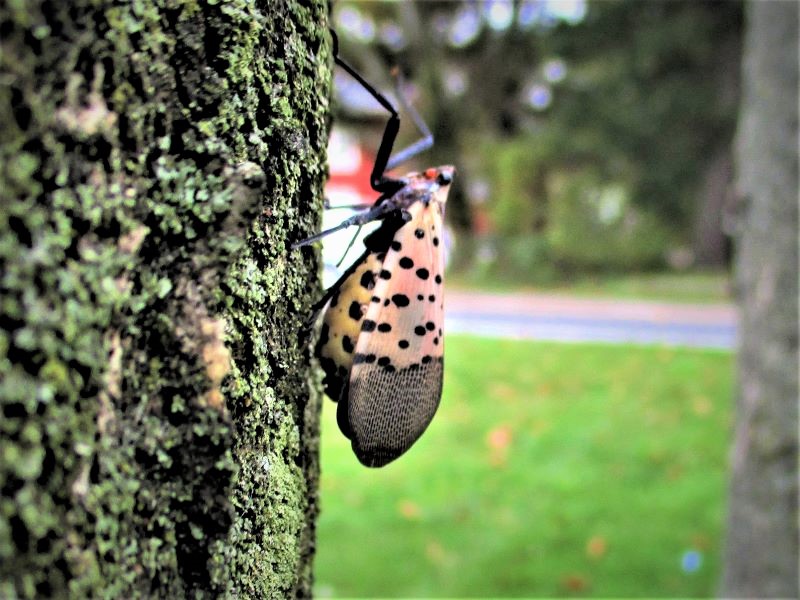
Spotted lanternfly gravid female. The enlarged yellow-colored abdomen indicates this female will soon begin to lay egg masses. (Photo Credit: Steven K. Rettke, Rutgers Coop. Ext.)
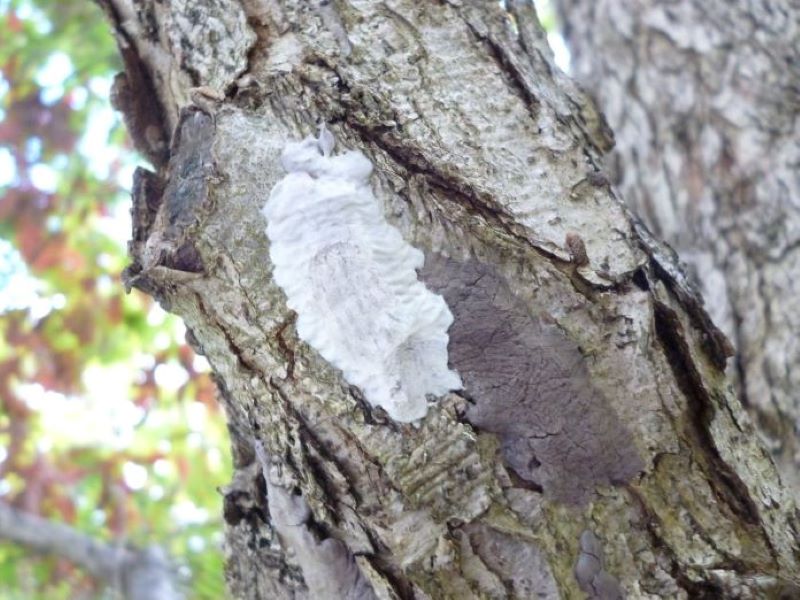
Spotted lanternfly egg masses

Spotted lanternfly egg masses. The white colored egg mass is only a few hours old. After less than a day the egg mass will turn a darker gray color & blend in with the bark of the tree. The masses contains 30-50 eggs each. (Photo Credit: Steven K. Rettke, Rutgers Coop. Ext.)

 

[Read more…]

Nursery Pest and Disease Update 6/15/2023

In this edition:

  • Insects:
    • MORE Scale crawlers emerging
    • Borers
    • Beetles
  • Diseases:
    • Oomycete root diseases (Phytophthora, Pythium, Phytopythium)
    • Leaf spots / foliage diseases
    • Boxwood Blight – reminder
    • Virus observations
  • Nutrient Management 
    • Managing Soluble Salts by monitoring EC
    • Plant Tissue analysis
  • Plant Spotlight:
    • American Holly (Ilex opaca)
  • Cumberland Nursery / NJNLA – Twilight: tonight (6/15) for NURSERYMEN ONLY (contact twaller@njaes.rutgers.edu or 856-451-2800 Ext. 1. for details)

Please click “read more” below to get updates on pests, diseases, and other important resources for the week of 6/15/2023.

[Read more…]

Nursery Pest and Disease Update 5/15/2023

In this edition:

  • Insects:
    • Scale crawler emergence
    • Borer insects
    • Upcoming problem pests / Redheaded flea beetle / SLF / Pest Scouting Guides
  • Diseases:
    • Leaf spot / foliage disease management
    • Fire blight on Rosaceous hosts
    • Canker fungi
    • Boxwood blight
    • Oomycete root diseases (Phytophthora, Pythium, Phytopythium)
  • Plant Spotlight:
    • NJ native azalea species

Please click “read more” below to get updates on pests, diseases, and other important resources for the week of 5/15/2023.

[Read more…]

Nursery Pest Update 4/25 – 5/5/2023

Please note: The Rutgers Nursery and Green Industry Working Group is working to deliver regular pest and disease updates throughout the season. These will be in addition to important alerts, critical topics, and pesticide credit opportunities. This tool is made for you, the commercial agriculture business, so please let us know if there are particular topics you would like to see included in the regular update.

Email:  twaller@njaes.rutgers.edu Phone: 856-451-2800 Ext. 1.

Insect Pests

Projected GDD50 accumulation as of 4/25/2023 (these change throughout the season!)
Region Location 25-Apr 1-May 1-Jun 1-Jul 1-Aug
Southern Upper Deerfield (NJ50) 251 281 682 1370 2218
Central Howell / Freehold (NJ10) 188 207 537 1160 1957
Northern High Point (NJ59) 142 143 371 864 1507
Forecast: 7-month NMME based seasonal climate forecast (USPEST.ORG)

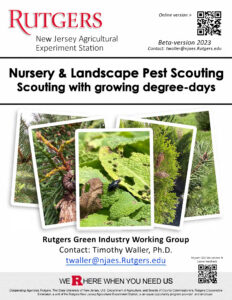
Please download and print the Rutgers Nursery and Landscape Pest Scouting Guide  or  Conifer and Christmas Tree Pest Scouting Guide and refer to this post “Obtaining your local growing degree-days (GDD)” for additional information.  (See pest scouting guides for complete list of references) 

Please SHARE what you SEE!! If you see a pest, disease, otherwise interesting or troublesome issue please report it to the Working Group by following the QR Code on the front of the Pest Scouting Guides or by filling out this reporting form.

Please continue reading for much more detailed and important information!

[Read more…]

Organic Grower Advisory 3/7 Registration Open

The Rutgers Organic Grower Advisory meeting will be held on March 7th. This meeting has served to increase communication between commercial farms using organic practices and Rutgers Cooperative Extension agricultural agents and specialists. This year the meeting will be held both in-person and online. We have a AV system that will allow for better sound quality for all participants. Please see details below, and use the Qualtrics link to register if you plan to attend.

March 7th 10:00 – 2:00
Rutgers Cooperative Extension of Mercer County
1440 Parkside Avenue, Ewing NJ 08638
OR Online via Zoom

In-person attendees will have a pizza lunch option at a cost of $5.00 per person, payable at the door.

Registration deadline is March 3rd, register here!

Examples of hot topics for discussion from the 2021 Organic Grower Advisory meeting are:
• Weed control updates
• Organic animal feed
• Allium leaf miner
• Spotted lanternfly
• Organic sweet corn
• Disease control
• Organic certifications

SLF: 2022 Management Recommendations in Vineyards

by Katarzyna Madalinska and Anne L. Nielsen

Adult SLF are moving into vineyards from the surrounding landscape. The number of SLF on each vine varies greatly within each vineyard and locations in the state. In most vineyards in NJ and PA there is a strong border effect with numbers highest along the outside rows. However, the orientation and shape of your vineyard influences border effects. SLF are actively feeding on grapevines and will continue to feed for 1-2 months. Most SLF are in the upper canopy and as the grapes start to store carbohydrates for the winter, SLF will move down the vine, eventually feeding at the base of the vine. Research suggests that feeding by adult SLF may harm primary bud formation the following season and reduce winter hardiness. There is not a specific treatment threshold, but a good rule of thumb is 10 SLF per vine. Movement into the vineyards will continue for several weeks so multiple insecticide applications may be needed.

Treatment at this time of year is of course complicated by pre-harvest intervals (PHI) for each insecticide and grape variety. It is important to remember that SLF will feed on vines post-harvest. There are several effective insecticides available with pre-harvest intervals and residual activity (Table 1). When treating vines pre-harvest, dead SLF are commonly observed in the clusters. Post-harvest, insecticides such as Danitol or Brigade/Bifenture/bifenthrin have the longest residual activity and are expected to reduce feeding.

There are several reasons to manage adult SLF in September and October during peak movement.

  1. Adults feed on the canes, cordon, and trunk of grape vines. Excessive feeding has been shown to lower winter hardiness by >1.5°C.
  2. SLF females lay egg masses in October. Killing females prior to egg laying will decrease population growth the following year.

Table 1. Effectiveness of Insecticides Against Spotted Lanternfly Adults. Modified recommendations from Leach et al. Crop Protection 2019 v. 24  DOI:10.1016/j.cropro.2019.05.027

Trade name Active ingredient SLF Activity Rate per acre Seasonal Allowance Residual Activity PHI

(days)

REI

(hrs)

Labeled for SLF?
Mustang Maxx 0.8EC cypermethrin Good 4 oz 24 oz <3 1 12 Yes, 2(ee)
Scorpion 35SL dinotefuran Excellent 5 oz. 20.9 oz <7 1 12 Yes, 2(ee)
Actara 25WDG thiamethoxam Excellent 3.5 oz 7.0 oz <14 5 12 Yes, 2(ee)
Carbaryl 4L carbaryl Excellent 1-2 qt 10 qt 7 7 12 No
Avaunt 30DG indoxicarb Fair 6 oz 12 oz 7 7 12 Yes, 2(ee)
Danitol 2.4EC fenpropathrin Excellent 16-21.33 oz 42.66 oz >26 21 24 Yes, 2(ee)
Brigade 2EC bifenthrin Excellent 3.2-6.4 oz. 6.4 oz 21 30 12 Yes, 2(ee)


There are several reasons to manage adult SLF in September and October during peak movement.

  1. Adults feed on the canes, cordon, and trunk of grape vines. Excessive feeding has been shown to lower winter hardiness by >1.5°C.
  2. SLF females lay egg masses in October. Killing females prior to egg laying will decrease population growth the following year.