Peach:
Oriental Fruit Moth: We are between generations 1 and 2, with the first insecticide applications due in southern counties by the end of the week, and in northern counties by the end of the following week. [Read more…]
Rutgers Cooperative Extension
Seasonal updates on diseases, insects, weeds impacting small fruit (blueberry, cranberry, and wine grape). Fruit Pest Alerts are also available via this category feed.
Subscription is through the general Fruit feed available via EMAIL and RSS.
Peach:
Oriental Fruit Moth: We are between generations 1 and 2, with the first insecticide applications due in southern counties by the end of the week, and in northern counties by the end of the following week. [Read more…]
On June 3, 2020, the U.S. Court of Appeals for the Ninth Circuit issued a ruling that vacates current U.S. registrations of of three dicamba herbicides, XtendiMax (Bayer), Engenia (BASF) and FeXapan (Corteva). The Court ruled in favor of a petition challenging the EPA’s 2018 registration decision. The ruling comes after a group of environmental organizations filed a petition with the Court challenging the U.S. Environmental Protection Agency’s . Other dicamba-containing products are not concerned by this ruling.
The subsequent action by the EPA provides, among other things, that “growers and commercial applicators may use existing stocks that were in their possession on June 3, 2020, the effective date of the Court decision. Such use must be consistent with the product’s previously-approved label, and may not continue after July 31, 2020.”
Click here for the EPA’s full order – see page 11 for key details.
The EPA’s order addresses the use, sale, and distribution of existing stocks of low-volatility dicamba products impacted by the Court’s ruling.
Peach:
Oriental Fruit Moth: We are between generations 1 and 2, with the first insecticide applications due in southern counties in 10 days to 2 weeks. Where trap captures are below 8 moths per trap and no injury is present, then stretch insecticides to get as close to the model timing as possible. Where trap counts continue above 8 males per trap, then the population is too high to take this approach. This is the case in several orchards in northern counties. [Read more…]
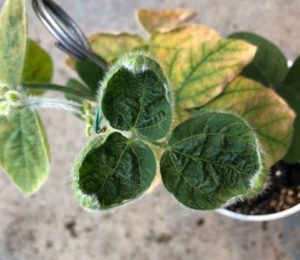
Figure 1. Non-tolerant soybean foliage when exposed to a sublethal rate of dicamba 2 weeks after treatment. Leaves are cupped with the bottom edges curved towards the top surface of the leaves.
Glyphosate-tolerant soybeans were first commercialized in 1996 in the United States. By 2006, almost 9 out of every 10 soybean acres were planted with glyphosate-tolerant cultivars. However, reliance on glyphosate alone for soybean weed control stimulates the selection of weed biotypes naturally resistant to glyphosate. By 2019, there were 43 weed species known to be resistant to glyphosate, including species such as Palmer amaranth or waterhemp that can easily out-compete soybean and reduce yield by more than 50% if left uncontrolled.
One way to control glyphosate-resistant weeds is to treat them with herbicides other than glyphosate, such as dicamba. Dicamba is a synthetic auxin herbicide that has been used to control broadleaf weeds for over 50 years. Chemical and seed companies have recently developed new soybean varieties that are tolerant to dicamba and that started to be commercialized in 2016. With the development of genetically modified dicamba-tolerant soybeans, dicamba may be sprayed more frequently during the growing season. Additionally, dicamba is regularly applied in corn, for right-of-way applications, and in the early fall for perennial weeds control.
Dicamba can injure sensitive broadleaf plants through tank incorrectly rinsed after spraying dicamba, particle drift during the dicamba application, and vaporization after dicamba has been applied . Particle drift refers to the herbicide being carried off-target by the wind during the application. Wind speed, particle droplet size, nozzle type, carrier volume, application method, and application speed will affect the extent of particle drift. Vaporization, on the other hand, occurs when the herbicide evaporates from the target plant and these vapors travel off-target. For more information on herbicide drift, please refer to the following PPA post 10-best-management-practices-to-avoid-herbicide-drift.
If some of the dicamba sprayed onto a soybean field moves off-target and lands on a nearby field planted with a sensitive crop, the results can be very harmful. This injury could potentially cause aesthetic damage as well as reduce yield reduction. Potential for yield loss is influenced by amount of dicamba as well as when the injury occurs. Small volumes of dicamba products can cause leaf cupping and deformation, plant twisting, and in extreme cases, plant death of sensitive crops.
Greenhouse studies conducted at Rutgers University in 2019-2020 screened economically important vegetable crops from the mid-Atlantic region for sensitivity to sublethal doses of dicamba. These micro-rates of dicamba simulated varying levels of drift conditions in the field. To put the rates into perspective, the highest dose in this study was equivalent to about one drop of product per quart of water. The goals of this study are to develop recommendations that can help growers design their planting strategies around dicamba-treated fields as well as to use this data to help refine recommendations to maximize protection of sensitive crops.
The most sensitive crops in this study were the leguminous crops, including non-tolerant soybean, lima bean, and snap bean, as well as solanaceous crops, such as tomato, eggplant and pepper. These crops demonstrated severe injury.
Soybean injury is characterized by the underside edges of the leaves curling upward toward the top surface of the leaves (Figure 1). Lima bean and snap bean have similar injury symptoms, both exhibiting injury in several ways. Higher rates caused some leaves to not emerge at all, while lower rates caused leaf cupping injury that caused the top edges of the leaves to curve downward towards the ground. Other symptoms included a bubble-like texture on the top sides of the leaves, as well as leaf crinkling.
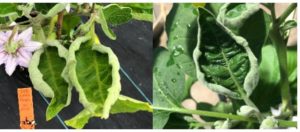
Figure 2. Eggplant 2 weeks after treatment. The undersides of affected leaves are curled upward toward the top surfaces of the leaves.
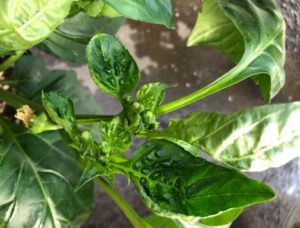
Figure 3. Bell pepper 2 weeks after treatment. The leaves are cupped with a bubble-like texture on the top surface.
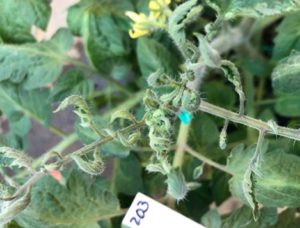
Figure 4. Tomato 2 weeks after treatment. Leaflets are curled, reduced in size, and deformed.
For eggplant and bell pepper, injury was expressed as the undersides of the leaves curling upward toward the top surface (Figures 2 and 3). Additionally, leaf crinkling is seen in bell pepper foliage (Figure 3). Finally, tomato plants express dicamba injury with leaf twisting, cupping, stunting, and crinkling. At higher rates, these leaflets will be extremely stunted and deformed (Figure 4). Lower rates will show slight cupping, leaf crinkling and a change in leaf surface texture. Among the most tolerant crops from this study were basil, pumpkin, lettuce, and kale. These plants incurred the lowest amount of damage. The moderately sensitive crops included watermelon, cucumber, and summer squash. Watermelon foliage exhibits injury differently than many of the other crops tested in the study. Rather than leaf cupping, watermelon leaf texture appears shriveled and more deeply lobed with small bubbles on the top leaf surface (Figure 5).
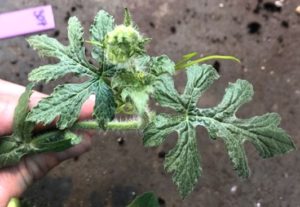
Figure 5. Watermelon 2 weeks after treatment. Leaves are deeply lobed with a puckering, bubble-like texture.
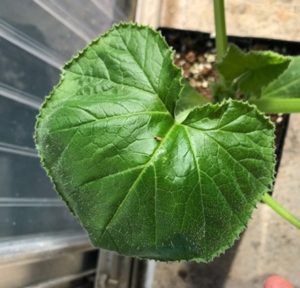
Figure 6. Summer squash 2 weeks after treatment. Leaf edges are curved downward toward the ground.
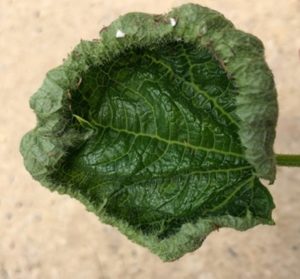
Figure 7. Cucumber 2 weeks after treatment. Leaf is cupped and the bottom edges of the leaf are curved upward towards the top leaf surface.
Summer squash and cucumber, however, show leaf cupping when injured. In summer squash, the top edges of the leaf curve downward towards the ground (Figure 6). The foliage of cucumber tends to curve the bottom edges upward toward the top surface of the leaf, although both directions of cupping were observed. (Figure 7).
This summer, Rutgers researchers will select a few of these crops to take yield in a field-based dicamba drift study that tests different drift rates and application timings. Although this study gives some preliminary information, more detailed studies are necessary to confirm these findings. However, in the meantime, this greenhouse work gives us a brief snapshot of which species to be most concerned with when working near dicamba treated fields and provides help with field identification of these injury symptoms.
If you suspect that dicamba drift may have injured your crops, please contact you local county extension agent or Rutgers weed science specialist (Dr. Thierry Besançon) as soon as possible, and take detailed pictures of the observed damages.
Management of Spotted Lanternfly Nymphs in New Jersey Vineyards
Megan Muehlbauer and Anne L. Nielsen
Vineyards in Salem and Hunterdon Counties in New Jersey are beginning to report spotted lanternfly (SLF) nymph sightings (Figure 1). These small black nymphs have white dots on their abdomens and will hop if disturbed. Although it is concerning to find them in large numbers in vineyards, we are not recommending that grape growers spray insecticides at the nymph stage.
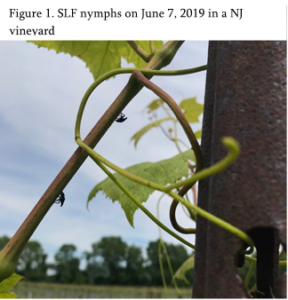
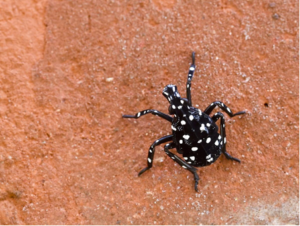
(Photo Credit: https://www.pottsmerc.com)
Why? Thus far, there has been no definitive research showing that young SLF nymphs cause damage to grapes. If SLF is feeding on grapes during the 1st and 2nd instar (nymph) stages, they are likely feeding on the fleshly new growth, not on the canes or cordon as the adults do.
However, these nymphs are also likely representing a very low number of the total population of SLF in and around the vineyard they are being seen at, because research has also shown that nymphs feed on multiple host plants. To further elucidate details of SLF life cycle, and feeding habits, we are surveying to determine which life stages are found in commercial vineyards throughout the growing season.
As you make a decision on whether to spray the nymphs in your vineyard, It is important to keep these two points in mind.
1) Do not overuse pyrethroids in a vineyard as they can flare mealybug populations which vector leaf roll virus.
2) Save highly effective insecticides with good residual (Brigade, Actara, Scorpion, Carbaryl, and Mustang Maxx) for use against the adults in late summer through harvest.
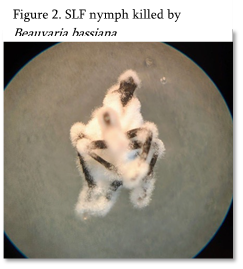
If you want a material to apply now while the nymphs are just becoming active in the vineyard, the biological pesticides, BoteGHA (1-2 qt/acre) or BotaniGard 22 WP (0.5- 2 lbs/acre), are effective against the nymphs and will minimally impact other pests. These products have Beauvaria bassiana, a beneficial fungus that attacks insects and has good efficacy against SLF nymphs and a 4 hour REI. Keep in mind when using B. bassiana materials, they take a few days to kill SLF and the fungal growth will turn the nymphs into fuzzy white cotton balls (Fig 2). As a biological material they work best under humid conditions. Recommendations tank mix compatibility for BoteGHA can be found here
There are two other pests in NJ vineyards, grape berry moth and Japanese beetles, that commonly require management in the early summer. While there is no action threshold for SLF nymphs in the vineyard, management can be combined with existing pest management programs. Grape berry moth timing is approaching and we recommend using an insecticide that is effective against both SLF nymphs and grape berry moth if you have SLF nymphs in your vineyard (Table 1).
Just remember that the degree-day timing for grape berry moth is based on using growth regulators or diamide chemistries and application of a broad-spectrum material would be applied 1-2 days after the predicted timing. Japanese beetles typically occur in late June/July and again, there are insecticide materials that are effective against both SLF nymphs and Japanese beetle (Table 1).
Table 1. Insecticide efficacy against SLF nymphs and key grape pests
| Rating of Insecticide Efficacy* | |||
| Insecticide | SLF Nymph ** | Grape Berry Moth | Japanese Beetle |
| Avaunt 30SG | E | G | G |
| Brigade 10WSB | E | E | – |
| Entrust 2SC | F | G | – |
| Imidan 70WP | E | G | – |
| Carbaryl | E | G | G |
| Actara 25 WG | E | – | G |
*E – Excellent; G – Good; F – Fair; ‘-‘ not rated
**H Leach, DJ Biddinger, G Krawczyk, E Smyers, JM Urban 2019 “Evaluation of insecticides for control of the spotted lanternfly, Lycorma delicatula, (Hemiptera: Fulgoridae), a new pest of fruit in the Northeastern U.S.” Crop Protection 124:104833
The recommendations for spotted lanternfly control are centered around the adult stage which are considered the primary damaging stage. If adults are found in your vineyard they likely warrant management. In 2019 we saw SLF move into Northern NJ vineyards in large numbers at the end of September. It is important to note that they do not discriminate between vines that have been harvested or not. The only available threshold for SLF in grapes is 10 adults/vine, however this is quickly exceeded in some vineyards. We are recommending that growers apply a border spray targeting the vines on the borders or the first few panels if rows are perpendicular around your vineyard, with a focus on areas near hedgerows as it has been shown that those are the areas that SLF if most likely to congregate in at higher densities. Further information on adult SLF control, recommended insecticides and rates will be in a forthcoming Plant and Pest Advisory Post.
The last springtime Rutgers Cooperative Extension, “Ask the Ag Agent” weekly 1-hour sessions for farmers will take place tonight 5/27/20 at 7:00PM. We realize the season is well underway and most farmers are out in the fields. With the regular sessions ending for now, please reach out to your local County Agricultural Agent at anytime for assistance. We are open for business, and as times have changed we have changed with them.
This last online webinar/call in event will begin promptly at 7:00PM with an open forum to discuss ag-related questions about production, marketing, regulations and any other topics farmers wish to discuss.
Thank you to all who joined each week over the past two months and thank you to the Ag Agents and Extension Specialists who have participated. Bill Bamka, Stephen Komar, Meredith Melendez and Michelle Infante-Casella created and hosted this forum one week after the State of NJ went into lockdown and it has been quite the journey. Please join us for one last session for spring. All are welcome.
To access via WebEx on a computer go to https://go.rutgers.edu/rc9n3kxt
Join by phone
+1-650-429-3300 USA Toll
Access code: 799 743 872 # and then # again to join

