Scale crawlers, updated 2026 scouting guide, IPM webinars, Box tree moth

Educational Resource Update: 

Stay informed

  • Sign up for the 2026 – Rutgers Ornamental IPM Program – click here to sign up
  • Program is free, but registration is required – Registration includes:
    • Site visit to your ornamental nursery/farm from Rutgers agents
    • Delivered printed IPM resources (Guides, factsheets, bulletins)
    • Free pheromone & sticky trap kit + guidance on setup/monitoring (for commercial nursery/greenhouse and Christmas tree farms)
    • Access to live bi-weekly webinars (Zoom)
    • (Next session – TUESDAY 6/9 @ 12PM) – Guest Speaker Dr. Richard Cowles – Connecticut Ag Exp. Station – Scale Management 
    • Every Second and Fourth, Tuesday, April through September
  • Visit the Rutgers Ornamental IPM Website Rutgers Ornamental IPM Website (click here) for updated webinar videos.

Scale crawler emergence predictions throughout NJ. 

Now is an excellent time to be scouting for crawler emergence using double sided (or doubled over – sticky side out) tape. Targeting scale insects is most successful during their crawler periods, however this should be visually confirmed for greatest efficacy. For more information on installing this type of IPM trap and others please see – Setting up and deploying IPM traps – Tutorial Video 2026 (click here).

Common Name GDD RANGE Target Stage SOUTH – Upper Deerfield (NJ50) CENTRAL – Howell (NJ10) NORTH – Randolph NJ (AU137)
MIN MAX START STOP START STOP START STOP
Cottony camellia / taxus scale (soft) 520 Crawlers (only) 17-May 20-May 18-May
Euonymus scale 533 820 Crawlers (Gen 1) 18-May 3-Jun 21-May 8-Jun 18-May 7-Jun
*Cryptomeria scale 600 800 Crawlers (Gen 1) 20-May 2-Jun 27-May 7-Jun 24-May 6-Jun
*Sprucebud scale (soft) 700 1150 Crawlers (only) 27-May 18-Jun 2-Jun 24-Jun 30-May 25-Jun
White prunicola scale 707 1151 Crawlers (Gen 1) 28-May 18-Jun 2-Jun 24-Jun 30-May 25-Jun
*Juniper scale 707 1260 Crawlers (Gen 1) 28-May 18-Jun 2-Jun 24-Jun 30-May 25-Jun
Calico scale (soft) 714 Crawlers (only) 28-May 2-Jun 31-May
Striped pine scale (soft) 750 800 Crawlers (only) 30-May 2-Jun 4-Jun 7-Jun 2-Jun 6-Jun
Oak lecanium scale (soft) 789 Crawlers (only) 1-Jun 6-Jun 5-Jun
Cottony maple leaf scale (soft) 802 1265 Crawlers (only) 2-Jun 23-Jun 7-Jun 29-Jun 6-Jun 30-Jun
Cottony maple scale (soft) 802 1265 Crawlers (only) 2-Jun 23-Jun 7-Jun 29-Jun 6-Jun 30-Jun
Golden oak scale (Pit) 802 1266 Crawlers (only) 2-Jun 23-Jun 7-Jun 29-Jun 6-Jun 30-Jun
Japanese maple scale 829 Crawlers (Gen 1) 3-Jun 9-Jun 7-Jun
European elm scale (soft) 831 1388 Crawlers (only) 4-Jun 27-Jun 9-Jun 4-Jul 8-Jun 6-Jul
European fruit lecanium scale (soft) 932 1645 Crawlers (only) 9-Jun 7-Jul 14-Jun 14-Jul 14-Jun 17-Jul

*Conifer / Christmas Tree scales

Please visit the Rutgers Ornamental IPM Website – Pest and Disease Index (click here) for more detailed information on specific scale species management and pesticide considerations.

Box tree moth – stay vigilant looking for this pest

Box Tree Moth (Cydalima perspectalis) is alive and well in MD, DE, VA, WV, NY, OH, MI, MA. Please report this pest to twaller@njaes.rutgers.edu

If this pest does make its way into New Jersey, and quarantines are established, nurseries will be required to comply with a federal compliance agreement if shipping out of potential quarantine areas. Please review this document if boxwoods are an important crop for you. Compliance Agreement for Production Nurseries in BTM Regulated Nurseries (click here)
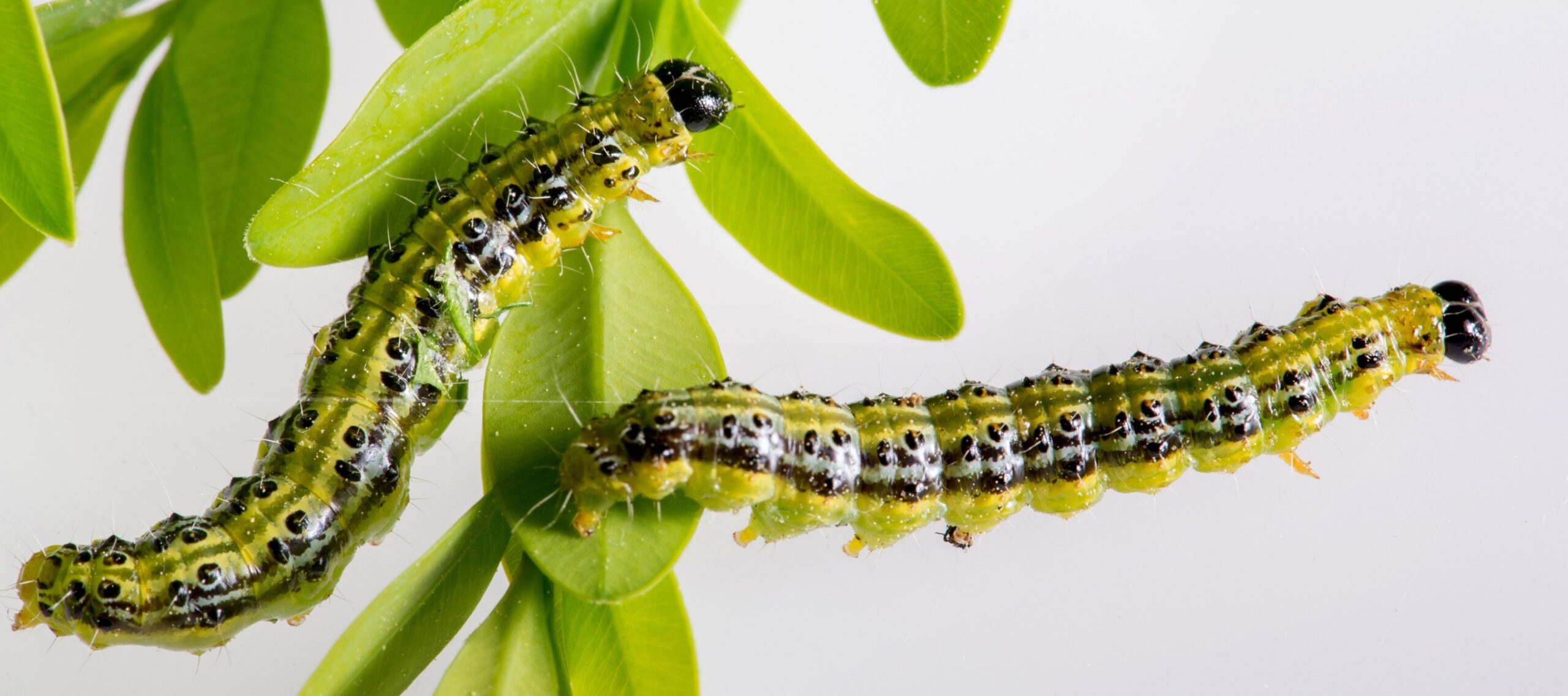
Box tree moth caterpillars. Photo credit: USDA.

Ornamental IPM 4/22 Recording Upload – Next session Tuesday 5/13

Sign up here for the NEW 2025 – Rutgers Ornamental IPM Program

Ornamental IPM – next session is Tuesday 5/13/25 


Click here for a PDF of April 22, 2025 webinar that can be printed and used as a field guide or similar

Click here for a VIDEO recording of April 22, 2025 webinar


5/13/25 sessions topics: 

Conifer Issues:

  • Pine needle scale
  • Cryptomeria scale
  • Elongate hemlock scale
  • Oystershell scale
  • Needle cast diseases
  • Red headed pine sawfly
  • Hemlock woolly adelgid
  • Phytophthora in conifers

Ornamental nursery:

  • Boxwood mites
  • Boxwood psyllid
  • Horned and gouty oak galls
  • Hawthorn lace bug
  • Pythium in nurseries

IPM monitoring:

  • Scale monitoring with double sided tape

2025 Registration includes:

The focus of this program is to provide timely updates on pest, disease, and weeds impacting commercial ornamental producers. The webinars will focus on the most important pests for a 2 week interval, will be recorded, and will be shared shortly thereafter with Spanish overdub (spoken word). The trap packages are in an effort to find grower led solutions for monitoring economically important pests throughout the multiple regions of New Jersey. Please consider joining this program for its inaugural year.

  • Site visit to your ornamental nursery/farm from Rutgers agents
  • Delivered printed IPM resources (Guides, factsheets, bulletins)
  • Free pheromone & sticky trap kit + guidance on setup/monitoring
  • Access to live bi-weekly webinars (Zoom)
  • Every Second and Fourth, Tuesday, April through September
  • Webinars will be recorded – posted later with Spanish overdub

This program is free, however registration is required.

click here to Register

(Next webinar Tu 4/22 at 12PM)

Frost Protection in Orchards – What Should You Monitor?

By Hemant Gohil and Megan Muehlbauer

The weather forecast for the next few days indicate subfreezing temperature in several parts of New Jersey. In fruit crops, such events during the flower bud development, can cause crop loss which could vary from minor loss of quality and quantity to a total crop loss. Recently, frost events seem to be occurring more frequently. These events have been driven by warmer spring temperatures pushing bud growth earlier, making blossoms more vulnerable to frost damage.

What to monitor before active frost protection?

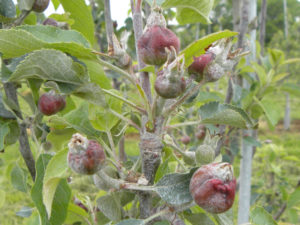
Frost damage occurs when plant tissues are exposed to subfreezing temperatures (Figure 1). However, it is the co-occurrence of other factors that determines the extent of the damage. All these factors should be monitored, and will assist in determining which frost protection method to employ and its duration.

Frost damage in apple

Figure 1. Frost damage in apple following the freeze event in 2010 in Pennsylvania (Photo by R. Crassweller).

Bud Stage: Regular monitoring of the bud development stage beginning at bud swell will help in determining the actual threat of frost damage. Critical temperatures have been researched and calculated for each bud development stage. For example, in an apple orchard, at 24°F, one can expect up to 90% crop loss at ‘first pink’ stage, but only marginal to zero percent loss at green tip stage at the same temperature. An example of the critical temperature for some of the most common pome and stone fruit crops In New Jersey is available at https://www.canr.msu.edu/news/critical_spring_temperatures_for_tree_fruit_bud_stages  Note that the critical temperature for damage at a particular bud stage may vary by 4 or 5⁰F depending on temperatures during the previous few days before the cold event.

Type of frost event: There are two types of frost:  Advective and Radiative frost.  Advective frost occurs when a large mass of cold dry air moves in from another region and replaces warmer air such as during a polar vortex. The rapid movement of air aids this, and there is generally an absence of an inversion layer, creating the potential for a prolonged event. Frost protection will generally be not effective during an advective frost.  Conversely, radiative or radiational frost occurs when there is a rapid loss of heat from the ground, usually with a cloudless open sky, dry air, little wind and the likely formation of an inversion layer. This frost is relatively manageable with frost protection methods.

Inversion Layer: A strong inversion layer can be a source of warmer air, and could have a substantial difference in temperature than that closer to the ground.  For this reason, inversions need to be closely monitored.

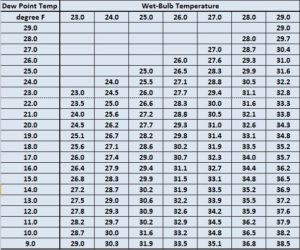
Table of wet bulb temp

Table 1. An example of determining wet bulb temp using ambient temp and dew point. Courtesy, Don Smith, Penn State University

Air Temperature: Frost can occur when the ambient temperature dips below freezing (32°F). The hourly rate of falling temperatures and the lowest forecasted temperature should also be monitored. However, temperature experienced by trees will not necessarily be the same as the reported ambient temperature.  To measure the temperature of the flower buds, farmers must take into account the cooling effect of evaporation of the moisture on the trees which is referred to as the wet-bulb temperature. Generally, the wet bulb temperature will be a few degrees lower than the dry bulb temperature except at the 100% RH. Table 1 provides an example of determining wet bulb temperature using the ambient temperature and the dew point. Hand-held and digital psychrometers can be used in the field to determine the wet bulb temperature.

Recently, Knox et al. (2017) at the University of Georgia showed that wet bulb temperature can be simply derived by ‘subtracting one third the difference between ambient temperature and dew point, from the ambient temperature.’ Modern frost alarms measure wet bulb temperature, which can directly transmit real time data to the user’s mobile phone or computer.

Dew point: Dew point is commonly reported as the atmospheric temperature below which water droplets begin to condense, forming dew. At low temperatures, the moisture in the air transitions from a gas to a liquid, as air temperature reaches the dew point. A higher dew point is associated with relatively slow drops in temperature, and vice versa. A lower dew point also generally means surface moisture will evaporate quicker.

Cloud coverage:  Clear skies normally result in lower low temperatures than when there is cloud cover trapping radiant energy from the ground.

Wind Speed: Wind will determine the rate of loss of thermal energy. Almost all Frost Protection methods will have reduced efficiency at wind speeds above 10 mph, and are therefore not recommended when winds are above 10 mph.

Effective Frost Protection requires weather stations and sensors for each of the fields you are seeking to monitor and protect.  Data from a nearby weather stations may not always be reliable.  On-farm weather stations are the most accurate source of weather data, and should be linked with a frost alarm.

Literature Cited:

Knox JA, Nevius DS, and Knox PN. 2017. Two Simple and Accurate Approximations for Wet-bulb Temperature in Moist Conditions with Forecasting Applications. Bulletin of American Meteorological Society. Sept Issue: 1897-1906. https://journals.ametsoc.org/doi/pdf/10.1175/BAMS-D-16-0246.1

Take home message: 

  • Monitor both your temperature and relative humidity to determine the wet bulb temperature. Remember nighttime temperatures often dip BELOW predicted temperatures, do not GAMBLE.
  • Determine what bud stage your tree fruit are at.
  • If you suspect you are at risk of a nighttime frost event, monitor the weather report for the likelihood of an inversion layer.
  • hink you have a potential for a frost event in your orchard, utilize appropriate frost protection measures.