Box tree moth Quarantine Expanded; Now includes Cumberland, Atlantic, and Cape May Counties

UPDATE: Emergency BTM Compliance Agreement Meeting with NJDA

– Seabrook Firehouse, 3PM – Monday 31st

(Free – just show up if within a quarantined county)

90 Foster Road, Bridgeton (Upper Deerfield Township), NJ 08302


This PPA post has no legal bearing. 

This is a long but extremely important post about the expansion of the Box Tree Moth (BTM) Quarantine into the major boxwood production counties of New Jersey. This impacts everyone in NJ – Please read this message.

What is box tree moth:

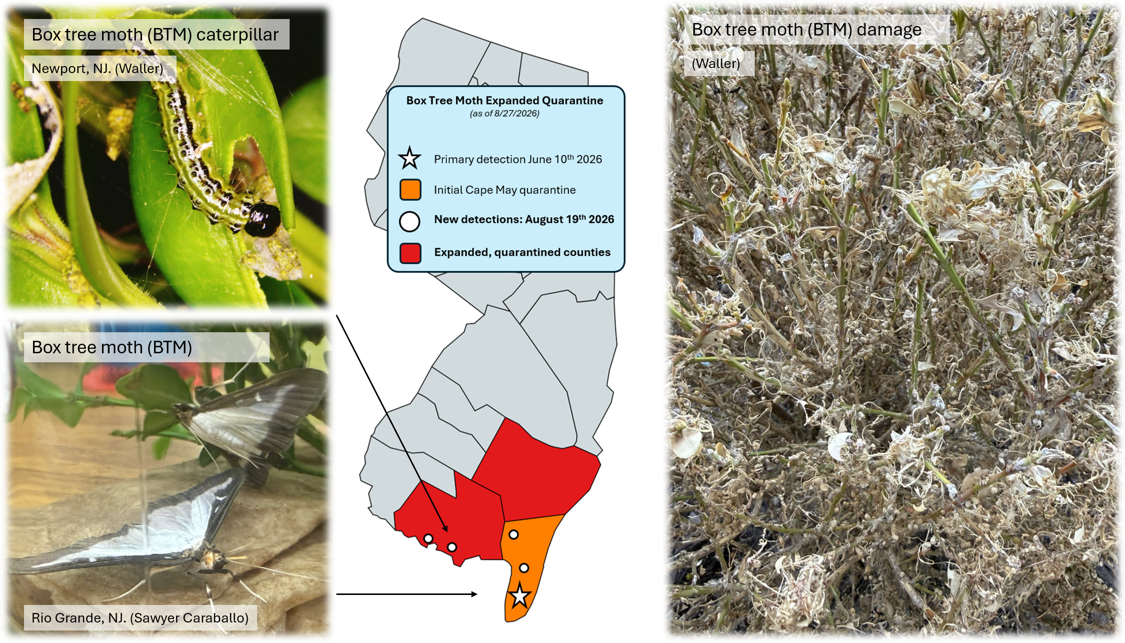
Box Tree Moth (Cydalima perspectalis) is an invasive insect pest native to East Asia, as its larvae are voracious feeders that can completely defoliate and kill Boxwood (Buxus species) plants. The aggressive, destructive nature of the Box Tree Moth’s caterpillar life stage makes it essential to quickly take action as soon as damage is detected as defoliation can occur within 10 days. The risk of human movement of infested nursery stock, plant material, and debris will rapidly expand the pest’s range. The nursery and landscape industries that rely on Boxwood plants generate more than $9.8 million in economic activity annually within New Jersey and an estimated $140 million annually throughout the United States, according to data provided by the United States Department of Agriculture (“USDA”) National Agricultural Statistics Service. The New Jersey Department of Agriculture (“Department”) has determined the Box Tree Moth to be an injurious insect that is dangerous and destructive to the horticultural and agricultural industries, residential landscapes, and heritage plantings of Boxwood plants throughout the State.

On June 10, 2026, the USDA Animal and Plant Health Inspection Service (USDAAPHIS) confirmed that Box Tree Moth was detected on residential plantings in Middle Township, Cape May County, New Jersey, and this was the first confirmed detection of this pest in New Jersey.

On August 21, 2026, the Department and USDA staff further detected Box Tree Moth on residential plantings in Commercial Township, Cumberland County, New Jersey; and the detection of Box Tree Moth in Cumberland County also threatens the nearby area of Atlantic County. USDA-APHIS has previously detected Box Tree Moth in Massachusetts, New York, Pennsylvania, Delaware, Maryland, Virginia, West Virginia, Kentucky, Ohio, and Michigan, and every one of these states established intrastate quarantines that restrict the movement of host plants, plant parts, and any articles capable of harboring life stages of the Box Tree Moth.

All life stages of box tree moth are active in southern NJ as of today, 8/27/2026.

What is happening: Expansion of quarantine into Cumberland and Atlantic Counties

Box tree moth quarantine expanded to Cumberland and Atlantic counties.
Important information from: Box Tree Moth Quarantine Order for Cape May, Cumberland and Atlantic Counties New Jersey State Board of Agriculture,  Approved by State Board of Agriculture on August 26, 2026 – PLEASE READ THE DOCUMENT – This is a ‘Stop Shipment’ level event in those counties. 

C.  Quarantine area

  1. By order of the State Board of Agriculture pursuant to N.J.S.A. 4:1-21.5 and N.J.S.A. 4:7, in order to control the spread of Box Tree Moth the following Counties are hereby quarantined:
  2. Cape May County
  3. Cumberland County
  4. Atlantic County
  5. This Order shall not be construed to limit the Department’s authority to quarantine additional counties, as necessary, consistent with its existing statutory authorities.”

&

“II. THEREFORE BE IT FURTHER RESOLVED, that the following requirements and restrictions concerning the movement of Boxwood plants, debris, and other regulated articles shall take effect:

Restrictions on movement of plant material; Disposal

  1. No business may move any regulated articles listed in this Order outside the quarantine area designated in this Order without a signed Compliance Agreement and certification issued by the Department. 
  2. A private individual or non-business entity seeking to move any regulated articles listed in this Order outside the quarantine area designated in this Order (Cape May, Cumberland, and Atlantic Counties) must first receive prior written authorization from the Department.
  3. Infested or dead Regulated articles must be disposed of within the designated quarantined area (Cape May, Cumberland, Atlantic Counties). This requirement is applicable to all businesses, including those with a signed Compliance Agreement and certification.

Regulated articles

  1. Regulated articles are as follows:
  2. Boxwood plants (Buxus species).
  3. Boxwood plant debris or dead boxwood plant material;
  4. The Box Tree Moths at any life stage; and d. Any means of conveyance for the Boxwood plant including, but not limited to: soil, pots, containers, and truck beds, or when it is determined by the Department that the regulated article presents a risk of spreading Box Tree Moth.”

&

F.  Mandatory Compliance Agreement for businesses; certification

  1. No regulated articles may be moved out of the designated quarantine area of Cape May, Cumberland and Atlantic Counties, unless in compliance with the requirements set forth in this section.
  2. Businesses moving regulated articles out of the quarantine area are required to sign a Compliance Agreement and receive a certification issued by the Department prior to moving the regulated articles.
  3. The technical requirements, specifications, and standards for compliance with this Order are set forth in the Compliance Agreement labeled “BTM Compliance Agreement” at https://www.nj.gov/agriculture/divisions/pi/prog/BoxtreeMoth.shtml (www.nj.gov/agriculture/divisions/pi/pdf/2026_BTM%20NJ%20Comp%20Agmt.pdf)
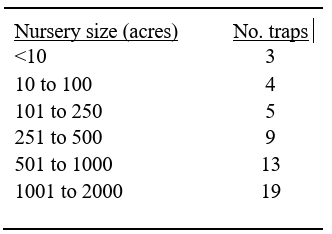
  4. This includes technical requirements for the proper use of traps, pre-inspections of plant materials, employee training requirements, recordkeeping requirements, and the proper use of insecticides.
  5. The “Pest Management Plan“” required by the Compliance Agreement shall be considered satisfied by the execution of the compliance agreement itself.
  6. The “Certification” referenced in the Compliance Agreement is a general-use certificate authorizing a business to move Boxwood plants and other regulated articles out of the quarantine area in compliance with these rules. The Department does not require individual certificates for individual movements of regulated articles by businesses.”

If you operate in Cumberland, Cape May, & Atlantic Counties: 

  1. Read and understand:
  2. Visit the NJ Department of Agriculture Box Tree Moth (BTM) webpage
  3. Start the process of obtaining the mandatory traps, pheromone lures, and pesticide strips.
    1. From Compliance Agreement – 
    2. Below is from the NJDA BTM website (linked above)
      1. Alpha Scents, Inc:
      2. Evergreen Growers Supply
      3. ChemTica
      4. Great Lakes IPM
      5. Trece
  4. Note: If you have already been utilizing the monitoring traps – please contact your local nursery inspector to expedite the Compliance Agreement process and ability to resume shipping. 
  5. Seek Compliance Agreement training:
    1.  Contact your local NJDA Nursery inspector to establish training appointments.
    2. Attend the Rutgers/NJDA/NJNLA BTM Training session on Sept. 17th – see details below. This is open to operators both within and outside of the quarantined counties and will count as the mandatory first step in Compliance Agreement training, regardless of your counties quarantine status.
  6. Understand the mandatory pesticides as described in the Compliance AgreementSee Appendix 1. Insecticides for BTM control

Steps to take if you see this pest: 

  1. Report BTM observations
  2. THEN Eradication:
    • Treat infested plants with Compliance Agreement cited materials (within Compliance Agreement – Appendix 1). Follow all label requirements, especially REIs. The label is the law.
    • Only after treatment efficacy has been confirmed and REI completed can you consider moving to the next step.
  3. (If applicable) Removal:
    • Once REI is complete, and the pesticide treatments are lethal to BTM, remove infested boxwoods. Boxwoods should be double bagged and taken to an in-county municipal dump.

Please educate yourself about this pest – Resources

If you see any significant amount of caterpillars in a boxwood plant it is EXTREMELY likely to be Box Tree Moth (BTM)

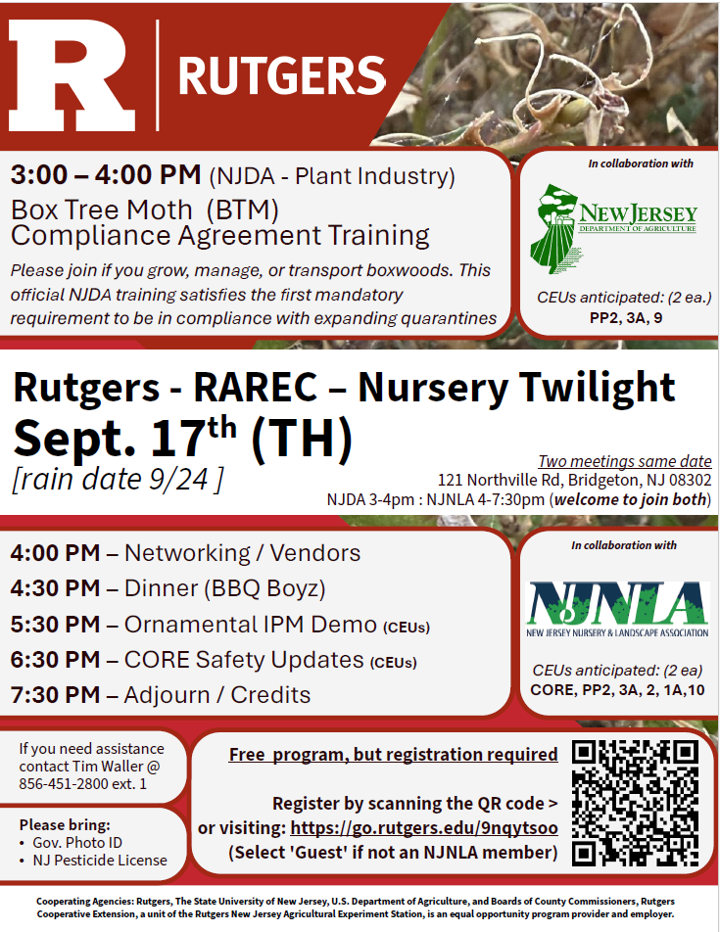
Box Tree Moth (BTM) Compliance Agreement Training + Rutgers RAREC Nursery Twilight 9/17/2026 

Nursery & Ornamentals Twilight Meeting

Collaboratively held by RCE, NJNLA, & NJDA

Location: Rutgers Agricultural Research and Extension Center (RAREC)

121 Northville Rd., Bridgeton, NJ  08302-5919


3:00PM to 4:00PM: 

Meeting: Box Tree Moth Compliance Agreement Training – Collaboratively held by RCE, NJNLA, and NJDA.

Please join if you grow, manage, or transport boxwoods. This official NJDA training satisfies the first mandatory requirement to be in compliance if the quarantine expands.

Anticipated credits: 2-PP2, 2-3A, 2-9, Certificate of Completion

_______________________________

4:00PM to 7:30PM:

Meeting: Rutgers Agricultural Research and Extension Center (RAREC) – Nursery & Ornamentals Twilight

Collaboratively held by RCE & NJNLA

4:00 pm – Arrival / Networking / Vendors / Look at plots

4:30 pm – Dinner (BBQ Boyz) / Networking / Vendors

5:30 pm – Presentation (1hr): (Outside) Ornamental IPM Implementation (Waller & Errickson)

6:30 pm – Presentation (1hr): (Inside) CORE SAFETY UPDATES (Presenter TBD)

7:30PM – Adjourn and signing for credits

Anticipated credits: 2-PP2, 2-CORE, 2-3A, 2-2, 2-1A, 2-10

Registration is required – Click here to register (select Guest if not a NJNLA member) (link fixed*)
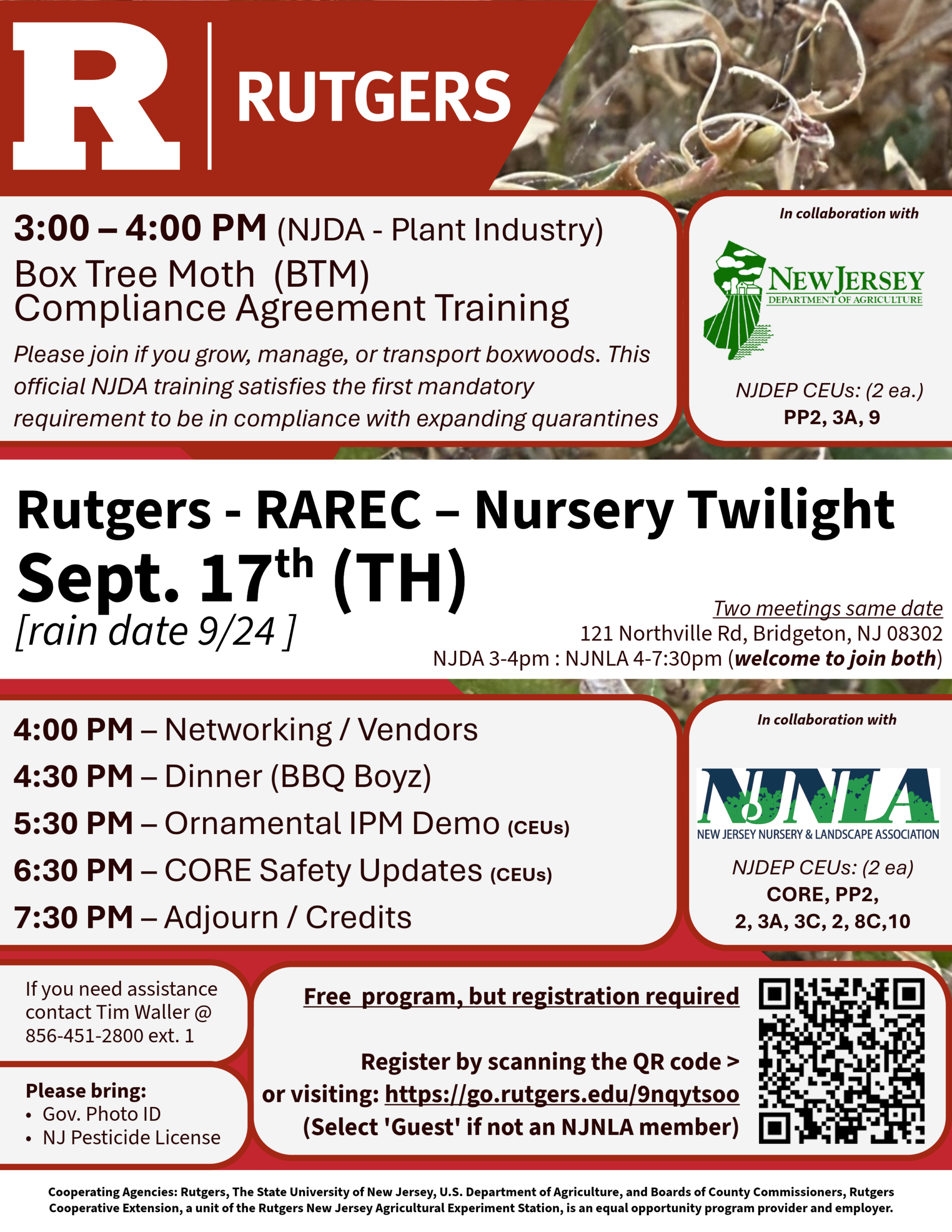
Nursery & Ornamentals Twilight Meeting Collaboratively held by RCE and NJNLA Location: Rutgers Agricultural Research and Extension Center (RAREC) 121 Northville Rd., Bridgeton, NJ 08302-5919 3:00PM to 4:00PM: Meeting: Box Tree Moth Compliance Agreement Training - Collaboratively held by RCE, NJNLA, and NJDA. Please join if you grow, manage, or transport boxwoods. This official NJDA training satisfies the first mandatory requirement to be in compliance if the quarantine expands. Anticipated credits: 2-PP2, 2-3A, 2-9, Certificate of Completion _______________________________ 4:00PM to 7:30PM: Meeting: Rutgers Agricultural Research and Extension Center (RAREC) – Nursery & Ornamentals Twilight Collaboratively held by RCE & NJNLA 4:00 pm – Arrival / Networking / Vendors / Look at plots 4:30 pm - Dinner (BBQ Boyz) / Networking / Vendors 5:30 pm – Presentation (1hr): (Outside) Ornamental IPM Implementation (Waller & Errickson) 6:30 pm – Presentation (1hr): (Inside) CORE SAFETY UPDATES (Presenter TBD) 7:30PM – Adjourn and signing for credits Anticipated credits: 2-PP2, 2-CORE, 2-3A, 2-2, 2-1A, 2-10

Registration is required – Click here to register (select Guest if not a NJNLA member)  (link fixed*)
Box Tree Moth CONFIRMED in Cape May, NJ

Cape May County NJ, with inset of Rio Grande (township)

Box tree moth (BTM) has been confirmed in Cape May County, NJ.

An official NJDA press-release expected within days – this PPA post has no legal bearing. 
  • What is happening:
  • Box tree moth (Cydalima perspectalis) has been reported and Federally confirmed in the area of Rio Grande, Cape May County.
  • USDA and NJDA have established a monitoring zone surrounding the infestation.
  • A quarantine will be established for all of Cape May County, NJ.
  • The quarantine will apply to ANYONE moving boxwoods out of Cape May County
  • NJDA has an official reporting tool and website for BTM
  • If you see this pest 1) Report it, 2) Eradicate it, 3) remove it (if applicable) following guidelines


Please click the read more tab below for important information
[Read more…]

Scale crawlers, updated 2026 scouting guide, IPM webinars, Box tree moth

Educational Resource Update: 

Stay informed

  • Sign up for the 2026 – Rutgers Ornamental IPM Program – click here to sign up
  • Program is free, but registration is required – Registration includes:
    • Site visit to your ornamental nursery/farm from Rutgers agents
    • Delivered printed IPM resources (Guides, factsheets, bulletins)
    • Free pheromone & sticky trap kit + guidance on setup/monitoring (for commercial nursery/greenhouse and Christmas tree farms)
    • Access to live bi-weekly webinars (Zoom)
    • (Next session – TUESDAY 6/9 @ 12PM) – Guest Speaker Dr. Richard Cowles – Connecticut Ag Exp. Station – Scale Management 
    • Every Second and Fourth, Tuesday, April through September
  • Visit the Rutgers Ornamental IPM Website Rutgers Ornamental IPM Website (click here) for updated webinar videos.

Scale crawler emergence predictions throughout NJ. 

Now is an excellent time to be scouting for crawler emergence using double sided (or doubled over – sticky side out) tape. Targeting scale insects is most successful during their crawler periods, however this should be visually confirmed for greatest efficacy. For more information on installing this type of IPM trap and others please see – Setting up and deploying IPM traps – Tutorial Video 2026 (click here).

Common Name GDD RANGE Target Stage SOUTH – Upper Deerfield (NJ50) CENTRAL – Howell (NJ10) NORTH – Randolph NJ (AU137)
MIN MAX START STOP START STOP START STOP
Cottony camellia / taxus scale (soft) 520 Crawlers (only) 17-May 20-May 18-May
Euonymus scale 533 820 Crawlers (Gen 1) 18-May 3-Jun 21-May 8-Jun 18-May 7-Jun
*Cryptomeria scale 600 800 Crawlers (Gen 1) 20-May 2-Jun 27-May 7-Jun 24-May 6-Jun
*Sprucebud scale (soft) 700 1150 Crawlers (only) 27-May 18-Jun 2-Jun 24-Jun 30-May 25-Jun
White prunicola scale 707 1151 Crawlers (Gen 1) 28-May 18-Jun 2-Jun 24-Jun 30-May 25-Jun
*Juniper scale 707 1260 Crawlers (Gen 1) 28-May 18-Jun 2-Jun 24-Jun 30-May 25-Jun
Calico scale (soft) 714 Crawlers (only) 28-May 2-Jun 31-May
Striped pine scale (soft) 750 800 Crawlers (only) 30-May 2-Jun 4-Jun 7-Jun 2-Jun 6-Jun
Oak lecanium scale (soft) 789 Crawlers (only) 1-Jun 6-Jun 5-Jun
Cottony maple leaf scale (soft) 802 1265 Crawlers (only) 2-Jun 23-Jun 7-Jun 29-Jun 6-Jun 30-Jun
Cottony maple scale (soft) 802 1265 Crawlers (only) 2-Jun 23-Jun 7-Jun 29-Jun 6-Jun 30-Jun
Golden oak scale (Pit) 802 1266 Crawlers (only) 2-Jun 23-Jun 7-Jun 29-Jun 6-Jun 30-Jun
Japanese maple scale 829 Crawlers (Gen 1) 3-Jun 9-Jun 7-Jun
European elm scale (soft) 831 1388 Crawlers (only) 4-Jun 27-Jun 9-Jun 4-Jul 8-Jun 6-Jul
European fruit lecanium scale (soft) 932 1645 Crawlers (only) 9-Jun 7-Jul 14-Jun 14-Jul 14-Jun 17-Jul

*Conifer / Christmas Tree scales

Please visit the Rutgers Ornamental IPM Website – Pest and Disease Index (click here) for more detailed information on specific scale species management and pesticide considerations.

Box tree moth – stay vigilant looking for this pest

Box Tree Moth (Cydalima perspectalis) is alive and well in MD, DE, VA, WV, NY, OH, MI, MA. Please report this pest to twaller@njaes.rutgers.edu

If this pest does make its way into New Jersey, and quarantines are established, nurseries will be required to comply with a federal compliance agreement if shipping out of potential quarantine areas. Please review this document if boxwoods are an important crop for you. Compliance Agreement for Production Nurseries in BTM Regulated Nurseries (click here)

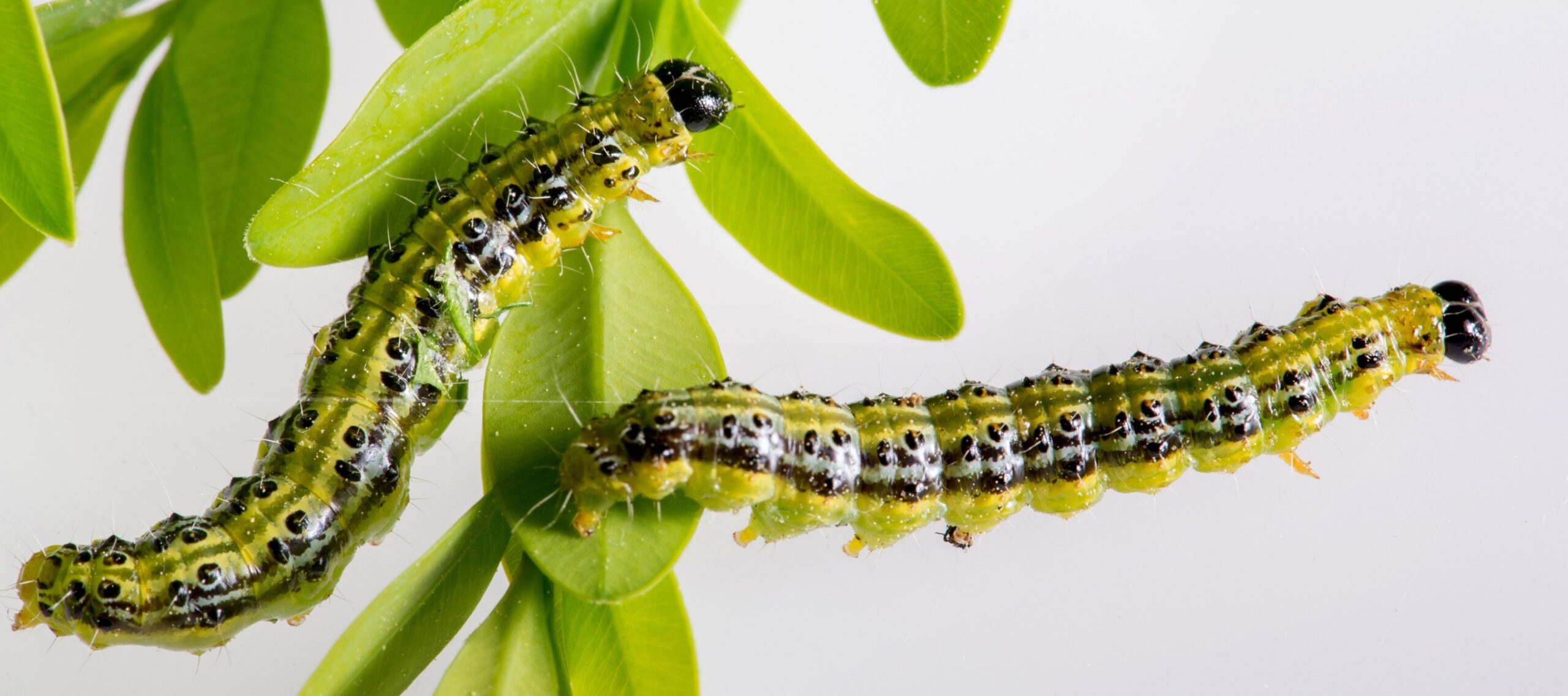
Box tree moth caterpillars. Photo credit: USDA.

Approaching boxwood blight season – 2026 (threat this week in Central and Southern NJ)

March weather is always unpredictable, however, if we have sustained periods of increased temperatures (above 50F) and spring rains, boxwood blight (BWB) can become an issue quickly.

[pictorial tri-fold] Common Boxwood Pests and Diseases (click-here). This includes Box Tree Moth images. Print the PDF out double-sided, then fold.

If you suspect Boxwood Blight and would like to have this verified – please contact the Rutgers Plant Diagnostic Laboratory (click here) for sample submission instructions

Boxwood Blight Risk Assessment as of 3/2/2026
Region Location Station

CODE

MON TUE WED THU FRI SAT
2-Mar 3-Mar 4-Mar 5-Mar 6-Mar 7-Mar
Southern Upper Deerfield NJ50 Very Low  Very Low  Very Low  Infection Risk Low Low 
Southern Vineland NJ73 Very Low  Very Low  Low  Infection Risk Infection Risk Infection Risk
Southern Millville KMIV Very Low  Very Low  Low  Infection Risk Low  Low 
Southern Bridgeton D4116 Very Low  Very Low  Very Low  Infection Risk Low  Low 
Southern Mays Landing G4661 Very Low  Very Low  Low  Infection Risk Low  Low 
Central Howell / Freehold NJ10 Very Low  Very Low  Very Low  Low  Low  Low 
Central Princeton F0303 Very Low  Very Low  Very Low  Low  Infection Risk Very Low 
Central Somerville F6261 Very Low  Very Low  Very Low  Low  Infection Risk Infection Risk
Northern High Point NJ59 Very Low  Very Low  Very Low  Very Low  Low  Low 
Northern Randolph AU137 Very Low  Very Low  Very Low  Very Low  Low  Low 
Northern Belvidere E7133 Very Low  Very Low  Very Low  Very Low  Low  Very Low 
Please check your local boxwood blight risk at (https://uspest.org/risk/boxwood_app)  

There is a minor potential for boxwood blight infections this Thursday, Friday, & Saturday throughout Southern and Central NJ. Incoming rains, coupled with warmer temperatures may initiate boxwood blight infections this week. This will likely extend into the following week with anticipated higher temperatures.

  • It is time to begin protective fungicide applications in boxwoods throughout the state if you have not already done so. 

  • If BWB is important to your business Use the USPEST – PUSH Alerts – (click here) – to setup weekly email alerts. Create an account, watch the tutorial, and then set up your subscriptions. You select which locations (as many as you like), days you want to receive emails, and what you would like to receive alerts about (BWB and a variety of other pests and diseases). Rutgers is not directly affiliated, however this is an incredible tool. 

[Read more…]

Box tree moth confirmed in MD, VA, and expanded quarantines in MI, OH. Plus+ IPM webinar recordings and 8/12 session

Box tree moth has been detected in MD and VA.

Additionally quarantines have been expanded (7/21/25) in counties of Michigan and Ohio: Click here for: APHIS Expands Box Tree Moth (Cydalima perspectalis) Quarantines in Michigan and Ohio (July 2025)

Click here for: Maryland BTM confirmed in Washington Co., MD.

Click here for: Virginia BTM confirmed at four sites in Clarke and Loudoun Counties, Va.

Efforts are being made to eradicate the pests at these locations & no additional quarantine information is available at this time. More information to follow.

Box Tree Moth – Resources:


Still time to Sign up for the 2025 – Rutgers Ornamental IPM Program

(Join us for the next Session Tuesday 8/12/25 – Rutgers Plant Diagnostic Lab – Rich Buckley (Guest Speaker))

Previous webinars:

Please visit our new –Rutgers Ornamental IPM Program Website


Approaching 2025 Boxwood Blight Season

March weather is always unpredictable, however, if we have sustained periods of increased temperatures and spring rains, boxwood blight (BWB) will become an issue quickly.

New – [pictorial tri-fold] Common Boxwood Pests and Diseases (click-here). This includes Box Tree Moth images. Print the PDF out double-sided, then fold. We are working to have a better resolution print of this material very soon.

If you suspect Boxwood Blight and would like to have this verified – please contact the Rutgers Plant Diagnostic Laboratory (click here) for sample submission instructions

Boxwood Blight Risk Assessment as of 3/4/2025
Region Location CODE 3-March 4-March 5-March 6-March 7-March 8-March
Southern Upper Deerfield NJ50 Very Low  Very Low  Low Minor Risk Very Low  Very Low 
Central Howell / Freehold NJ10 Very Low  Very Low  Low Minor Risk Very Low  Very Low 
Northern High Point NJ59 Very Low  Very Low  Very Low  Minor Risk Very Low  Very Low 
M T W TH F S
 Please check YOUR LOCAL risk (click here)

There is a minor potential for boxwood blight infections this Wednesday & Thursday, throughout ALL of NJ. Incoming rains, coupled with warmer temperatures may initiate boxwood blight infections this week.

  • It is time to begin protective fungicide applications in boxwoods throughout the state if you have not already done so. 

  • If BWB is important to your business Use the USPEST – PUSH Alerts – (click here) – to setup weekly email alerts. Create an account, watch the tutorial, and then set up your subscriptions. You select which locations (as many as you like), days you want to receive emails, and what you would like to receive alerts about (BWB and a variety of other pests and diseases). Rutgers is not directly affiliated, however this is an incredible tool. 

[Read more…]