Get ready for bagworms…NOW

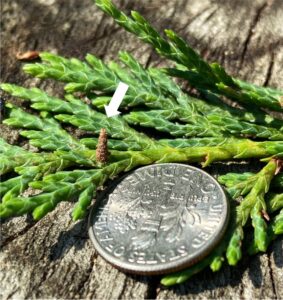
Days old bagworm size

Days-old bagworm = critical management target – T. Waller – RCE

Bagworms should begin hatching NOW through – 4 weeks in NJ, beginning in the southern regions. Now is an optimal time to get this pest on your radar and prepare materials or approaches to attack first/second instar caterpillars. The control window for this pest is typically between 600-900 GDD50  when they begin to hatch and become airborne, i.e. the “ballooning” phase. It is important to check for egg-hatch prior to applications for greatest chemical efficacy, and to continue scouting as they often hatch and develop at asynchronous rates.

It is critical to target these insects EARLY!

Bagworm management – mechanical: If eggs have not hatched: hand-remove sacs/bags. Typically female/egg filled sacs are higher in the canopy so keep that in mind while scouting. This removes the problem from the field or landscape.

Treatment options for Lepidoptera (caterpillars) to have at the ready – containing: B.t. (Bacillus thuringiensis), spinosad , bifenthrin ), cyfluthrin, carbaryl, chlorantraniliprole, cyclaniliprole, cyclaniliprole + flonicamid, Lambda-cyhalothrin, cyantraniliprole, Indoxacarb.  NOTE – Lethal pesticide doses are important, as sub-lethal doses can trigger early pupation, making the pest all but invincible to chemical or biological treatments. Follow label exactly.

IT IS CRITICAL TO ROTATE MATERIALS (Rotate between IRAC groups) 

DISCLAIMER: The label is the law, always refer to it for allowable host crops, use-restrictions, application rates, reapplication intervals, re-entry intervals (REI), and mix compatibility information. Production and pesticide information on this site are for private/commercial pesticide applicators and landscape professionals only, and are NOT for home gardener use. Provided materials represent examples and do not cover all possible control scenarios. Please contact your local agent or chemical sales representative for more information or to discuss additional pest management options.

BAGWORMS (600-900 GDD) (Bagworm hatch prediction as of 5/24/23)
Crop type Common Name Scientific Name GDD Min (50F) GDD Max (95F) Reference Developmental / Target Stage
Conifer mostly, many minor hosts Bagworm Thyridopteryx ephemeraeformis 600 900 RU Larvae (early instars) – ONLY CONTROL WINDOW
Region Location Station Date (600 GDD) Date (900 GDD) *Treatment window  *Bagworm Hatch – Predictions only, SCOUTING is critical! Treat as soon as larvae detected. 
South Upper Deerfield NJ50 31-May 14-Jun 14 days
Central Howell / Freehold NJ10 9-Jun 23-Jun 14 days
North High Point NJ59 15-Jun 2-July 17 days 

Please download and print the Rutgers Nursery and Landscape Pest Scouting Guide  or  Conifer and Christmas Tree Pest Scouting Guide and refer to this post “Obtaining your local growing degree-days (GDD)” for additional information.  (See pest scouting guides for complete list of references – cited within lists below) 

Please SHARE what you SEE!! If you see a pest, disease, otherwise interesting or troublesome issue please report it to the Working Group by following the QR Code on the front of the Pest Scouting Guides or by filling out this reporting form.

Conifer Pest and Disease Update 5/15/2023

In this edition:

  • Insects – Pest Scouting with growing degree-days (250-600 GDD50)
    • Scales
    • Mites
  • Diseases
    • Needle casts (Rhabdocline and Swiss needlecasts – Douglas fir, & Rhizosphaera – spruces)
    • Phytophthora
  • Soil fertility – resources

Please click “read more” below to get updates on pests, diseases, and other important resources for the week of 5/15/2023.

[Read more…]

Nursery Pest and Disease Update 5/15/2023

In this edition:

  • Insects:
    • Scale crawler emergence
    • Borer insects
    • Upcoming problem pests / Redheaded flea beetle / SLF / Pest Scouting Guides
  • Diseases:
    • Leaf spot / foliage disease management
    • Fire blight on Rosaceous hosts
    • Canker fungi
    • Boxwood blight
    • Oomycete root diseases (Phytophthora, Pythium, Phytopythium)
  • Plant Spotlight:
    • NJ native azalea species

Please click “read more” below to get updates on pests, diseases, and other important resources for the week of 5/15/2023.

[Read more…]

Nursery Pest Update 4/25 – 5/5/2023

Please note: The Rutgers Nursery and Green Industry Working Group is working to deliver regular pest and disease updates throughout the season. These will be in addition to important alerts, critical topics, and pesticide credit opportunities. This tool is made for you, the commercial agriculture business, so please let us know if there are particular topics you would like to see included in the regular update.

Email:  twaller@njaes.rutgers.edu Phone: 856-451-2800 Ext. 1.

Insect Pests

Projected GDD50 accumulation as of 4/25/2023 (these change throughout the season!)
Region Location 25-Apr 1-May 1-Jun 1-Jul 1-Aug
Southern Upper Deerfield (NJ50) 251 281 682 1370 2218
Central Howell / Freehold (NJ10) 188 207 537 1160 1957
Northern High Point (NJ59) 142 143 371 864 1507
Forecast: 7-month NMME based seasonal climate forecast (USPEST.ORG)

Please download and print the Rutgers Nursery and Landscape Pest Scouting Guide  or  Conifer and Christmas Tree Pest Scouting Guide and refer to this post “Obtaining your local growing degree-days (GDD)” for additional information.  (See pest scouting guides for complete list of references) 

Please SHARE what you SEE!! If you see a pest, disease, otherwise interesting or troublesome issue please report it to the Working Group by following the QR Code on the front of the Pest Scouting Guides or by filling out this reporting form.

Please continue reading for much more detailed and important information!

[Read more…]

Spotted lanternfly (SLF) hatch is ON in Southern and Central NJ – ALL New Jersey COUNTIES are now QUARANTINED

Spotted Lanternfly nymphs will be emerging now through the first week of May for Southern and Central New Jersey – reduce their population early in the nursery industry!

Two important notes:

  • Through conversations with nursery operators, state inspectors (NJDOA), and internal agent communications SLF hatch has begun, which indicates a critical time to knock down nymph populations with CONTACT insecticides.
  • The entire state of New Jersey is now within the SLF QUARANTINE!

More information:


Immediate potential for Boxwood Blight 3/24 and 3/25 – First infection potentials

There is a potential for new boxwood blight infections this FRIDAY and SATURDAY throughout much of NJ – especially central regions. Increased temperatures and prolonged periods of leaf wetness will contribute to the spread of boxwood blight infections.

  • It is time to begin protective fungicide applications in high value areas if you have not already done so! 

  • Protective fungicide applications should remain in effect or be initiated immediately for Boxwood Blight in “Infection risk or High Risk areas”. 
  • If your area is not listed (throughout all of NJ please visit the USPEST.ORG Boxwood Blight Risk Model – CLICK HERE TO CHECK YOUR LOCAL PREDICTIONS

Boxwood Blight risk-model information, considerations, and links:

Boxwood Blight Risk Assessment as of 3/22/2023
Region Location CODE 22-Mar 23-Mar 24-Mar 25-Mar 26-Mar 27-Mar NOTES
Southern Upper Deerfield NJ50 Very Low  Low Low  Infection Risk Very Low  Very Low 
Central Howell / Freehold NJ10 Very Low  Low HIGH Risk HIGH Risk Very Low  Very Low  High prob. of first BWB infections
Northern High Point NJ59 Very Low  Very Low   Infection Risk Very Low Very Low  Very Low 
 Please check YOUR LOCAL risk (click here)

(input your area code – select closest weather station – check 7-14 prediction – click on graph / table)

These advisories are general in nature, change rapidly over time, are site-specific…therefore  Someone from your business should be using this risk model daily if boxwood is important to your financial stability– In 30 seconds you can have a better idea of boxwood blight (and other pathogen) activity in your immediate area! Please contact Tim Waller if you need help using this service (twaller@njaes.rutgers.edu), we want to help! 

Fungicides; 

  1. You very well may have these materials already applied as ‘cover-sprays’ – But – be mindful that protectant fungicides loose efficacy the more rain (or overhead irrigation) they are subjected to, and reapplication may be warranted.
  2. ROTATE between Fungicide Resistance Action Committee (FRAC codes) to avoid this pathogen becoming resistant to specific chemicals

Format: [FRAC code]: Chemical name (Trade names * no endorsement implied, other options exist)  

  • [M05]: Chlorothalonil (Daconil WS)
  • [M05 + 1] Chlorothalonil + Thiophanate methyl (Spectro 90WDG)
  • [11] Trifloxystrobin + [7] Fluopyram  (Broadform)
  • [11] Trifloxystrobin + [3] Triadimefon (Armada 50WDG)
  • [M03] Mancozeb
  • [12] Fludioxonil (Medallion WDG)
  • [3] Tebuconazole (Torque)BW

DISCLAIMER: The label is the law, always refer to it for allowable host crops, use-restrictions, application rates, reapplication intervals, re-entry intervals (REI), and mix compatibility information. Production and pesticide information on this site are for private/commercial pesticide applicators and landscape professionals only, and are NOT for home gardener use. Provided materials represent examples and do not cover all possible control scenarios. Trade-names listed do not imply endorsement and are used as examples only. Please contact your local agent or chemical sales representative for more information or to discuss additional pest management options.

Resources 

Background on the pathogen: