Cranberry Early-Season Insect Pests – May 2026

From now until bloom, growers should scout their beds using sweep net sampling for lepidopteran pests (blackheaded fireworm, spotted fireworm, Sparganothis fruitworm, and cranberry blossomworm), and blunt-nosed leafhoppers. Table 1 shows the activity periods of the major insect pests of cranberries in New Jersey. Bars show the period when scouting (in grey) and management (in […]

Continue reading...

Fruit IPM Report 5/11/2026

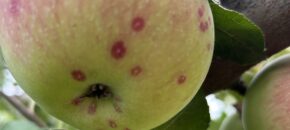
Frogeye leaf spot on apple.

  Apples Disease Management Considerations Primary scab season is coming to an end or has ended. While the majority of mature ascospores have been released, there is still a risk of infection. An apple scab infection period occurred over the weekend (5/9-5/11), and currently the forecast indicates an apple scab infection period for May 13-14. […]

Continue reading...

Networks to Reduce Risk: Field trip to Montclair Community Farms and Program Wrap up

Join us on Saturday, June 13, 2026, for the final event of the Networks to Reduce Risk: Building Viable NJ Farms program! We’re celebrating with a special field trip to Montclair Community Farms from 10:00 a.m. to 12:00 p.m. This fun wrap‑up event offers a great chance to explore urban agriculture, learn about sustainability and […]

Continue reading...

Managing Orchards Through a Season With Limited Yields 

The recent freeze event April 20-21, 2026, has had wide ranging impacts on fruit crops statewide, including but not limited to peaches, nectarines, cherries, apples, pears, and plums. Across the state, significant injury to blossoms and young fruit has been confirmed, with many orchards reporting substantial crop loss. The extent of damage remains highly variable by location, elevation, crop, cultivar, and ultimately […]

Continue reading...

Controlling Rhizoctonia root rot

Rhizoctonia root rot has been reported over the past  week in transplanted crops. Rhizoctonia root rot, caused by Rhizoctonia solani, is an important soil-borne fungal pathogen with a very large host range. The pathogen can survive saprophytically on living or dead plant material (organic matter) or as sclerotia in the soil (for more than 3 […]

Continue reading...

Vegetable IPM Update 5/08/26

Greetings from the Veg IPM team! We hope everyone is doing alright despite the tough spring weather. In this post, we’ll discuss what we’ve been seeing as we’ve begun scouting cole crops and high tunnel tomatoes.

Continue reading...