Rutgers NJAES Wine Grape Extension, in association with Penn State Extension Grape and Wine Team, is calling on those who own, operate, or manage a farm or vineyard in the New Jersey region to participate in a survey that aims to track the spread and severity of nymph and adult spotted lanternfly populations during the 2023 season. The data collected will provide insights into the distribution patterns of both nymph and adult SLF within and outside vineyards, enabling growers and researchers to better understand this invasive pest’s potential impact on agriculture in the Mid-Atlantic region. [Read more…]
Landscape, Ornamentals, Nursery, and Turf Edition
Seasonal updates on ornamental, nursery, and turf pests.
Subscriptions are available via EMAIL and RSS.
Companion Website Links:
 Rutgers Turf Blog - Articles on turfgrass diseases and cultural practices for the commercial turfgrass industry. Subscription available via RSS.
Rutgers Weather Forecasting - Meteorological Information important to commercial agriculture.
June 2, 2023 Steven K. Rettke
Landscape Pest Notes for Early June 2023
Boxwood Spider Mite: (GDD =450-700) (PPI = Kousa Dogwood; Cranberry Bush) This spider mite, which attacks all boxwoods, is neither a true cool nor warm season mite species. It is usually most active with intermediate temperatures during late spring & early summer. The adult is yellow-tan in color with long legs. When the boxwood mites are active, they can be found on both the top & bottom of new growth. Eggs are light yellow & overwinter on leaves & twigs. There are several generations per year.
Boxwood spider mite feeding damage results in foliage with yellow to bronze stippling, which may resemble injury caused by thrips. Both of these insects cause distinctive linear stippling streaks. These symptoms can be diagnostic when observed on foliage. With high mite populations, entire leaves may develop yellowish-white streaks; premature defoliation can occur.
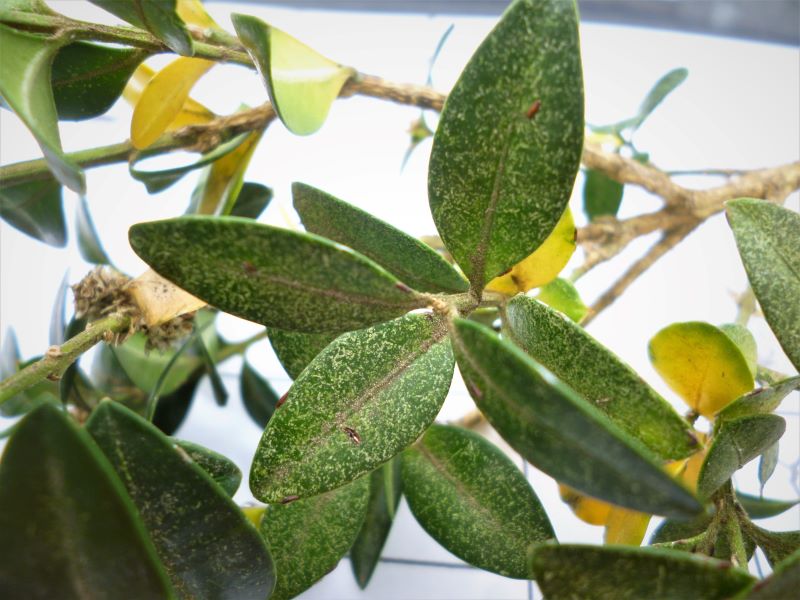
Boxwood spider mite feeding symptoms. This mite species creates linear streaks on leaves. (Photo Credit: Steven K. Rettke, Rutgers Coop. Ext.)
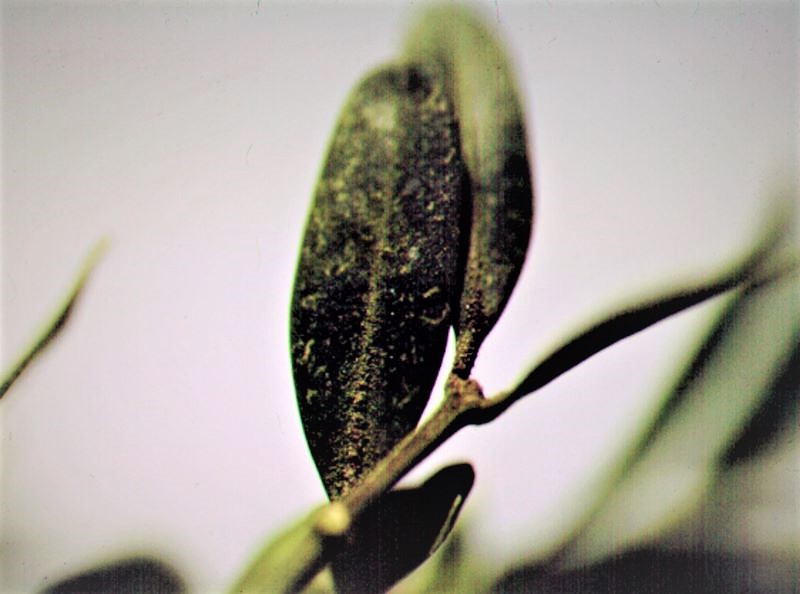
Boxwood spider mite symptoms that are more mild. The distinctive linear streaks are more clearly observed. (Photo Credit: Steven K. Rettke, Rutgers Coop. Ext.)
Detected overwintering eggs are treated with dormant oils (2-3%). Although normally unnecessary, summer oils (1-2%) or insecticidal soaps are recommended to control mild mite populations. With high infestations, some reduced-risk materials include spinosad, spiromesifen, acequinocyl, & bifenazate. Examples of other materials include hexythiazoc, abamectin, fluvalinate & acephate. Be aware that fluvalinate is a pyrethroid & can promote spider mite resurgence. Acephate may only provide mite suppression.
The Rutgers Plant & Pest Advisory Blog for Early June 2023 includes some commonly observed insect/mite & disease pests within the landscape during the late weeks of spring & early weeks of summer. In addition to boxwood spider mites, the other insect/mite pests included are juniper scale, bagworm, black vine weevil, bronze birch borer, pear leaf blister mite, & beneficial predacious mite. The disease pathogens included are fire blight, oak leaf blister fungus, black spot of rose, powdery mildew & Verticillium wilt. Some suggested monitoring techniques & variables are listed between the insect/mite & disease pests.
May 24, 2023 Tim Waller
Get ready for bagworms…NOW
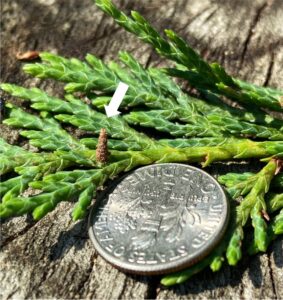
Days-old bagworm = critical management target – T. Waller – RCE
Bagworms should begin hatching NOW through – 4 weeks in NJ, beginning in the southern regions. Now is an optimal time to get this pest on your radar and prepare materials or approaches to attack first/second instar caterpillars. The control window for this pest is typically between 600-900 GDD50 when they begin to hatch and become airborne, i.e. the “ballooning” phase. It is important to check for egg-hatch prior to applications for greatest chemical efficacy, and to continue scouting as they often hatch and develop at asynchronous rates.
It is critical to target these insects EARLY!
Bagworm management – mechanical: If eggs have not hatched: hand-remove sacs/bags. Typically female/egg filled sacs are higher in the canopy so keep that in mind while scouting. This removes the problem from the field or landscape.
Treatment options for Lepidoptera (caterpillars) to have at the ready – containing: B.t. (Bacillus thuringiensis), spinosad , bifenthrin ), cyfluthrin, carbaryl, chlorantraniliprole, cyclaniliprole, cyclaniliprole + flonicamid, Lambda-cyhalothrin, cyantraniliprole, Indoxacarb. NOTE – Lethal pesticide doses are important, as sub-lethal doses can trigger early pupation, making the pest all but invincible to chemical or biological treatments. Follow label exactly.
IT IS CRITICAL TO ROTATE MATERIALS (Rotate between IRAC groups)
DISCLAIMER: The label is the law, always refer to it for allowable host crops, use-restrictions, application rates, reapplication intervals, re-entry intervals (REI), and mix compatibility information. Production and pesticide information on this site are for private/commercial pesticide applicators and landscape professionals only, and are NOT for home gardener use. Provided materials represent examples and do not cover all possible control scenarios. Please contact your local agent or chemical sales representative for more information or to discuss additional pest management options.
| BAGWORMS (600-900 GDD) (Bagworm hatch prediction as of 5/24/23) | ||||||
| Crop type | Common Name | Scientific Name | GDD Min (50F) | GDD Max (95F) | Reference | Developmental / Target Stage |
| Conifer mostly, many minor hosts | Bagworm | Thyridopteryx ephemeraeformis | 600 | 900 | RU | Larvae (early instars) – ONLY CONTROL WINDOW |
| Region | Location | Station | Date (600 GDD) | Date (900 GDD) | *Treatment window | *Bagworm Hatch – Predictions only, SCOUTING is critical! Treat as soon as larvae detected. |
| South | Upper Deerfield | NJ50 | 31-May | 14-Jun | 14 days | |
| Central | Howell / Freehold | NJ10 | 9-Jun | 23-Jun | 14 days | |
| North | High Point | NJ59 | 15-Jun | 2-July | 17 days | |
Please download and print the Rutgers Nursery and Landscape Pest Scouting Guide or Conifer and Christmas Tree Pest Scouting Guide and refer to this post “Obtaining your local growing degree-days (GDD)” for additional information. (See pest scouting guides for complete list of references – cited within lists below)
Please SHARE what you SEE!! If you see a pest, disease, otherwise interesting or troublesome issue please report it to the Working Group by following the QR Code on the front of the Pest Scouting Guides or by filling out this reporting form.
May 17, 2023 Tim Waller
Application for Cost-Share Grant Funding for Installation of Deer Fencing on UNPRESERVED Farmland – Out NOW
“The NJDA Deer Fencing Program makes cost-sharing funding available for the installation of deer fencing on unpreserved farms. The program is conducted in accordance with N.J.S.A 4:40-6.1.”
Please click here for the full application, eligibility, and other important information
Timing is important if considering this program. NJDA began accepting applications on 5/15/23.
May 15, 2023 Steven K. Rettke
Landscape Pest Notes for Late May 2023
Artillery Fungus (Sphaerobolus): This wood decomposer is found in mulched areas and has probably caused the most concern to landscapers and potentially poses some economic concern to their clients. This fungus produces fruiting structures that resemble tiny cream or orange-brown cups that hold a spore mass resembling a tiny black egg (0.1 inches in diameter). When enough water accumulates, the spores are shot high into the air up to several yards. The dark-colored spores resemble small tar spots and will stick to house siding, downspouts, cars, leaf surfaces, and any nearby structure. The artillery fungus is strongly phototrophic & will shoot its spores toward light sources or white-colored surfaces. The spores have extreme adhesive qualities & are difficult to remove, even with high-pressure sprayers.
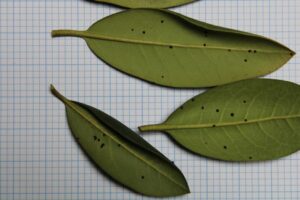
The black colored spores of Artillery Fungus can also be mistaken for pests (e.g., scales) when stuck on the undersides of plant leaves. (Photo Credit: Tim Waller, Rutgers Coop. Ext.)
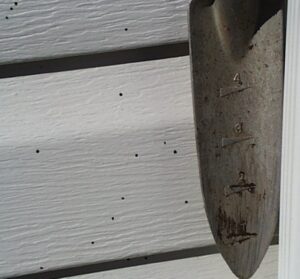
Artillery Fungus black spores can mare the surface of white siding on houses. (Photo Credit: Steven K. Rettke, Rutgers Coop. Ext.)
The Landscape Pest Notes Blog for Late May 2023 reviews a dozen insect & disease pests that are commonly observed during the second half of May within NJ landscapes & nurseries. The insect pests highlighted include the elongate hemlock scale, pine needle scale, Euonymus scale, Taxus mealybug, four-lined plant bug, & aphids. In addition to the artillery fungus, the other fungal organisms included are black sooty mold, Volutella blight, cedar rust diseases, Cytospora canker, & Botrytis.
Nursery Pest and Disease Update 5/15/2023
In this edition:
- Insects:
- Scale crawler emergence
- Borer insects
- Upcoming problem pests / Redheaded flea beetle / SLF / Pest Scouting Guides
- Diseases:
- Leaf spot / foliage disease management
- Fire blight on Rosaceous hosts
- Canker fungi
- Boxwood blight
- Oomycete root diseases (Phytophthora, Pythium, Phytopythium)
- Plant Spotlight:
- NJ native azalea species
Please click “read more” below to get updates on pests, diseases, and other important resources for the week of 5/15/2023.

