Fruit Crops Edition

Seasonal updates on diseases, insects, weeds impacting tree fruit and small fruit (blueberry, cranberry, and wine grape). Fruit Pest Alerts are also available via this category feed.
 
Subscriptions are available via EMAIL and RSS.

Pre-Harvest Drop Control and Harvest Management for Apples

For growers interested in using products to control pre-harvest drop, particularly on Early/Mid-Season apple varieties, now is the time to consider applying them.  This is a valuable consideration particularly this year for retaining high value varieties such as early season Honeycrisp.

As apples mature they produce the hormone ethylene.  Ethylene induces stem loosening which results in pre-harvest drop of apples.  Luckily there are several tools that when applied at optimal times can aid in the management of pre-harvest drop of apples.

*Prior to the application of any product though, remember to read and follow the product label, because the label is the law.


Plant Growth Regulator Options for Apple Harvest Management:

Active Ingredient: AVG (aminoethoxyvinylglycine)

ReTain 

This product slows starch disappearance, fruit softening, stem loosening and red color development.

Benefits include:

Expansion of the harvest window by minimizing pre-harvest drop and retaining fruit firmness.

Enhancement of fruit size since fruit are given more time to hang onto the tree.

Color enhancement due to exposure to improved weather for fruit coloring (warm sunny days and cool nights).

Application Timing: For maximum efficacy ReTain must be applied 4 weeks prior to harvest.

Single Pick Varieties

For single pick early season varieties, establish the ‘usual’ harvest time for the variety, and if the season is running early adjust the date earlier (accordingly).  Once an accurate estimated harvest date is established count back four weeks.  This timepoint plus 7 days is the spray window for ReTain for that variety.

Calculate the spray timing for later season, single pick varieties in a similar way.  However, later varieties generally do not need harvest date adjustment due to seasonal variation in the same way early season varieties do.

Multiple Pick Varieties i.e. Gala and Honeycrisp

Spray timing for these varieties is 7 to 14 days prior to harvest/first pick.  Note that ReTain will not affect the first harvest/pick but will provide stop drop control for later season picks.

Variety Response to ReTain and Rate:
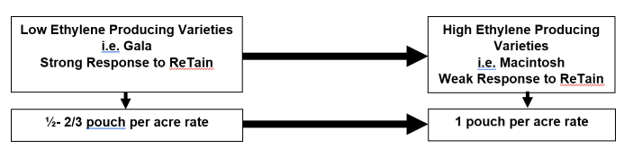
Variety response to ReTain and rate.

*When applying ReTain be sure to include 100% Organosilicate surfactant @ 12 ounces/100 gallons.

*Ensure there will be 6 hours of drying time after the application.


Active Ingredient: 1-MCP (1-Methylcyclopropene)

Harvista

Much like ReTain this product slows starch disappearance, fruit softening, red color development and pre-harvest drop.

Application Timing: It should be applied within 3 days prior to harvest, much closer to the time of harvest than a ReTain application.  This product is a bit more complicated to use in that it must be applied via a proprietary in-line injector system.


Active Ingredient: NAA (naphthaleneacetic acid)

NAA (Multiple Formulations)

This product provides what is considered a rescue treatment for control of fruit drop.

Application Timing: Optimum timing of spray is a couple days prior to harvest, when the first fruit begins to drop.

One application of 10 ppm NAA will provide 7-10 days of drop control.

A two-part spray of 10 ppm, one a couple days prior to harvest and a second 5 days later will provide 10-14 days of drop control.

Keep in mind it takes ~2-3 days for the sprays to take effect.

*Apply with a nonionic or organosilicate surfactant.

*Spray when the temperatures are in the mid 70’s.  If the temperature is too hot, fruit ripening can be accelerated.


Table 1. A quick comparison of compounds registered as stop drops.

Parameter ReTain Fruitone, PoMaxa, or Refine Harvista
Active Ingredient AVG NAA 1-MCP
What Is Blocked Ethylene production Stem loosening Ethylene action
Drop Delay (Approximate) 10–14 days 5–7 days 10–14 days
Fruit Ripening Slowed Advanced Slowed
Fruit Color Delayed No effect Somewhat delayed
Fruit Softening Delayed No change or advanced Delayed
Applied (Relative to Drop) 2-4 weeks before Just prior to Just prior to
Rescue Option? No Yes Yes
Days to Take Effect >7 ~2 ~2
Split Sprays Helpful Yes Yes Not applicable
REI 12 hours 48 hours 4 hours
PHI 7 days 2 days 3 days

Cited from 2024-2025 Penn State Tree Fruit Production Guide page 79.


For additional details on utilizing plant growth regulators for harvest management read:

2025/2026 New Jersey Commercial Tree Fruit Production Guide Chapter 10. https://njaes.rutgers.edu/pubs/publication.php?pid=e002
Apple PGRs – Prevention of Preharvest Drop in Apple Orchards – Production and Harvesting – Fruit – Forage and Food Crops (psu.edu)

Blueberry Webinar Series September 2026 – Registration is Open!

Registration is open for a 4-part live virtual webinar series for commercial blueberry producers co-organized by Rutgers University and Penn State University. Scan the QR-code on the attached flyer or follow the link to register: https://extension.psu.edu/commercial-blueberry-update

When: Tuesdays, September 8, 15, 22, and 29, 2026
(11:00 AM-12:30 PM ET)

Registration deadline: September 7, 2026

Registration fee: $20

NJ recertification credits are available:

  • Certification Area 1A (Agricultural Plant): 2 units
  • Certification Area 10 (Demonstration and Research): 2 units
  • Private Applicator Category (PP2): 2 units

Registration is required to receive the link to access the webinar.

Farming Twilight Meeting

October 22, 2026
6:00PM – 8:30 PM

Location:
1076 Seahorse Winery
Seashore Road
Cape May NJ  08204


Program

6:00 PM – Registration / Light Refreshments

6:15 PM – Welcome – Claudia Gil Arroyo, County Agent III, Rutgers Cooperative Extension of
Cape May County; Rutgers NJAES

6:20 PM – James Shope, PhD., Assistant Extension Specialist in Climate Services
Department of Environmental Sciences, SEBS, New Brunswick; Rutgers NJAES

6:50 PM – Joseph Heckman, PhD., Extension Specialist – Soil Fertility, Department of Plant Biology, SEBS, New Brunswick; Rutgers NJAES

7:20 PM – David Hlubik, Burlington County Agent III, Rutgers Cooperative Extension of
Burlington County;
Rutgers NJAES

7:50 PM – Patrick McMullen, County Agent III, Rutgers Cooperative Extension of Atlantic
County; Commercial Vegetable Production; Rutgers NJAES


Light refreshments will be served.

The following pesticide recertification credits will be awarded:

Please RSVP by October 20, 2025:
Jocelyn Shillingford 609-465-5115 ext. 3607 or
capemayag@njaes.rutgers.edu

Fruit IPM Report August 5, 2026

It has been a wet start to the month, with parts of New Jersey receiving more than 4 inches of rainfall on Monday alone. On average, 4 inches of rainfall is typical for the whole month of August. With wet and hot conditions this week, the potential for disease pressure will be high and will be a driver in maintaining fungicide coverage in orchards as we approach harvest. Even in orchards without fruit, a minimal fungicide program is recommended to reduce inoculum for the next season.

Apples
Disease Management Considerations

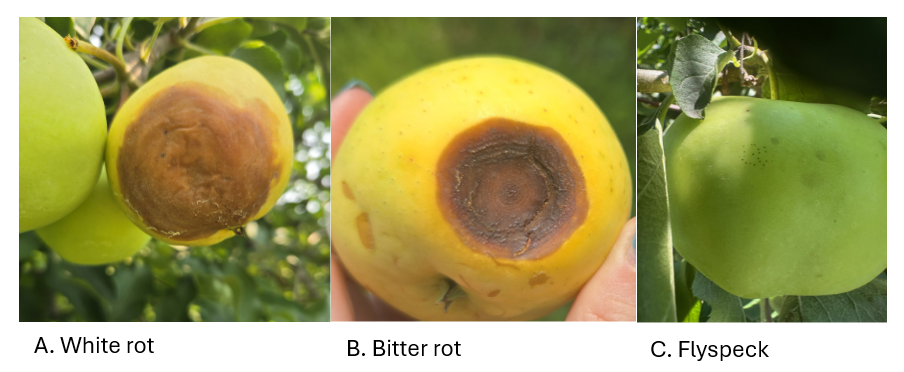
Summer scab, rots, sooty blotch, and flyspeck are the main targets at this time and are present in orchards throughout the state (Figure 1). Captan plus a phosphonate-based acid like Prophyt can slow scab development and provide good summer disease control. Add FRAC 7 and 11 single-site products, such as Merivon, Luna Sensation, and Pristine, for improved control. Consider the pre-harvest interval as harvest approaches. Also, read labels and consider restrictions on the number of applications for FRAC 7 + 11 fungicides. Time applications before rain events through the growing season according to the cover spray rule of applications every 2” of rain or 14 days, whichever comes first.

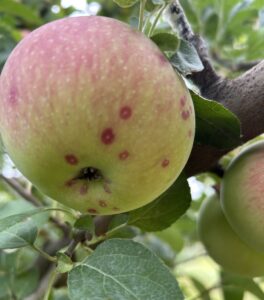
Diseases observed on developing apples a) white rot, b) bitter rot, and c) sooty blotch and fly speck.

Figure 1. Diseases observed on developing apples.

As terminal shoot growth sets, fire blight infection will slow. Pruning of blighted shoots should be done in dry weather, cutting 8 to 12 inches below diseased wood. Pruning tools should be sanitized after each cut by dipping them into a 10 percent bleach solution.

Insect Update

Codling Moth (CM) trap captures increased from the previous weeks. Additional treatments are not recommended unless there are more than 5 moths per trap.

San Jose scale crawlers on maturing apple fruit.

Figure 2. San Jose scale crawlers on maturing apple fruit.

Scale crawlers are active and can be found feeding on fruit (Figure 2). Control options at this point include Assail, Belay, and Venerate (0-day PHI; Make two applications 7 days apart, starting a week after crawler emergence).

Aphid populations, on average, remain below treatment levels. A treatment threshold is set at 50% of the terminals infested with live colonies. Minimize the use of pyrethroids to manage insect pests, as they can knock down beneficial organisms and predators. Research from Dr. Monique Rivera at Cornell University has demonstrated good control from Sefina for Woolly Apple Aphid in late summer.

Brown Marmorated Stink Bug adults and nymphs are being captured in orchards statewide. See the NJ Tree Fruit Production guide for effective materials on harvesting fruit.

Dogwood borer continues to be caught in pheromone-baited traps in orchards. Chemical control is not recommended at this time. If trap counts have been high in your orchard blocks, consider mating disruption (i.e., Isomate DWB) for next season, which has been very effective in reducing larval infestations. NOTE: multiyear treatment is recommended for optimal efficacy.

Traps

Average Trap Captures in Apple – Southern Counties

  Week STLM TABM CM OFM DWB AMBROSIA BEETLE BMSB
5/11/2026 18  11  6 3   25   2 –
5/18/2026 16 21 3 10   54 13 –
5/25/2026 1.3 23 2 2   71 7 –
6/1/2026 378 33 3 2   49 6 0.4
6/8/2026 258 11 2 1   61 21 1.2
6/15/2026 355 4 0.6 1.5   57 13 0.8
6/22/2026 178 5 0.6 2   54 8 1.2
6/29/2026 504 0.3 0.1 0.5   27 12 0.8
7/6/2026 202 1.1 1.6 0.6   25 7.5 0.6
7/13/2026 226 0.9 1 1   33 1 1.6
7/20/2026 253 1.8 2 3   26 2.3 2.4
7/27/2026 246 1.5 5 1.6   38 2 1.6


Average Trap Captures in Apple – Northern Counties

  Week STLM TABM CM DWB AMBROSIA BEETLE BMSB
5/11/2026 13.7 1.5 1.8 12.8 1.1 –
5/18/2026 8.3 13.25 2.4 18.5 10.8 –
5/25/2026 2.2 13.75 1.2 24.5 5.1 –
6/1/2026 25.1 24.3 3.4 23.8 9.4 0.3
6/8/2026  94 22.3 0.3 24.6  18 1.4
6/15/2026 68 22.3 1 22.6 14 1.1
6/22/2026 105.9 35 0.7 27.2 8.2 0.5
6/29/2026 100 11.5 0.3 28.9 5.3 0.3
7/6/2026 50.2 7.3 0.6 26.4 5.2 0.2
7/13/2026 52.4 7 0.5 24.8 5.3 0.2
7/20/2026 69.7 2.5 0.7 27.4 4.3 0.1
7/27/2026 92.4 2 0.6 30.6 0.2

Pears
Disease Management

Foliar diseases, including Fabraea leaf spot and summer rots, should be managed to protect fruit as we approach harvest. FRAC 7 and 11 fungicides provide good control. Consider the pre-harvest interval (PHI) as we approach harvest. Also, read labels and consider restrictions on the number of applications for FRAC 7 and 11 fungicides. Topsin (FRAC 1) is also a good option for control with a 1-day PHI.

Where fire blight is present, it is appropriate to prune out infected shoots. Prune out strikes on dry, cooler days, cut back 8-12” back into healthy tissue, and sterilize pruners between cuts.

Insect Update

Pear psylla populations have decreased compared to previous weeks. If adult psylla are present, options for control include Actara, Assail, and Belay (IRAC group 4A); Sivanto Prime (IRAC group 4D); Delegate (IRAC Group 5); and products containing abamectin (IRAC group 6).

Peaches
Disease Management

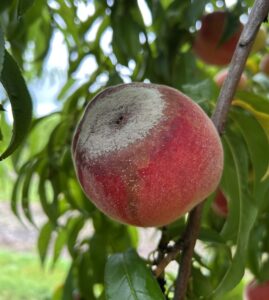
Brown rot incidence remains low, but where fruit is present, rot has been observed (Figure 3). If you are harvesting fruit, this would be a good week to use one of your stronger single-site materials with a low PHI: Indar, Cevya, Orius, Quash, and Tilt (FRAC group 3); and Merivon, Luna Sensation, Pristine, and Quadris Top (FRAC group 11).

Figure 3. Brown rot on ripening peach fruit.

Insect Update

Oriental Fruit Moth (OFM) trap captures have decreased, and flight activity should be ending. Consider treatment if trap captures are above threshold (>8 moths per trap). A few options for late in the season with low PHIs would include Assail (7-day), Baythroid XL (7-day), Danitol (3-day), Delegate (1-day), and Sevin (3-day).

Japanese beetles are present in orchards and have been persistent this season, feeding in the tree canopy and on fruit. To prevent losses, include neonicotinoid materials such as Assail (7-day PHI), pyrethroids such as Baythroid (7-day), or premix products such as Leverage 360 (7-day). Verdepryn (IRAC 28, 7-day PHI) is also effective.

Lesser peachtree borer adult.

Figure 4. Lesser peachtree borer adult.

Scale crawlers are active in orchards. Options at this point include Assail, Belay (Group 4A), and the bioinsecticide Venerate. These products may provide some late-season suppression where fruit damage is observed. Venerate has a 0-day PHI, making it useful for blocks near or at harvest.

Brown Marmorated Stink Bug nymphs and adults are active and increasing in orchards. Late-season and pre-harvest control options include Assail (7-day PHI), Brigade (14-day), Danitol (3-day), Leverage 360 (7-day), and Venerate (0-day).

Lesser and greater peachtree borer trap captures continued to decline this week, although adults remain active, and egg laying is ongoing (Figure 4). Newly hatched larvae feed on the bark before boring into the lower trunk and root crown, where they overwinter and can weaken or kill trees. Growers should begin preparing for post-harvest trunk applications of pyrethroids (Asana or Pounce) or chlorpyrifos, with mid-August through early September generally providing the best timing to target young larvae before they enter the tree. Apply the insecticide thoroughly to the lower trunk, root flare, scaffold crotches, and any cankered areas, following label directions.

Traps

Average Trap Captures in Peach – Southern Counties

 Week OFM TABM LPTB PTB BMSB
5/11/2026 5 10 – – –
5/18/2026 4 20 – – –
5/25/2026 2 20 31 1 –
6/1/2026 4 46 28 3 0
6/8/2026 8 13 25 3 0.75
6/15/2026 5 6 13 3 0.75
6/22/2026 6 4 23 7 1
6/29/2026 3 0.2 16 6 2
7/6/2026 5 0.6 16 4 1.3
7/13/2026 9 1.4 18 7 3.5
7/20/2026 8 2.4 12 6 2.5
7/27/2026 6 2 6 6 8


Average Trap Captures in Peach – Northern Counties

  Week OFM LPTB PTB
5/11/2026 4.4 24 0
5/18/2026 2.4 16.5 0.2
5/25/2026 0.7 8.75 0.1
6/1/2026 1.8 11 0.5
6/8/2026  0.6  8.5 0.05
6/15/2026 3.5 9.7 1.2
6/22/2026 3.4 7.4 1.6
6/29/2026 2 4.6 1.1
7/6/2026 1.7 8.5 1.8
7/13/2026 0.5 2.8 3.7
7/20/2026 2.1 1.5 2.9
7/27/2026 4.3 0.9 1.7

Blueberries
Insect Update

Spotted-wing drosophila (SWD) adults continue to be captured in monitoring traps (Table 1). SWD remains the primary target for insecticide applications.

Blueberry maggot is present, but is managed when controlling for SWD (Table 1). For management recommendations for SWD in blueberry and other berry crops, reference Rutgers Cooperative Extension Factsheet FS1246 and SWD Insecticides for Berries.

Table 1. Spotted-Wing Drosophila and Blueberry Maggot traps

Spotted-wing Drosophila Blueberry Maggot
Atlantic County Burlington County Atlantic County Burlington County
Avg High Avg High Avg High Avg High
6/6 8.99 35 2.86 7 0.03 1 0 0
6/12 9.9 46 3.7 25 0 0 0 0
6/20 10.24 48 8.22 35 0 0 0 0
6/27 6.96 78 3.6 18 0 0 0 0
7/3 29.78 273 50.9 81 0.33 27 0 0
7/10 31.2 130 86.1 177 0.15 12 0 0
7/18 28.3 110 59.3 125 0.07 5 0.16 1
7/25 40.22 227 79.1 223 0.07 6 0.06 2
7/31 52.3 199 58.8 167 0.04 2 0.04 1


Sharp-nosed leafhopper trap counts remain low (Table 2).

Oriental beetle adult flight activity continues to decrease (Table 2).

Table 2. Sharp-nosed Leafhopper and Oriental Beetle traps

Sharp-nosed Leafhopper Oriental Beetle
Atlantic County Burlington County Atlantic County Burlington County
Avg High Avg High Avg High Avg High
6/6 1.42 16 1.25 7 5.78 35 2.57 14
6/12 0.56 12 4.8 46 62 340 47 170
6/20 0.88 6 1.44 12 411 2025 403 2025
6/27 0.77 9 0.37 2 243 2025 458 2025
7/3 1.5 15 0.55 2 466.7 2025 182.7 510
7/10 1.40 14 0.33 2 396 1970 393 2025
7/18 0.98 13 0 0 191.1 2025 235 1350
7/25 1.11 7 0.11 1 64.4 340 136.6 675
7/31 0.90 5 0.25 2 27.68 132 35.3 85


Scales crawler activity of both terrapin scale and Putnam scale slightly increased (Table 3). Monitoring will continue throughout the fall to detect the emergence of the second crawler generation and determine the appropriate timing for pesticide applications. Continued monitoring will help ensure that management recommendations are based on current pest activity and that insecticide applications are made when crawlers are most susceptible. Scale infestations on fruit remain low (Table 4).

Table 3. Scale Traps

Putnam Scale Terrapin Scale
Avg High Avg High
5/23 36.85 230 1.8 8
5/29 65.17 352 21.2 41
6/6 136.25 402 75.25 84
6/12 164 639 96 202
6/20 102 288 85 167
6/27 45 193 32 119
7/3 41.7 315 27.5 46
7/10 16.26 74 24.6 61
7/18 6.06 25 12 24
7/25 10.5 73 11 24
7/31 12.6 64 11.3 27


Table 4. Scale Infestation on Fruit

Scale % infestation on fruit
Avg High
6/12 0.13 2.1
6/20 0.19 5.7
6/27 0.06 1.5
7/3 0.06 1.8
7/10 0.07 3.1
7/18 0.02 0.9
7/25 0 0
7/31 0.006 0.1


Diseases

The IPM team continues to observe anthracnose and Alternaria. For recommendations on fungicide products, refer to the 2026 Commercial Blueberry Pest Control Recommendations for New Jersey or https://extension.rutgers.edu/sites/default/files/2026-03/bb-v42n01.pdf.

% Mummy Berry Infested Fruit % Anthracnose Infested Fruit % Alternaria Infested Fruit
Avg High Avg High Avg High
6/20 0.03 0.9 0.06 2.5 0.004 0.7
6/27 0.007 0.3 0.08 2.2 0.07 3
7/3 0.005 0.2 0.227 4.1 0.07 1.2
7/10 0.002 0.1 0.20 2.5 0.13 3
7/18 0.001 0.1 1.23 13.1 0.43 9.3
7/25 0 0 0.42 2 0.11 0.6
7/31 0 0 0.89 9.7 0.05 0.3


Weeds

Last week, the IPM team monitored 88 fields for weed pressure. The predominant weed species observed across production fields were nutsedge and goosegrass followed by marestail and barnyard grass. This was the last week for assessing weed pressure in the fields.  Based on current field conditions, postemergence herbicide selections should prioritize products with strong activity on annual grass species while considering the existing weed spectrum within individual fields. Refer to the 2026 Rutgers Blueberry Commercial Guide for management recommendations. 

Grapes
Insects

Grape berry moth (GBM) continues to be captured in pheromone-baited traps in vineyards. Where populations have been managed, no further treatment should be needed, particularly as insecticide management shifts to other pests. Monitor for damage to bunches and consider treatment when 10% or more of the bunches show berry webbing and GBM larval feeding injury. See the Commercial Grape Pest Control Recommendations for New Jersey for management options.

Spotted lanternfly (SLF) adults are present in vineyards. As we approach September, adult migration into vineyards will increase, at which point we consider applying materials with long residual efficacy. See this previous Plant & Pest Advisory post on Management of Spotted Lanternfly in New Jersey Vineyards.

Spotted-Wing Drosophila trap counts continue to remain high in blueberries in southern counties. Monitoring efforts have shifted to grapes as veraison progresses and ripe fruit becomes vulnerable to infestation.

Grape root borer (GRB) adults are active and flying in vineyards. Monitoring traps indicate the presence of GRB in the area, but only scouting around the bases of vines will indicate the presence of GRB in the vineyard. Adult moths will lay eggs July-August. Larvae will enter the soil and migrate to the roots, where they feed and cause damage. Dr. Anne Nielsen and the IPM team will be monitoring vineyards throughout the state to assess GRB population pressure in NJ.

Diseases

Grapes are beginning veraison in southern counties. Disease management continues to focus mainly on downy mildew (Figure 5), as well as powdery mildew, bunch rot, and black rot, but disease observations have been minimal. Refer to the NJ Commercial Grape Production Guide for more information on disease management options.

Figure 5. Downy mildew on the underside of a grape leaf.

Introduction to GAP Audit Prep – Online Training

GAPs for fruit and vegetable producers: GAP audit prep and food safety plan writing workshop
Presented by educators from University of Minnesota, Colorado State University, Kansas State University, and Rutgers Cooperative Extension. August 19th 9:30 – 2:30.

Using good food safety practices on your farm can reduce risks of foodborne illness, improve product quality and open new markets. Join national experts and experienced farmers for a deep dive into on-farm food safety practices you can use right now to reduce risks related to your fresh produce. The day will include practical guidance, tips and science-based best practices to ensure your produce is safe, fresh and wholesome. Register online. (registration form will indicate CST zone)

The course consists of two parts:

  • The morning is the educational training on GAPs concepts on the farm
  • The afternoon is preparing for and passing a GAP audit for your farm.

You can opt to attend just the morning, just the afternoon, or both sessions.

All attendees of the morning session will receive a certificate of attendance.

Morning: 9:30 – 1:30 EST: GAPs for fruit and vegetable farms

-Deep dive into best practices for the production and postharvest handling of fresh fruits and vegetables to reduce potential for contamination with foodborne pathogens

-Topics will include compost/manure use, water testing, safely washing vegetables, sanitizer use and guidelines, packing area designs and ideas, coolers, managing wildlife and pets, low-cost handwashing stands, employee training and more

-Time for questions and discussion about using the practices on your farm

Afternoon: 2:00 – 4:30 EST – Prepare for a GAP audit and write a food safety plan

-Do you want to prepare for and pass a GAP audit to sell your fresh produce to a buyer who requires it? 

-The session will help cover the GAP audit process and your food safety plan so that you can pass an audit if needed.

-A farmer and educator from K-State will share what he has learned from years of passing GAP audits on his farm (costs, who to contact, what to expect), how to create a farm map, records, and reviewing the core aspects of a food safety plan. You will have all the information you need to prepare the needed documents for a GAPs audit.

-Note that the workshop will focus on the GAP/GHP audit, and will also provide information on the Harmonized GAP and the Harmonized GAP Plus+ audit.

Choose either the morning session only, afternoon session only, or the full day training (both are included for the $20 course fee). All participants of the morning session will receive a certificate of attendance.

Agri-Technology, Nursery, Agronomy, Fruit and Vegetable Research Twilight Meeting at RAREC: Wednesday August 26, 2026

 Agri-Technology, Nursery, Agronomy, Fruit and Vegetable Research Twilight Meeting at RAREC

Wednesday August 26th, 2026 (4 pm until dark)

Location: Rutgers Agricultural Research and Extension Center (RAREC), 121 Northville Road, Bridgeton, New Jersey 08302

Hosted by: Ramandeep Kumar Sharma, Patrick McMullen, and Andy Wyenandt

Questions? Contact: Andy Wyenandt (wyenandt@njaes.rutgers.edu)

This year’s twilight meeting at RAREC will showcase advances in crop production, integrated pest management, soil fertility, weed management, and innovative agricultural technologies for growers and stakeholders across the state.

  • Dan Ward, Director, RAREC. Welcome to RAREC
  • Wesley Kline, Cumberland County Agricultural Agent
    • ‘Impact of Cyclospora on fruit and vegetable production’ CORE: 30 minutes
  • Tim Waller, Cumberland County RCE Nursery Agent.
    • ‘Useful Nursery and Ornamental Crops and Considerations’
  • Raul Cabrera, Extension Specialist in Nursery Production and Management.
    • ‘Recent developments on substrates (for container-grown crops)’
  • Dan Ward, Director, RAREC; Rutgers Agrivoltiacs Program.
    • ‘Update on the agrivoltaics research program at Rutgers’
  • Ann Nielsen, Extension Specialist in Entomology
    • Emma Waltman, PhD candidate, ‘Land-use around farms impacts stink bug biological control’
    • Amanda Furuya, Post-Doctoral Associate, ‘Tackling Spotted Lanternfly in South Jersey Vineyards’
    • Octavio Menocal Sandoval, Post-Doctoral Associate, ‘Updating Monitoring and Management for Codling Moth in Apple’
  • Thierry Besancon, Extension Weed Specialist for Specialty Crops.
    • ‘Update on new technologies for weed management in vegetable crops’
  • Ramandeep Kumar Sharma, Salem County Agricultural Agent.
    • ‘Optimizing Nitrogen Rate and Application Timing for Corn Yield and Quality’
    • ‘Evaluation of Sulfur Fertilizer Sources and Application Rates for Optimizing Soybean Growth and Yield in Southern New Jersey’
  • Maria Cramer, Senior Program Coordinator, Vegetable IPM,
    • ‘Thrips management in tomatoes’
  • Patrick McMullen, Atlantic County Agricultural Agent.
    • ‘Wilts of cucurbits: Identification and management’
  • Andy Wyenandt, Extension Specialist in Vegetable Pathology.
    • ‘Updates on vegetable disease control’

NJDEP pesticide recertification credits are pending approval. Expected credits include CORE (1), PP2 (4), 1A (4), 3A (2), and Category 10 (3).