Greetings from the Veg IPM team!
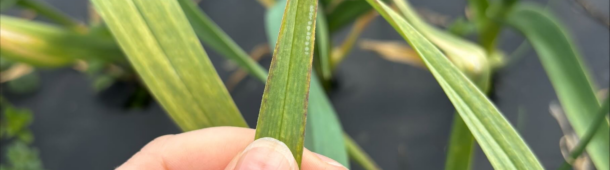
We detected the first Allium Leafminer oviposition scars on garlic in Burlington County, NJ today (see photos below). Adults are likely active throughout the state at this time. Be on the lookout for oviposition scars on both crop alliums and wild alliums such as wild onion/garlic and ramps. You can also use yellow sticky cards to monitor for adult presence in the field.

Allium Leafminer oviposition scars. Notice the neat line of white dots near the tips of the leaves. Photos by Maria Cramer.
Allium Leafminer (Phytomyza gymnostoma) is a small grey-bodied fly with a yellow head (A). In warm, still weather, you may see adult flies settling on foliage. The females lay eggs in neat rows, leaving behind a line of white dots on the leaves (B). As the larvae hatch and begin to feed, they will tunnel downwards, causing damage to leaves and bulbs. ALM have two generations per year; the first in early spring, and the second occurring in the fall. Crops such as chives, scallions, garlic, onions and leeks are attacked by ALM, but leeks and scallions seem to be the most affected.
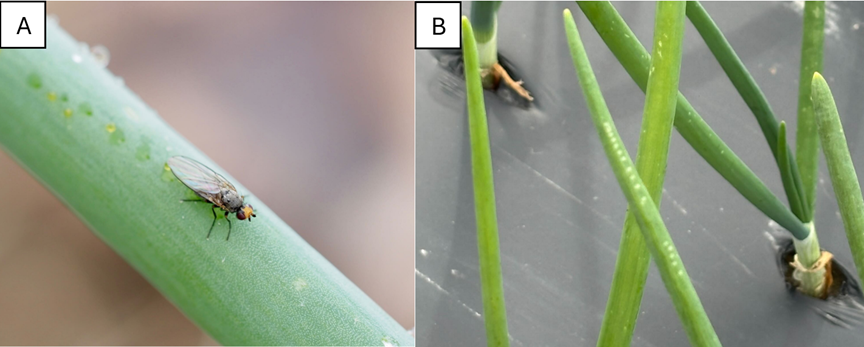
An allium leafminer adult (A) and oviposition scars (B). Photos by Maria Cramer a7l;/nd Amanda Quadrel
If you are concerned about crop injury due to ALM, floating row covers, kept on until the first flight ends (around the end of May) can restrict ALM’s access to vulnerable plants. Reflective mulches may also provide some additional crop protection. Adults and larvae can be targeted through well-timed insecticide sprays. Materials labeled for ALM control include spinosyns (IRAC 5- Radiant or Entrust (OMRI approved)), pyrethroids (IRAC 3A- Mustang Maxx, Proaxis, and Warrior II), neonicotinoids (IRAC 4A- Scorpion, Venom), the insect growth regulator Trigard (IRAC 17), and diamide products (IRAC 28- Exirel, Minecto Pro). The newly registered product Vertento (IRAC 30) may also be used for ALM control. However, growers who have trouble managing onion thrips may want to save group 28 and 30 products for thrips sprays, as both groups have season use limits. The first spray application of a material should be completed 2- 3 weeks after initial detection of ALM (either oviposition scars or the fly itself). Subsequent sprays should be completed in 1–2-week intervals. Two or three sprays should provide adequate control. As always, be sure to follow label rates and application instructions for any pesticide that you plan to use.
For more pictures and detailed information on the biology and management of ALM, Cornell has an excellent fact sheet that can be found here: https://cals.cornell.edu/integrated-pest-management/outreach-education/fact-sheets/allium-leafminer. In the meantime, feel free to reach out to us if you have any questions.
~Amanda Quadrel and Maria Cramer, Senior Program Coordinators- Vegetable IPM
Questions or concerns? Get in touch with us by filling out the form below:


