Recent Increase in Tomato Prices

Tomato prices in the United States have risen notably in recent months, driven by a combination of supply constraints, trade policy changes, and rising costs throughout the supply chain. Tomato prices at the consumer level nationwide, as measured by the Consumer Price Index (CPI), increased 18% from February to March and were 24% higher than a year earlier. Consistent with this trend, wholesale market data from terminal markets in New York and Philadelphia indicate strong price increases.

Source: USDA Market News; figure created by the author.

Note: Weekly tomato prices (non-organic) at the New York and Philadelphia Terminal Market by origin and year. Prices in 2026 are highlighted in red, while earlier years (2022–2025) are shown for comparison. Line types distinguish between origins.


Why Are Tomato Prices Increasing?

One of the primary drivers of higher prices is tight supply conditions. Weather disruptions in major producing regions such as Mexico and Florida have reduced available volumes, creating shortages across the supply chain.

Trade policy has also played a significant role. The imposition of tariffs on Mexican tomatoes, which account for roughly 70% of U.S. fresh tomato consumption, has increased import costs and contributed directly to higher market prices.

In addition, broader economic factors are amplifying price pressures. Rising fuel and transportation costs have increased the cost of moving perishable goods such as tomatoes, while higher input costs (e.g., energy and fertilizer) are raising production expenses, particularly for greenhouse production.


How Recent Fertilizer Price Increases Affect Your Per-Acre Costs

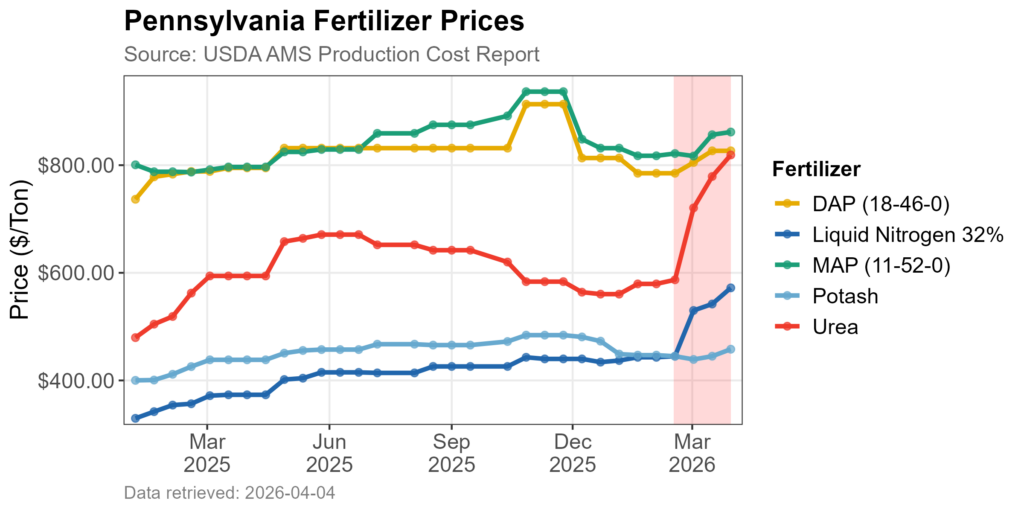
Recent increases in fertilizer prices, especially for nitrogen-based inputs, are raising production costs. This article summarizes recent price trends in our region and provides a simple worksheet for you to calculate your own cost of production.

1. Increase in recent fertilizer prices

March 30 vs. Mid-February

  • Urea: +40%
  • Liquid nitrogen 32%: +29%
  • DAP (18-46-0): +5%
  • MAP (11-52-0): +5%
  • Potash: +3%

March 2026 vs. March 2025

  • Urea: +38%
  • Liquid nitrogen 32%: +53%
  • DAP (18-46-0): +4%
  • MAP (11-52-0): +8%
  • Potash: +4%

2. Translating fertilizer prices into production costs

Fertilizer prices are typically reported in dollars per ton, but farmers apply fertilizer in pounds per acre. To translate market prices into on-farm costs, the price per ton is first converted to a price per pound by dividing by 2,000 (the number of pounds in a ton). This per-pound price is then multiplied by the application rate (in pounds per acre) to calculate fertilizer cost per acre.

  • Fertilizer cost per acre = fertilizer price per ton / 2000 * application rate.

You can find a worksheet to calculate your total fertilizer costs on the Rutgers Farm Management website (Link here).