How Recent Fertilizer Price Increases Affect Your Per-Acre Costs

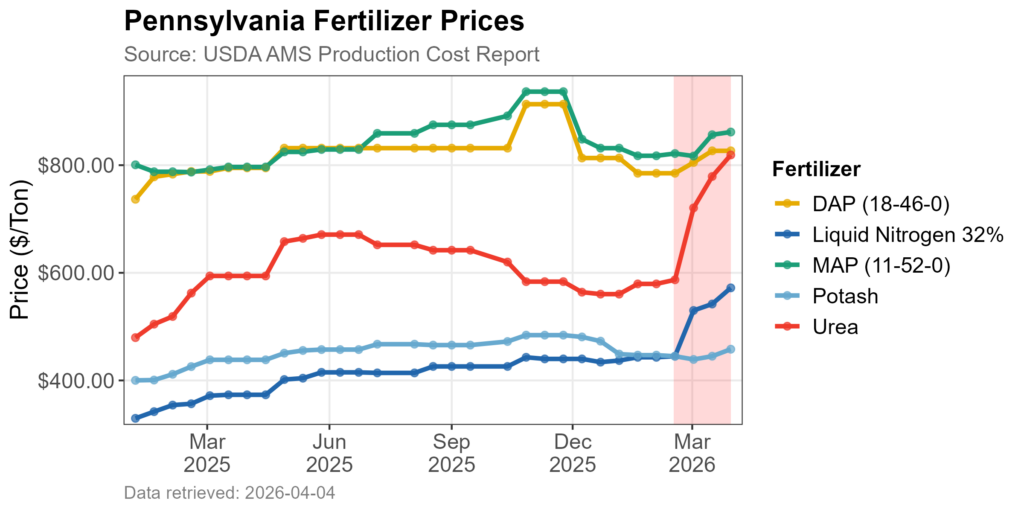
Recent increases in fertilizer prices, especially for nitrogen-based inputs, are raising production costs. This article summarizes recent price trends in our region and provides a simple worksheet for you to calculate your own cost of production.

1. Increase in recent fertilizer prices

March 30 vs. Mid-February

  • Urea: +40%
  • Liquid nitrogen 32%: +29%
  • DAP (18-46-0): +5%
  • MAP (11-52-0): +5%
  • Potash: +3%

March 2026 vs. March 2025

  • Urea: +38%
  • Liquid nitrogen 32%: +53%
  • DAP (18-46-0): +4%
  • MAP (11-52-0): +8%
  • Potash: +4%

2. Translating fertilizer prices into production costs

Fertilizer prices are typically reported in dollars per ton, but farmers apply fertilizer in pounds per acre. To translate market prices into on-farm costs, the price per ton is first converted to a price per pound by dividing by 2,000 (the number of pounds in a ton). This per-pound price is then multiplied by the application rate (in pounds per acre) to calculate fertilizer cost per acre.

  • Fertilizer cost per acre = fertilizer price per ton / 2000 * application rate.

You can find a worksheet to calculate your total fertilizer costs on the Rutgers Farm Management website (Link here).



Soil Fertility from Non-Commercial Nutrient Sources

All essential plant nutrients cycle through the ecosystem of soil, water, air, plant, microbe, and animal.  Agronomic information about the composition and beneficial use of waste materials and how the nutrients can be recycled can help growers reduce the need to purchase soil fertility inputs.  Many different types of non-commercial nutrient sources are available in New Jersey.  Examples include horse manure with bedding, shade tree leaves, lawn clippings, wood chips, food waste, coffee grounds, eggshells, wood ash and more.

With 43,000 horses in New Jersey, there is an abundance of horse manure produced.  One horse can produce about 65 pounds of manure plus bedding per day.  The quantity of horse manure is substantial on a statewide basis.  Unfortunately, sometimes horse manure goes to landfills when it should be used to build and sustain soil fertility.

The Soil Profile Newsletter 2023 issue posted at Rutgers NJAES explains how to build and maintain soil fertility harnessing the nutrient supplying ability of horse manure and many other types of non-commercial materials.  The chemical composition and soil fertility value of each material is presented for beneficial use.  Available on the web at Rutgers NJAES ‘The Soil Profile’: https://njaes.rutgers.edu/soil-profile/pdfs/sp-v28.pdf