ALERT – Control window approaching for Cryptomeria and Elongate Hemlock Scale

Cryptomeria Scale, Elongate Hemlock Scale, and Bagworms in Conifers – Control Window Approaching!

Projected GDD50 accumulation as of 5/23/2024 (for June – July)
CODE Location 23-May 1-Jun 15-Jun 1-Jul 15-Jul
NJ50 Upper Deerfield (South) 501 678 977 1383 1786
D2738 Mays Landing (South) 500 667 943 1327 1711
NJ10 Howell (Central) 407 568 833 1203 1577
NJ36 Parsippany (Central) 389 548 795 1141 1491
E7133 Belvidere (North) 432 592 836 1178 1523
N59 High Point (North) 345 486 706 1020 1338
USPEST.ORG – Model: simple average/growing degree-day, Min: 50F – Max: 95F, NMME forecast
Forecast:  7-month NMME based seasonal climate forecast (USPEST.ORG) – Subject to change regularly = Check Often


Cryptomeria Scale – Click here for full Cryptomeria Scale write-up (with pictures)

(Adapted from Steve Rettke – RCE post above)

Crawlers Generation 1: 600-800 GDDs (first few weeks of June in NJ)

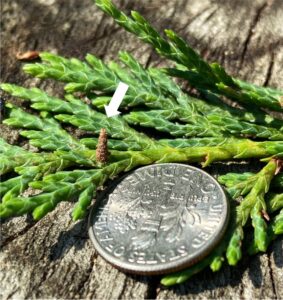
  • Similar to many other armored scale species, the Cryptomeria scale has more than one generation of crawlers during the growing season. In New Jersey, this scale has two crawler generations per year, Crawlers are lemon yellow in color & because of the color contrast can typically be easy to observe on needles, even without a hand lens. Unfortunately, the crawler emergence periods of both generations of the Cryptomeria scale are not restricted to only a week or two. Their more prolonged crawler periods can extend for 4 weeks or even longer, although a large percentage of crawlers will occur during the first 2 weeks after emergence begins.

Crawlers Generation 2: 1750-2130 GDDs (end of July early August in NJ)

Control options: When applying control materials with short residuals (e.g., horticultural oils), the use of multiple applications will probably be required to achieve a more complete crawler suppression. If a single application is desired, then oils plus synthetic pyrethroids can provide a 3-week residual. Examine infested trees closely to determine if significant predators or parasitoids are presently active. When numerous, these beneficials can be extremely valuable to help with suppression. Therefore, the use of horticultural oil applications alone will help conserve the beneficials & still control crawlers when coverage is adequate. The use of most of the neonicotinoid insecticides (e.g., Merit) will not achieve satisfactory controls (maybe only 30-40% efficacy). However, the usage of dinotefuran (Safari) as a soil drench or bark spray has been shown to give excellent results against armored scales, with some studies showing 90% efficacy. The extremely high-water solubility of Safari allows this material to penetrate the plant cells where the scales are feeding.

Elongate Hemlock Scale – Click here for more information (with pictures)

(Adapted from Steve Rettke – RCE post above)

First crawler emergence: 360-700 GDDs (Late May – June in NJ)

  • Female covers are oval, flat, tan/translucent; males are whitish. There may be six or more scales per needle. Yellow spots appear on needles under light feeding and foliage appears thin; in heavy infestations, needle drop occurs, and trees may be killed. Adult females have an exceptionally long egg-laying period (lasting throughout the summer) with two overlapping generations. Crawlers (immatures) are noticeable in late May, in conjunction with new growth. Although there are only two generations per year, crawlers can emerge over an extended period. Look for the tiny crawlers using a 10-15x hand-lens.

Control options: Pyriproxyfen (Distance) is an insect growth regulator & can provide good suppression. It is classified as a “reduced risk” material by the EPA. Dinotefuran (Safari) is a neonicotinoid that has been a product of choice to control armored scales for more than a decade. Imidacloprid (Merit) is highly effective controlling the hemlock woolly adelgid but will not provide satisfactory control of elongate hemlock scales. Acephate (Orthene) has translaminar properties within foliage & can provide some suppression.


Bagworms 
Days old bagworm size

Days-old bagworm = critical management target – T. Waller – RCE

Bagworms should begin hatching NOW through – 4 weeks in NJ, beginning in the southern regions. Now is an optimal time to get this pest on your radar and prepare materials or approaches to attack first/second instar caterpillars. The control window for this pest is typically between 600-900 GDD50  when they begin to hatch and become airborne, i.e. the “ballooning” phase. It is important to check for egg-hatch prior to applications for greatest chemical efficacy, and to continue scouting as they often hatch and develop at asynchronous rates.

It is critical to target these insects EARLY!

Bagworm management – mechanical: If eggs have not hatched: hand-remove sacs/bags. Typically female/egg filled sacs are higher in the canopy so keep that in mind while scouting. This removes the problem from the field or landscape.

Treatment options for Lepidoptera (caterpillars) to have at the ready – containing: B.t. (Bacillus thuringiensis), spinosad , bifenthrin ), cyfluthrin, carbaryl, chlorantraniliprole, cyclaniliprole, cyclaniliprole + flonicamid, Lambda-cyhalothrin, cyantraniliprole, Indoxacarb.  NOTE – Lethal pesticide doses are important, as sub-lethal doses can trigger early pupation, making the pest all but invincible to chemical or biological treatments. Follow label exactly.

IT IS CRITICAL TO ROTATE MATERIALS (Rotate between IRAC groups) 

DISCLAIMER: The label is the law, always refer to it for allowable host crops, use-restrictions, application rates, reapplication intervals, re-entry intervals (REI), and mix compatibility information. Production and pesticide information on this site are for private/commercial pesticide applicators and landscape professionals only, and are NOT for home gardener use. Provided materials represent examples and do not cover all possible control scenarios. Please contact your local agent or chemical sales representative for more information or to discuss additional pest management options.

BAGWORMS (600-900 GDD) (Bagworm hatch prediction as of 5/20/24)
Crop type Common Name Scientific Name GDD Min (50F) GDD Max (95F) Reference Developmental / Target Stage
Conifer mostly, many minor hosts Bagworm Thyridopteryx ephemeraeformis 600 900 RU Larvae (early instars) – ONLY CONTROL WINDOW
Region Location Station Date (600 GDD) Date (900 GDD) *Treatment window  *Bagworm Hatch – Predictions only, SCOUTING is critical! Treat as soon as larvae detected.     

Remove any ‘bags’ prior to hatch if possible

South Upper Deerfield NJ50 29-May 12-June 13 days
Central Howell / Freehold NJ10 4-June 19-June 15 days
North High Point NJ59 11-June 26-June 15 days 


Please download and print the Rutgers Nursery and Landscape Pest Scouting Guide  or  Conifer and Christmas Tree Pest Scouting Guide and refer to this post “Obtaining your local growing degree-days (GDD)” for additional information.  (See pest scouting guides for complete list of references) 

Please SHARE what you SEE!! If you see a pest, disease, otherwise interesting or troublesome issue please report it to the Working Group by following the QR Code on the front of the Pest Scouting Guides or by filling out this reporting form.

Get ready for bagworms…NOW

Days old bagworm size

Days-old bagworm = critical management target – T. Waller – RCE

Bagworms should begin hatching NOW through – 4 weeks in NJ, beginning in the southern regions. Now is an optimal time to get this pest on your radar and prepare materials or approaches to attack first/second instar caterpillars. The control window for this pest is typically between 600-900 GDD50  when they begin to hatch and become airborne, i.e. the “ballooning” phase. It is important to check for egg-hatch prior to applications for greatest chemical efficacy, and to continue scouting as they often hatch and develop at asynchronous rates.

It is critical to target these insects EARLY!

Bagworm management – mechanical: If eggs have not hatched: hand-remove sacs/bags. Typically female/egg filled sacs are higher in the canopy so keep that in mind while scouting. This removes the problem from the field or landscape.

Treatment options for Lepidoptera (caterpillars) to have at the ready – containing: B.t. (Bacillus thuringiensis), spinosad , bifenthrin ), cyfluthrin, carbaryl, chlorantraniliprole, cyclaniliprole, cyclaniliprole + flonicamid, Lambda-cyhalothrin, cyantraniliprole, Indoxacarb.  NOTE – Lethal pesticide doses are important, as sub-lethal doses can trigger early pupation, making the pest all but invincible to chemical or biological treatments. Follow label exactly.

IT IS CRITICAL TO ROTATE MATERIALS (Rotate between IRAC groups) 

DISCLAIMER: The label is the law, always refer to it for allowable host crops, use-restrictions, application rates, reapplication intervals, re-entry intervals (REI), and mix compatibility information. Production and pesticide information on this site are for private/commercial pesticide applicators and landscape professionals only, and are NOT for home gardener use. Provided materials represent examples and do not cover all possible control scenarios. Please contact your local agent or chemical sales representative for more information or to discuss additional pest management options.

BAGWORMS (600-900 GDD) (Bagworm hatch prediction as of 5/24/23)
Crop type Common Name Scientific Name GDD Min (50F) GDD Max (95F) Reference Developmental / Target Stage
Conifer mostly, many minor hosts Bagworm Thyridopteryx ephemeraeformis 600 900 RU Larvae (early instars) – ONLY CONTROL WINDOW
Region Location Station Date (600 GDD) Date (900 GDD) *Treatment window  *Bagworm Hatch – Predictions only, SCOUTING is critical! Treat as soon as larvae detected. 
South Upper Deerfield NJ50 31-May 14-Jun 14 days
Central Howell / Freehold NJ10 9-Jun 23-Jun 14 days
North High Point NJ59 15-Jun 2-July 17 days 

Please download and print the Rutgers Nursery and Landscape Pest Scouting Guide  or  Conifer and Christmas Tree Pest Scouting Guide and refer to this post “Obtaining your local growing degree-days (GDD)” for additional information.  (See pest scouting guides for complete list of references – cited within lists below) 

Please SHARE what you SEE!! If you see a pest, disease, otherwise interesting or troublesome issue please report it to the Working Group by following the QR Code on the front of the Pest Scouting Guides or by filling out this reporting form.

Conifer Pest and Disease Update 5/15/2023

In this edition:

  • Insects – Pest Scouting with growing degree-days (250-600 GDD50)
    • Scales
    • Mites
  • Diseases
    • Needle casts (Rhabdocline and Swiss needlecasts – Douglas fir, & Rhizosphaera – spruces)
    • Phytophthora
  • Soil fertility – resources

Please click “read more” below to get updates on pests, diseases, and other important resources for the week of 5/15/2023.

[Read more…]

Updated 2023 Pest Scouting Guides are up – Getting prepared for the season ahead

The updated Pest Scouting Guides are here, and have a few improvements that enable YOU to share what YOU are seeing in the field with RCE.

Please click, download, and print these scouting guides for use at your nursery, landscape, or conifer plantation. Once printed you can scan the QR at the top of document to link back to the digital copy. These are much larger documents than 2022, as they are sorted by GDD, NEW-Insect “Group”, and by NEW-“favored host plants”. 

Nursery and Landscape Pest Scouting Guide – Scouting with Growing Degree-days (GDD) 2023 (click here)

Conifer and Christmas Tree Pest Scouting Guide – Scouting with Growing Degree-days (GDD) 2023 (click here)

Refer to this post “Obtaining your local growing degree-days (GDD)” for additional information (click here)  or contact Tim Waller twaller@njaes.rutgers.edu for help.

It is important to note that the GDD ranges do not replace scouting and that many of these GDD ranges have not been validated in New Jersey and would greatly benefit from local feedback. Therefore you will notice a QR code at the bottom of the cover-page. If you scan this code it will take you to a form that asks for details about pest occurrence, host plants, any observations, and after you submit your comments it allows the user to upload photographs. This is also a great place to leave feedback on what you would like to see in future iterations (such as pictures…).

PLEASE REPORT – pest observations that deviate from the stated GDD ranges in the guides

PLEASE SHARE PICTURES OF PESTSwe are working to develop insect ID pocket guides and other resources for our NJ growers…but we need your help

LONT – Comment and Photo upload REPORTING LINK (click here) 

Conifer – Comment and Photo upload REPORTING LINK (click here) 

If you would like to interact with the raw data yourself or incorporate it more closely into your businesses needs download this data file (click here) (file will download once clicked!). Please note it is a Microsoft Excel file, that is protected / cannot be modified on all but the two sheets labeled “GDD ACCU”. If you would like help with this or a non-protected file please contact twaller@njaes.rutgers.edu.


Regular updates will be utilizing this resource throughout the 2023 season. Have a great Spring Season everyone.  


Choosing the Perfect Christmas Tree – Tim Waller & Bill Errickson Podcast on Ask the Agent

Just in time for the holiday season! Please listen and SHARE with clientele.

Listen to our NEW “Choosing the Perfect Christmas Tree” podcast by clicking here

Agents Tim Waller (Cumberland) and Bill Errickson (Monmouth) were invited by Rutgers – Ask the Agent – hosts Steve Komar (Sussex), Bill Bamka (Burlington), and Lisa Chiariello (Sussex), to discuss all things Christmas Trees in New Jersey.

The goal of this podcast was to provide the general public with an idea of what it takes to produce a perfect Christmas Tree. We discuss tree production, why Christmas trees cost what they do, variety considerations, complexities of this industry, seasonal offerings, tree care (cut vs choose and cut vs B&B trees), the importance of supporting local communities and traditions, as well as offering some resources for current Christmas tree operators.

Please share this podcast with your clients, and keep an eye for more podcasts to come.


Please visit the Ask the Agent Podcast Page for more interesting topics!

Nutrient Management for Christmas Trees

Joseph Heckman, Extension Soil Fertility

Whatever the crop, soil testing and record keeping are guides to sustainable soil fertility and nutrient management.  When soil tests levels are low, Christmas tree growers should attempt to build soil fertility levels into the optimum range.  And once that goal has been achieved, growers should focus on maintaining soil test levels in the optimum range.

This practice requires information on balancing fertilizer amendments with crop nutrient removal.  In the case Christmas Trees, this means nutrients associated with harvest of cut trees.  Rutgers NJAES has this type of data already built into an extension fact sheet: Soil Fertility Recommendations for Christmas Trees   https://njaes.rutgers.edu/fs1187/

For nutrient management purposes it is useful to know what a harvested or cut Christmas Tree removes from the soil.  On average, a harvest of 100 cut Christmas Trees contains 29 lb. Nitrogen, 3 lb. Phosphorus, 8 lb. Potassium, 12 lb. Calcium, 2 lb. Magnesium, and 1 lb. Sulfur.

An average fresh cut Christmas Tree that is 92 inches tall may be expected to have a fresh weight of about 48.5 lb.  Water typically makes up about 54% of a fresh cut tree weight.  Thus, on a dry basis a cut tree would have a weight of about 22.4 lb.

Tree recycling and mulch making are now common in many communities.  If the trees are shredded the nutrient content data above can be used to estimate the nutrient density of the resulting wood chips.

Reference:

Zinati, G., J.R. Heckman, and M. Vodak. 2016. Nutrient Removal by Christmas Tree Harvest. Journal Plant Nutrition. 39: 1506-1512.