Veg IPM Update 8/1/25

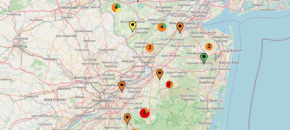
Spray intervals based on nightly pheromone moth captures for the southern part of New Jersey. Note that not all locations in the IPM program are currently trapping. This map is based on the following thresholds: 0 moths = 6-7 day schedule, 1 moth = 5 day spray schedule, 2-20 moths = 4 day spray schedule, 20+ moths = 3 day spray schedule.

Greetings from the Veg IPM team! Sweet Corn Corn earworm moth captures are increasing, leading to 3- or 4-day spray intervals being needed throughout the state. When temperatures are high (>85 degrees F), shorten the spray interval by one day. Rotation is important for avoiding resistance, and there are four IRAC groups that are registered […]

Continue reading...
The A-B-C’s of cucurbit powdery mildew control

Cucurbit powdery mildew (CPM), caused by Podosphaera xanthii, is one the most important diseases of cucurbit crops throughout the world. The pathogen is an obligate parasite, just like cucurbit downy mildew, meaning it needs a living host in order to survive. In northern regions that have a killing frost in the fall the pathogen will […]

Continue reading...

Late July Peach Varieties for New Jersey – New and Standard

EVELYNN is a new, excellent, semi-free stone with a firm, yellow-fleshed peach variety. It is a low-acid, sweet to very sweet peach that ripens with Redhaven. Fruit is large, uniform, and has attractive, complete scarlet coloring, with smooth, low pubescence skin. It retains firmness on trees and during storage for longer than Redhaven, giving extra […]

Continue reading...

Late-July Nectarine Varieties for New Jersey – New and Standard

BRIGANTINE is a new yellow-fleshed nectarine with semi-freestone, ripening July 20-25, just before ‘Summer Beaut’ and ‘Redhaven’. It has a full, glossy scarlet coloring with a slight golden-yellow background. Fruit skin is consistently free from blemishes. It has a nice, sweet, and acidic flavor, and firm, melting flesh. Flesh has traces of red. This is […]

Continue reading...

Quick reviews of fungicide chemistries, FRAC groups, and fungicide resistance management

Did you know that first EBDC fungicide was registered for use in vegetable crops in 1964 followed by chlorothalonil in 1966. Historically speaking, the first New Jersey Vegetable Production Recommendations Guide was produced in 1969 and was only 33 pages long (it’s 502 pages now). Things have changed significantly over the past 55 years when […]

Continue reading...

Identifying and controlling leaf mold in high tunnel & greenhouse tomato production

Leaf mold occasionally appears in high tunnel or greenhouse tomato production in New Jersey. However, under ideal conditions the disease will develop in field-grown crops. The fungus will cause infection under prolonged periods leaf wetness and when relative humidity remains above 85%. If relative humidity is below 85% the disease will not occur. Therefore, the […]

Continue reading...
