
This advisory has three topics: (1) Bagworm hatch, (2) boxwood blight activity, and (3) NJNLA online pesticide credit course availability.
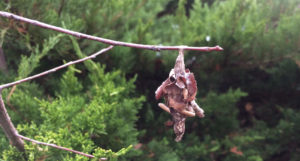
Photo: Rich Buckley
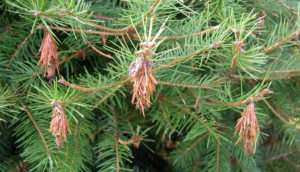
Photo: Rich Buckley
(1) Bagworms
Bagworms (and many other caterpillars) will be hatching any day now, and should be managed very soon. Bagworms should be targeted during egg hatch through first/second instar caterpillars, typically between 600-900 GDD50 (growing degree-days) prior to their airborne “ballooning” phase. Check that the eggs have hatched prior to application of pesticides as most compounds will not be effective at all if the first instar caterpillars are not present. Lethal pesticide doses are important, as sub-lethal doses can trigger early pupation, making the pest all but invincible.
Growing degree-days as of 6/7 (Using NEWA): (Upper Deerfield: 651 GDD50)(Howell: 502 GDD50)(Pequest: 414.5 GDD50)
Bagworm management: If eggs have not hatched: hand-remove sacs/bags. Typically female/egg filled sacs are higher in the canopy so keep that in mind while scouting.
Bagworm preferred materials: B.t. (Bacillus thuringiensis) and Spinosad containing compounds.
Other bagworm material options: Indoxacarb(Provaunt), chlorantraniliprole (Acelepryne), cyantraniliprole (Ference), growth regulator such as tebufenozide (Mimic), and many other compounds are available. Please contact your extension agent or chemical dealer for more information.
Please read the label. The label will provide use rates, restrictions (phytotoxicity or pollinator concerns), and re-application intervals.
Bagworm links / Shade tree insect recommendations:
https://njaes.rutgers.edu/pubs/publication.php?pid=FS1144
https://njaes.rutgers.edu/pubs/publication.php?pid=E334
Photo Credits: Rich Buckley (Plant Diagnostics Laboratory) https://njaes.rutgers.edu/plant-diagnostic-lab/
(2) Boxwood blight
Please continue or initiate protective/preventative applications this week for Boxwood Blight.
Previous Boxwood PPA 6/4/2020: https://plant-pest-advisory.rutgers.edu/immediate-potential-for-boxwood-blight-activity/
Boxwood blight activity as of today (6/8) for the next week (using a Millville, NJ weather station)
As of now the predicative model found at (https://uspest.org/risk/boxwood_app) indicates that there is a possibility for Boxwood Blight activity Wednesday (10th) and Thursday (11th) of this week. Additionally, I am expecting another round of pathogen activity on Sunday (14th). The tropical storm systems pushing up from the south may bring higher winds and short periods of rain that could easily spread the disease if present. Be mindful of overhead irrigation during this period and only water when leaves will have adequate time to dry.
Please visit and use this webpage for local disease forecasting (select a close-by weather station within the website or application): https://uspest.org/risk/boxwood_app)
(3) NJNLA online pesticide credit opportunity
NJNLA pesticide credit webinar/course: Invasive Forest Pests: New Threats and Their Management
Sign-up: https://www.njnla.org/events/EventDetails.aspx?id=1383945
Webinar – June 10th, 2020 – 7:00pm to 8:30pm. Invasive Forest Pests: New Threats and Their Management. You must include your email address when registering. Information to join Webinar will be sent just prior to the start. Cost: $35/Member, $50/Non-Member
NJ Pest Credits: 3A (Ornamentals) – 3, PP2 (Private Applicator Category) – 3, Plus: 2 (Forest) – 3, 8C (Campgrounds) – 3, 9 (Regulatory) – 3,. CNLP: Environment – 1.5, LTE/LTCO: 1 CEU, NJUCF: 1 CEU and ISA is still pending.
Please take the 2020 Nursery Industry Survey: https://forms.gle/dUjLxaiu6qDQYYsRA
Have a plant problem? Contact the Rutgers Plant Diagnostic Laboratory https://njaes.rutgers.edu/plant-diagnostic-lab/
Timothy J. Waller, Ph.D. @ twaller@njaes.rutgers.edu
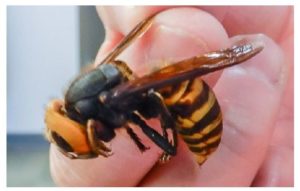
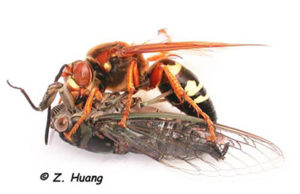 wasps found throughout the U.S. and burrow holes in the soil. Even with their large size, dangerous appearance and “dive-bombing” habit, adult Cicada killer wasps rarely come in contact with people and it is rare they will sting. The males of this species will make “dive-bombing” flight patterns, but do not have a stinger and an attack would not result in a sting. The female’s tubular egg-laying structure on the rear end can function as a very weak stinger. Her mild sting is similar to a slight pin scratch and is not considered by most people to be painful. Rutgers Cooperative Extension has more information on the
  ommitted to the agriculture industry and all interested in growing plants, raising livestock and essential resources related to agriculture. The program now features a new
 ertain time together.