
Each year for the New Jersey Vegetable Meeting, Rutgers Cooperative Extension publishes a proceedings book with summaries of presentations given during the educational sessions. The 2021 proceedings book is now posted on the Rutgers Vegetable Online Resources webpage. All proceedings books dating back to 2009 are also archived on this site and can be found by scrolling down to the bottom left corner of the webpage.
The 2021 Proceedings Book is dedicated in the memory of William Roberts who passed away on May 21, 2020 at the age of 88. After completing his college degree at Rutgers, Bill served our country in the military until 1955 where he earned the rank of First Lieutenant. He then returned to Rutgers, Cook College, to teach and later became an Extension Specialist in Agricultural Engineering. Early in his career, he invented the air-inflated, double-layer polyethylene film system for covering the roof of a greenhouse. Today, approximately 65 percent of all commercial greenhouses in the United States use the air-inflated system. This innovation won Bill many awards and tremendous gratitude from the industry. On a personal note, Bill was most known for his tremendous faith and love for family; especially wife Dottie. For more information about Bill Roberts, please see the beginning pages of the proceedings book for 2021.
We hope you will take the time to read the summaries included in the 2021 proceedings book. Robin Brumfield, Rutgers Extension Specialist in Agricultural Economics, recommends that anyone participating in the “Know Your Numbers, Know Your Options” morning and afternoon sessions on Monday, February 22nd, utilize her proceedings summaries on pages 19-25 (morning session) and pages 42-47 (afternoon session) while attending.
Also of interest – to obtain an online copy the 2020-2021 Commercial Vegetable Production Recommendations Guide a free download is available on the Rutgers NJAES Publications website. The guide is the same as in 2020 and a “critical updates” document is also available online for changes – mainly pesticide recommendations updates.
Potato and Tomato Disease Forecasting
Growers who are interested in using disease forecasting models should chose the location from the report that is closest in proximity to their farming operation.
In addition, regularly check the Cornell NEWA website @http://newa.cornell.edu/ where this information is compiled from. From the NEWA site menu click on Pests Forecasts, select your weather station, and click on the specific disease, set accumulation start date, and a table of daily and total DSVs will be generated.
Related Websites
Proceedings Book – Speaker Summaries for February 22-25th NJ Vegetable Meeting
Ask the Agent Fall Series
“Ask the Ag Agent” was created in spring 2020, when COVID-19 forced a new normal in communications nationwide. Rutgers Cooperative Extension Agricultural Agents working with “Ask the Ag Agent” education and outreach are committed to the agriculture industry and all interested in growing plants, raising livestock and essential resources related to agriculture. The program will now continue beginning on Wednesday, September 16th and run every-other Wednesday in September and October.
Farmers and others are welcome to join this bi-weekly teleconference each Wednesday night from 7:00pm-8:00pm. Weekly events are hosted by Rutgers Cooperative Extension Agricultural Agents working with the farming industry.
This call-in/WebEx event features updates on farm management, crop conditions, farm industry observations, agricultural agency programs and other topics discussed by farmers, agricultural agents and other agricultural service providers.
Hosted by Agricultural Agents Bill Bamka, Stephen Komar, Michelle Infante-Casella and Meredith Melendez, this bi-weekly communication provides a forum for discussion for farmers and all involved in NJ agriculture, including agricultural agency personnel, non-profit organizations and others.
This event and other events hosted by Rutgers Cooperative Extension can be found on the Rutgers NJAES Events website.
To join the “Ask the Ag Agent” forum each week on a computer/tablet/smartphone via the WebEx Videoconference use the link:
“Ask the Ag Agent” was created in spring 2020, when COVID-19 forced a new normal in communications nationwide. Rutgers Cooperative Extension Agricultural Agents working with “Ask the Ag Agent” education and outreach are committed to the agriculture industry and all interested in growing plants, raising livestock and essential resources related to agriculture. The program will now continue beginning on Wednesday, September 16th and run every-other Wednesday in September and October.
Farmers and others are welcome to join this bi-weekly teleconference each Wednesday night from 7:00pm-8:00pm. Weekly events are hosted by Rutgers Cooperative Extension Agricultural Agents working with the farming industry.
This call-in/WebEx event features updates on farm management, crop conditions, farm industry observations, agricultural agency programs and other topics discussed by farmers, agricultural agents and other agricultural service providers.
Hosted by Agricultural Agents Bill Bamka, Stephen Komar, Michelle Infante-Casella and Meredith Melendez, this bi-weekly communication provides a forum for discussion for farmers and all involved in NJ agriculture, including agricultural agency personnel, non-profit organizations and others.
This event and other events hosted by Rutgers Cooperative Extension can be found on the Rutgers NJAES Events website.
To join the “Ask the Ag Agent” forum each week on a computer/tablet/smartphone via the WebEx Videoconference click here
Join by phone
+1-650-429-3300 passcode 1202639477##
Nursery update; focus on warm season spider mites
This advisory provides; (1) warm season spider mite biology and control options, (2) current growing degree-day information, and (3) a boxwood blight risk update.
Note: Previous spider mite advisories
Steve Rettke, Rutgers IPM, wrote two very good advisory posts pertaining to the different seasonal mites, in addition to symptomology and images of the different mites. He is a wealth of information and has contributed photos and will be assisting in future fact-sheets pertaining to common pests and their control. In light of these advisory posts (below) this current advisory will only cover the basics as it applies to pest control. Contact: rettke@njaes.rutgers.edu
Please review his very informative advisories:
Cool season mites: https://plant-pest-advisory.rutgers.edu/cool-season-mites-wax-as-the-warm-season-mites-wane/
Warm season mites: https://plant-pest-advisory.rutgers.edu/cool-season-mites-have-faded-but-warm-season-mites-now-surge/
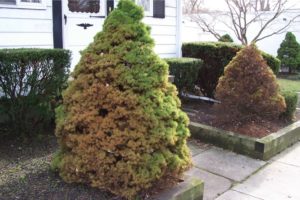
Cool season: Spruce spider mite damage on an Aberta Dwarf Spruce. Photo: Steven Rettke, RCE.
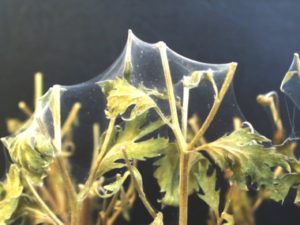
Warm season: Two spotted spider mite webbing and damage. Photo: Steven Rettke, RCE.
(2) Basic spider mite biology and control options
Cool season mites: The mites affecting horticulture crop production can be broken into two functional groups; cool season and warm season. Cool season mites feed and lay eggs, as the name suggests, in cooler times of the year (late winter-early spring and then again fall-early winter depending on the year). The two most common cool season mites are the Spruce and Southern red spider mites that feed on conifers and broadleaf evergreens, respectively. In many cases the damages caused by these mites are not noticed until well into the growing season. Meaning that if damages are observed mid-season you would be better off waiting until the fall to control cool season mites, i.e. targeting late season egg hatches and developing mites.
Warm season mites: As the season progresses towards summer, the warm season mites including Two-spotted, Maple, Oak, Honey locust, European, and other host specific spider mites become active (typically June – September). The Two-spotted spider mite is known as a “cosmopolitan” pest because of its ability to colonize, and damage, a wide variety of horticulture crops (but are rarely observed on conifers). Sentinel plants would include rose, euonymus, and forsythia, as they are favorites of these mites. In contrast to the cool season mites, warm season mite damages are often visible while the pest is actively feeding and multiplying, as up to 10-15 generations per growing season can impact your crop. Warm season mites evade suffocation by dormant oil sprays and other miticide applications by leaving their feeding locations on plants once temperatures begin to drop, and overwinter in the soil horizon or leaf litter under the host plant. As warm season mites are preparing to go into dormancy they begin to change their color to an orange hue, meaning they are not feeding as readily and will not be as affected by miticides because of this.
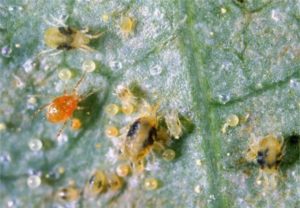
Multiple life stages of Two spotted spider mites. Photo: Steven Rettke, RCE.
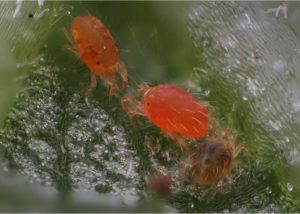
Two spotted spider mite females going into dormancy (orange coloration). Photo: Steven Rettke, RCE.
Conditions favoring spider mites: Full sun and dry, dusty conditions are often associated with increasing mite populations as low relative humidity often stimulates mite reproduction. Additionally, during periods of rain (and resulting leaf wetness-periods), certain fungi are able to attack and reduce mite populations (called entomopathogenic fungi). Meaning in frequently wet seasons mite numbers, damage, and miticide applications should be lowered due to increased fungal activity. However, this situation can certainly lead to increased plant pathogenic fungi activity as well, therefor a balance between the two is most desirable. Excessive nitrogen fertilizer has also been linked to explosive mite populations; therefor a well-planned nutritional regiment should be strictly followed.
IPM is important when suppressing spider mite populations!
Beneficials: In addition to entomopathogenic fungi (like Beauveria bassiana), numerous beneficial organisms can also manage mite populations including predacious mites (Phytoseiidae family), spider mite destroyer (Stethorus punctillim), ladybug larvae, midge larvae (Feltiella acarisuga), and minute pirate bugs. Given this complex, and many times free, natural defense system, applications of certain insecticides can actually cause mite populations to resurge by killing the mite-feeding beneficials (see note below). Therefor, all applications should be thoughtfully considered with economic (or cosmetic) thresholds in mind.
Compounds that can cause spider mite resurgence:
- Carbaryl (Sevin)
- Cyfluthrin containing compounds (Tempo, Decathalon, Scimitar)
- Permethrin (Astro)
- Imdacloprid (Merit, Marathon)
Warm season spider mite treatment options:
ROTATE between Insecticide Resistance Action Committee (IRAC #)
Format: [IRAC Group #]: Chemical name (Trade names)
- [3A]: Pyrethrins (Tersus)
- [5]: Spinosad (Conserve, Entrust)
- [6]: Abamectin (Avid, Lucid, Aracinate TM)
- [20D]: Bifenazate (Floramite SC)
- [10A]: Hexythiazox (Hexygon)
- [21A]: Pyridaben (Sanmite, Sanmite SC)
- [21A]: Fenazaquin (Magus)
- [23]: Spiromesifen (Forbid 4F, Judo)
“Softer” spider mite materials
- Agitator (forces mites out of hiding): Captiva
- Azadirachtin from the Neem plant: (Azatrol EC)
- Beauveria bassiana: (Naturalis-L)
- Horticulture oil: (@ 1-2% vol:vol summer applications)
- Insecticidal soaps: (M-Pede)
Always refer to the label for allowable host crops, use-restrictions, application rates, reapplication intervals, REI times, and mix compatibility information.
NOTE: Production and pesticide information on this site are for commercial operators only and are NOT for home gardener use. Provided materials represent examples and do not cover all possible control scenarios. Please contact your local agent or chemical sales representative for more information.
(2) Growing Degree-days as of 6/16/2020 (if you need help please contact me at twaller@njaes.rutgers.edu)
Upper Deerfield (NJ50)= 809 GDD50 Howell/Freehold (NJ10) = 628 GDD50 Pequest (NJ58) = 525 GDD50
Growing degree day map for our area: (courtesy of Cornell University; Fore Cast)
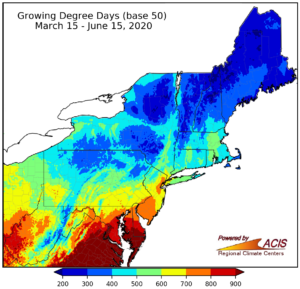
Growing degree-day map for our area. Cornell, Fore Cast.
(3) Boxwood blight risk update
| Boxwood Blight Risk Model | ||||
| Date | Upper Deerfield (NJ50) | Howell (NJ10) | Pequest (NJ58) | |
| 6/14/20 | Sun | Very low risk | Very low risk | Very low risk |
| 6/15/20 | M | Very low risk | Very low risk | Very low risk |
| 6/16/20 | T | Very low risk | Very low risk | Very low risk |
| 6/17/20 | W | Very low risk | Very low risk | Very low risk |
| 6/18/20 | Th | Low risk | Low risk | Low risk |
| 6/19/20 | F | Infection potential | Infection potential | Low risk |
| 6/20/20 | S | Low risk | Infection potential | Low risk |
| 6/21/20 | Sun | Very low risk | Low risk | Very low risk |
| Risk of infection | ||||
| adapted from: https://uspest.org/risk/boxwood_app | ||||
Please visit this website (there is a mobile app as well): https://uspest.org/risk/boxwood_app
Protective fungicide applications should remain in effect or be initiated immediately for Boxwood Blight. The disease may be sporulating and spreading amongst plantings if present (or may come into your nursery via shipments) within the next few days. Please continue preventative/protectant fungicide applications utilizing; chlorothalonil (FRAC Group M05), mancozeb (FRAC Group M03), and QoI-fungicides (FRAC Group 11) in a rotation (other materials available as well).
NJAES; Plant Diagnostic Lab https://njaes.rutgers.edu/plant-diagnostic-lab/
*Additional links and resources*
Please take the 2020 Nursery Industry Survey: https://forms.gle/dUjLxaiu6qDQYYsRA
Ask the Agent (every Wednesday @ 7:00pm): : https://go.rutgers.edu/t7wjkit1
NJNLA- Wine Down Wednesdays (every first and third Wednesday @ 7:00pm-8:00pm).
Email: Lori Jenssen @ njnla.director@gmail.com
Subscribe to the NJAES YouTube webpage: https://www.youtube.com/user/RutgersNJAES/
RU Sustainable Nursery Production website: https://njaes.rutgers.edu/nursery/
March meeting PDF: https://njaes.rutgers.edu/nursery/documents/2020%20SJ%20Nursery%20Meeting%20Proceedings.pdf
How to use growing degree-day resources: https://plant-pest-advisory.rutgers.edu/using-growing-degree-day-calculators-nursery-pest-and-pathogen-updates-important-resource-links/
2017 Southeastern U.S. Pest Control Guide for Nursery Crops and Landscape Plantings: https://content.ces.ncsu.edu/southeastern-us-pest-control-guide-for-nursery-crops-and-landscape-plantings
Rutgers Insect Control Recs. for Shade Trees and Commercial Nursery Crops: https://njaes.rutgers.edu/pubs/publication.php?pid=E334
NJAES; Soil Testing Lab: https://njaes.rutgers.edu/soil-testing-lab/
Thank you,
Cumberland County Extension: Timothy J. Waller, Ph.D. @ twaller@njaes.rutgers.edu
Bagworms will be hatching very soon and need attention
This advisory has three topics: (1) Bagworm hatch, (2) boxwood blight activity, and (3) NJNLA online pesticide credit course availability.
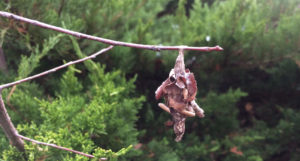
Photo: Rich Buckley
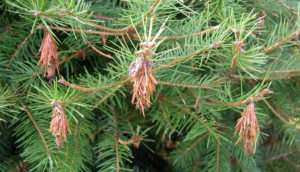
Photo: Rich Buckley
(1) Bagworms
Bagworms (and many other caterpillars) will be hatching any day now, and should be managed very soon. Bagworms should be targeted during egg hatch through first/second instar caterpillars, typically between 600-900 GDD50 (growing degree-days) prior to their airborne “ballooning” phase. Check that the eggs have hatched prior to application of pesticides as most compounds will not be effective at all if the first instar caterpillars are not present. Lethal pesticide doses are important, as sub-lethal doses can trigger early pupation, making the pest all but invincible.
Growing degree-days as of 6/7 (Using NEWA): (Upper Deerfield: 651 GDD50)(Howell: 502 GDD50)(Pequest: 414.5 GDD50)
Bagworm management: If eggs have not hatched: hand-remove sacs/bags. Typically female/egg filled sacs are higher in the canopy so keep that in mind while scouting.
Bagworm preferred materials: B.t. (Bacillus thuringiensis) and Spinosad containing compounds.
Other bagworm material options: Indoxacarb(Provaunt), chlorantraniliprole (Acelepryne), cyantraniliprole (Ference), growth regulator such as tebufenozide (Mimic), and many other compounds are available. Please contact your extension agent or chemical dealer for more information.
Please read the label. The label will provide use rates, restrictions (phytotoxicity or pollinator concerns), and re-application intervals.
Bagworm links / Shade tree insect recommendations:
https://njaes.rutgers.edu/pubs/publication.php?pid=FS1144
https://njaes.rutgers.edu/pubs/publication.php?pid=E334
Photo Credits: Rich Buckley (Plant Diagnostics Laboratory) https://njaes.rutgers.edu/plant-diagnostic-lab/
(2) Boxwood blight
Please continue or initiate protective/preventative applications this week for Boxwood Blight.
Previous Boxwood PPA 6/4/2020: https://plant-pest-advisory.rutgers.edu/immediate-potential-for-boxwood-blight-activity/
Boxwood blight activity as of today (6/8) for the next week (using a Millville, NJ weather station)
As of now the predicative model found at (https://uspest.org/risk/boxwood_app) indicates that there is a possibility for Boxwood Blight activity Wednesday (10th) and Thursday (11th) of this week. Additionally, I am expecting another round of pathogen activity on Sunday (14th). The tropical storm systems pushing up from the south may bring higher winds and short periods of rain that could easily spread the disease if present. Be mindful of overhead irrigation during this period and only water when leaves will have adequate time to dry.
Please visit and use this webpage for local disease forecasting (select a close-by weather station within the website or application): https://uspest.org/risk/boxwood_app)
(3) NJNLA online pesticide credit opportunity
NJNLA pesticide credit webinar/course: Invasive Forest Pests: New Threats and Their Management
Sign-up: https://www.njnla.org/events/EventDetails.aspx?id=1383945
Webinar – June 10th, 2020 – 7:00pm to 8:30pm. Invasive Forest Pests: New Threats and Their Management. You must include your email address when registering. Information to join Webinar will be sent just prior to the start. Cost: $35/Member, $50/Non-Member
NJ Pest Credits: 3A (Ornamentals) – 3, PP2 (Private Applicator Category) – 3, Plus: 2 (Forest) – 3, 8C (Campgrounds) – 3, 9 (Regulatory) – 3,. CNLP: Environment – 1.5, LTE/LTCO: 1 CEU, NJUCF: 1 CEU and ISA is still pending.
Please take the 2020 Nursery Industry Survey: https://forms.gle/dUjLxaiu6qDQYYsRA
Have a plant problem? Contact the Rutgers Plant Diagnostic Laboratory https://njaes.rutgers.edu/plant-diagnostic-lab/
Timothy J. Waller, Ph.D. @ twaller@njaes.rutgers.edu
Immediate potential for Boxwood Blight activity: Plus a Nursery and Greenhouse growers’ update
There is a potential for new boxwood blight infections in the next few days according to https://uspest.org/risk/boxwood_app.
Protective fungicide applications should remain in effect or be initiated immediately for Boxwood Blight. The disease may be sporulating and spreading amongst plantings if present (or may come into your nursery via shipments) within the next few days. According to https://uspest.org/risk/boxwood_app, this is the first legitimate potential for boxwood blight spread and new infections in 2020 for southern NJ. Please continue preventative/protectant fungicide applications utilizing; chlorothalonil (FRAC Group M05), mancozeb (FRAC Group M03), and QoI-fungicides (FRAC Group 11) in a rotation. Please contact Tim Waller at twaller@njaes.rutgers.edu for more information or questions.
UPDATES:
Growing Degree-days as of 6/4/20 using NEWA
GDD50 = Growing Degree-Day with min. temp. set to 50F
Upper Deerfield = 548.5 GDD50 ; Howell = 407.5 GDD50 ; Pequest = 335.0 GDD50
How to use growing degree-day resources: https://plant-pest-advisory.rutgers.edu/using-growing-degree-day-calculators-nursery-pest-and-pathogen-updates-important-resource-links/
Pests: The number of accumulated growing degree-days has been rapidly increasing with higher and higher temperatures (approaching normalcy). Throughout New Jersey various adult borers will be emerging, these include; Lilac, Emerald Ash, Banded Ash Clearwing, and Peach Tree borers. Additionally, Ambrosia beetles (multiple species) will be in-flight and actively seeking egg-laying locations. Pyrethroids should be used as preventative sprays but should be targeted to the bases of susceptible hosts such as Magnolias, Yellow bud, Red bud, Japanese maples, Styrax, and Hybrid chestnuts. These Targeted applications are geared towards protecting beneficial insect populations. The eggs of many scale insects are hatching now, leaving their ‘crawler’ stage vulnerable to pesticide applications. Scale insect species to be mindful of; Maskell, Oystershell, Taxus, Euonymus, Prunicola, Oak lecanium, Japanese maple, Cottony maple, Calico, Golden oak, and Juniper scale. Aphids, especially on roses, and mites will be increasing their populations with the warmer weather and should be minded when in high density. Management should utilize an appropriate pesticide rotation when necessary, as these pests are prone to developing pesticide resistance quickly. Four lined plant bugs, basswood lacebug, and multiple leaf and plant hoppers have been reported south of NJ and should be monitored and treated for as appropriate through the coming weeks as many of these insects are capable of vectoring plant viruses. Lilac leafminer, Juniper tip-midge, and Pin oak sawfly may also be an issue in some locations. Red-headed flea beetle will be hatching between 250-480 GDD50, with adults emerging between 500-1000 GDD50. A second generation of larva will then be active between 1,570 to 1860 GDD50, emerging later 1,878 to 2,318 GDD50. Reminder, keep an eye out for the Box tree moth that has been identified approaching the border of US and Canada. This pest has prompted APHIS importation amendments for Boxwood, Euonymus, and Illex. Gypsy moths, Bagworms, Mimosa webworm will be hatching or emerging in many parts of the state very soon, (in some locations they may already have).
Please visit https://njaes.rutgers.edu/pubs/publication.php?pid=E334 for more specific information.
Understanding and approaching plant diseases: The weather as of late has been conducive to plant disease for much of NJ. Higher humidity, increasing temperatures, and prolonged periods of leaf wetness (particularly at night) are considered the factors associated with the ‘sweet spot’ of disease development. Regularly scheduled protectant fungicide applications should be continued if a pathogen or history-thereof is suspected. Compounds should be rotated to guard against pesticide resistance to any one compound (rotating high/medium-risk with low-risk materials). Also, any steps geared towards increasing airflow, reducing wet-feet, limiting mechanical injury, and reducing leaf wetness duration or excessive overhead irrigation during this warm and humid period will benefit disease management efforts.
Please visit: https://njaes.rutgers.edu/pubs/publication.php?pid=E036 for more specific information on individual plant and pathogen species.
Other timely diseases to note: Many needle cast diseases of conifers should be well into a fungicide application schedule, utilizing chlorothalonil, azoxystrobin, basic sulfate coppers, mancozeb, and T-methyl in a rotation of materials. Many of these compounds will also control Pine needle rust that may become prevalent in some locations, especially those locations with high levels of goldenrod or aster weeds. Botrytis and powdery mildew are still a concern in many parts of the state, especially those that are experiencing cooler nighttime temperatures. What fungicide used is dependent on the specific host species in many cases. Please refer to the link above for specific information. Fungal and bacterial leaf spots are very common and often only intensively treated if those plants are to enter the market the next season. However, in areas prone to disease or severe cases (defoliation occurs), treatments should be preventative and conducted throughout the season. Sooty mold grows on the honeydew produced by large populations of sap-sucking insect pests (aphids, scales, leaf/plant hoppers). Controlling the insect pests is our best option to reduce this unsightly disease. In severe casts of sooty mold, plants can be washed free of this fungal growth using mild detergents. Phytophthora diseases are ever present at the nursery, however cultural practices such as sterilized potting media, cleaning tools and machinery regularly, efforts to reduce wet-feet or overwatering, and sterilization or treatment of recycled water can have profound impacts on the expression or spread of Phytophthora diseases. When fungicide applications are required, materials like phosphorus acids, fosetyl-Al (Aliette), mefenoxam (Ridomil), and etridiazole + T-methyl (Banrot) are commonly used. Rotation of these compounds and proper disease identification are incredibly important as many root-rotting pathogens have a strong propensity towards developing pesticide resistance.
Please consider the Rutgers Plant Diagnostics Laboratory for pest/pathogen identification concerns: https://njaes.rutgers.edu/plant-diagnostic-lab/
Online discussions and credit events
NJNLA pesticide credit webinar/course: Invasive Forest Pests: New Threats and Their Management (6/10/20): https://www.njnla.org/events/EventDetails.aspx?id=1383945
Webinar – June 10th, 2020 – 7:00pm to 8:30pm. Invasive Forest Pests: New Threats and Their Management. You must include your email address when registering. Information to join Webinar will be sent just prior to the start. Cost: $35/Member, $50/Non-Member. NJ Pest Credits: 3A (Ornamentals) – 3, PP2 (Private Applicator Category) – 3, 2 (Forest) – 3, 8C (Campgrounds) – 3, 9 (Regulatory) – 3,. CNLP: Environment – 1.5, LTE/LTCO: 1 CEU, NJUCF: 1 CEU and ISA is still pending.
EPA information pertaining to online credits for licenses expiring in 2020: https://pestmanagement.rutgers.edu/increased-online-ceus-for-licenses-expiring-2020-act-now/
Ask the Agent (every Wednesday @ 7:00pm): https://go.rutgers.edu/t7wjkit1 . A new online forum has been created where anyone can log-on and speak with Rutgers Cooperative Extension agents (multiple agents from multiple counties)
NJNLA- Wine Down Wednesdays (every first and third Wednesday @ 7:00pm-8:00pm). Email: Lori Jenssen @ njnla.director@gmail.com. This is a great opportunity to speak with other green-industry businesses.
Rutgers nursery survey, advisory, and other resources:
Please take the 2020 Nursery Industry Survey: https://forms.gle/dUjLxaiu6qDQYYsRA
The new nursery agents have prepared a preliminary survey aimed at understanding the needs of our growers and clientele, i.e. you. Please take a moment to complete the survey, as this type of information really helps the agents secure grant funding to deal with the problems you actually have. Thank you!
Subscribe to the NJAES YouTube webpage: https://www.youtube.com/user/RutgersNJAES/
RU Sustainable Nursery Production website: https://njaes.rutgers.edu/nursery/
March meeting PDF: https://njaes.rutgers.edu/nursery/documents/2020%20SJ%20Nursery%20Meeting%20Proceedings.pdf
Using Growing Degree-day calculators, nursery pest and pathogen updates, important resource links
Announcements:
NJ Department of Agriculture Issues Burn Permit for Frost Protection –May 7 thru May 11
New Jersey Department of Agriculture has issued a notice concerning open burning due to colder spring overnight temperatures presently forecasted for areas of New Jersey from Thursday, May 7 through Monday, May 11, 2020, which could adversely affect fruit, vegetable, and floriculture crops in bloom or near bloom around the state. For more information: https://plant-pest-advisory.rutgers.edu/nj-department-of-agriculture-issues-burn-permit-for-frost-protection-thru-may-11/
Sourcing PPE for your workers:
If you need PPE for you and your workers, please do not wait to obtain more supplies! When our region re-opens to the masses there will be another wave of high-demand for masks and PPE. https://plant-pest-advisory.rutgers.edu/sourcing-personal-protective-equipment-ppe-for-your-farm-employees/
Recent financial Plant and Pest Advisory Posts:
US Small Business Admin Opens Economic Injury Disaster Loan (EIDL) Programs to Agriculture: https://plant-pest-advisory.rutgers.edu/us-small-business-admin-opens-economic-injury-disaster-loan-eidl-programs-to-agriculture/
SBA resumed accepting Paycheck Protection Program applications: https://plant-pest-advisory.rutgers.edu/sba-resumed-accepting-paycheck-protection-program-applications/
Utilizing Growing Degree-day calculators and resources:
(As of 5/7/20 using NEWA, Upper Deerfield = 213.5GDD50 ; Howell = 153.5 GDD50 ; Pequest = 88.0 GDD50) (GDD50 = Growing Degree-Day with min. temp. set to 50F)
Using Growing Degree Day models to plan pest management timing is a proven method for understanding when a pest or pathogen will rear its ugly head. These models utilize temperature min. and max. throughout the day to generate “growing degree day” units that accumulate throughout the year (typically starting on Jan. 1st, with a minimum temperature set to 50F (base-50)). Correlations between degree-day accumulation and vulnerable life stage events, such as egg hatch or adult emergence, allow pest management to be conducted, or scouted for, more efficiently. These models can track or predict insect, mite, weed, and plant pathogen lifecycles as well as those of beneficial insects, allowing us to protect that arm of Integrated Pest Management (IPM).
Within these models the user can set multiple parameters, allowing hyper-localized information for most of the country. Simple models are also available. The temperature min/max, can be manipulated for specific pests, however a minimum temperature of 50F (aka base-50) is most often cited in growing degree-day pest lists. These models are general in nature, as biology occurs over some span of time or set of conditions, and should therefor be ground-truthed at each location if at all possible. Many other types of pest or disease predictive models are available within the resources listed below, and the agents can help you understand what information you need for those calculations.
Note: The nursery agents are working to develop a local, Rutgers centralized, growing degree-day calculator that will provide information on key pests as well as nursery and greenhouse BMPs thereof. Armed with this information, we will be generating charts and other visual aids that target multiple pests per application, thus increasing labor efficiency.
Degree Day Calculators (select a local weather station within the website):
NEWA (Cornell): http://newa.cornell.edu/index.php?page=growing-degree-days
– Very easy to use
Integrated Plant Protection Center (Oregon State): http://uspest.org/
– More complicated but has many different modeling options
– ***Boxwood blight specific risk model: https://uspest.org/risk/boxwood_app , also available as an iOS or Android app ***
Typically the procedure is as follows: select a close by weather station, select degree-day calculator, select the min. temperature (50F or “base-50”), select max. temperature (arbitrarily high- 110F), click graph or calculate or get report, then locate the date(s) of interest on the computed table. The accumulated growing degree-days of those dates can then be compared to the target GDD50 on the pest lists below. *Tim Waller will help you set up a local degree-day calculation, or understand how to use this information if needed (twaller@njaes.rutgers.edu)
Pest lists with GDD50 targets:
Ohio State: http://cues.cfans.umn.edu/old/Web/049DegreeDays.pdf
University of California: http://ipm.ucanr.edu/MODELS/index.html
University of Maryland: https://extension.umd.edu/node/11155
University of New Hampshire: http://ccetompkins.org/resources/using-growing-degree-days-for-insect-management
*Some discrepancies between degree-day targets; go with what you have observed locally*
Pests and diseases to be on the lookout for:
(Upper Deerfield = 213.5GDD50 ; Howell = 153.5 GDD50 ; Pequest = 88.0 GDD50)
Pests: Looking towards our southern neighbor states, several pests are either currently present or will become evident in the near future including: Boxwood leafminer, Allium Leaf miner, Lilac borer, Ambrosia beetles (multiple species), Red-headed flea beetle, Hemlock woolly adelgid, Pine Bark adelgid, Roseslug sawflies, Spruce spider mites, Wooly elm aphids, Spirea aphid, Andromeda lace bug, Azalea lace bug, and Pine needle scale. The warm weather jump-started pest development only to be slowed by the current cool days and cooler nights, providing more wiggle room for protective or systemic pesticide applications. Utilize growing degree-day (GDD50) models to apply protectant applications as well as systemic soil drenches when applicable or allowable for pollinator protection.
Red-headed flea beetle larva will be hatching between 250-480 GDD50, with adults emerging between 500-1000 GDD50. A second generation of larva will then be active between 1,570 to 1860 GDD50, emerging later 1,878 to 2,318 GDD50. Brian Kunkel, entomologist at the University of Delaware, has determined that up to three, overlapping, generations can be present in container grown ornamentals. Ambrosia beetles, particularly Xylosandrus crassiusculus (granulate ambrosia beetle), and Xylosandrus germanus (black stem borer), should begin flights soon, or have already done so to some degree. These small beetles begin flight when temperatures hover around 60-70F and are attracted to alcohol produced by woody ornamentals in the spring. The cooler nighttime temperatures and daily averages have kept much of this activity low but scouting should be vigilant during this time. Another invasive pest, the Box tree moth, has been identified approaching the border of US and Canada. This pest has prompted APHIS importation amendments for Boxwood, Euonymus, and Illex. (https://content.govdelivery.com/accounts/USDAAPHIS/bulletins/27f467d)
Diseases: The current temperatures coupled with long wetness-periods, provide optimal pathogen conditions for diseases such as Botrytis, Sclerotinia sclerotiorum, Black spot on roses, multiple Needle cast diseases of conifers, root rots, and bacterial diseases. Once temperatures begin to increase again, pathogen numbers could explode. Efforts towards protectant applications are critical, especially in situations where plants are being held longer than previously anticipated due to COVID-19 related disruptions. Any steps geared towards increasing airflow, reducing wet-feet, and limiting mechanical injury during this wet and cool period will benefit disease management approaches. Please consult your agents for specific disease control recommendations.
Beach Leaf Disease, caused by an exotic nematode, is affecting beeches in the Great Lakes region and into Pennsylvania. Little is known about the disease, other than the nematodes distort beech leaves by forming sunken lesions, which eventually turn the leaf yellow and drop off. Please contact your local agent if you suspect this disease to be anywhere in New Jersey (forest, farm, etc.). https://www.state.nj.us/dep/parksandforests/forest/docs/Pest_Alert-Beech_Leaf_Disease.pdf .USDA-ARS (more info on the nematode): https://tellus.ars.usda.gov/stories/articles/what-s-killing-beech-trees/
Please advise what pests/pathogens you are seeing in the field so we can be better informed on their management!
Online events and resources:
Ask the Agent (every Wednesday @ 7:00pm): https://go.rutgers.edu/t7wjkit1
A new online forum has been created where anyone can log-on and speak with Rutgers Cooperative Extension agents (multiple agents from multiple counties).
NJAES YouTube webpage: https://www.youtube.com/user/RutgersNJAES/
Our Rutgers Nursery Working group will be uploading many more instructional videos to the NJAES YouTube page in the near future. This webpage has numerous pest/pathogen/ID educational videos, especially from the Plant Diagnostics Lab here at Rutgers.
Tim Waller has posted an introduction video to the newly created “Commercial Nursery and Greenhouse Production” playlist https://youtu.be/RQbXmc5Uug8.
(Please email twaller@njaes.rutgers.edu or william.errickson@njaes.rutgers.edu with ideas for videos!)
2020 Nursery Industry Survey: https://forms.gle/dUjLxaiu6qDQYYsRA
The new nursery agents have prepared a preliminary survey aimed at understanding the needs of our growers and clientele, i.e. you. Please take a moment to complete the survey, as this type of information really helps the agents secure grant funding to deal with the problems you actually have. Thank you! Please share with other growers that may not have access.
RU Sustainable Nursery Production website: https://njaes.rutgers.edu/nursery/
March meeting PDF: https://njaes.rutgers.edu/nursery/documents/2020%20SJ%20Nursery%20Meeting%20Proceedings.pdf
Thank you.
Contact information for the new nursery agents:
Timothy J. Waller
County Agent
Specialty areas: Commercial nursery production, plant health, and phytopathology
Rutgers Cooperative Extension of Cumberland County
291 Morton Ave. Millville, NJ 08332
856-451-2800
twaller@njaes.rutgers.edu
Bill Errickson
County Agent
Specialty areas: Nursery and turfgrass production, agricultural innovation, and soil fertility
Rutgers Cooperative Extension of Monmouth Count
4000 Kozloski Rd., P.O. Box 5033. Freehold, NJ 07728
732-431-7260, ext. 7273
william.errickson@njaes.rutgers.edu
