Ask the Ag Agent Weekly Online/Call-In Forum and New Web Page

Ask the Ag Agent was created when COVID-19 forced a new normal in communications nationwide. Rutgers Cooperative Extension Agricultural Agents working with “Ask the Ag Agent” education and outreach are cAsk the Ag agentommitted to the agriculture industry and all interested in growing plants, raising livestock and essential resources related to agriculture. The program now features a new Ask the Ag Agent website with more information.

Farmers and others are welcome to join a weekly teleconference each Wednesday night from 7:00pm-8:00pm. Weekly events are hosted by Rutgers Cooperative Extension Agricultural Agents working with the farming industry.

This call-in/WebEx event features updates on farm management, crop conditions, farm industry observations, agricultural agency programs and other topics discussed by farmers, agricultural agents and other agricultural service providers.

Hosted by Bill Bamka, Stephen Komar, Michelle Infante-Casella and Meredith Melendez, this weekly communication provides a forum for discussion for farmers and all involved in NJ agriculture. Agricultural agency personnel, non-profit organizations and others have participated and added additional discussion with farmers.

This event and other events hosted by Rutgers Cooperative Extension can be found on the Rutgers NJAES Events website.

To join the “Ask the Ag Agent” forum each week on a computer/tablet/smartphone via the WebEx Videoconference:

Use the URL: https://go.rutgers.edu/rc9n3kxtiPhone

To join the “Ask the Ag Agent” each week on the Phone:
Call: (650)-429-3300
Access Code: 799-743-872 # followed by #

Dealing with Stress on the Farm During Trying Times

This is a stressful time for many people in our country and especially on the farm. With constant updates from government officials and media sharing new about the pandemic and the fear of the unknown for the future, it is understandable to feel overwhelmed, stressed and anxious. Seeing other farmers around the nation struggling with crop losses and distribution nightmares makes other farmers wonder what is yet to come. You are not alone and there are resources to help if you are struggling with stress and anxiety.

For assistance contact the Substance Abuse and Mental Health Services Administration’s (SAMHSA) Disaster Distress Helpline at 800-985-5990, the National Suicide Prevention Lifeline at 800-273-8255 or text MHFA to 741741 to talk to a Crisis Text Line counselor.

Farmers often feel they may be mentally and physically tougher than most people. That may be true. However, it is understandable if you are feeling depressed or anxious right now, just like the millions of people across the country who are facing the same worries and challenges. It’s perfectly understandable since most people have never experienced times like we are facing now. It’s extremely important to take care of your mental health. Helping yourself means you will be able to help others in the future.

While times may not change as quickly as we would like, there are easy self-care strategies that can help reduce feelings of depression and anxiety, or prevent anxiety before it even starts.

Here are some tips that may help:
1. Eat healthy foods to keep your body in top working order and avoid foods/beverages that cause issues with underlying health conditions.
2. Exercise reduces symptoms of depression and anxiety. Exercise is not the same as regular activity at work. Take a brisk walk or jog down a farm road, ride a bike, lift weights (even if you need to make your own out of what you have around the farm and start light).
3. Practice relaxation therapy. Focusing on tensing and relaxing muscle groups can help you relax voluntarily when feeling overwhelmed, stressed or anxious. Concentrate on the shoulder and neck regions of the body, where stress often builds.
4. Be kind to yourself. Treat yourself with the same compassion you would a friend and allow others to help as you would help them.
5. Stay connected. Even if you can’t get together face-to-face, you can stay connected to friends, family and neighbors with phone calls, text messages, video chats and social media. If you’re feeling lonely, sad or anxious, reach out to your social support networks – all is kept confidential. Share what you are feeling and offer to listen to friends or family members about their feelings. We are all experiencing this scary and uncPerson holding a fishertain time together.
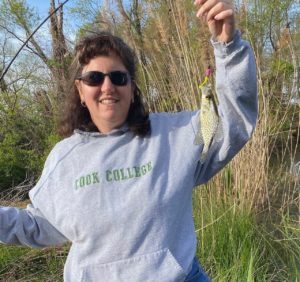
6. Monitor media consumption. While you might want to stay up-to the minute with COVID-19 news, too much exposure can be overwhelming. Balance media consumption with other activities you enjoy, such as playing with pets, reading, cooking, fishing at the farm pond, playing games with family or listening to music.

Adding small changes to your routine each day can make a big difference to your overall mood and well-being. Just remember, if you need help, help is available.

Sustainable Nursery Production Website Updates / Join Our Nursery Grower Email List

Fields of flowers

Please visit (click on links) the Rutgers Sustainable Nursery Production website for the following:

Join our Nursery Growers email list: please email Brandi Williams at brandiwi@co.cumberland.nj.us to stay connected during this time of COVID-19 social distancing and beyond. We will only email you important nursery industry related materials.

Voice your needs: please complete the 2020 Nursery Industry Survey to help the new nursery agents align their programmatic efforts to the needs of our communities.

Get information: view or download the missed 2020 South Jersey Nursery Meeting presentations (PDF).

Watch: visit the Rutgers NJAES video channel for educational content.

We need your input as this website is for you! Please feel free to contact us with ideas, suggestions, discrepancies, and thoughts on website improvements.


Please note: The Sustainable Nursery Production website will be rapidly expanding with new instructional videos, recorded webinar sessions, and commercial nursery production resources, serving as a key resource to our New Jersey grower communities. Additional sections such as commonly used forms will also be updated soon.

The new RCE nursery agents: Bill Errickson (Monmouth) and Timothy Waller (Cumberland) are focused on bringing new and updated Rutgers branded educational materials (fact-sheets, recommendations, videos, etc) to the forefront in an effort to better serve our growers.

Thank you for participating!


Contact Us:

Timothy J. Waller (website improvements)
County Agent
Rutgers Cooperative Extension of Cumberland County
291 Morton Ave.
Millville, NJ 08332
856-451-2800
twaller@njaes.rutgers.edu

Brandi Williams (Nursery Growers email-list)
Agriculture and Natural Resources Secretary
Rutgers Cooperative Extension of Cumberland County
291 Morton Ave.
Millville, NJ 08332
856-451-2800
brandiwi@co.cumberland.nj.us


Monitoring for SLF Egg Masses

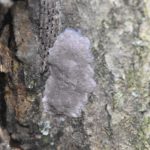
Spotted lanternfly egg mass

Spotted lanternfly egg mass – photo by A.L. Nielsen

Spotted lanternfly is a new invasive species in NJ. Egg masses are brownish grey and generally laid on bark in early fall and appear like a smudge of mud. Adults are expected to start egg laying in August and continue through November or the first hard frost.

SLF eggs overwinter and can be laid on multiple hard surfaces, including fence posts, trees, patio furniture, fruit bins, landscaping stones, railway cars, etc. Due to this they can be easily transported and represent a significant risk to SLF populations spreading. Vehicles, stones, agricultural equipment, and fruit bins coming from PA or VA should be inspected for egg masses beginning in August. Within state movement is also of concern to prevent new populations. If found, egg masses can be scraped into a plastic bag and frozen to limit spread and future impact of this pest.

Spotted Lanternfly in NJ

NEW PEST ALERT

Spotted lanternfly in grape

Spotted lanternfly in grape – photo credit E. Smyers

Spotted lanternfly (Lycorma deliculata, SLF) has been found in NJ. SLF is an invasive plant hopper species that could be very devastating to some NJ crops. Since its discovery in Pennsylvania in 2014, SLF has been placed under a state quarantine encompassing 13 Pennsylvania counties. Populations are also present in Virginia.

SLF adults and nymphs are phloem feeders that feed in large aggregations on woody tissue. Over 65 host plants were reported in Asia, many of which grow in the mid-Atlantic area. These host plants include hardwood trees such as Tree of Heaven, black walnut, and red maple and agricultural crops such as grape, apple, and hops. Feeding occurs on the trunk and limbs of plants, not on the fruit or leaf tissues. However, because they feed in aggregations and produce large amounts of honey dew (or sugar water), sooty mold can grow on plant surface and fruit, leading to reduced photosynthesis and plant vigor. In Pennsylvania, adults and nymphs have been observed feeding in commercial vineyards on cultivated grape. Economic estimates of injury are not available but growers report direct yield losses due to sooty mold and reductions in plant health and canopy coverage. Insecticides are effective but due to the high mobility of this pest, in highly infested areas, vines should be monitored closely for new bugs. Populations and injury are higher along vineyard edges, especially near Tree of Heaven. Interestingly, SLF tends to aggregate on a few trees or vines. Survey for SLF along the perimeters of fields and on Tree of Heaven, Black Walnut, Red Maple, and wild grapevines at the edges of wood lines. Aggregations of adults were found on commercial apple trees in PA near apples harvest in 2017, so apple growers need to be diligent as well.

The adults are large (~1” long) and quite colorful with a black head, grayish black spotted forewings and reddish black spotted hind wings. Adults may start to appear mid-late July (now) and will feed through the first hard freeze in the fall. Young nymphs hatch from eggs in late Spring/early summer and are black with white spots and as they get older they become red and black with white spots. While 4th instars have been reported in NJ, adults are present in VA, so be on the lookout for all life stages.

Spotted lanternfly on tree

Spotted lanternfly on Tree of Heaven – photo by A.L. Nielsen

If you think you seen or collected a spotted lanternfly please report it the New Jersey Department of Agriculture and the Department of Entomology at the Rutgers University School of Environmental and Biological Sciences by emailing slanternfly@njaes.rutgers.edu

Rutgers Cooperative Extension of Gloucester County Has New Office Location

County Agricultural Agents, Michelle Infante-Casella and Hemant Gohil have a new office location in Gloucester County. The Rutgers Cooperative Extension (RCE) Office in Gloucester County relocated last week. The new location is now at the Shady Lane County Complex, 254 County House Road, Clarksboro, NJ 08020. The entrance is on the right side of the main 3-story brick building, under the numbers 254; follow the sidewalk with gray brick pavers.

Front-side of a building

Entrance to the RCE of Gloucester County Offices down the sidewalk on the right.

The office also has a new phone number and Agricultural Agents and other staff can be reached at 856-224-8040 (Agriculture and Natural Resources is extension 1). This new complex provided by Gloucester County offers more office space and multiple options for educational programs. To the left side of the complex is a 4-classroom building, formerly the Gloucester County Fire Academy, that is now operated by Rowan College of Gloucester County, that can be utilized for extension education and other county-related events. The main office building has 3 conference rooms for small group meetings. RCE will still have access to the main auditorium at the former facility in Clayton. For more information about Rutgers Cooperative Extension of Gloucester County see http://gloucester.njaes.rutgers.edu.