Spotted Lanternfly in NJ

NEW PEST ALERT

Spotted lanternfly in grape

Spotted lanternfly in grape – photo credit E. Smyers

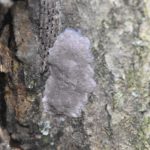
Spotted lanternfly (Lycorma deliculata, SLF) has been found in NJ. SLF is an invasive plant hopper species that could be very devastating to some NJ crops. Since its discovery in Pennsylvania in 2014, SLF has been placed under a state quarantine encompassing 13 Pennsylvania counties. Populations are also present in Virginia.

SLF adults and nymphs are phloem feeders that feed in large aggregations on woody tissue. Over 65 host plants were reported in Asia, many of which grow in the mid-Atlantic area. These host plants include hardwood trees such as Tree of Heaven, black walnut, and red maple and agricultural crops such as grape, apple, and hops. Feeding occurs on the trunk and limbs of plants, not on the fruit or leaf tissues. However, because they feed in aggregations and produce large amounts of honey dew (or sugar water), sooty mold can grow on plant surface and fruit, leading to reduced photosynthesis and plant vigor. In Pennsylvania, adults and nymphs have been observed feeding in commercial vineyards on cultivated grape. Economic estimates of injury are not available but growers report direct yield losses due to sooty mold and reductions in plant health and canopy coverage. Insecticides are effective but due to the high mobility of this pest, in highly infested areas, vines should be monitored closely for new bugs. Populations and injury are higher along vineyard edges, especially near Tree of Heaven. Interestingly, SLF tends to aggregate on a few trees or vines. Survey for SLF along the perimeters of fields and on Tree of Heaven, Black Walnut, Red Maple, and wild grapevines at the edges of wood lines. Aggregations of adults were found on commercial apple trees in PA near apples harvest in 2017, so apple growers need to be diligent as well.

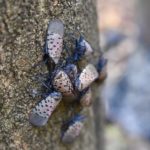
The adults are large (~1” long) and quite colorful with a black head, grayish black spotted forewings and reddish black spotted hind wings. Adults may start to appear mid-late July (now) and will feed through the first hard freeze in the fall. Young nymphs hatch from eggs in late Spring/early summer and are black with white spots and as they get older they become red and black with white spots. While 4th instars have been reported in NJ, adults are present in VA, so be on the lookout for all life stages.

Spotted lanternfly on tree

Spotted lanternfly on Tree of Heaven – photo by A.L. Nielsen

If you think you seen or collected a spotted lanternfly please report it the New Jersey Department of Agriculture and the Department of Entomology at the Rutgers University School of Environmental and Biological Sciences by emailing slanternfly@njaes.rutgers.edu

Rutgers Cooperative Extension of Gloucester County Has New Office Location

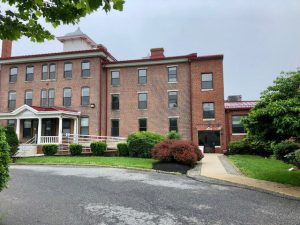
County Agricultural Agents, Michelle Infante-Casella and Hemant Gohil have a new office location in Gloucester County. The Rutgers Cooperative Extension (RCE) Office in Gloucester County relocated last week. The new location is now at the Shady Lane County Complex, 254 County House Road, Clarksboro, NJ 08020. The entrance is on the right side of the main 3-story brick building, under the numbers 254; follow the sidewalk with gray brick pavers.

Front-side of a building

Entrance to the RCE of Gloucester County Offices down the sidewalk on the right.

The office also has a new phone number and Agricultural Agents and other staff can be reached at 856-224-8040 (Agriculture and Natural Resources is extension 1). This new complex provided by Gloucester County offers more office space and multiple options for educational programs. To the left side of the complex is a 4-classroom building, formerly the Gloucester County Fire Academy, that is now operated by Rowan College of Gloucester County, that can be utilized for extension education and other county-related events. The main office building has 3 conference rooms for small group meetings. RCE will still have access to the main auditorium at the former facility in Clayton. For more information about Rutgers Cooperative Extension of Gloucester County see http://gloucester.njaes.rutgers.edu.

Answers to Emerald Ash Borer Questions

The NJ Emerald Ash Borer Task Force has agreed upon the following in response to EAB management questions in NJ:

  • All ash trees in NJ should be considered at high risk for EAB.
  • It is appropriate to begin treatment of high value ash trees throughout NJ now.
  • For any questions about treatment methods, we should refer to the “Insecticide Options for Protecting Ash Trees from Emerald Ash Borer” bulletin on the website (emeraldashborer.nj.gov).
  • We should recommend that people work with a Certified (Licensed) Tree Expert or Approved Consulting Forester to help them determine whether or not their ash trees are good candidates for a treatment program (vs. removal), and that they should contract a Certified Pesticide Applicator to complete any chemical treatments.
  • Any trees determined to be of high safety risk should be removed immediately.
  • Any actively infested trees should be cut down and chipped as soon as possible and then left on site (in the municipality).
  • For all other ash, it is best to complete removals in the fall and winter. The material must be processed (chipped or de-barked) before emergence (by late April).
  • For municipalities, we should recommend triage of the ash resource to spread out ash removals over several years.

Rich Buckley at the Rutgers Plant Diagnostic Lab has agreed to examine samples for EAB at no charge as long as they are brought to the lab.

Anyone interested should be directed to contact the Rutgers Plant Diagnostic Lab, and should bring the beetle, larvae, or sample of symptomatic tissue (chunk of bark with exit wound).

The NJ EAB Task Force is comprised of representatives from the NJ Department of Agriculture, NJ State Forest Service, USDA APHIS, Rutgers University, and the US Forest Service. The Task Force works to collaborate on EAB management decisions and advice, and to consolidate and disburse information and resources relevant to EAB in New Jersey.

Ladies and Gentlemen: Start Your Engines!

In February, I was scheduled to speak at a landscape program in Rockville, MD. Before I went on, I had a chance to chat with one of the other speakers–the esteemed entomologist from the University of Maryland, Dr. Mike Raupp–who said concerning the Emerald Ash Borer, “nobody believes you until the trees start dying.”

Thin canopied ash trees in a central-Jersey landscape. Photo: Richard Buckley, Rutgers PDL

Thin-canopied ash trees in a central-Jersey landscape. Photo: Richard Buckley, Rutgers PDL

[Read more…]

Better Late Than Never

Today’s rain got me thinking about insect damage in turfgrass. Actually I’ve been thinking about insect damage in turf for a week or so, ever since I saw a flock of birds pecking sod webworms out of the bentgrass plots behind the Plant Diagnostic Laboratory.

Flocks of birds on turfgrass are usually up to no good. Photo: Richard Buckley, Rutgers PDL

Flocks of birds on turfgrass are usually up to no good. Photo: Richard Buckley, Rutgers PDL

[Read more…]

Too Much of Everything is Just Enough

Right along with stormy skies, the Plant Diagnostic Laboratory is firing up with golf turf samples. We’ve seen it all lately: anthracnose, summer patch, slime molds, take-all, Pythium root diseases, annual bluegrass weevils, black turfgrass ataenius, and lots of wear and tear. Here are a couple of random notes from the last week or two:

Slime mold-just because they are cool. Photo: Howard Szczurek

Slime mold–just because it’s cool. Does this look like dog yak? Photo: Howard Szczurek

[Read more…]