Farm Credit East Report on Grants & Incentives Available for Northeast Agriculture Businesses

One of the most frequent calls over the past few years has been, “I want to start a farm/business/value-added product (etc.).”

That is usually followed up with, “What grants/funding sources are available?”

After rattling off a list of a few common sources of funding for new farmers there’s an added caveat that I don’t know the current status of those programs or what restrictions they have regarding new farming ventures. There are more programs out there with available funding, but there’s no comprehensive list of all grant programs supporting agricultural businesses, until now.

Farm Credit East has just released a report “identifying federal, regional and state grants, loan guarantees, and other incentives available to assist Northeast producers of all types and sizes.”

“Grants can be a great resource to provide additional funds needed to take on larger projects,” said Chris Laughton, Farm Credit East Director of Knowledge Exchange. “Unfortunately, they’re often under-utilized because they can be time consuming and involve quite a bit of paperwork.”

The report, from Farm Credit East Knowledge Exchange, includes funding opportunities available in the eight states served by Farm Credit East. Programs are categorized by their main focus:  beginning farmers; conservation, environment and forestry; energy; fisheries and aquaculture; organic; rural business development; and research, education and promotion.

The report titled Grants and Incentives for Northeast Agriculture is available at FarmCreditEast.com or by contacting Chris Laughton at (800) 562-2235 or Chris.Laughton@farmcrediteast.com for more information.

Farm Credit East also has grant writing assistance services. Information is available on their grant writing page.

[Source:  https://www.farmcrediteast.com/en/about/NewsRoom/press-releases/230717FundingforNortheastAgriculturalProducers]

Summer Weeds

It finally feels like summer in New Jersey. Rain, humidity, and warmer temperatures, especially at night, mean that warm-season weeds are growing quickly. Of particular concern are summer annuals like crabgrass, goosegrass, and spurges. Yellow nutsedge and false-green kyllinga are warm-season perennials are also enjoying the weather. These weeds are now growing more quickly than […]


Nursery Pest and Disease Update 6/15/2023

In this edition:

  • Insects:
    • MORE Scale crawlers emerging
    • Borers
    • Beetles
  • Diseases:
    • Oomycete root diseases (Phytophthora, Pythium, Phytopythium)
    • Leaf spots / foliage diseases
    • Boxwood Blight – reminder
    • Virus observations
  • Nutrient Management 
    • Managing Soluble Salts by monitoring EC
    • Plant Tissue analysis
  • Plant Spotlight:
    • American Holly (Ilex opaca)
  • Cumberland Nursery / NJNLA – Twilight: tonight (6/15) for NURSERYMEN ONLY (contact twaller@njaes.rutgers.edu or 856-451-2800 Ext. 1. for details)

Please click “read more” below to get updates on pests, diseases, and other important resources for the week of 6/15/2023.

[Read more…]

Time to Control Yellow Nutsedge

Now is the ideal time to control yellow nutsedge (Cyperus esculentus). This plant is a perennial that grows best during the heat of summer and survives the winter through underground tubers. While the drought may have limited nutsedge emergence in unirrigated areas, it is visible and rapidly growing in irrigated beds and lawns. Yellow nutsedge […]

Get ready for bagworms…NOW

Days old bagworm size

Days-old bagworm = critical management target – T. Waller – RCE

Bagworms should begin hatching NOW through – 4 weeks in NJ, beginning in the southern regions. Now is an optimal time to get this pest on your radar and prepare materials or approaches to attack first/second instar caterpillars. The control window for this pest is typically between 600-900 GDD50  when they begin to hatch and become airborne, i.e. the “ballooning” phase. It is important to check for egg-hatch prior to applications for greatest chemical efficacy, and to continue scouting as they often hatch and develop at asynchronous rates.

It is critical to target these insects EARLY!

Bagworm management – mechanical: If eggs have not hatched: hand-remove sacs/bags. Typically female/egg filled sacs are higher in the canopy so keep that in mind while scouting. This removes the problem from the field or landscape.

Treatment options for Lepidoptera (caterpillars) to have at the ready – containing: B.t. (Bacillus thuringiensis), spinosad , bifenthrin ), cyfluthrin, carbaryl, chlorantraniliprole, cyclaniliprole, cyclaniliprole + flonicamid, Lambda-cyhalothrin, cyantraniliprole, Indoxacarb.  NOTE – Lethal pesticide doses are important, as sub-lethal doses can trigger early pupation, making the pest all but invincible to chemical or biological treatments. Follow label exactly.

IT IS CRITICAL TO ROTATE MATERIALS (Rotate between IRAC groups) 

DISCLAIMER: The label is the law, always refer to it for allowable host crops, use-restrictions, application rates, reapplication intervals, re-entry intervals (REI), and mix compatibility information. Production and pesticide information on this site are for private/commercial pesticide applicators and landscape professionals only, and are NOT for home gardener use. Provided materials represent examples and do not cover all possible control scenarios. Please contact your local agent or chemical sales representative for more information or to discuss additional pest management options.

BAGWORMS (600-900 GDD) (Bagworm hatch prediction as of 5/24/23)
Crop type Common Name Scientific Name GDD Min (50F) GDD Max (95F) Reference Developmental / Target Stage
Conifer mostly, many minor hosts Bagworm Thyridopteryx ephemeraeformis 600 900 RU Larvae (early instars) – ONLY CONTROL WINDOW
Region Location Station Date (600 GDD) Date (900 GDD) *Treatment window  *Bagworm Hatch – Predictions only, SCOUTING is critical! Treat as soon as larvae detected. 
South Upper Deerfield NJ50 31-May 14-Jun 14 days
Central Howell / Freehold NJ10 9-Jun 23-Jun 14 days
North High Point NJ59 15-Jun 2-July 17 days 

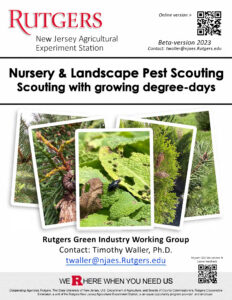
Please download and print the Rutgers Nursery and Landscape Pest Scouting Guide  or  Conifer and Christmas Tree Pest Scouting Guide and refer to this post “Obtaining your local growing degree-days (GDD)” for additional information.  (See pest scouting guides for complete list of references – cited within lists below) 

Please SHARE what you SEE!! If you see a pest, disease, otherwise interesting or troublesome issue please report it to the Working Group by following the QR Code on the front of the Pest Scouting Guides or by filling out this reporting form.

Application for Cost-Share Grant Funding for Installation of Deer Fencing on UNPRESERVED Farmland – Out NOW

“The NJDA Deer Fencing Program makes cost-sharing funding available for the installation of deer fencing on unpreserved farms. The program is conducted in accordance with N.J.S.A 4:40-6.1.”

Please click here for the full application, eligibility, and other important information

Timing is important if considering this program. NJDA began accepting applications on 5/15/23.