by Katarzyna Madalinska and Anne L. Nielsen
Adult SLF are moving into vineyards from the surrounding landscape. The number of SLF on each vine varies greatly within each vineyard and locations in the state. In most vineyards in NJ and PA there is a strong border effect with numbers highest along the outside rows. However, the orientation and shape of your vineyard influences border effects. SLF are actively feeding on grapevines and will continue to feed for 1-2 months. Most SLF are in the upper canopy and as the grapes start to store carbohydrates for the winter, SLF will move down the vine, eventually feeding at the base of the vine. Research suggests that feeding by adult SLF may harm primary bud formation the following season and reduce winter hardiness. There is not a specific treatment threshold, but a good rule of thumb is 10 SLF per vine. Movement into the vineyards will continue for several weeks so multiple insecticide applications may be needed.
Treatment at this time of year is of course complicated by pre-harvest intervals (PHI) for each insecticide and grape variety. It is important to remember that SLF will feed on vines post-harvest. There are several effective insecticides available with pre-harvest intervals and residual activity (Table 1). When treating vines pre-harvest, dead SLF are commonly observed in the clusters. Post-harvest, insecticides such as Danitol or Brigade/Bifenture/bifenthrin have the longest residual activity and are expected to reduce feeding.
There are several reasons to manage adult SLF in September and October during peak movement.
- Adults feed on the canes, cordon, and trunk of grape vines. Excessive feeding has been shown to lower winter hardiness by >1.5°C.
- SLF females lay egg masses in October. Killing females prior to egg laying will decrease population growth the following year.
Table 1. Effectiveness of Insecticides Against Spotted Lanternfly Adults. Modified recommendations from Leach et al. Crop Protection 2019 v. 24 DOI:10.1016/j.cropro.2019.05.027
| Trade name | Active ingredient | SLF Activity | Rate per acre | Seasonal Allowance | Residual Activity | PHI
(days) |
REI
(hrs) |
Labeled for SLF? |
| Mustang Maxx 0.8EC | cypermethrin | Good | 4 oz | 24 oz | <3 | 1 | 12 | Yes, 2(ee) |
| Scorpion 35SL | dinotefuran | Excellent | 5 oz. | 20.9 oz | <7 | 1 | 12 | Yes, 2(ee) |
| Actara 25WDG | thiamethoxam | Excellent | 3.5 oz | 7.0 oz | <14 | 5 | 12 | Yes, 2(ee) |
| Carbaryl 4L | carbaryl | Excellent | 1-2 qt | 10 qt | 7 | 7 | 12 | No |
| Avaunt 30DG | indoxicarb | Fair | 6 oz | 12 oz | 7 | 7 | 12 | Yes, 2(ee) |
| Danitol 2.4EC | fenpropathrin | Excellent | 16-21.33 oz | 42.66 oz | >26 | 21 | 24 | Yes, 2(ee) |
| Brigade 2EC | bifenthrin | Excellent | 3.2-6.4 oz. | 6.4 oz | 21 | 30 | 12 | Yes, 2(ee) |
There are several reasons to manage adult SLF in September and October during peak movement.
- Adults feed on the canes, cordon, and trunk of grape vines. Excessive feeding has been shown to lower winter hardiness by >1.5°C.
- SLF females lay egg masses in October. Killing females prior to egg laying will decrease population growth the following year.
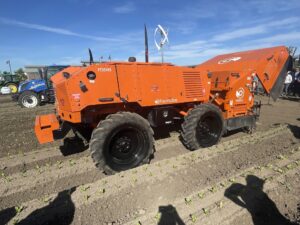
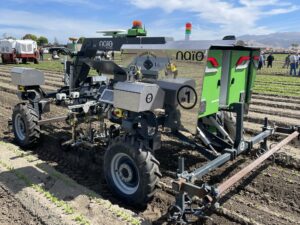 Weed management in vegetables can be difficult due to a shrinking labor pool, which is becoming more costly to source, and a lack of effective herbicides. Research and extension efforts must focus on integrating novel weed technology into current crop production systems. Autonomous and semi-autonomous robotic weed control technology has been implemented by some vegetable growers, mainly in the Western US, but is not universally available to or adapted by many producers. This survey is designed to new tools of interest (e.g. precision sprayers or cultivators, electrical weeders, drones, etc.) for managing weeds in cole crop and leafy green systems as well as the environmental, physical and economic barriers to adoption. The results of this survey will benefit vegetable growers by enabling the research team to develop relevant and realistic research efforts informed by the needs of and constraints faced by our local stakeholders. Specifically, we will use survey data to develop a multi-regional USDA grant proposal to bring grower-specified technology to each our states for evaluation and demonstration under a variety of commercial conditions and provide growers with an economic assessment of their performance relative to current best management practices.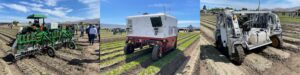
 ave an idea you would like to try on your farm that is related to sustainable agriculture?