
Tree Fruit Edition

Seasonal updates on insects, diseases, weeds, maturity dates and cultural practices impacting only tree fruit.
 
Subscriptions are available via EMAIL and RSS.

2024 New Jersey Agricultural Convention and Trade Show

NJ Vegetables Growers Association logoRutgers NJAES

The 2024 Annual New Jersey Agricultural Convention and Trade Show will be held Tuesday to Thursday, February 6-8 at Harrah’s Resort and Waterfront Conference Center 777 Harrah’s Blvd. in Atlantic City, New Jersey. The convention is hosted in cooperation with the Vegetable Growers Association of NJ, the NJ Department of Agriculture, and Rutgers Cooperative Extension. The VGANJ is working with Rutgers Cooperative Extension and others to bring new offerings to the 2024 convention. Look for new activities in the trade show area, new vendors and traditional vendors from the past, and new participation from the Garden State Wine Growers Association. VGANJ is currently accepting exhibitor booth registrations. To find out more about purchasing a booth space see https://vganj.com/exhibitors.

What is new for 2024? On Tuesday during the mid-day break, participants at the convention can pre-sign up and participate in a free “Lunch and Learn” program where exhibitors will discuss their products and services. Registration is required for the free “Lunch and Learn” program, complimentary lunch will be provided, and space is limited. Attendees are also encouraged to participate in the Tuesday evening social and charity auction to bid on some fantastic items from our supporters. The charity auction will benefit Shriners Hospital and will be held on the trade show floor. Tickets will be available for the Wednesday, February 7th NJ Agricultural Society’s luncheon and everyone at the convention is welcome to sign up and buy tickets to attend. Also, on Wednesday evening, the annual VGANJ/NJDA Awards Dinner and Banquet will be held. This year VGANJ will be presenting their 2024 Vegetable Growers of the Year award to Angelo and Leonard Grasso Farms of Mullica Hill, NJ at the Wednesday dinner banquet. In addition, the NJ Department of Agriculture will be honoring their awardees at the dinner. More to come on these awards. Tickets for scheduled meals and events can be purchased through Nancy Wood at the NJ Department of Agriculture. Email Nancy at Nancy.Wood@ag.nj.gov or see Nancy at registration.

All information for the NJ Agricultural Convention and Trade Show can be found on the VGANJ website at https://vganj.com. To register for attending the educational sessions and trade show, to make hotel reservations, and view the Rutgers educational program, scroll to the bottom of the VGANJ webpage or click the “convention” tab at the top of the page. To help VGANJ meet their room reservations commitment please use the hotel room block for the convention on the VGANJ website through this link https://book.passkey.com/go/SH02VG4 or call the hotel at 888-516-2215 and use group code SH02VG4. Attendees can register for all 3 days by purchasing a VGANJ membership or they can purchase one-day passes on the VGANJ website or when arriving at the convention. Everyone is encouraged to pre-register for the event.

The Rutgers Educational Program at the convention this year has the theme of “Pathways to Grow Farm Viability” and covers a wide range of topics including soil health, hemp production, basic wine grape production, tree fruit establishment, vegetable topics, high tunnel production, nursery and ornamentals, strawberry production, transition to organics, blueberry production, food safety, retail marketing, new agricultural technology, pest problems among many other topics. On Thursday, February 8 a half-day session on Worker Protection Safety Respiratory Protection Training with Fit Testing for Respirators will be hosted and licensed applicators can receive 8 core credits. Additionally, there is an all-day Farm Food Safety workshop on Thursday for a fee that can be paid online. Pre-Registration is required for both Thursday workshops and both have limited seating – so register early. See the Thursday Workshop section of the program for workshop registration links and more information. Or use this link for the Food Safety Workshop registration https://go.rutgers.edu/mhqc3m5u or register for the Respirator Training Workshop at https://go.rutgers.edu/pesticideworkshop.

In addition to the Rutgers educational sessions the NJ State Board of Agriculture will be hosting their annual delegates convention. For more information regarding the NJ State Board of Agriculture Delegates Convention see https://www.nj.gov/agriculture/conventions/. Everyone is welcome to attend the NJ State Board of Agriculture delegates sessions to learn more about agricultural issues. The delegates and NJ SBOA meet on Wednesday and Thursday of the convention. Each county board of agriculture, commodity organizations and other groups send delegates to this convention to vote on resolutions important to the agricultural industry. This event is hosted and organized by the NJ Department of Agriculture.
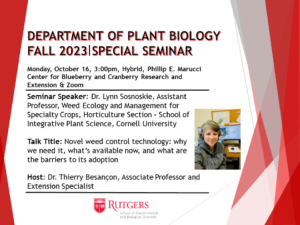
 

Rutgers Seminar on Novel Weed Control Technology – Oct. 16 at 3 pm

Department of Plant Biology – Fall 2023 Special Seminar 

Description of a seminar

Please, contact Dr. Thierry Besançon if you plan to attend it in-person at the Rutgers P.E. Marucci Center (space limited) or if you want to receive the zoom link for attending the seminar online.


Webinar: 2024 NRCS Funding Opportunities

Monday, October 16 @ 6:30 pm – 7:30 pm EST

Join NRCS Soil Conservationist Kimberly Dalton and Natural Resource Specialist James Strehse for a webinar explaining 2024 NRCS Funding Opportunities.

REGISTER HERE

Whether you’re small or large scale, conventional or organic, there are NRCS practices that can apply to your operation. The presentation will include program information and guidance on how to apply with your local USDA service center.

Registration is through the NOFA-NJ website.

Notes from the 2022 Chambourcin Wine Tastings and Evaluations

A Chambourcin wine tasting and evaluation meeting for New Jersey winemakers was held on November 10, 2022, at the Autumn Lake Winery, Williamstown, in Gloucester County. The notes below are based on individual observations of Chambourcin growers and winemakers, follow-on discussions, and related literature. The responses to the survey sent before the event are also summarized.

Participants: Auburn Road Winery, Autumn Lake Winery, Bellview Winery, Blue Cork Winery, Cedar Rose Winery, William Heritage Winery, Salem Oak Winery, Sharrott Winery and James Castelli Vineyards. [Read more…]

Notice of Public Hearing on SADC Rule Proposal Establishing Soil Protection Standards on Preserved Farmland

Proposed rules: PRN_2023-079_SADC_2_76-25

Original Notification of Public Hearing: Notice of public hearing SPS rule proposal 


Important information:

DATE: September 27, 2023
TIME: 6:00 p.m. to 9:00 p.m
LOCATION: TEAMS Virtual Meeting
To join the hearing via computer: Click here to join the meeting

To join the hearing via phone: Call (856)338-7074
Conference ID: 268 371 32#
Meeting Link and Call-In information is also available on the SADC website at https://www.nj.gov/agriculture/sadc/

NOTE: If you wish to provide oral testimony at the virtual public hearing, you must
register with the SADC no later than 5:00 p.m. Monday, September 25, 2023. Participants
may register by emailing Jessica.uttal@ag.nj.gov or calling her at (609) 913-6567.


From original notice:

STATE AGRICULTURE DEVELOPMENT COMMITTEE
Notice of Public Hearing on SADC Rule Proposal Establishing Soil Protection Standards
on Preserved Farmland

Proposal of new rules, N.J.A.C. 2:76-25, Soil Disturbance on Preserved Farmland; N.J.A.C.
2:76-25A, Supplemental Soil Disturbance Standards

PUBLIC NOTICE
Take notice that the New Jersey State Agriculture Development Committee (SADC) is holding
a virtual public hearing for the proposed new rules defining what activities on preserved
farmland constitute soil disturbance, establishing a soil disturbance limitation on preserved
farms, allowing for waivers of the soil disturbance limit under certain conditions, providing
preserved farm landowners written notice of and an opportunity to be heard on mapped soil
disturbances, and promulgating technical standards for certain agricultural practices for
compliance with the soil disturbance limitation.

The notice of proposal was published in the New Jersey Register on August 7, 2023, at 55
N.J.R. 8(1).

The SADC will be holding a virtual public hearing on Wednesday, September 27, 2023 at
6:00 p.m. through the SADC’s video conferencing software (Microsoft TEAMS).
Registration: If you wish to provide oral testimony at the virtual public hearing, you must
register with the SADC no later than 5:00 p.m. Monday, September 25, 2023. Participants
may register by emailing Jessica.uttal@ag.nj.gov or calling her at (609) 913-6567. Please
provide your name, organization, telephone number, and email address. A verbal or written
confirmation will be provided of your interest to testify at the hearing.
Please note that the SADC will take oral testimony at the hearing by alphabetical order of the
testifying person’s last name, and that this hearing will be recorded.

DATE: September 27, 2023
TIME: 6:00 p.m. to 9:00 pm
LOCATION: TEAMS Virtual Meeting
To join the hearing via computer: Click here to join the meeting
To join the hearing via phone: Call (856)338-7074
Conference ID: 268 371 32#
Meeting Link and Call-In information is also available on the SADC website at https://www.nj.gov/agriculture/sadc/

The SADC is also accepting written and/or electronic comments on the proposed rule
through October 6, 2023. Please submit electronic comments to SADC@ag.state.nj.us. In
the alternative, comments may be submitted on paper to:
Susan E. Payne, Executive Director
State Agriculture Development Committee
P.O. Box 330
Trenton, NJ 08625-0330

Please refer to the original notice of proposal for detailed information regarding the proposed
rules.

Tree Fruit IPM Report for August 25, 2023

Peach:

Borers:  Where mating disruption dispensers are used there should be no need for butt sprays. If mating disruption was not used, the only other options are pyrethroids with a label for the use. The New Jersey Commercial Tree Fruit Production Guide recommends either Asana or Pounce. Pyrethroids lack a long residual so our recommendation would be a late August/early September butt spray followed by an additional application in mid to late September. Since this would be a labor intensive practice it would be most efficient to give priority younger and most productive orchards. Remember to follow the label as to the maximum allowable amount per season of either material.

Apples and Pears

Brown Marmorated Stink Bugs: Brown Marmorated Stink bugs are nearly absent in orchards statewide, likewise native stinkbug populations have been very low. If stinkbugs are a concern for your orchard, see the NJ Tree Fruit Production guide for effective materials. If treatment is needed for orchards near harvest. Venerate has a +++ rating for stink bugs and a 0 day PHI. In tests conducted by Dr. Neilsen’s lab, Venerate always performed better when applied at half the highest labeled rate.

Codling Moth (CM): Second generation treatments according to the degree day model are now over. Additional treatments should be made if trap captures are over 5 moths/trap. Most orchards have very low CM pressure, however a few orchards have had continuing trap captures above threshold.

Summer Diseases: Disease control is over for early season apple varieties. Mid to late season varieties will need further applications on a two week schedule until mid september for sooty blotch and fly speck.

Lesser Appleworm: In 2022 some orchards in southern counties have had internal worm damage that we think was Lesser Apple Worm. This sporadic pest sometimes shows up in late summer and fall. The damage is similar to codling moth. Larvae complete their life cycle quickly and often by the time damage is seen the larvae is already gone. Typically LAW will feed in the fruit calyx and not go into the flesh, however they may also feed on fruit flesh excavating a small hole under the skin and occasionally tunneling into the fruit. Control options are the same as for codling moth. LAW can be monitored using traps baited with OFM pheromone.

Grape

Bunch Rots: Disease management continues to focus on downy and powdery mildew and also turns to bunch rot management. Refer to the NJ Commercial Grape Production Guide as well as the linked presentation from Dr. Nita in Virginia.

Grape Berry Moth: The timing for the third generation is past. In some hot summers a fourth generation may occur, however no further treatments should be needed, especially where insecticides are being applied for SLF and SWD.

Drosophila’s and Sour Rot: SWD adults are being caught in and around commercial vineyards. As the sugars start to increase in early verities like Chardonnay, be aware of Spotted Wing Drosophila combined with native fruit fly species. These populations increase at this time of year and help spread sour rot. Sour rot will only be pres ent when you also have injured fruit. Fruit splits and various insects can help cause that initial injury. It is thought that the spotted wing drosophila (SWD), because of its saw-like ovipositor, can help cause this initial injury, helping to make the fruit more attractive to native drosophilid species.  After injury the fruit serves as a food source for ethanol-producing yeasts and acetic acid producing bacteria, the causal agents of sour rot. This in turn attracts more fruit flies to lay more eggs and spread the decay. Good canopy management for air circulation is useful to reduce sour rot incidence. However, this must be combined with insecticides and antimicrobials. A treatment regime that consists of weekly applications of an insecticide (Mustang Maxx (or other pyrethroid), Malathion, Delegate/Entrust, Verdepryn).  Add Oxidate 2.0 if fruit cracking from rain or other causes is observed. Since it is important to rotate insecticide classes when treating this often, growers should use no pyrethroid or other insecticide class more that 2 times in a row. These treatments should be started before the onset of visible sour rot and fruit fly presence.

Spotted Lantern Fly: Spotted lantern fly adults are not yet appearing in vineyards, however they should be soon. When the first adults are observed, border treatments with effective materials should be adequate since most adults will be found on vineyard edges and populations will be low. As we move into September adult migration will increase and at that point growers should apply materials with long residual efficacy (refer to the table from Penn State below.) More information on biology and control can be found from Penn State.
