Archives for March 2025

Register for the NEW – 2025 Ornamental IPM Program PLUS Boxwood Blight, Pest emergence, Updates

Ornamental IPM 2025 v1 flyer

Please consider signing up for the NEW 2025 – Rutgers Ornamental IPM Program.

The focus of this program is to provide timely updates on pest, disease, and weeds impacting commercial ornamental producers. The webinars will focus on the most important pests for a 2 week interval, will be recorded, and will be shared shortly thereafter with Spanish overdub (spoken word). The trap packages are in an effort to find grower led solutions for monitoring economically important pests throughout the multiple regions of New Jersey. Please consider joining this program for its inaugural year.

Registration includes:

  • Site visit to your ornamental nursery/farm from Rutgers agents
  • Delivered printed IPM resources (Guides, factsheets, bulletins)
  • Free pheromone & sticky trap kit + guidance on setup/monitoring
  • Access to live bi-weekly webinars (Zoom)
  • (First session NEXT TUESDAY 4/8 @ 12PM)
  • Every Second and Fourth, Tuesday, April through September
  • Webinars will be recorded – posted later with Spanish overdub

This program is free, however registration is required.

click here to Register

Boxwood Blight Risk Assessment as of 3/4/2025
Region Location CODE 31-March 1-April 2-April 3-April 4-April 5-April
Southern Upper Deerfield NJ50 Very Low  Very Low  Very Low  Low Minor Risk Very Low 
Central Howell / Freehold NJ10 Minor Risk Very Low  Very Low  Low Minor Risk Very Low 
Northern Wantage NJ79 Low Very Low  Very Low  Low Risk Very Low 
M T W TH F S
 Please check YOUR LOCAL risk (click here)

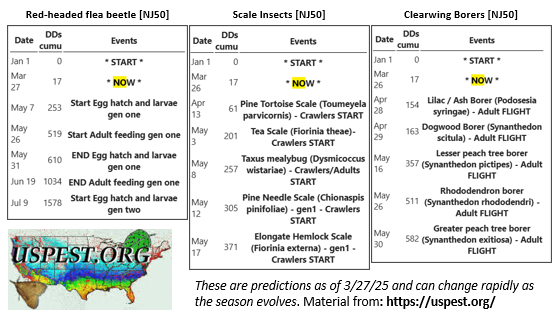
Please download and print the Rutgers Nursery and Landscape Pest Scouting Guide  or  Conifer and Christmas Tree Pest Scouting Guide and refer to this post “Obtaining your local growing degree-days (GDD)” for additional information.  (See pest scouting guides for complete list of references) 

Please SHARE what you SEE!! If you see a pest, disease, otherwise interesting or troublesome issue please report it to the Working Group by following the QR Code on the front of the Pest Scouting Guides or by filling out this reporting form.

Keep reading for more resources!


[Read more…]

Last Call: Farmer Resource Fair in Somerset County

All New Jersey farmers are invited to attend this Farmer Resource Fair which will feature an array of agricultural service providers. In-between a light breakfast and a hearty lunch, there will be engaging presentations and opportunities to visit with service providers at their table displays. The program schedule, as well as a preliminary list of service providers who’ve confirmed their attendance, is included below.
The event will be held on Friday, April 11, 2025 from 8:30 am to 2:00 pm at the Ted Blum 4-H Center located at 310 Milltown Road, Bridgewater, NJ 08807.

Click here to register for this free event (registration is required). Please register by April 1, 2025.

This collaborative event is being organized by Rutgers Cooperative Extension of Somerset County, Somerset County Agriculture Development Board, and the State Agriculture Development Committee Next Gen Program. We hope you will join us! [Read more…]

Last Call: Stop the Bleed Training in Burlington County

Person applying a tourniquet to a mannequin Rutgers Cooperative Extension, in partnership with the Vegetable Growers Association of NJ and the Rutgers NJ Medical School, will host a Stop the Bleed training on Tuesday, April 8, 2025 from 10:00 am to 12:00 pm at the Rutgers EcoComplex located at 1200 Florence Columbus Rd, Fieldsboro, NJ 08505.
Don’t miss this opportunity to learn the life-saving skills of pressure application, wound packing, and use of tourniquets. Attendees of this free training will also receive a complementary bleeding control kit. Space is limited, register today! Please complete our pre-registration form by Monday, April 1.

Questions? Email Kate Brown, RCE-Somerset County Ag Agent, at kbrown@njaes.rutgers.edu or call 908-526-6293.

Preparing Orchards Against the Frost – Low Tech Strategies

Frost is common in the northeastern US. However, frost events during bloom, specifically in orchard crops, can be economically devastating. Often, the cause is a few hours below the injury threshold temperature for the developing buds, as cooler nights result in the rapid loss of thermal energy. Several passive or low-tech strategies can help maintain a slightly higher orchard floor temperature and potentially prevent substantial crop loss.

Site selection is the most effective frost protection method. When planning a new orchard, selecting a site with proper cold air drainage is the most valuable decision a grower can make and enjoy the rewards for many years. Cold air drainage is essential, so avoid buying a site or planting trees on the site that accumulate cold air. Also, identify areas where the cold air moves in and out. When possible, plant early blooming varieties in the least frost-prone areas and plant delayed and or extended bloom varieties in frost-prone areas.

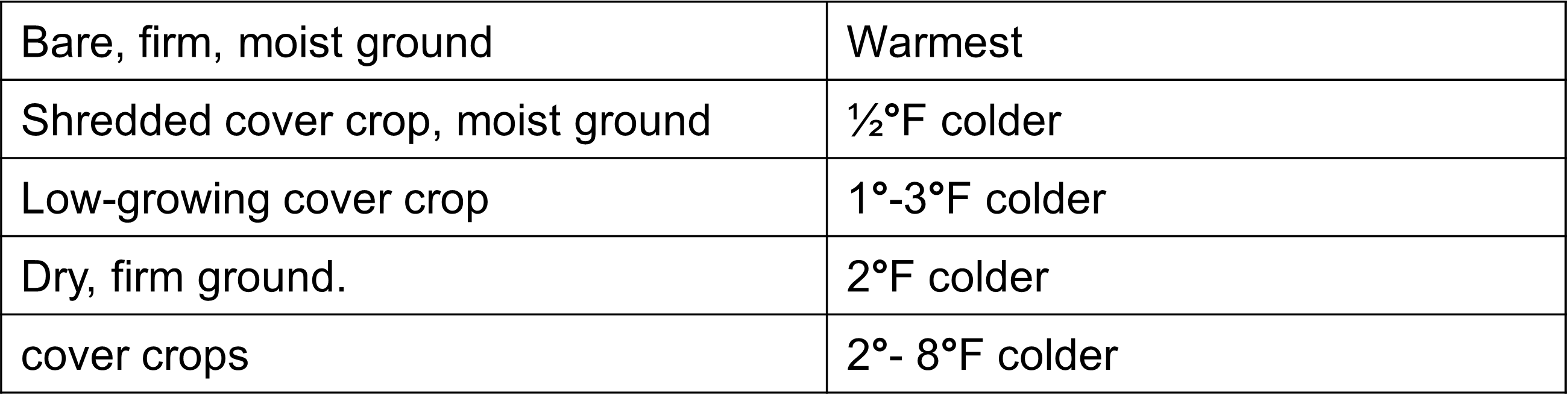
Table 1. Relative temperature differences are influenced by orchard floor conditions (Courtesy, Robert Crassweller, PSU).

Do not invite the frost with excess vegetation and ground cover. The management of weeds along the row and sod between the rows will influence orchard temperatures. The bare ground will absorb more heat during the day and release more heat at night than soil covered in vegetation (Table 1). During the day, 45-50% of solar radiation gets reflected or absorbed by the atmosphere, and the earth absorbs the remaining 50-55%. Vegetation reduces this heat transfer to the soil because it reflects light before it can reach the soil surface. Removing tall weeds and windbreaks along the edges of orchards will also help improve airflow and limit the accumulation of cold air pockets in some areas of the orchard. This can be particularly important during spring bloom when just a few more degrees can make the difference between killing the flowers or not!

Extremely low grass cutting: Maintaining sod between the rows at a minimum height by frequently mowing will help with frost protection. Similarly, keeping the rows weed-free by using postemergence herbicides to kill emerged weeds and removing weed residues from the previous season will maximize the warming of the soil by solar energy during the day. Maintaining weed-free rows should also be considered by applying residual herbicides in the fall. Depending on herbicides applied in the fall, this will prevent or reduce weed emergence in early spring and give you more flexibility for applying your residual and postemergence herbicides in spring. 

The cold air drain machine has a fan that pulls cold air from the surrounding ground and pushes it into the sky. This is effective in a lower section of the orchard or the end of the vineyard where the cold air drains due to a slight slope. Placing the machine in the middle of the orchard may prove ineffective as the pulled cold air could settle back into the orchard unless there is a low inversion layer to mix with warmer air. Using the cold air drain machine can enhance the effectiveness of low grass cutting. The machine costs around $15,000, and its operating cost is much less than other active frost protection methods.

Wet soil slows the release of thermal energy on frost night. However, the soil profile must be thoroughly wet. This can be achieved by irrigating the soil to field capacity (maximum water holding capacity of that soil). Also, the temperature must be warmer during the preceding days to pack sufficient heat into the soil. Sandy soils store less energy than loamy soils because there is more air space between soil particles than loamy soils. Heavier soils may require more than 8–10 hours of irrigation to reach field capacity.

Delayed pruning delays bud development, which helps avoid damage from early spring frosts. Years of observation in commercial orchards in the northeast indicate that more buds survive after a frost event, specifically in peaches, if the pruning is delayed. Often, large farm operations begin pruning early in the dormant season due to labor availability and time constraints. In such cases, avoid pruning upper branches until the risk of a late freeze has passed. Also, avoid hard blossom thinning on peaches on lower branches or blossom thinning altogether. Instead, focus only on fruit thinning, which can serve as insurance against crop loss. Remember that any available crop will likely command a good price in frost years.

Combining the above methods can have a cumulative effect on overall frost protection in the orchard. Keeping trees healthy with proper nutrient and pest management is also important. Healthy trees may still lose a crop but are more likely to survive the next season than poor vigor and diseased trees. The success of Frost Protection will also depend on understanding each method’s working principles and the combination of environmental factors necessitating its use. The bulletin https://njaes.rutgers.edu/e363/ explains what to monitor before a frost event and active frost protection methods such as irrigation, heat application, and air mixing.

White Pine Weevil Adults Become Active During the Early Weeks of Spring

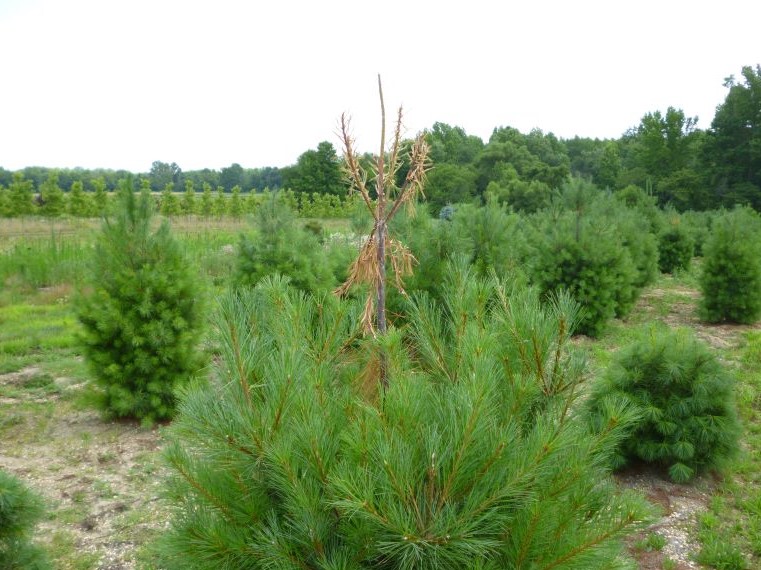
Many arborists & landscapers often find it difficult to prevent white pine weevil pests (Pissodes strobi), because they are typically applying fertilizer & dormant oil treatments during the control window. In NJ, the control window against feeding white pine weevil adults occurs in March & April. Adults overwinter in the duff beneath trees. The WPW adults will often crawl or sometimes fly to the top terminal leaders of pine, spruce, or Douglas-fir trees. Eastern white pine & Norway spruce species are the most severely attacked & the death of the terminal leaders of these trees will often occur.

Often by July, an infested terminal will brown & die as the weevil larvae have destroyed the vascular tissues. (Photo Credit: Steven K. Rettke, Rutgers Coop. Ext.)

Treatment timing is critical with this pest, and controlling the adult female before egg laying is necessary. Apply preventative sprays (e.g., pyrethroids) only to the terminal leaders during this time. Before mating & egg laying, adults will feed by chewing holes within the central leader, causing a characteristic pitch flow that becomes white when dry. Then females will lay eggs in new cut-out holes within the top 12 inches of the leader just below the terminal bud.

White pine weevil adults will feed within the upper terminal leaders & cause pitch flow that when dries has a white appearance. This is an early symptom that adults are active & control materials need to be applied. (Photo Credit: Steven K. Rettke, Rutgers Coop. Ext.)

[Read more…]

Tree Fruit IPM Report March 24, 2025

Tree Fruit Phenology: 

Tree fruit phenology is about normal southern counties based on historical observations. In southern counties some early blooming varieties are pre-pink. Redhaven is normally at bud swell around March 22. Some apples are at green tip, and pears are about ½” green. Plums are at early to full bloom. Cooler weather this week and rain forecast for the weekend should help slow development.  

Peach: 

Brown Rot: Blossom infections from the brown rot fungus can occur whenever pistils are exposed and a favorable climate exists. Infections can occur during any wetting period when temperatures are between 41 and 86 °F. However, optimum conditions for infection occur with wetting and temperatures in the mid 70’s. During long wetting periods (several days or more) blossoms can be infected regardless of temperature. Generally infections that occur when conditions are sub optimal are less severe. Blossoms and fruitlets will remain susceptible until the pistil dessicates (sometime between petal fall and shuck split). Initiate coverage for blossom blight starting at pink for short petaled varieties and 5-10% bloom for showy flowers. See the NJ Commercial Tree Fruit Production Guide for recommended materials and rates. 

Scale Insects: Oil applications may be safely applied up to pink on peach. Other options include Centaur, Sivanto Prime, Esteem, and Venerate. These products can be combined with oil or applied alone. See the apple section below for more information. 

 Apple: 

Diseases: Fire blight is the main target at this stage. Copper formulations applied for fire blight suppression should be adequate for scab control at green tip to 1/4″ green, unless scab was not controlled in 2022. If your orchard had scab last year, include a protectant such as vangard or syllit at 1/4″ green tip. Copper should not be applied after 1/4″ green where fruit russet is a concern. Beginning at 1/2″ green highly effective scab materials should be used. Primary apple scab spores are released during any substantial infection period. At tight cluster include products effective for powdery mildew and cedar apple rust. See the NJ Commercial Tree Fruit Production Guide for recommended materials and rates. 

 Scale and Rosy Apple Aphid: One sees many recommendations for mixing materials efficacious for scale such as the insect growth regulators (Centaur; Esteem) with delayed dormant oil applications. The general consensus from data review seems to be that the addition of scale insecticides to oil do not significantly improve control over oil applied alone. Tests performed by Dr. Neilsen’s lab indicate that both Sivanto Prime and Centaur and Venerate when applied alone in the pre-bloom period are comparable to dormant oil for scale control. Esteem has good efficacy for scale when applied up to to 1/2″ green. Closer has some efficacy against scale, however it has not been evaluated for control of overwintering scale. Whether you opt to add insecticides to dormant oil or not for scale control, dilute coverage is the most important thing. Scale do not move. In order for oil to do its job and suffocate overwintering scale and mite eggs it must cover as much of the tree surface area as possible. Esteem, Closer, Sivanto Prime, and Versys, applied either alone or with oil at 1/4″ to 1/2″ green all have good to excellent ratings for rosy apple aphids. See the NJ Commercial Tree Fruit Production Guide for more information. Note that the Virginia Spray Bulletin for Commercial Tree Fruit Growers lists syllit as incompatible with centaur. 

 European Red Mite; San Jose Scale: Oil applications for mite suppression and scale control should start at 1/4” green. Apply 2% dilute or 4-6 gals oil/acre concentrate at 1/4”green to tight cluster; 1% dilute or 2-3 gals/acre concentrate at tight cluster to pink. Oil should not be applied if temperatures are expected to dip into the mid 30’s within 48 hours of application, and captan or sulfur should not be applied within 14 days of any applications of oil or oil-based formulations. Check the product labels for additional phytoxicity precautions. 

 Pear: 

 Pear Psylla:  Dormant oil applications should have already been started to deter psylla egg laying. At the green cluster stage a pyrethroid is generally included with oil to knock down adults migrating into the orchard.  In lieu of oil, Surround may also be applied starting at swollen bud and continued through bloom. If using Esteem for psylla control make one application delayed dormant through popcorn or two applications; one at delayed dormant through popcorn and one at petal fall. Centaur is also effective and one application may be made pre-bloom or at petal fall. Sivanto Prime is also labeled for early season applications and should be combined with oil. 

 Pear Diseases: It’s not too late to apply copper for fire blight suppression, but copper should not be applied past the green tip stage if fruit russet is a concern. Include effective materials such as Ziram or EBDC formulations for Pear Scab and beginning at the cluster bud stage. At white bud use products effective for rust, pear scab, and fabrea leaf spot. Particular attention should be paid to rust on aisan varieties. Start planning for blossom sprays using antibiotics. For both apples and pears, consider using Kasumin at bloom. Kasumin is an antibiotic like Streptomycin and Oxytetratracycline. It contains Kasugamycin which is a different chemistry. Kasumin is only labeled for bloom and petal fall applications while strep and oxytet are labeled for post bloom use. Using 3 different chemistries in rotation allows for resistance management while extending the protection into the post bloom period when late blossoms typically appear. Whichever material you use, the addition of Actigard, Lifeguard or other plant defense elicitors during bloom may improve control.