Search Results for: sare

What Can Summer Cover Crops Do for Soil Health and Future Crops?

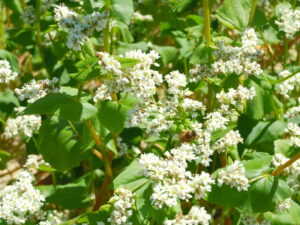
Plants floweringNow that some of our spring planted crops have finished, rather than leaving fields fallow or replanting fields that may have had some issues with plant diseases or insect pests, consider replanting with a summer cover crop. It is not too late to take advantage of summer cover crop benefits. What do summer cover crops do for soil health or future crop improvements? See below:
1. Increase Soil Organic Matter– One of the best attributes of having organic matter in the soil is improvement in soil structure. Adding organic matter improves tilth, water infiltration, water holding capacity, nutrient holding capacity and reduction of soil crusting. Also, as important is the increase in beneficial soil microbes and earthworms. Beneficial microbes can compete with pathogens and help release nutrients. Earthworms can cycle nutrients and improve pore spaces in the soil.
2. Reduce Soil Erosion – Just like with winter cover crops, summer cover crops can also reduce wind and water erosion in fields, especially those with slopes. During summer rainfall events, that can be significant if resulting from tropical storms, runoff may not just include soil loss, but also fertilizer and chemical movement. Therefore, keeping cover on a field during non-production times in any season is an excellent practice.
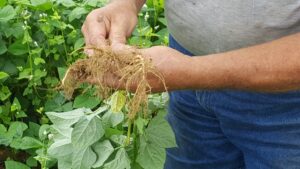
3. Nitrogen Cycling in the Soil – Nitrogen is often the most limiting nutrient for crop production, since it is so readily lost through nitrification and leaching. Storing nitrogen through plant cycling is an excellent way to improve fertility management. Whether it is a grass or non-leguminous cover crops N is still kept in the mix by the cover crop taking up residual N that wouldPerson holding plant to show root system otherwise be lost. The cover crop plant takes up the nitrogen and after the crop is incorporated it decomposes, thus releasing the N for subsequent crops to use. If legume cover crops are planted, they have the ability to “fix” nitrogen from the atmosphere and through the same decomposition process will provide N for subsequent crops. Be sure to inoculate legume seed just prior to planting with Rhizobium bacteria in order to gain the maximum N fixation benefits.
4. Reduce Weeds – When fields are left fallow after crops are harvested, weed growth can occur. If left to produce seeds, these weeds will multiply in subsequent crops. Therefore, managing the field by planting cover crops between cash crops is a great weed management option. As the cover crop grows, it will suppress the germination and growth of weeds through competition and shading. Some cover crop species can also suppress weeds biochemically, either while they are growing or while they are decomposing, which may prevent the germination or growth of other plants (allelopathy). Research has shown some cover crops like wheat, barley, oats, rye, sorghum, and sudangrass may suppress weeds. In some cases, it has also been reported that residues and leachates from crimson clover, hairy vetch, and other legumes have shown weed suppression.
5. Impacts on Plant Diseases – Cover crop residues could possibly be beneficial when it comes to plant pathogens, or can in some cases increase plant disease organisms. Some cover crop species are in the same plant families as cash crops and may be susceptible to the same disease organisms. Therefore, carrying the pathogen to the next crop. This is why paying attention to crop rotations is so important. In other cases, the cover crop residue can improve soil health in order to produce a better environment for beneficial microbes. By improving soil health, water infiltration, air pore space and other positive attributes, some soil pathogens may not survive as well, as in the case of water molds and water fungi. Some cover crops, like sorghum-sudangrass and sunnhemp, have been reported to reduce nematodes in soils. There are multiple positive factors from cover crops that can combat plant diseases.
6. Impacts on Insects – Like with plant diseases, cover crops can be susceptible to the same insect pests as cash crops. However, they may also attract beneficial insects into an area. Insect pests should be monitored in cover crops, just like in cash crops in order to not let populations get out of control and then move into nearby fields after the cover crop is killed.

For more resources on the us e of cover crops check out these resources: Cover Crops for Sustainable Crop Rotations – SARE

Vegetable Twilight Meeting and Research Tour

Thursday, August 19, 2021, 4:00 pm (meet at the shelter near the parking lot)

Rutgers Agricultural Research & Extension Center

121 Northville Rd., Bridgeton, NJ (Upper Deerfield)

4:00 – Discussion

Strawberry Soil Fertility – Bill Hlubik, Middlesex County Agricultural Agent

Silicon, Sulfur and Manganese Nutrition for Protecting Cucurbits from Powdery Mildew – Joe Heckman, PhD, Specialist in Soil Fertility

 Rutgers Covid-19 Project – Rick VanVranken, Atlantic County Agricultural Agent

 Sustainable Agriculture and Research and Extension (SARE) Farmer Grants a Way to Try New Things and Cover the Cost – Michelle Infante-Casella, Gloucester County Agricultural Agent

 4:30 – Tour

Evaluation of Bell Pepper Varieties and Breeding Lines for Bacterial Leaf Spot and Phytophthora Blight Management – Wes Kline, PhD, Cumberland County Agricultural Agent

Cover Crops for Between Beds in Plasticulture Cucumbers – Thierry Besancon, PhD, Extension Weed Specialist for Specialty Crops

Update on Breeding for Fusarium Wilt Resistance in Basil  – Kathryn Homa, IR-4 Program

Anthracnose Control in Peppers – Andy Wyenandt, PhD,  Specialist in Vegetable Pathology

Phytophthora Blight Control Through the Use of Fungicides – Andy Wyenandt, PhD,  Specialist in Vegetable Pathology

Control of Basil Downy Mildew with Organic Materials – Andy Wyenandt, PhD,  Specialist in Vegetable Pathology

The Effects of Simulated Dicamba Drift on Cucumber and Snap Bean Yields – Maggie Wasacz, Rutgers Graduate Student

Sweet Corn Demonstrating the Differences/Effectiveness of Non-Bt, Providence Bt, and Attribute II Bt Varieties for Resistance to Corn Earn Worm and Fall Army Worm – Joe Ingerson-Mahar, PhD, Vegetable IPM Coordinator

Update on Industrial Hemp Research in South Jersey – Raul Cabrera, Specialist in  Nursery Production and Management


PESTICIDE CREDITS                                     UNITS

1A          Agriculture Plant                             9

10          Demonstration and Research         9

PP2       Private Applicator                            9


Note:  face masks and hand sanitizers will be available

New Cover Crops Decision Making Tool Available Online

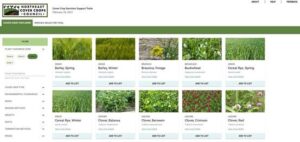
The Northeast Cover Crops Council (NECCC) recently released an online tool designed to support farm decision-making around cover crops. The Cover Crop Decision Support Tool is available at no cost at: http://covercrop.tools/. It includes a Cover Crop Explorer that provides in-depth information on more than 35 cover crop species. It also has a Species Selector that assists users in selecting individual cover crops based on plant hardiness zones, field soil and growing conditions, and cover cropping goals.

CoverMore than 35 specialists from around the Northeast and Mid-Atlantic contributed their expertise to develop the tool. The project was spearheaded by the Northeast Cover Crops Council, a group of farmers, researchers, Extension educators and personnel from nonprofits and industry that encourages the adoption of cover crops by fostering the exchange of information, inspiration and outcome-based research. The Council was formed with support from a Northeast SARE Professional Development Program grant. Through this and other USDA funding, the project team collaborated with USDA’s Agricultural Research Service (ARS) and Natural Resources Conservation Service (NRCS), Agricultural Informatics Lab and Precision Sustainable Agriculture to design the tool.

More information about NECCC and the Cover Crop Decision Support Tool can be found on the NECCC website at: www.northeastcovercrops.com.

Regional Survey Seeks Input from Strawberry Growers

A team of extension educators from the University of New Hampshire, University of Vermont, and Cornell University is seeking input from strawberry growers in the region on current practices and challenges faced in strawberry production. As part of the Northeast SARE project “Advancing Strawberry Production in the Northeast,” your feedback will guide research and outreach programs in the Northeastern U.S. and Canada.

The survey should take about 15 minutes to complete and be sure to submit your responses by December 31, 2020. At survey completion, you can also be entered into a drawing for some great prizes. The survey is available here: https://unh.az1.qualtrics.com/jfe/form/SV_2nlFpEZhejOE0Pr

Immediate potential for Boxwood Blight activity: Plus a Nursery and Greenhouse growers’ update


There is a potential for new boxwood blight infections in the next few days according to https://uspest.org/risk/boxwood_app.

Protective fungicide applications should remain in effect or be initiated immediately for Boxwood Blight. The disease may be sporulating and spreading amongst plantings if present (or may come into your nursery via shipments) within the next few days. According to https://uspest.org/risk/boxwood_app, this is the first legitimate potential for boxwood blight spread and new infections in 2020 for southern NJ. Please continue preventative/protectant fungicide applications utilizing; chlorothalonil (FRAC Group M05), mancozeb (FRAC Group M03), and QoI-fungicides (FRAC Group 11) in a rotation. Please contact Tim Waller at twaller@njaes.rutgers.edu for more information or questions.

UPDATES: 

Growing Degree-days as of 6/4/20 using NEWA

GDD50 = Growing Degree-Day with min. temp. set to 50F

Upper Deerfield = 548.5 GDD50 ; Howell = 407.5 GDD50 ; Pequest = 335.0 GDD50

How to use growing degree-day resources: https://plant-pest-advisory.rutgers.edu/using-growing-degree-day-calculators-nursery-pest-and-pathogen-updates-important-resource-links/

Pests: The number of accumulated growing degree-days has been rapidly increasing with higher and higher temperatures (approaching normalcy). Throughout New Jersey various adult borers will be emerging, these include; Lilac, Emerald Ash, Banded Ash Clearwing, and Peach Tree borers. Additionally, Ambrosia beetles (multiple species) will be in-flight and actively seeking egg-laying locations. Pyrethroids should be used as preventative sprays but should be targeted to the bases of susceptible hosts such as Magnolias, Yellow bud, Red bud, Japanese maples, Styrax, and Hybrid chestnuts. These Targeted applications are geared towards protecting beneficial insect populations. The eggs of many scale insects are hatching now, leaving their ‘crawler’ stage vulnerable to pesticide applications. Scale insect species to be mindful of; Maskell, Oystershell, Taxus, Euonymus, Prunicola, Oak lecanium, Japanese maple, Cottony maple, Calico, Golden oak, and Juniper scale. Aphids, especially on roses, and mites will be increasing their populations with the warmer weather and should be minded when in high density. Management should utilize an appropriate pesticide rotation when necessary, as these pests are prone to developing pesticide resistance quickly. Four lined plant bugs, basswood lacebug, and multiple leaf and plant hoppers have been reported south of NJ and should be monitored and treated for as appropriate through the coming weeks as many of these insects are capable of vectoring plant viruses. Lilac leafminer, Juniper tip-midge, and Pin oak sawfly may also be an issue in some locations. Red-headed flea beetle will be hatching between 250-480 GDD50, with adults emerging between 500-1000 GDD50. A second generation of larva will then be active between 1,570 to 1860 GDD50, emerging later 1,878 to 2,318 GDD50. Reminder, keep an eye out for the Box tree moth that has been identified approaching the border of US and Canada. This pest has prompted APHIS importation amendments for Boxwood, Euonymus, and Illex. Gypsy moths, Bagworms, Mimosa webworm will be hatching or emerging in many parts of the state very soon, (in some locations they may already have).

Please visit https://njaes.rutgers.edu/pubs/publication.php?pid=E334 for more specific information.

Understanding and approaching plant diseases: The weather as of late has been conducive to plant disease for much of NJ. Higher humidity, increasing temperatures, and prolonged periods of leaf wetness (particularly at night) are considered the factors associated with the ‘sweet spot’ of disease development. Regularly scheduled protectant fungicide applications should be continued if a pathogen or history-thereof is suspected. Compounds should be rotated to guard against pesticide resistance to any one compound (rotating high/medium-risk with low-risk materials). Also, any steps geared towards increasing airflow, reducing wet-feet, limiting mechanical injury, and reducing leaf wetness duration or excessive overhead irrigation during this warm and humid period will benefit disease management efforts.

Please visit: https://njaes.rutgers.edu/pubs/publication.php?pid=E036 for more specific information on individual plant and pathogen species.

Other timely diseases to note: Many needle cast diseases of conifers should be well into a fungicide application schedule, utilizing chlorothalonil, azoxystrobin, basic sulfate coppers, mancozeb, and T-methyl in a rotation of materials. Many of these compounds will also control Pine needle rust that may become prevalent in some locations, especially those locations with high levels of goldenrod or aster weeds. Botrytis and powdery mildew are still a concern in many parts of the state, especially those that are experiencing cooler nighttime temperatures. What fungicide used is dependent on the specific host species in many cases. Please refer to the link above for specific information. Fungal and bacterial leaf spots are very common and often only intensively treated if those plants are to enter the market the next season. However, in areas prone to disease or severe cases (defoliation occurs), treatments should be preventative and conducted throughout the season. Sooty mold grows on the honeydew produced by large populations of sap-sucking insect pests (aphids, scales, leaf/plant hoppers). Controlling the insect pests is our best option to reduce this unsightly disease. In severe casts of sooty mold, plants can be washed free of this fungal growth using mild detergents. Phytophthora diseases are ever present at the nursery, however cultural practices such as sterilized potting media, cleaning tools and machinery regularly, efforts to reduce wet-feet or overwatering, and sterilization or treatment of recycled water can have profound impacts on the expression or spread of Phytophthora diseases. When fungicide applications are required, materials like phosphorus acids, fosetyl-Al (Aliette), mefenoxam (Ridomil), and etridiazole + T-methyl (Banrot) are commonly used. Rotation of these compounds and proper disease identification are incredibly important as many root-rotting pathogens have a strong propensity towards developing pesticide resistance.

Please consider the Rutgers Plant Diagnostics Laboratory for pest/pathogen identification concerns: https://njaes.rutgers.edu/plant-diagnostic-lab/


Online discussions and credit events

NJNLA pesticide credit webinar/course: Invasive Forest Pests: New Threats and Their Management (6/10/20): https://www.njnla.org/events/EventDetails.aspx?id=1383945

Webinar – June 10th, 2020 – 7:00pm to 8:30pm. Invasive Forest Pests: New Threats and Their Management. You must include your email address when registering. Information to join Webinar will be sent just prior to the start. Cost: $35/Member, $50/Non-Member. NJ Pest Credits: 3A (Ornamentals) – 3, PP2 (Private Applicator Category) – 3, 2 (Forest) – 3, 8C (Campgrounds) – 3, 9 (Regulatory) – 3,. CNLP: Environment – 1.5, LTE/LTCO: 1 CEU, NJUCF: 1 CEU and ISA is still pending. 

EPA information pertaining to online credits for licenses expiring in 2020: https://pestmanagement.rutgers.edu/increased-online-ceus-for-licenses-expiring-2020-act-now/

Ask the Agent (every Wednesday @ 7:00pm): https://go.rutgers.edu/t7wjkit1 . A new online forum has been created where anyone can log-on and speak with Rutgers Cooperative Extension agents (multiple agents from multiple counties)

NJNLA- Wine Down Wednesdays (every first and third Wednesday @ 7:00pm-8:00pm). Email: Lori Jenssen @ njnla.director@gmail.com. This is a great opportunity to speak with other green-industry businesses.


Rutgers nursery survey, advisory, and other resources:

Please take the 2020 Nursery Industry Survey: https://forms.gle/dUjLxaiu6qDQYYsRA

The new nursery agents have prepared a preliminary survey aimed at understanding the needs of our growers and clientele, i.e. you. Please take a moment to complete the survey, as this type of information really helps the agents secure grant funding to deal with the problems you actually have. Thank you!

Subscribe to the NJAES YouTube webpage: https://www.youtube.com/user/RutgersNJAES/

RU Sustainable Nursery Production website: https://njaes.rutgers.edu/nursery/

March meeting PDF: https://njaes.rutgers.edu/nursery/documents/2020%20SJ%20Nursery%20Meeting%20Proceedings.pdf

Grants for Your Ag Innovation Ideas

The Northeast SARE (USDA Sustainable Agriculture Research and Education Program) makes grants available to farmers and partnerships to test your ideas. Lists of previous years’ Farmer and Partnership grant awards provide you an idea of the projects they have funded. [Read more…]