Search Results for: corn borer

Pest Scouting 200-500 GDD – Get sprayers ready for Borers, Scale Crawlers, and other important pests

It’s that time of year again, many scale crawlers and borers will be active over the next few weeks throughout NJ. Be prepared to target specific pest life-stages for the highest level of efficacy per material cost and get those problem insects in check. Application of contact insecticides during specific activity windows for these pests should be coupled with systemic applications now to help protect woody plants later on.

Borers attack stressed plants. If you recently dug then heeled-in trees, transplanted seedlings, or otherwise seriously stressed a tree, please consider taking immediate action to protect them from both adult flights (contact trunk sprays) and future infestations (systemics)   

Please Download these resources: (The scouting guide is for you to print and keep on hand…these are just updates)

Nursery and Landscape Pest Scouting Guide 2022 PDF (note this contains conifer pests as well)

Conifer Pest Scouting Guide 2022 PDF

Contact if seeing insects at different times: twaller@njaes.rutgers.edu (or call the Cumberland County Extension Office – 856-451-2800)

Projected GDD50 accumulation as of 5/13/2022 Note: Growing degree-day values utilize daily average air temperatures with a minimum temperature threshold (a.k.a. ‘base’) of 50F = GDD50 (max. temp. threshold set at 95F). These values are accumulated from a biofix date, such as January or March 1st in the NE USA. Provided GDD50 are scouting ranges and should be truthed.
Region Location Station 13-May 1-Jun 1-Jul
South Upper Deerfield NJ50 297 603 1323
Central Howell / Freehold NJ10 242 508 1160
North High Point NJ59 135 345 867
Forecast: NOAA NCEP Coupled Forecast System model version 2 (CFSv2) forecast system (3.5 months) (USPEST.ORG)

Refer to this post “Obtaining your local growing degree-days” for additional information 

[Read more…]

Pest Notes: Witches’ Brooms, Pitch Mass Borers and Ants

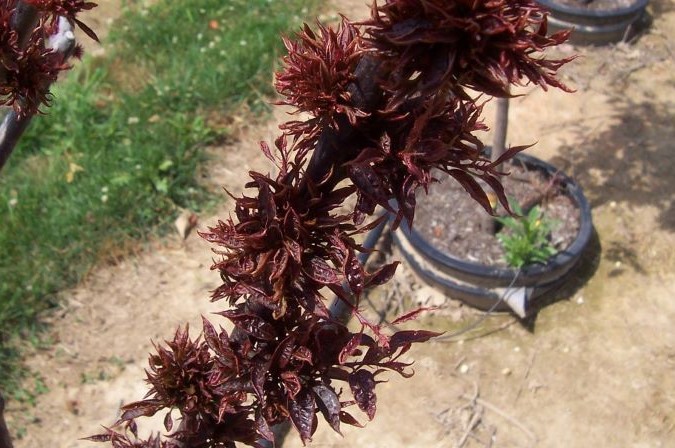
WITCHES’ BROOMS: The development of witches’ brooms on woody plants and the resulting formation of abnormal growth can cause curiosity and concern to your clients. Typically, the new growth is distorted, and a proliferation of leaves or fruit/cones closely clumped together appears when apical dominance is lost. Witches’ Brooms are created on plants when the transfer of growth hormones is disrupted (perhaps caused from the introduction of a foreign substance). Insects (e.g., aphids), fungi, bacteria, viruses, phytoplasmas, and herbicides have all been implicated in causing the formation of witches’ brooms in many plant species.

Witches' Broom

Witches’ Brooms are plants having stunted foliage & short stem internodes. (Photo Credit: Steven K. Rettke, Rutgers Coop. Ext.)

[Read more…]

Corn Earworm Developing Resistance to Bt Toxins in Sweet Corn

Corn earworm caterpillar feeding on sweet corn tassel

New research from the University of Maryland indicates that corn earworm, also known as tomato fruitworm, has developed resistance to the Cry1 Bt toxins present in some sweet corn hybrids.  Based upon Galen Dively’s twenty-one years of research comparing non-Bt sweet corn varieties with Bt varieties in plot studies, the proportion of damaged ears in Bt varieties has dramatically increased over that time.

Syngenta sweet corn hybrids with Attribute® technology expressing Cry1 Ab toxins in 1996 showed less than 10% ear damage.  Those hybrids with Attribute® in 2016 averaged 84% ear damage.  Similarly, the amount of damaged area per ear had tripled.

Seminis produced sweet corn hybrids with Performance SeriesTM containing Cry1 A.105 and Cry2 ab for worm control.  When some of these hybrids were first evaluated in 2010 they provided 100% control of fall armyworm and 95% control of corn earworm.  In 2016, six plantings at research farm sites of these hybrids averaged 67% damaged ears.

[Read more…]

Sweet Corn IPM Field Guide for NJ

Rutgers Cooperative Extension
Kris Holmstrom,
Vegetable IPM Program Associate,
Rutgers NJAES

Sampling Method: 10 samples per field, random area. Sample 5 consecutive plants for a total of 50 plants.

Seedling Stage

PEST THRESHOLD NOTES
Flea Beetle 6+/100 seedlings if no soil insecticide used. Observe from an upright position so as not to disturb these pests.
Fall Armyworm >/= 12% of plants infested. Check for ragged injury, droppings, and live fall armyworms.


Whorl-Tassel Stage

PEST THRESHOLD NOTES
European Corn
Borer
>/= 12% of plants infested. Check leaves for “shot-hole” type feeding signs. Check emerging tassels for live European corn borers.
Fall Armyworm >/= 12% of plants infested. Check leaves for ragged-hole type feeding signs. Check inside whorl for droppings and larvae.
Leaf Rust Presence Check for pustules.
Northern Corn
Leaf Blight
Presence @ whorl; presence >3 sample sites @ pre-tassel/tassel. Check for lesions.
Sap Beetles Note: presence may require frequency adjustment to silk spray program. Check emerging tassels for sap beetles.
Corn Leaf Aphid >/= 12% of plants infested; may require specific insecticide during silk spray program. Check emerging tassels for aphid.


Silk Stage

PEST THRESHOLD NOTES
Corn Earworm Apply insecticides at interval prescribed by local blacklight trap catches. See local blacklight trap information guide spray schedule in the Plant & Pest Advisory Vegetable IPM Updates.
Two-spotted Spider Mite Presence at >1 site. Check for colonies on underside of leaves.
Japanese Beetles ~10% or more plants with beetles feeding on silks. Check for presence on emerging silks.

 
[Download PDF Version]

Veg IPM Update 9/19/25

Greetings from the Veg IPM team!

Sweet Corn

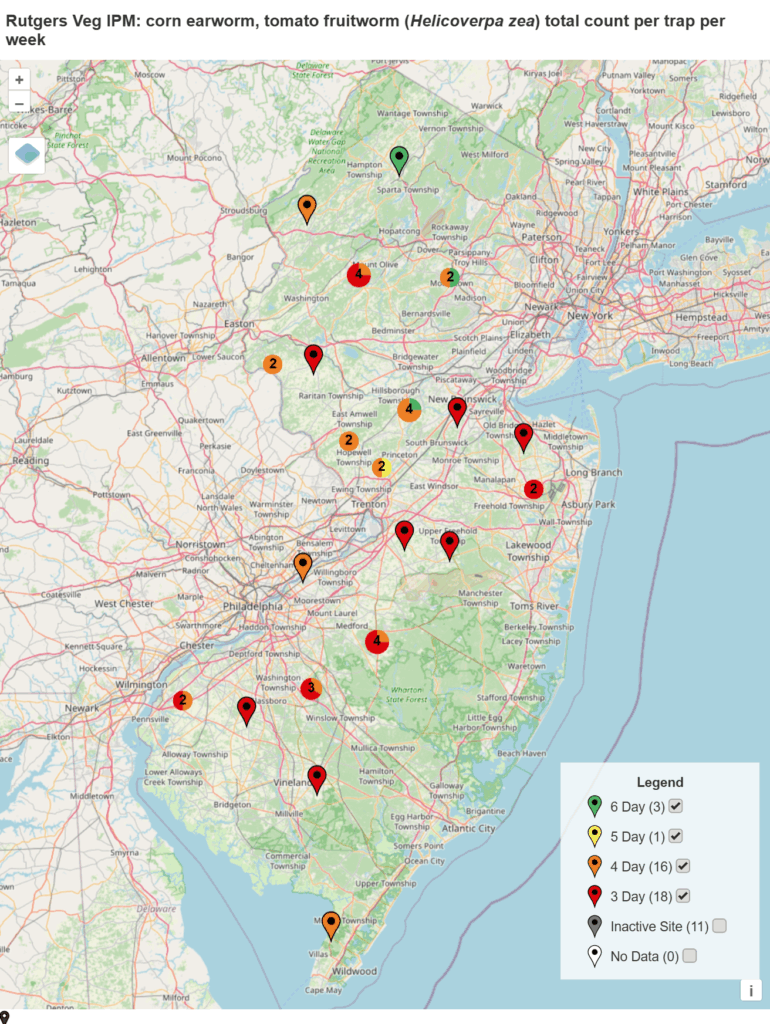
Corn is wrapping up very slowly with the cool weather we’re having. Meanwhile, corn earworm (CEW) moth captures are staying high — many locations need 3-day spray intervals (see map). If temperatures get high (>85 degrees F), shorten the spray interval by one day. Rotation is important for avoiding resistance, and there are four IRAC groups that are registered in silking sweet corn: 1 (carbamates), 3 (pyrethroids), 5 (spinosyns), and 28 (diamides). CEW is at least partly resistant to several pyrethroids, so a spray program should not rely solely on pyrethroids, although they can be useful in tank-mixes or as pre-mixed products, such as Besiege or Elevest (Group 28 + Group 3). For detailed information about resistance and potential spray programs, the University of Delaware has an excellent resource on corn earworm management.

Spray intervals based on nightly pheromone moth captures for the southern part of New Jersey. Note that not all locations in the IPM program are currently trapping. This map is based on the following thresholds: 0 moths = 6-7 day schedule, 1 moth = 5 day spray schedule, 2-20 moths = 4 day spray schedule, 20+ moths = 3 day spray schedule.

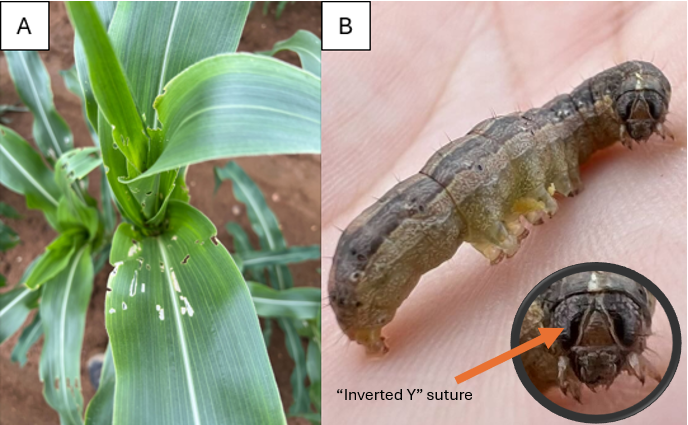
We’re seeing fall armyworm (FAW) infestations in many locations. Young larvae will cause damage known as “window paning”, in which the top surface of the leaf is eaten away, leaving behind thin, white, membranous-looking scratch marks. As the larvae get bigger, these feeding marks become more ragged (A). The damage can look somewhat similar to European corn borer feeding, but FAW damage will be more severe and will lead down into the whorl. The caterpillars have a dark head capsule with a distinct, inverted Y-shaped suture (B). They can also be identified by four dark dots arranged in a square on their last segments. We use a treatment threshold of 12% fresh feeding damage in pre-tassel corn. Below this level, treatments for FAW are unlikely to pay off and can flare up aphids. For treatment, we recommend using products other than diamides (IRAC Group 28) when treating whorl-stage infestations, as diamides are important to save for silk protection. Effective products include Lannate (Group 1A), Radiant (Group 5), Intrepid (Group 18), Intrepid Edge (5+18), and Avaunt (Group 22). Note that Avaunt can only be used through tassel push.

Fall armyworm damage (A) and larva (B). Note the distinctive suture on the head, which will differentiate FAW from other caterpillar pests of corn. Photos by Amanda Quadrel

We continue to see corn leaf aphids in sweet corn tassels and ears. In high numbers they can reduce pollination or cause honeydew and sooty mold on ears that harm marketability. Broad spectrum insecticides, especially pyrethroids, can flare up aphids by disrupting the natural enemies that typically control them. We have seen several instances where FAW sprays in the vegetative stage may have caused high aphid populations during silking. If you’re seeing a lot of aphids on corn tassels, you can start your CEW spray rotation with Lannate (group 1A), which has some efficacy for aphids. Come back a week later and check ear tips for aphid populations. If they are high, as in the below picture, use a product more targeted for aphids, such as Assail 30SG or 30 SC (group 4A), Transform WG (group 4C), or Sivanto Prime (group 4D). Keep in mind that Transform WG and Sivanto Prime have 7 day PHIs.

Close up of the silks and leaves at the tip of a corn ear with many blue-green aphids clustered on the leaf.

Corn leaf aphids on the tip of an ear. Note blue-green color with dark tail pipes (also called cornicles), legs, and antennae. Picture by Maria Cramer.

Allium Leafminer Alert

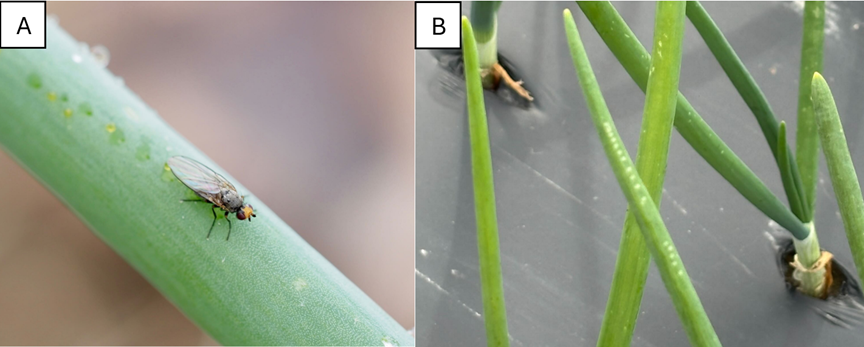
Allium leafminer adults and oviposition scars were detected in Sussex county today, indicating that the second generation of the pest is active. ALM can cause injury to chives, scallions, garlic, onions and leeks, but leeks and scallions seem to be the most effected. Look for neat rows of white spots descending from the upper tips of allium leaves (see photos below). We recommend treating around 2-3 weeks after initial detection of the pest, and then subsequent sprays can be made in 1-2 week intervals. Approved materials for controls include spinosyns (Radiant, Entrust (OMRI approved)), pyrethroids (Mustang Maxx, Warrior), neonicotinoids (Scorpion, Venom), and the insect growth regulator Trigard. Two or three sprays should provide adequate control.

The picture on the left shows a small fly with a yellow head leaving a row of oviposition scars in a scallion leaf as it lays eggs. The picture on the right shows alliums planted on black plastic, with some of the leaves showing rows of pale, triangle-shaped oviposition scars.

An allium leafminer adult (A) and oviposition scars (B). Photos by Maria Cramer (A) and Amanda Quadrel (B).

Tomatoes

Thrips are starting to slow down as tomatoes are slowing down, but they’re still out there. Thrips management is especially important because of their ability to vector tomato spotted wilt virus (TSWV), a growing problem in New Jersey where we have resistance-breaking strains. There have been many outbreaks of TSWV (in both peppers and tomatoes) throughout south Jersey this season. Scouting and roguing out these plants (see pictures below) while continuing to manage thrips can help contain losses. Additionally, follow best management practices for reducing TSWV risk throughout the season.

For scouting, we consider 1-5 thrips on 10 leaves to be a low count and more than 5 thrips a high count. Other guides suggest a treatment threshold of 3-5 thrips per flower or the presence of stippling damage on fruit. Western flower thrips, the primary vector of TSWV, has resistance to some carbamates (group 1A) and organophosphates (group 1B) as well as pyrethroids (group 3), so few are useful for management. They are also broad-spectrum and hard on natural enemies, potentially flaring up secondary pests like spider mites. The following products have varying efficacy for western flower thrips management:

  • Group 5 insecticides (e.g. Radiant, Entrust) historically have given the best control, but growers have been finding resistance throughout south Jersey. If you have applied Radiant or Entrust and have not gotten good control, your local thrips populations may be resistant. Group 5 insecticides can also only be used twice per season in a planting.
  • Lannate (Group 1A) gives the next best thrips knockdown, but is broad spectrum and is not a part of all growers’ spray programs.
  • Beleaf 50SG (Group 29) can be very effective applied through drip irrigation, but takes a while to decrease thrips populations. It is systemic, making it safer for natural enemies than some other products.
  • Group 28 products with the active ingredient cyantriniliprole (e.g. Minecto Pro, Verimark, Exirel) provided suppression in trials.
  • Movento (Group 23, active ingredient spirotetramat) — provided suppression in trials.
  • Requiem EC (no group, active ingredient Chenopodium extract) — provided suppression in trials.

Many products only suppress thrips, meaning they kill larvae but not adults, or kill only the active life stages (larvae and adults, not the egg or pupal stages). Rotate between active ingredients and try to avoid getting to very high thrips numbers which are more difficult to knock back down.

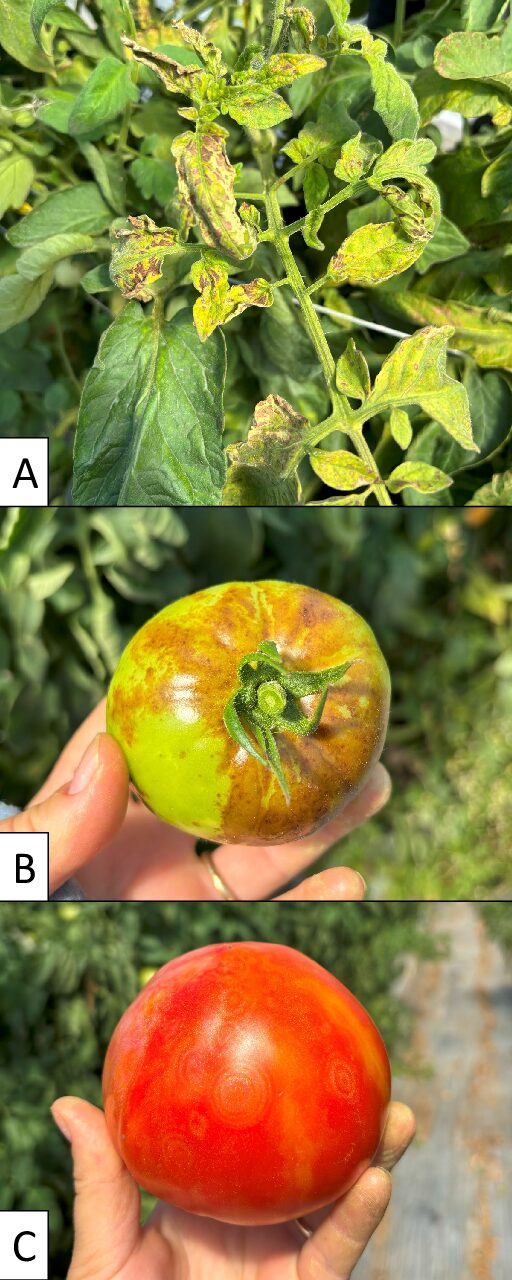
A) TSWV symptoms on leaves — note curling, yellowing, and browning. B) Symptoms on green fruit — irregular brown blotches and misshapen fruit. C) Symptoms on red fruit — concentric circles. Photos by Maria Cramer.

We’ve seen some fruit damage from caterpillars, and tomato fruitworm (AKA corn earworm), armyworms (beet and yellow striped), and hornworms on plants and fruit. There are no reliable thresholds for determining when to spray for these caterpillar pests, however scouting and consulting the corn earworm pressure map for the state will help give a sense of risk to the crop. When corn earworm pressure indicates a 3 or 4 day spray interval in corn (2-20 moths per night) as is currently the case in much of the state, tomatoes should be scouted weekly for feeding damage. Beet armyworm moth numbers in traps in Salem and Cumberland counties remain low to moderate, with counts below 20 moths per trap per night in the last week. Pyrethroid resistance is widespread in tomato fruitworm/corn earworm and beet armyworm, so other classes of insecticides should be used if management is needed.

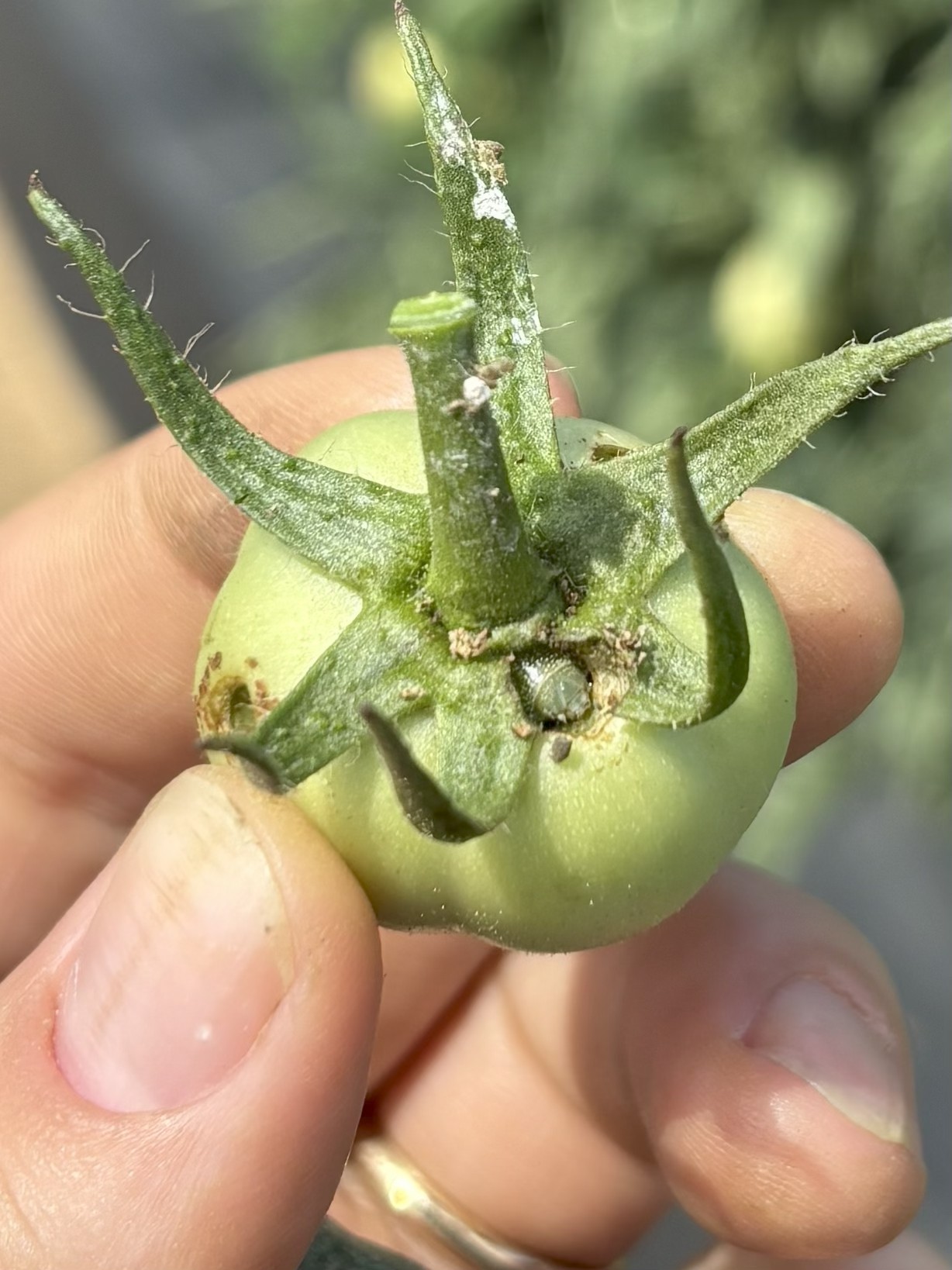
Tomato fruitworm head visible emerging from a hole in a small green tomato.

Tomato fruitworm/corn earworm infesting a green tomato. Photo by Maria Cramer.

We continue to see high spider mites in many plantings. When sampling spider mites, check 10 upper leaflets in at least 5 sites per field. The treatment threshold is 2 mites per leaflet on average (one of the individual leaves that makes up the compound tomato leaf). On farms where crop rotation is limited and the same miticides have been used for multiple years we’re seeing some miticide resistance — check whether and application has decreased mite populations, and if it did not work well, do not keep using it. Rotate between miticides and only treat when above threshold. Some products for spider mites in tomatoes include:

  • Nealta (group 25)
  • Oberon (group 23)
  • Portal (group 21A)
  • Agri-Mek (group 6) *7 day PHI
  • Kanemite (group 20B)
  • Acramite (group 20D) *3 day PHI
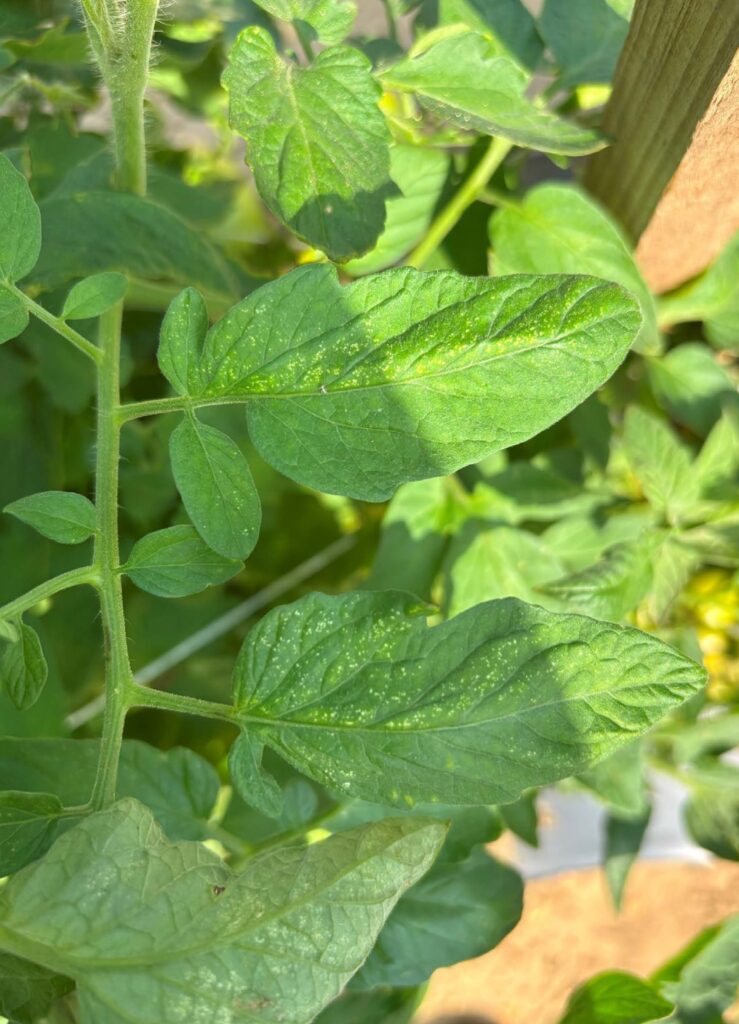
Tomato leaves with tiny yellow or white dots on visible on the top surface of the leaf.

Spider mite stippling visible when looking at tomato leaves from above. The spider mites are generally found on the undersides of the leaves. Photo by Maria Cramer.

Peppers

In terms of most insect pests, peppers have been looking very good. We have seen aphids, spider mites, and thrips at low levels so far, however it’s important to keep in mind that thrips can transmit TSWV to peppers as well, and so monitoring and staying on top of thrips populations is crucial. As with tomatoes, finding and roguing out infected plants is important as well (see picture below for symptoms on foliage and fruit).

Two pictures: the top picture shows a pepper plant with mottled yellow and green foliage. The bottom picture shows a cherry hot pepper that is green and red with many concentric circles on the skin.

A) TSWV symptoms on pepper foliage — note mottling and cupping of the foliage. B) Symptoms on cherry pepper fruit. Photos by Maria Cramer.

Pepper weevils — We’re currently finding pepper weevils on traps throughout south Jersey (Camden, Gloucester, Cumberland, and Salem counties). Read more about pepper weevil biology and management here.  One sign of pepper weevil infestation is aborted fruits on the ground between rows — if you think you may have pepper weevil on your farm or are interested in monitoring, please contact Maria Cramer.

Cole Crops 

We are seeing many different kinds of caterpillars in fall cole crop plantings, including diamondback moth, imported cabbage worm, cabbage looper, cross-striped cabbageworm, and yellow striped armyworm. All cole crop seedlings can tolerate up to 10% infestation for these caterpillar. For heading cole crops between early vegetative and cupping, the treatment threshold is 30%. As heads form, the treatment threshold goes down to just 5% infestation. Sprayable Bt products (IRAC 11A) such as Dipel, Xentari, or Javelin can be effective on young imported cabbage worm, cross-striped cabbageworm, and yellow-striped armyworm caterpillars. Diamondback moth has resistance to many insecticide groups, and pyrethroids (IRAC 3A) and Bt products (IRAC 11A) are not effective for their management. Besides Bt, materials approved for caterpillar control include Entrust/Radiant (IRAC 5), Proclaim (IRAC 6), Torac (IRAC 21A), and Exirel (IRAC 28).  For Bt products and contact insecticides, coverage on the undersides the leaves is essential.

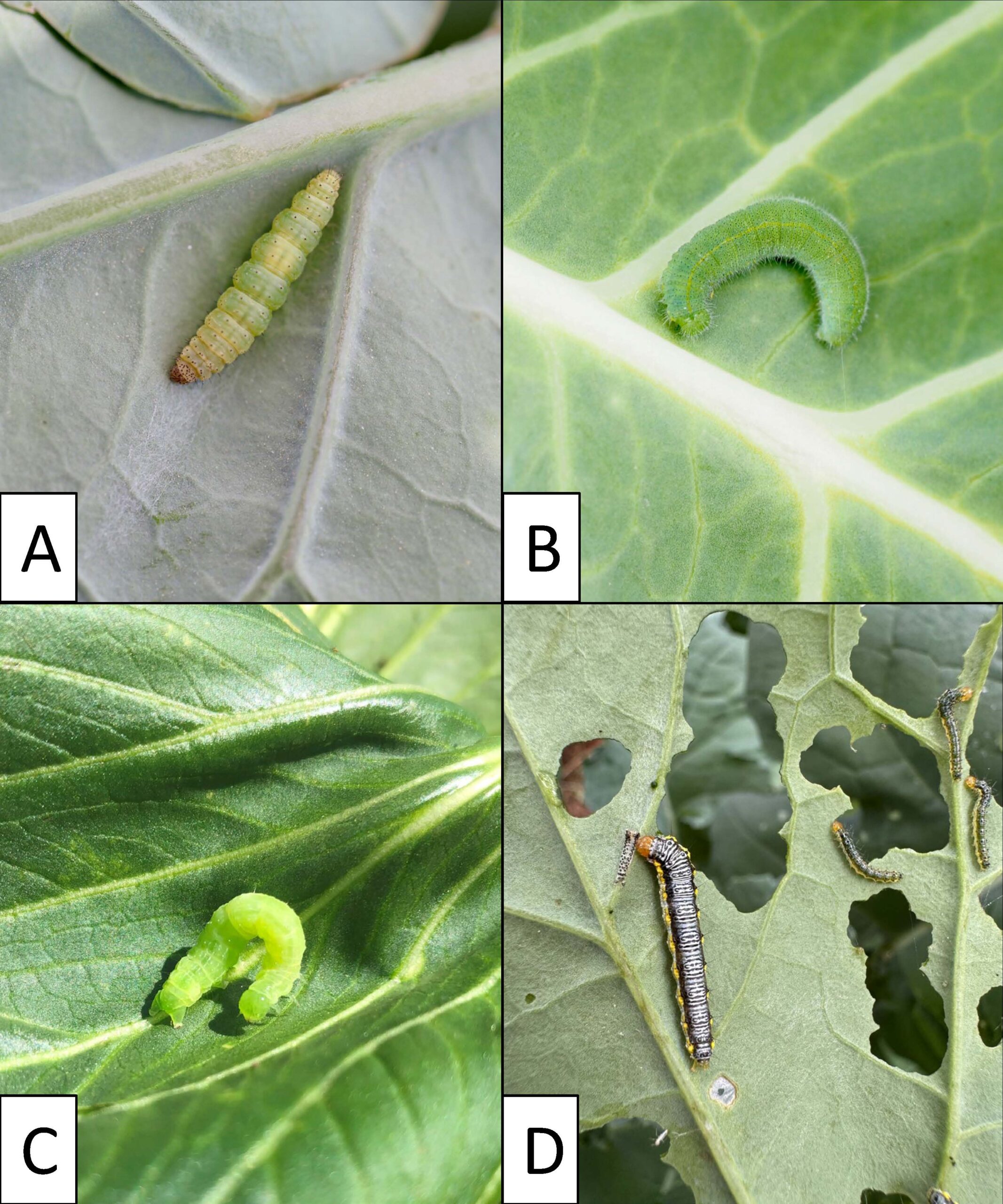
Caterpillar pests of cole crops. A) Diamondback moth — smooth and tapered at each end. B) Imported cabbageworm — fuzzy and not tapered. C) Cabbage looper — characteristic looping behavior. D) Cross-striped cabbage worm — distinctive stripes, usually occurs in groups. Photos A-C by Maria Cramer, photo D from iNaturalist COO.

Downy mildew is showing up in cole crops. This is a disease that develops best around 50-59ºF and our cool night temperatures are making prime conditions for disease development. Downy mildew may appears as light-colored lesions on the top of the leaves and as masses of white spores on the lower surface. Scout at least 25 plants per field (5 plants in 5 locations), checking the undersides for spores. If you have downy mildew, rotate or tank-mix chlorothalonil 6F (FRAC M05) with another product listed in the Mid-Atlantic Veg Guide for downy mildew in cole crops, rotating MOAs. Use overhead irrigation at times of the day when leaves can dry quickly to slow disease progression.

Downy mildew spore masses on the underside of a collard leaf. Photo by Renee Carter.

Pumpkins and Other Cucurbits

Pumpkin harvests are underway, and few issues have been seen in fields. Downy mildew of pumpkins and squash still has not been detected in the area and is unlikely to be a threat for this year. Powdery mildew is still active; continue treating if your fruit will be in the field for the next several weeks. Leaves will serve as protection against sunscalding of the fruits.

As always, please consult the Mid-Atlantic Commercial Vegetable Production Guide for a comprehensive list of materials that are labeled for specific crops and pests. As always, be sure to follow label rates and application instructions.

The Vegetable IPM Program wishes to thank the following Field Technicians, without whom much of the information presented weekly here would not be available.

Southern team: Renee Carter and Kris Szymanski

Northern team: Martina Lavender, Coco Lin, and Cassandra Dougherty

Veg IPM Update 9/12/25

Greetings from the Veg IPM team!

Sweet Corn

Corn is wrapping up very slowly with the cool weather we’re having. Meanwhile, corn earworm (CEW) moth captures are staying high — many locations need 3-day spray intervals (see map). If temperatures get high (>85 degrees F), shorten the spray interval by one day. Rotation is important for avoiding resistance, and there are four IRAC groups that are registered in silking sweet corn: 1 (carbamates), 3 (pyrethroids), 5 (spinosyns), and 28 (diamides). CEW is at least partly resistant to several pyrethroids, so a spray program should not rely solely on pyrethroids, although they can be useful in tank-mixes or as pre-mixed products, such as Besiege or Elevest (Group 28 + Group 3). For detailed information about resistance and potential spray programs, the University of Delaware has an excellent resource on corn earworm management.

Spray intervals based on nightly pheromone moth captures for the southern part of New Jersey. Note that not all locations in the IPM program are currently trapping. This map is based on the following thresholds: 0 moths = 6-7 day schedule, 1 moth = 5 day spray schedule, 2-20 moths = 4 day spray schedule, 20+ moths = 3 day spray schedule.

We’re seeing fall armyworm (FAW) infestations in many locations. Young larvae will cause damage known as “window paning”, in which the top surface of the leaf is eaten away, leaving behind thin, white, membranous-looking scratch marks. As the larvae get bigger, these feeding marks become more ragged (A). The damage can look somewhat similar to European corn borer feeding, but FAW damage will be more severe and will lead down into the whorl. The caterpillars have a dark head capsule with a distinct, inverted Y-shaped suture (B). They can also be identified by four dark dots arranged in a square on their last segments. We use a treatment threshold of 12% fresh feeding damage in pre-tassel corn. Below this level, treatments for FAW are unlikely to pay off and can flare up aphids. For treatment, we recommend using products other than diamides (IRAC Group 28) when treating whorl-stage infestations, as diamides are important to save for silk protection. Effective products include Lannate (Group 1A), Radiant (Group 5), Intrepid (Group 18), Intrepid Edge (5+18), and Avaunt (Group 22). Note that Avaunt can only be used through tassel push.

Fall armyworm damage (A) and larva (B). Note the distinctive suture on the head, which will differentiate FAW from other caterpillar pests of corn. Photos by Amanda Quadrel

We continue to see corn leaf aphids in sweet corn tassels and ears. In high numbers they can reduce pollination or cause honeydew and sooty mold on ears that harm marketability. Broad spectrum insecticides, especially pyrethroids, can flare up aphids by disrupting the natural enemies that typically control them. We have seen several instances where FAW sprays in the vegetative stage may have caused high aphid populations during silking. If you’re seeing a lot of aphids on corn tassels, you can start your CEW spray rotation with Lannate (group 1A), which has some efficacy for aphids. Come back a week later and check ear tips for aphid populations. If they are high, as in the below picture, use a product more targeted for aphids, such as Assail 30SG or 30 SC (group 4A), Transform WG (group 4C), or Sivanto Prime (group 4D). Keep in mind that Transform WG and Sivanto Prime have 7 day PHIs.

Close up of the silks and leaves at the tip of a corn ear with many blue-green aphids clustered on the leaf.

Corn leaf aphids on the tip of an ear. Note blue-green color with dark tail pipes (also called cornicles), legs, and antennae. Picture by Maria Cramer.

Tomatoes

Thrips are starting to slow down as tomatoes are slowing down, but they’re still out there. Thrips management is especially important because of their ability to vector tomato spotted wilt virus (TSWV), a growing problem in New Jersey where we have resistance-breaking strains. There have been many outbreaks of TSWV (in both peppers and tomatoes) throughout south Jersey this season. Scouting and roguing out these plants (see pictures below) while continuing to manage thrips can help contain losses. Additionally, follow best management practices for reducing TSWV risk throughout the season.

For scouting, we consider 1-5 thrips on 10 leaves to be a low count and more than 5 thrips a high count. Other guides suggest a treatment threshold of 3-5 thrips per flower or the presence of stippling damage on fruit. Western flower thrips, the primary vector of TSWV, has resistance to some carbamates (group 1A) and organophosphates (group 1B) as well as pyrethroids (group 3), so few are useful for management. They are also broad-spectrum and hard on natural enemies, potentially flaring up secondary pests like spider mites. The following products have varying efficacy for western flower thrips management:

  • Group 5 insecticides (e.g. Radiant, Entrust) historically have given the best control, but growers have been finding resistance throughout south Jersey. If you have applied Radiant or Entrust and have not gotten good control, your local thrips populations may be resistant. Group 5 insecticides can also only be used twice per season in a planting.
  • Lannate (Group 1A) gives the next best thrips knockdown, but is broad spectrum and is not a part of all growers’ spray programs.
  • Beleaf 50SG (Group 29) can be very effective applied through drip irrigation, but takes a while to decrease thrips populations. It is systemic, making it safer for natural enemies than some other products.
  • Group 28 products with the active ingredient cyantriniliprole (e.g. Minecto Pro, Verimark, Exirel) provided suppression in trials.
  • Movento (Group 23, active ingredient spirotetramat) — provided suppression in trials.
  • Requiem EC (no group, active ingredient Chenopodium extract) — provided suppression in trials.

Many products only suppress thrips, meaning they kill larvae but not adults, or kill only the active life stages (larvae and adults, not the egg or pupal stages). Rotate between active ingredients and try to avoid getting to very high thrips numbers which are more difficult to knock back down.

A) TSWV symptoms on leaves — note curling, yellowing, and browning. B) Symptoms on green fruit — irregular brown blotches and misshapen fruit. C) Symptoms on red fruit — concentric circles. Photos by Maria Cramer.

We’ve seen some fruit damage from caterpillars, and tomato fruitworm (AKA corn earworm), armyworms (beet and yellow striped), and hornworms on plants and fruit. There are no reliable thresholds for determining when to spray for these caterpillar pests, however scouting and consulting the corn earworm pressure map for the state will help give a sense of risk to the crop. When corn earworm pressure indicates a 3 or 4 day spray interval in corn (2-20 moths per night) as is currently the case in much of the state, tomatoes should be scouted weekly for feeding damage. Beet armyworm moth numbers in traps in Salem and Cumberland counties have been low (>5 per night). Pyrethroid resistance is widespread in tomato fruitworm/corn earworm and beet armyworm, so other classes of insecticides should be used if management is needed.

Tomato fruitworm head visible emerging from a hole in a small green tomato.

Tomato fruitworm/corn earworm infesting a green tomato. Photo by Maria Cramer.

We continue to see high spider mites in many plantings. Spider mites tend to be worse in hot, dry conditions, and their populations can dramatically increase following broad-spectrum insecticides, which reduce their natural enemies. The first sign of their presence is often light-colored stippling seen on the top surface of tomato leaves. The mites causing this damage are usually found on the undersides of leaves, though with bad infestations mites will be found on the upper surface as well. When sampling spider mites, check 10 upper leaflets in at least 5 sites per field. The treatment threshold is 2 mites per leaflet on average (one of the individual leaves that makes up the compound tomato leaf). On farms where crop rotation is limited and the same miticides have been used for multiple years we’re seeing some miticide resistance — check whether and application has decreased mite populations, and if it did not work well, do not keep using it. Rotate between miticides and only treat when above threshold. Some products for spider mites in tomatoes include:

  • Nealta (group 25)
  • Oberon (group 23)
  • Portal (group 21A)
  • Agri-Mek (group 6) *7 day PHI
  • Kanemite (group 20B)
  • Acramite (group 20D) *3 day PHI
Tomato leaves with tiny yellow or white dots on visible on the top surface of the leaf.

Spider mite stippling visible when looking at tomato leaves from above. The spider mites are generally found on the undersides of the leaves. Photo by Maria Cramer.

Peppers

In terms of most insect pests, peppers have been looking very good. We have seen aphids, spider mites, and thrips at low levels so far, however it’s important to keep in mind that thrips can transmit TSWV to peppers as well, and so monitoring and staying on top of thrips populations is crucial. As with tomatoes, finding and roguing out infected plants is important as well (see picture below for symptoms on foliage and fruit).

Two pictures: the top picture shows a pepper plant with mottled yellow and green foliage. The bottom picture shows a cherry hot pepper that is green and red with many concentric circles on the skin.

A) TSWV symptoms on pepper foliage — note mottling and cupping of the foliage. B) Symptoms on cherry pepper fruit. Photos by Maria Cramer.

As a reminder, we have found pepper weevils on pepper weevil traps in Gloucester, Cumberland, and Salem Counties this summer. Read more about pepper weevil biology and management here. If you think you may have pepper weevil on your farm or are interested in monitoring, please contact Maria Cramer.

Cole Crops 

We are seeing many different kinds of caterpillars in fall cole crop plantings, including diamondback moth, imported cabbage worm, cabbage looper, cross-striped cabbageworm, and yellow striped armyworm. All cole crop seedlings can tolerate up to 10% infestation for these caterpillar. For heading cole crops between early vegetative and cupping, the treatment threshold is 30%. As heads form, the treatment threshold goes down to just 5% infestation. Sprayable Bt products (IRAC 11A) such as Dipel, Xentari, or Javelin can be effective on young imported cabbage worm, cross-striped cabbageworm, and yellow-striped armyworm caterpillars. Diamondback moth has resistance to many insecticide groups, and pyrethroids (IRAC 3A) and Bt products (IRAC 11A) are not effective for their management. Besides Bt, materials approved for caterpillar control include Entrust/Radiant (IRAC 5), Proclaim (IRAC 6), Torac (IRAC 21A), and Exirel (IRAC 28).  For Bt products and contact insecticides, coverage on the undersides the leaves is essential.

Caterpillar pests of cole crops. A) Diamondback moth — smooth and tapered at each end. B) Imported cabbageworm — fuzzy and not tapered. C) Cabbage looper — characteristic looping behavior. D) Cross-striped cabbage worm — distinctive stripes, usually occurs in groups. Photos A-C by Maria Cramer, photo D from iNaturalist COO.

Downy mildew is showing up in cole crops. This is a disease that develops best around 50-59ºF and our cool night temperatures are making prime conditions for disease development. Downy mildew may appears as light-colored lesions on the top of the leaves and as masses of white spores on the lower surface. Scout at least 25 plants per field (5 plants in 5 locations), checking the undersides for spores. If you have downy mildew, rotate or tank-mix chlorothalonil 6F (FRAC M05) with another product listed in the Mid-Atlantic Veg Guide for downy mildew in cole crops, rotating MOAs. Use overhead irrigation at times of the day when leaves can dry quickly to slow disease progression.

Downy mildew spore masses on the underside of a collard leaf. Photo by Renee Carter.

Pumpkins and Other Cucurbits

Cucurbit downy mildew was first reported on 7/11/25 on cucumbers in central NJ and has been found on cucumbers and cantaloupe at the Snyder Research Farm in Pittstown. Growers should be applying protectants on cucumbers and cantaloupes for cucurbit downy mildew at this time. As of this post, we still haven’t found any instances of the disease on pumpkins, squash, or watermelon. For information on how to build an effective cucurbit down mildew control program, please reference this post by Dr. Andy Wyenandt and consult the Mid-Atlantic Production Guide for additional materials that can be used.

Cucurbit downy mildew symptoms on the upper surface (A) and underside (B) of cucumber leaves and symptoms on cantaloupe (C). Photos by Amanda Quadrel

In pumpkins, we continue to see squash bug eggs and nymphs. Consider treating for squash bug if you see more than one egg mass or group of nymphs per plant (see photos below).

Squash bug eggs (A), newly hatched nymphs (B), and an adult (C). Photos by Amanda Quadrel

Aphid populations remain present in several scouted fields. While not causing direct damage to the fruits, the honeydew produced by aphids can stick to the fruits and attract hornets or promote sooty mold growth, resulting in unsightly fruit. If a colony is found at three or more sites in a ten site sample, growers may wish to apply control measures. There are several options available, such as Assail, Fulfill, PQZ, Sefina, and Beleaf that are labeled for aphids and are safer for bees. If also dealing with heavy mite populations, Minecto Pro can target both pests, but has a higher toxicity to bees.

Melon aphids infesting a pumpkin leaf. Photo by Amanda Quadrel.

Powdery mildew has shown up in most scouted sites. If more than one leaf in a 50 leaf sample is infected, fungicide programs for powdery mildew should be initiated.

Powdery mildew on pumpkin leaf. Photo by Amanda Quadrel.

In many pumpkin fields, disease management has shifted from foliage to fruit — plan to use a high water volume in sprays if a lot of foliage remains so that sprays can contact fruit sufficiently. A preventative diseases management plan based on recommendations from the Mid-Atlantic Production Guide is important for suppressing many of these diseases. If you suspect diseases in your pumpkins (or other cucurbits), reference the “Diagnosing important diseases in Cucurbit crops” guide or send/bring samples to Rutger’s Plant Diagnostic Lab.

As always, please consult the Mid-Atlantic Commercial Vegetable Production Guide for a comprehensive list of materials that are labeled for specific crops and pests. As always, be sure to follow label rates and application instructions.

The Vegetable IPM Program wishes to thank the following Field Technicians, without whom much of the information presented weekly here would not be available.

Southern team: Renee Carter and Kris Szymanski

Northern team: Martina Lavender, Coco Lin, and Cassandra Dougherty