Search Results for: corn borer

Nursery Pests Scouting June – Bagworms, Scales, Borers, RHFB, BWB


Red-headed flea beetle – Adult emergence beginning any day now

  • Contains material selection and timing, along with regime information and considerations

Boxwood Blight Alert – Infection Potential (Saturday) 5/27

Boxwood Blight Risk Assessment as of 5/24/2022
Region Location CODE 24-May 25-May 26-May 27-May 28-May 29-May
Southern Upper Deerfield NJ50 Very Low  Very Low  Low  High Risk Very Low  Very Low 
Central Howell / Freehold NJ10 Very Low  Very Low  Low  Infection Risk Very Low  Very Low 
Northern High Point NJ59 Very Low  Very Low  Very Low  Infection Risk Very Low  Low 
Check local boxwood blight risk here (CLICK HERE – input your area code – select closest weather station – check 7-14 prediction – click on graph / table)


Refer to the most recent Alert for more information – CLICK HERE


Pest Scouting – Please refer to these documents for a full listing of insects pests for your area corresponding to growing degree-days (GDDs). 

Contact if seeing insects at different times: twaller@njaes.rutgers.edu (or call the Cumberland County Extension Office – 856-451-2800)

The following key groups of pests will be active, vulnerable, or otherwise treatable during the next month throughout most of NJ. Here, bagworms, scale insects and borers with key life stage events during the 350-1500 GDD timeframe are discussed. Note there are many other insect pests present this time of year so please view the pest scouting guides above for your particular needs.

Projected GDD50 accumulation as of 5/24/2022 (USPEST) Note: Growing degree-day values utilize daily average air temperatures with a minimum temperature threshold (a.k.a. ‘base’) of 50F = GDD50 (max. temp. threshold set at 95F). These values are accumulated from a biofix date, such as January or March 1st in the NE USA. Provided GDD50 are scouting ranges and should be truthed.
Region Location Station 24-May 1-Jun 1-Jul
South Upper Deerfield NJ50 488 638 1358
Central Howell / Freehold NJ10 426 551 1203
North High Point NJ59 288 387 909
Forecast: NOAA NCEP Coupled Forecast System model version 2 (CFSv2) forecast system (3.5 months) (USPEST.ORG)

Refer to this post “Obtaining your local growing degree-days” for additional information 

BAGWORMS (600-900 GDD) (Bagworm hatch prediction as of 5/24/22 – now until July 14 (Southern NJ (NJ50)))
Crop type Common Name Scientific Name GDD Min (50F) GDD Max (95F) Reference Developmental / Target Stage
Conifer mostly, many minor hosts Bagworm Thyridopteryx ephemeraeformis 600 900 RU Larvae (early instars) –

ONLY CONTROL WINDOW

Refer to this post for additional information on Bagworms

BORER Insect Activity for 350 – 1500 GDD (Now until ~July 1 in Southern NJ (NJ50))
Crop type Common Name Scientific Name GDD Min (50F) GDD Max (95F) Reference Developmental / Target Stage
Malus, Prunus, many Lesser peach tree borer Synanthedon pictipes 350 375 4 Adult flight, egg laying
Dogwood, apple, pecan, elm, hickory, willow Dogwood borer Synanthedon scitula 350 850 4 adults, eggs, caterpillars
Birch Bronze Birch Borer Agrilus anxius 440 880 RU Adults (egg laying)
Malus, Prunus, many Peach Tree Borer Synanthedon sp. 500 600 RU Adults – emerge (1st treatment both types)
Rhododendron Rhododendron borer Synanthedon rhododendri 509 696 RU Adults emerge
Malus, Prunus, many Greater peach tree borer Synanthedon exitiosa 575 710 4 Adult emergence
Many Roundheaded appletree borer Saperda candida 802 1129 RU Adults
Ash Emerald ash borer Agrilus planipennis 1000 1200 4 Peak adult activity
Malus, Prunus, many Peachtree borer Synanthedon sp. 1500 1800 RU Larvae Treatment
Many Roundheaded apple tree borer Saperda candida 1514 1798 5 Typical treatment window
Conifer Nantucket tip moth Rhyacionia frustrana 1514 1917 RU Adults 2nd generation

Click here – “Identifying Clearwing Moth Borers in Pheromone Traps” or “Differentiating the Common Wood Borers of Ash Trees”
[Read more…]

Pest Scouting 200-500 GDD – Get sprayers ready for Borers, Scale Crawlers, and other important pests

It’s that time of year again, many scale crawlers and borers will be active over the next few weeks throughout NJ. Be prepared to target specific pest life-stages for the highest level of efficacy per material cost and get those problem insects in check. Application of contact insecticides during specific activity windows for these pests should be coupled with systemic applications now to help protect woody plants later on.

Borers attack stressed plants. If you recently dug then heeled-in trees, transplanted seedlings, or otherwise seriously stressed a tree, please consider taking immediate action to protect them from both adult flights (contact trunk sprays) and future infestations (systemics)   

Please Download these resources: (The scouting guide is for you to print and keep on hand…these are just updates)

Nursery and Landscape Pest Scouting Guide 2022 PDF (note this contains conifer pests as well)

Conifer Pest Scouting Guide 2022 PDF

Contact if seeing insects at different times: twaller@njaes.rutgers.edu (or call the Cumberland County Extension Office – 856-451-2800)

Projected GDD50 accumulation as of 5/13/2022 Note: Growing degree-day values utilize daily average air temperatures with a minimum temperature threshold (a.k.a. ‘base’) of 50F = GDD50 (max. temp. threshold set at 95F). These values are accumulated from a biofix date, such as January or March 1st in the NE USA. Provided GDD50 are scouting ranges and should be truthed.
Region Location Station 13-May 1-Jun 1-Jul
South Upper Deerfield NJ50 297 603 1323
Central Howell / Freehold NJ10 242 508 1160
North High Point NJ59 135 345 867
Forecast: NOAA NCEP Coupled Forecast System model version 2 (CFSv2) forecast system (3.5 months) (USPEST.ORG)

Refer to this post “Obtaining your local growing degree-days” for additional information 

[Read more…]

Pest Notes: Witches’ Brooms, Pitch Mass Borers and Ants

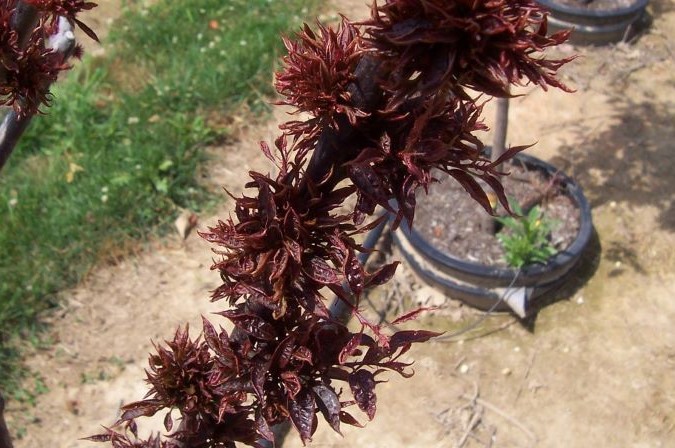
WITCHES’ BROOMS: The development of witches’ brooms on woody plants and the resulting formation of abnormal growth can cause curiosity and concern to your clients. Typically, the new growth is distorted, and a proliferation of leaves or fruit/cones closely clumped together appears when apical dominance is lost. Witches’ Brooms are created on plants when the transfer of growth hormones is disrupted (perhaps caused from the introduction of a foreign substance). Insects (e.g., aphids), fungi, bacteria, viruses, phytoplasmas, and herbicides have all been implicated in causing the formation of witches’ brooms in many plant species.

Witches' Broom

Witches’ Brooms are plants having stunted foliage & short stem internodes. (Photo Credit: Steven K. Rettke, Rutgers Coop. Ext.)

[Read more…]

Corn Earworm Developing Resistance to Bt Toxins in Sweet Corn

Corn earworm caterpillar feeding on sweet corn tassel

New research from the University of Maryland indicates that corn earworm, also known as tomato fruitworm, has developed resistance to the Cry1 Bt toxins present in some sweet corn hybrids.  Based upon Galen Dively’s twenty-one years of research comparing non-Bt sweet corn varieties with Bt varieties in plot studies, the proportion of damaged ears in Bt varieties has dramatically increased over that time.

Syngenta sweet corn hybrids with Attribute® technology expressing Cry1 Ab toxins in 1996 showed less than 10% ear damage.  Those hybrids with Attribute® in 2016 averaged 84% ear damage.  Similarly, the amount of damaged area per ear had tripled.

Seminis produced sweet corn hybrids with Performance SeriesTM containing Cry1 A.105 and Cry2 ab for worm control.  When some of these hybrids were first evaluated in 2010 they provided 100% control of fall armyworm and 95% control of corn earworm.  In 2016, six plantings at research farm sites of these hybrids averaged 67% damaged ears.

[Read more…]

Sweet Corn IPM Field Guide for NJ

Rutgers Cooperative Extension
Kris Holmstrom,
Vegetable IPM Program Associate,
Rutgers NJAES

Sampling Method: 10 samples per field, random area. Sample 5 consecutive plants for a total of 50 plants.

Seedling Stage

PEST THRESHOLD NOTES
Flea Beetle 6+/100 seedlings if no soil insecticide used. Observe from an upright position so as not to disturb these pests.
Fall Armyworm >/= 12% of plants infested. Check for ragged injury, droppings, and live fall armyworms.


Whorl-Tassel Stage

PEST THRESHOLD NOTES
European Corn
Borer
>/= 12% of plants infested. Check leaves for “shot-hole” type feeding signs. Check emerging tassels for live European corn borers.
Fall Armyworm >/= 12% of plants infested. Check leaves for ragged-hole type feeding signs. Check inside whorl for droppings and larvae.
Leaf Rust Presence Check for pustules.
Northern Corn
Leaf Blight
Presence @ whorl; presence >3 sample sites @ pre-tassel/tassel. Check for lesions.
Sap Beetles Note: presence may require frequency adjustment to silk spray program. Check emerging tassels for sap beetles.
Corn Leaf Aphid >/= 12% of plants infested; may require specific insecticide during silk spray program. Check emerging tassels for aphid.


Silk Stage

PEST THRESHOLD NOTES
Corn Earworm Apply insecticides at interval prescribed by local blacklight trap catches. See local blacklight trap information guide spray schedule in the Plant & Pest Advisory Vegetable IPM Updates.
Two-spotted Spider Mite Presence at >1 site. Check for colonies on underside of leaves.
Japanese Beetles ~10% or more plants with beetles feeding on silks. Check for presence on emerging silks.

 
[Download PDF Version]

Vegetable IPM Update 7/24/26

Greetings from the Veg IPM team! Read more for the latest pest and disease updates.

[Read more…]
