Search Results for: corn borer

Sweet Corn Insect Pests:
European Corn Borer

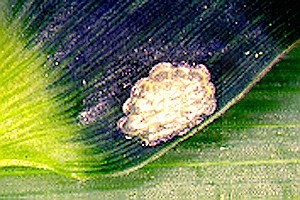
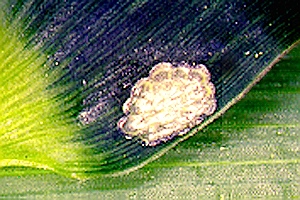
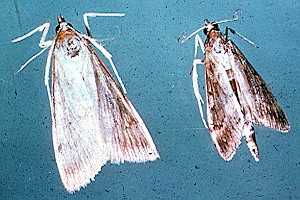
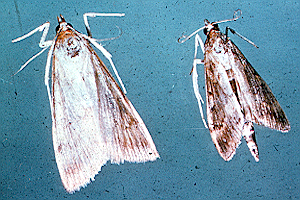
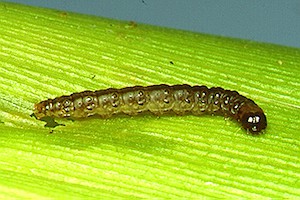
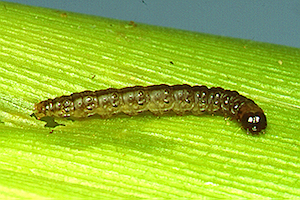
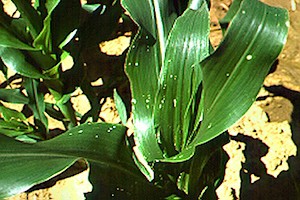
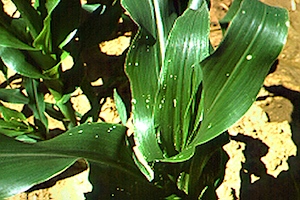
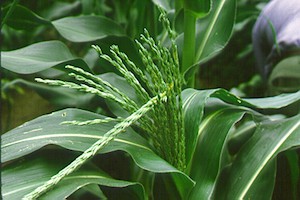
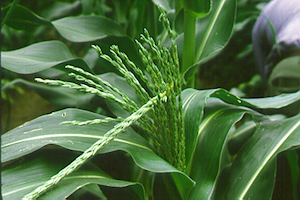
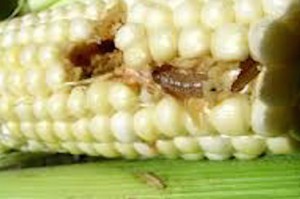
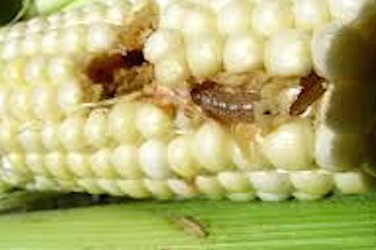
European corn borer (ECB) is one of the three major caterpillar pests of sweet corn. ECB has two to three generations per year in New Jersey. Adult moths emerge in late April and May, mate and begin laying eggs on the undersides of corn plants. Typically, eggs are laid on whorl stage plants. Damage occurs as larvae hatch and bore through the leaves to get to the center of the stalk where the tassel is forming. As the plant progresses to the pre-tassel stage, ECB larvae may be found feeding in the newly emerged tassels. Once the tassel spreads and begins to shed pollen, larvae migrate down the stalk and bore back into the stalk at leaf axils or into the developing ears. The latter event results in unmarketable ears.

Find adult ECB population activity (population maps and interpretive information as well as current occurrence and severity of crop damage) published throughout the growing season at:

 
It is important that growers use the above sites to determine when to begin field scouting. While sweet corn plants can tolerate significant injury when in the vegetative stages, ECB must be controlled prior to the development of ears or that marketable portion of the crop will be lost.

The first generation of the year, when larval damage peaks in mid-June is typically the most difficult to manage. It is often not possible to eliminate the threat with one insecticide application; however the most critical application is one timed for the plant’s transition from pre-tassel to full tassel. This is when there is maximum exposure of the larvae to the spray material. If the number of plants infested is above 12% at any time prior to full silk, an insecticide application should be considered. After the planting is in full silk, the majority of ECB larvae still alive will have bored back into stalks or ears and will be unreachable by sprays. See the NJ Commercial Vegetable Production Recommendations for labeled insecticides.

Multiple Pest Alerts in nursery, landscape, Christmas tree – boxwood blight, ambrosia beetle, white pine weevil, clearwing borers, and Phytophthora management

In response to the increased air temperature highs and averages, accumulating growing degree-days, increasing soil temperatures, and expected rainfall and overcasts days the following pest alerts have been generated for boxwood blight, ambrosia beetle, white pine weevil, and clearwing borers. Oomycete/Phytophthora treatment considerations are also listed at the bottom of the posting.

Stay informed:

  • Sign up for the 2026 – Rutgers Ornamental IPM Program – click here to sign up
  • Program is free, but registration is required – Registration includes:
    • Site visit to your ornamental nursery/farm from Rutgers agents
    • Delivered printed IPM resources (Guides, factsheets, bulletins)
    • Free pheromone & sticky trap kit + guidance on setup/monitoring (for commercial nursery/greenhouse and Christmas tree farms)
    • Access to live bi-weekly webinars (Zoom)
    • (First session TUESDAY 4/14 @ 12PM)
    • Every Second and Fourth, Tuesday, April through September

Boxwood Blight: high potential for new /spreading infections this week in Southern NJ

[pictorial tri-fold] Common Boxwood Pests and Diseases (click-here). This includes Box Tree Moth images. Print the PDF out double-sided, then fold.

If you suspect Boxwood Blight and would like to have this verified – please contact the Rutgers Plant Diagnostic Laboratory (click here) for sample submission instructions

Boxwood Blight Risk Assessment as of 3/30/2026
Region Location CODE MON TUE WED THU FRI SAT
30-Mar 31-Mar 1-Apr 2-Apr 3-Apr 4-Apr
Southern Upper Deerfield NJ50 Very Low  Low  Very Low  Infection Risk Very Low  Infection Risk
Southern Vineland NJ73 Very Low  Low  Very Low  Infection Risk Low  Infection Risk
Southern Millville KMIV Very Low  Very Low  Low  Infection Risk Very Low  Infection Risk
Southern Bridgeton D4116 Very Low  Low  Very Low  Infection Risk Very Low  Infection Risk
Southern Mays Landing G4661 Very Low  Very Low  Very Low  Low  Very Low  Infection Risk
Central Howell / Freehold NJ10 Very Low  Low  Very Low  Low  Very Low  Low 
Central Princeton F0303 Very Low  Low  Very Low  Low  Very Low  Low 
Central Somerville F6261 Very Low  Low  Very Low  Low  Very Low  Low 
Northern High Point NJ59 Very Low  Low  Very Low  Very Low  Very Low  Very Low 
Northern Randolph AU137 Very Low  Low  Very Low  Very Low  Very Low  Very Low 
Northern Belvidere E7133 Very Low  Low  Very Low  Low  Very Low  Low 
Please check your local boxwood blight risk at (https://uspest.org/risk/boxwood_app)

Fungicides; 

  1. You very well may have these materials already applied as ‘cover-sprays’ – But – be mindful that protectant fungicides loose efficacy the more rain (or overhead irrigation) they are subjected to, and reapplication may be warranted.
  2. ROTATE between Fungicide Resistance Action Committee (FRAC codes) to avoid this pathogen becoming resistant to specific chemicals

Format: [FRAC code]: Chemical name (Trade names * no endorsement implied, other options exist)  

  • [M05]: Chlorothalonil (Daconil WS)
  • [M05 + 1] Chlorothalonil + Thiophanate methyl (Spectro 90WDG)
  • [11] Trifloxystrobin + [7] Fluopyram  (Broadform)
  • [11] Trifloxystrobin + [3] Triadimefon (Armada 50WDG)
  • [M03] Mancozeb
  • [12] Fludioxonil (Medallion WDG)
  • [3] Tebuconazole (Torque)BW

Approaching boxwood blight season – 2026 (threat this week in Central and Southern NJ)


Ambrosia beetle adult flight will VERY LIKELY occur this week throughout most of NJ. 

The last few seasons we have seen an upswing in ambrosia beetle activity in nursery production, principally in field grown nursery stock of thin barked trees (commonly – dogwood, honey locust, magnolia, maple, redbud, zelkova, styrax, Prunus spp.). Based on evidence from multiple lines of trap collection data throughout the United States, adult female flights appear to be correlated to consecutive days (2-3) of 70F temperatures (highs) with daily average air temps around 65F (max+min/2), i.e. THIS WEEK IN NJ.

Consider using pyrethroids in your production areas if this pest has been a regular problem OR there are water stressed (typically flooded / slow draining) plants.

(generic) Ambrosia Beetle Flight Predictions – as of 3/30/2026 
Region Location Metric MON TUE WED THU FRI SAT SUN MON TUE WED
30-Mar 31-Mar 1-Apr 2-Apr 3-Apr 4-Apr 5-Apr 6-Apr 7-Apr 8-Apr
Southern Millville High Temp [ºF] 69 78 82 55 71 77 75 59 59 58
Low Temp [ºF] 57 62 50 45 58 57 47 40 41 43
Average [ºF] 63 70 66 50 64.5 67 61 49.5 50 50.5
High at/above 70ºF FALSE TRUE TRUE FALSE TRUE TRUE TRUE FALSE FALSE FALSE
Avg at/above 65ºF FALSE TRUE TRUE FALSE FALSE TRUE FALSE FALSE FALSE FALSE
Adult flight risk Probable flight Potential flight
Central Freehold High Temp [ºF] 71 80 83 48 67 75 75 59 58 58
Low Temp [ºF] 57 63 45 42 58 52 46 40 41 42
Average [ºF] 64 71.5 64 45 62.5 63.5 60.5 49.5 49.5 50
High at/above 70ºF TRUE TRUE TRUE FALSE FALSE TRUE TRUE FALSE FALSE FALSE
Avg at/above 65ºF FALSE TRUE FALSE FALSE FALSE FALSE FALSE FALSE FALSE FALSE
Adult flight risk Probable flight Potential flight
Northern Hackettstown High Temp [ºF] 70 77 75 47 65 75 69 57 58 57
Low Temp [ºF] 55 60 45 39 54 49 42 36 38 39
Average [ºF] 62.5 68.5 60 43 59.5 62 55.5 46.5 48 48
High at/above 70ºF TRUE TRUE TRUE FALSE FALSE TRUE FALSE FALSE FALSE FALSE
Avg at/above 65ºF FALSE TRUE FALSE FALSE FALSE FALSE FALSE FALSE FALSE FALSE
Adult flight risk Potential flight Minor risk
Air temperatures: Weather Underground (https://www.wunderground.com/) and NEWA: (https://newa.cornell.edu/)
Compiled by Waller. T. 3/30/2026 [twaller@njaes.rutgers.edu]

Contact insecticides: 

  • Pyrethroids [3A]: –thrins (bifenthrin, permethrin, etc.) – Pyrethroids longer lasting residual activity is why these materials are so effective against ambrosia beetles. 
  • Systemic insecticides DO NOT WORK

Ambrosia Beetle Borers of Nursery Plants


White Pine Weevil (WPW) may have already emerged during the last heat wave, but if not, it will very likely occur this week throughout NJ.

Factors leading to this post include increased air temperatures and climbing growing degree-days (WPW adult movement and egg laying is around 7-58 growing degree-days (GDD50)), and most importantly rising soil temperatures as this pest typically begins movement with soils hovering around 50F. All of these factors lead to WPW movement this week and growers may wish to utilize a preventative, long lasting residual spray (pyrethroids) to target adults before they begin egg laying in the upper canopy.

So we have: 

  • Within the GDD window for adult movement and egg laying (~58 GDD50)
  • Soil temperatures in NJ are at or above 50F.
  • Increased air temperatures and insect mobility
White Pine Weevil (Pissodes strobi) – as of 3/30/2026 
Region Location CODE METRIC MON TUE WED THU FRI SAT
30-Mar 31-Mar 1-Apr 2-Apr 3-Apr 4-Apr
Southern Upper Deerfield NJ50 GDD50 81 98 117 117 117 118
High Temp [ºF]  (Average) 69 (63) 78 (70) 82 (66) 55 (50) 71 (64.5) 77 (65)
24hr Average –       Soil TEMP [ºF] 54 <- (This will change over time / no prediction available)
Central Freehold / Howell NJ10 GDD50 68 83 100 100 100 100
High Temp [ºF]  (Average) 70 (64) 80 (71.5) 83 (64) 48 (45) 67 (62.5) 75 (63.5)
24hr Average –       Soil TEMP [ºF] 55 <- (This will change over time / no prediction available)
Northern HACKETTSTOWN G5633 GDD50 59 72 89 89 89 89
High Temp [ºF]  (Average) 69 (62) 77 (68.5) 75 (60) 47 (43) 65 (59.5) 75 (62)
24hr Average –       Soil TEMP [ºF] 54 <- (This will change over time / no prediction available)
USPEST.ORG – Model: simple average/growing degree-day, Min: 50F – Max: 95F, NMME forecast
GDD Forecast:  7-month NMME based seasonal climate forecast (USPEST.ORG) – Subject to change regularly = Check Often
Air temperatures: Weather Underground (https://www.wunderground.com/) and NEWA: (https://newa.cornell.edu/)
Soil temperatures (10cm): https://www.greencastonline.com/tools/soil-temperature
Compiled by Waller. T. 3/30/2026 [twaller@njaes.rutgers.edu]

Chemical Controls for WPW at this stage of the season:

Chemical insecticides against white pine weevils during the spring period are only effective when adults are feeding & before females lay eggs. Arial sprays only need to be applied to cover the terminal leaders at the tops of trees. Pyrethroids sprayed on the bark can have an effective residual of up to 3-weeks. Included within this group of insecticides include bifenthrin (e.g., Onyx), permethrin (e.g., Astro) & cyfluthrin (e.g., Tempo). Since an extended egg-laying duration occurs with this pest, a second application may be recommended.

White Pine Weevil: Overwintering Adults Become Active in March & April


Clearwing borers: Be prepared to manage these pests in the coming weeks.

If you are a commercial grower signed up for the 2026 Rutgers Ornamental IPM program (click here to register), please contact twaller@njaes.rutgers.edu for clearwing pheromone trap kits.

Clearwing Borer Flight (GDD model) as of 3/30/2026
Events / Pests Southern NJ  Central NJ Northern NJ
 UPPER DEERFIELD (NJ50) HOWELL (NJ10) RANDOLPH (AU137)
Date DDs Date DDs Date DDs
* START * 1-Jan 0 1-Jan 0 1-Jan 0
* NOW * 29-Mar 76 29-Mar 64 29-Mar 71
Lilac / Ash Borer (Podosesia syringae) 18-Apr 149 30-Apr 151 5-May 153
Dogwood Borer (Synanthedon scitula) 19-Apr 154 1-May 158 6-May 161
Lesser peach tree borer (Synanthedon pictipes) 12-May 362 21-May 352 25-May 352
Rhododendron borer (Synanthedon rhododendri) 23-May 516 1-Jun 515 5-Jun 513
Greater peach tree borer (Synanthedon exitiosa) 27-May 583 5-Jun 584 9-Jun 578
USPEST.ORG – Model: simple average/growing degree-day, Min: 50F – Max: 95F, NMME forecast
Forecast:  7-month NMME based seasonal climate forecast (USPEST.ORG) – Subject to change regularly = Check Often
Compiled by Waller. T. 3/30/2026 [twaller@njaes.rutgers.edu]

Identifying Clearwing Moth Borers in Pheromone Traps


Early season management of Phytophthora, Pythium, Phytopythium should be initiated throughout NJ in sensitive plant species, areas with known histories of disease, and in Christmas tree plantations.  

Oomycide Considerations in Ornamentals – (Phytophthora, Pythium, Phytopythium)
Prepared by T. Waller – Rutgers Cooperative Extension – 2026 for use in New Jersey
FRAC Risk
of pathogen resistance
Active ingredient Tradename
examples*
(Review each specific label)
Notes
Translocation Movement in plant
P07 Low Phosphonates.
Aluminum tris (O-ethyl phosphonate)
Areca, Aliette,
generic fosetyl-Al
See label. Foliar and drench/soil reapplication interval is 30d or greater. Do not apply group P07 and copper-based
fungicides within 14d of one another
Fully systemic – xylem and phloem mobile (amphimobile)
P07 Low Phosphonates. Mono-and di- potassium salts of phosphorus acid Alude, Reliant, Rampart, K-Phite 7LP See label. Generally, soil drench minimum reapplication interval is 30d and foliar applications, less than. Do not apply group P07 and copper-based fungicides within 14d of one another Fully systemic – xylem and phloem mobile (amphimobile)
40 Low to Medium Dimethomorph, Mandipropamid Stature SC, Micora See label. Foliar, drench, soil directed, and chemigation applications. Translaminar systemic
– local translocation
40 + 45* Medium + High* Dimethomorph + ametoctradin* Orvego See label. Foliar, drench, soil directed, and chemigation applications. Translaminar systemic
– local translocation
49 Medium to High Oxathiapiprolin Segovis See label for use restrictions and tank-mix compatibility. Xylem mobile systemic
– translocation upwards (acropetal)
11 High Fenamidone Fenstop See label: Now labeled for outdoor nurseries. Reapplication interval is 28d Xylem mobile systemic
– translocation upwards (acropetal)
43 Medium Fluopicolide Adorn See label. Foliar, drench, and chemigation applications. No more than 2 applications per crop cycle. Minimum reapplication interval – 14d. Xylem mobile systemic
– translocation upwards (acropetal)
4 High Mefenoxam Subdue Maxx, Subdue GR, generic Mefenoxam See label. Typically, spring and fall drench applications with total allowable of 6lb/A/year (Subdue Maxx). Foliar, drench, soil directed, soilless media incorporation, and chemigation applications. See label for minimum reapplication intervals for drench applications (ranging from 3 weeks to 4 months). Mefenoxam resistance has been detected in the USA. Xylem mobile systemic
– translocation upwards (acropetal)
21 Medium to High Cyazofamid Segway-O, Celoxid SC See label. Minimum reapplication interval 14 – 21d. No more than 2 applications per crop cycle.
Applied as drench or soil
directed.
Protectant – no systemic activity
BM02 Unknown (likely low) Biologicals Rhapsody (bacteria), Root Sheild Plus (fungi) See label. Reapplication interval typically very rapid at 3-10d. Antagonistic – hinders pathogen colonization of host tissues
Quaternary ammoniums KleenGrow, Uptake, Physan 20, Green Shield See label. Typically used in sanitation efforts, irrigation maintenance (biofilms), and some labels allow for application to plant surfaces.
Phytotoxicity concerns are rate and label specific. Generally considered broad spectrum fungi/bacteria/oomycete pesticides.
Direct contact – varying residual activity, no systemic activity
Hydrogen dioxides Zerotol, Oxidate

PESTICIDE USE DISCLAIMER. THE LABEL IS THE LAW . The Rutgers Plant and Pest Advisory is not intended for homeowners. Recommendations and considerations given herein are designed to be specific to the state of New Jersey, even though it may be broadly applicable across multiple geographic areas. A pesticide applicator is legally bound by the labeling found on and with the pesticide container in their possession. Before using a pesticide, check and always follow the labeling distributed with the product at the point of sale for legally enforceable rates and restrictions. New Jersey notes. 1. Private and commercial applicators must be certified AND possess a valid applicator license to make applications or supervise the use of ANY* EPA-registered pesticide (*as required NJAC 7:30; limited exemptions exist). 2. Only certified applicators possessing a valid New Jersey applicator license may purchase restricted use pesticides (RUPs). 3. Pursuant to NJ S1016, neonicotinoids can only be applied in agricultural settings. Commercial applications in outdoor, non-agricultural settings (i.e. landscapes) is prohibited, with no pest-specific exceptions, as of the printing of this document. In addition to the pesticide chemistries and Mode of Action (MoA) listed in this document, others may be commercially available. It is understood that no discrimination is intended and no endorsement by Rutgers Cooperative Extension is implied. THE LABEL IS THE LAW. Cooperating Agencies: Rutgers, The State University of New Jersey, U.S. Department of Agriculture, and Boards of County Commissioners, Rutgers Cooperative Extension, a unit of the Rutgers New Jersey Agricultural Experiment Station, is an equal opportunity program provider and employer.

Ambrosia Beetle Borers of Nursery Plants

General Overview:

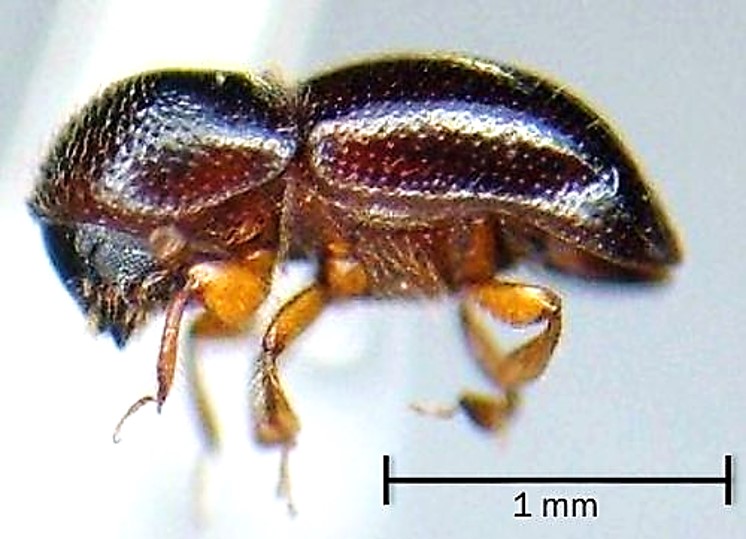
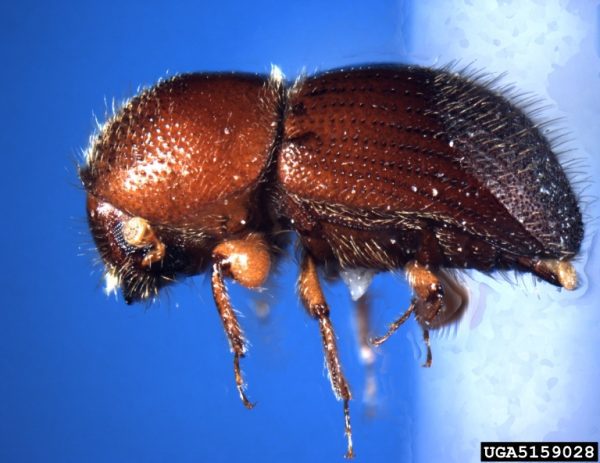
There are 30 non-native ambrosia beetle species in North America but only a half dozen are serious insect pests within nurseries, pecans & apples. The Xylosandrus species of beetle borers are native to southeast Asia & were first reported in the United States during the early 1930s (black stem borer). Today they are found in 29 states. Two ambrosia species found in NJ nurseries cause serious damage to trees. (1) The black stem borer (Xylosandrus germanus) (~2 mm) has attacked more than 200 tree species (fig.1). (2) The granulate (Asian) borer (Xylosandrus crassiusculus) (~2.5 mm) has attacked more than 120 tree species (fig.2). Both species are a threat to trees that are stressed. A 3rd species, the invasive redbay ambrosia beetle (Xyleborus glabratus), was first found in Louisiana in 2014. A major difference is it will also attack trees not under stress. It is not presently found in NJ, but it is moving north. The concern is the impact it may have on sassafras forests.

Fig. 1: An adult female ambrosia black stem beetle borer. Photo Credit: Brad Barnd, Bug Guide.net

Fig 2: An adult female ambrosia granulate borer. Photo Credit: Alabama Coop. Ext.

[Read more…]

High Probability of Downed Droughty Corn During Hurricane Season

The national oceanic and atmospheric agency at Colorado University has released their forecasting for the next two months of the Hurricane and Tropical Storm Season. The strong La Nina is persisting into a third year coupled with decreasing water temperatures returning closer to normal for this time of year are reportedly similar to 1999, 2000, 2011 and 2021 conditions.

Field corn: The stalk stability of droughty corn is much less tolerant to high winds than non-droughty corn. Given the drought conditions, corn producers may have the ability to harvest corn earlier than normal due to rapid dry down on the cob. Current soil moisture conditions are very suitable for fitting fields for winter small grain establishment.

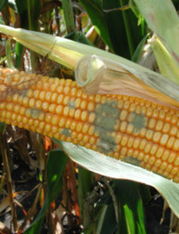
Moldy cornAspergillus mold species often show up after drought conditions, posing a significant risk of aflatoxins in the corn crop if present. Aspergillus molds are carcinogenic to people and cause losses in livestock and poultry. Combine operators and elevator operators should take precautions against inhaling fungal spores. Signs of Aspergillus ear rot include evidence of powdery olive-green mold on the ear tip or on kernels in the ear.
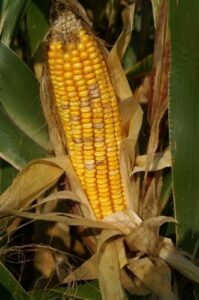
Corn with brown spots

Fusarium ear rots are also probable in fields that had significant high humidity and high temperatures as grains are developing to black layer. Fusarium molds show up as white to pink cotton-like growths mold scattered throughout the ear. A starburst like pattern may occur on infected kernels that may also be brown in color.

*Inhaling poison ivy volitile oils and ivyleaf morning glory and jimson weed dust as they go through the combine along field edges should also be avoided. 

For additional images see https://cropprotectionnetwork.org/encyclopedia/aspergillus-ear-rot-of-corn

Hurricane Season: Hurricane forecasters have stated that this La Nina and nearer to average water temperatures are similar to 1999, 2000, 2011 and last year. Given that in 1999, 11.41 inches of rain fell in Salem County; and in 2000, 5.76 inches fell in Salem County; and in 2011, 6.19 inches fell in Salem County in the month of September, producers who can harvest early may want to consider higher moisture harvest if standability is an issue. Hurricane season peaks from mid-August to mid-October with the season ending on Nov. 30.

Soybeans: Soybean fields should be walked for signs of stem snap in areas with high levels of soybean stem borer activity in 2020 and where July herbicide applications visibly stressed plants during the height of the drought this season. Due to in season stresses, bean maturity in the pods may be farther along in some fields than leaves indicate. If 90% of the beans are tan, test moisture levels frequently.

Salem County producers can pick up mycotoxin plant analysis bags at the extension office. Current pricing from regional laboratories are as follows:

1. NJ Department of Agriculture website submission form: (click link)

Mycotoxin test. Please call the laboratory to check on current availability and pricing


2. Dairy One Mycotoxin Testing: (click link)

  • Mycotoxin Panel $105: Aflatoxin B1, B2, G1, G2, Vomitoxin, Zearalenone, T2, 3-acetyl DON, 15-acetyl DON
  • Ochratoxin A $77
  • Fumonisin B1, B2, B3 $77
  • Full Panel $210

3. Dairyland Laboratories Individual Toxins: (click link)

  • Aflatoxin  $55.00
  • Vomitoxin (DON) $55.00
  • Zearalenone $55.00
  • T-2 /HT2 $55.00
  • Fumonisin  $55.00
  • Ochratoxin $55.00

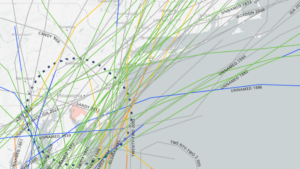
Check out the historical storm map maker image below at https://spacecoastdaily.com/2019/08/noaa-historical-hurricane-tracks-explore-more-than-150-years-of-historical-hurricane-landfalls/

July Pest Scouting Nursery, Landscape, and Christmas Trees – Key borer and scale insect control timings

Pest Scouting – Please refer to these documents for a full listing of insects pests for your area corresponding to growing degree-days (GDDs). 

Quick look guides for July (Borers and Scales) and (All other) 

Contact if seeing insects at different times: twaller@njaes.rutgers.edu (or call the Cumberland County Extension Office – 856-451-2800)

The following key groups of pests will be active, vulnerable, or otherwise treatable during the next month throughout most of NJ. Here, scale insects and borers with key life stage events during the 1000-2500 GDD timeframe are discussed. Note there are many other insect pests present this time of year so please view the pest scouting guides above for your particular needs.

Projected GDD50 Accumulation as of July 13 2022 Note: Growing degree-day values utilize daily average air temperatures with a minimum temperature threshold (a.k.a. ‘base’) of 50F = GDD50 (max. temp. threshold set at 95F). These values are accumulated from a biofix date, such as January or March 1st in the NE USA. Provided GDD50 are scouting ranges and should be truthed.
Region Location Station 13-Jul 1-Aug 1-Sep
South Upper Deerfield NJ50 1598 2115 2905
Central Howell / Freehold NJ10 1383 1871 2594
North High Point NJ59 1132 1541 2138
Forecast: NOAA NCEP Coupled Forecast System model version 2 (CFSv2) forecast system (3.5 months) (USPEST.ORG)

Refer to this post “Obtaining your local growing degree-days” for additional information 

BORER Insect Activity for 1000-2500 GDD (~ July)
Crop type Common Name Scientific Name GDD Min (50F) GDD Max (95F) Reference Developmental / Target Stage
Many Roundheaded appletree borer Saperda candida 802 1129 RU Adults
Ash Emerald ash borer Agrilus planipennis 1000 1200 4 Peak adult activity
Many Roundheaded apple tree borer Saperda candida 1514 1798 5 Typical treatment window
Conifer Nantucket tip moth Rhyacionia frustrana 1514 1917 RU Adults 2nd generation
Maple Sugar maple borer Glycobius speciosus 2032 2375 5 Typical treatment window
Locust Locust borer Magacyllene robiniae 2271 2805 5 Typical treatment window
Poplar and Willow Poplar and willow borer Crytorhynchus lapathi 2271 2806 5 Typical treatment window

Click here – “Identifying Clearwing Moth Borers in Pheromone Traps” or “Differentiating the Common Wood Borers of Ash Trees”

SCALE Insect Activity for 1000 – 2500 GDD (~ July)
Crop type Common Name Scientific Name GDD Min (50F) GDD Max (95F) Reference Developmental / Target Stage
Conifer Cryptomeria scale Aspidiotus cryptomeriae 600 800 3 First crawler emergence
Many White prunicola scale Psedaulacaspis prunicola 707 1151 RU Crawlers (1st generation)
Conifer Juniper scale Carulaspis juniperi 707 1260 RU Crawlers (1st generation)
Many Calico scale Eulecanium cerasorum 714 6 Crawlers (1st generation)
Conifer Striped pine scale Toumeyella pini 750 800 4 Egg hatch
Oak, hickory, birch, many Oak leacanium scale Parthenolecanium quercifex 789 6 Crawlers (1st generation)
Acer Cottony maple leaf scale Pulvinaria acericola 802 1265 5 Crawlers (1st generation)
Many, shadetrees Cottony maple scale Pulvinaria innumerabilis 802 1265 RU Crawlers (1st generation) – control target
Oaks Golden oak scale Asterolecanium variolosum 802 1266 5 Egg hatch
Maples Japanese maple scale Lopholeucaspis japonica 829 6 Crawlers (1st generation)
Elm European elm scale Gossyparia spuria 831 1388 6,2 Crawlers (1st generation)
Shade trees European fruit lecanium scale Parthenolecanium corni 932 1645 6,RU Crawlers  – control target
Conifer Pine tortoise scale Toumeyella parvicornis 1000 1200 4 Egg hatch ends, last of crawlers
Yew, many conifers Fletcher Scale (Yew) Parthenolecanium fletcheri 1029 1388 RU Crawlers (1st generation) – control target
Many Indian wax scale Ceroplastes ceriferus 1145 6 Crawlers (1st generation)
Euonymus Euonymus Scale Unaspis euonymil 1150 1388 5 2nd generation targeted treatments
Shade trees European fruit lecanium scale Parthenolecanium corni 1266 1645 5 Crawlers
Conifer Pine Needle Scale Chionaspis pinifoliae 1290 1917 3 Crawlers emerge (2nd generation) – control target
Conifer Hemlock scale Abgrallaspis ithacae 1388 2154 5 Typical treatment window
Malus, Prunus, many Peachtree borer Synanthedon sp. 1500 1800 RU Larvae Treatment
Many White prunicola scale Pseudaulacaspis prunicola 1637 6 Egg hatch / crawler (2nd generation)
Euonymus Euonymus Scale Unaspis euonymil 1700 RU Continued 2nd generation treatments
Conifer Cryptomeria scale Aspidiotus cryptomeriae 1750 2130 RU, 4 Crawlers emerge (2nd generation)
Many Obscure scale Melanaspis obscura 1774 6 Egg hatch / crawler
Conifer Maskell scale lepidosaphes pallia 2035 6 Egg hatch / crawler (2nd generation)
Mainly Tulip Tulip tree scale Toumeyella liriodendri 2037 2629 RU Crawlers (1st generation)
Mainly Magnolia Magnolia scale Neolecanium cornuparvum 2155 2800 RU Crawlers (1st generation)
Maple Japanese maple scale Lopholeucaspis japonica 2508 6 Egg hatch / crawler (2nd generation)
Conifer Elongate hemlock scale Fiorinia externa 2515 2625 RU Typical treatment window – fall activity
Yew, many conifers Fletcher Scale (Yew) Parthenolecanium fletcheri 2515 2800 RU Fall control of overwintering stage

[Read more…]

Native White Birches & Their Resistance to the Bronze Birch Borer

The Dilemma Regarding Birch Trees

Bronze birch borer adult female laying an egg on the bark surface of a birch tree. (Photo Credit: Ohio State Coop. Ext.)

Bronze Birch Borer (Agrilus anxius) adults (440-800 GDD) are now actively searching landscapes for various species of Betula (Birch) to lay eggs upon. The adult beetles will be attracted to susceptible trees that are genetically defenseless or are compromised from stress (e.g., especially drought stress).

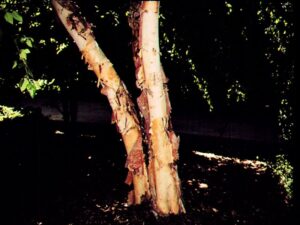
It is well known that the native River Birch (Betula nigra) has a strong resistance against the BBB. As a result, this species has been extensively planted in NJ landscapes during the past few decades to the extent of arguably being over-planted. And it is also widely understood that the non-native Asian & European birch species have virtually no or little resistance to the BBB. Therefore, the planting of these non-natives has rightfully been reduced over the decades. However, what about some of our other native species such as the paper, gray, & yellow birches. Is it best to avoid planting these species as well?       

River birch (Betula nigra) is a native birch that is strongly resistant to the bronze birch borer. (Photo Credit: Steven K. Rettke, Rutgers Coop.Ext.)

Is it best to avoid planting other native birch trees in our landscapes, such as the gray birch shown above? (Photo Credit: Steven K. Rettke, Rutgers Coop. Ext.)


[Read more…]