Organic Farm Advisory

The Plant & Pest Advisory serves NJ growers by reporting on important pests and recommending responses that are grounded in reproducible trials.

Articles in this section contain information helpful to the NJ commercial organic grower.
Sharing organic practice trial results between land-grant universities is a cost effective way to create a common knowledge base built on the strengths of individual programs. In the sidebar, find institutions with programs in organic agriculture which augment knowledge developed at the Rutgers New Jersey Ag Experiment Station.

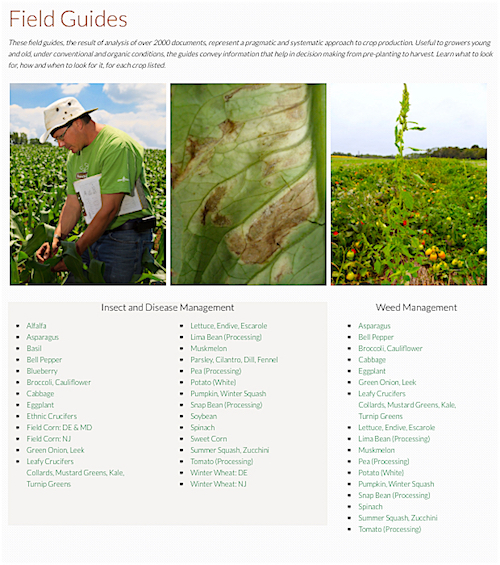
Rutgers Cooperative Extension Field Guides: These concise guides help with decision making from pre-planting to harvest. For each crop listed, learn what pests to proactively look for as the season progresses, how to look for them, and when to take action.

Field Guide List

Vegetable IPM Update 7/03/24

Sweet Corn

European corn borer (ECB) moth catches are very low in blacklight traps in the northern and central counties.  Feeding signs are largely absent from whorl and pre-tassel stage plantings.

The highest nightly trap catches of ECB for the week ending 7/03/24 are as follows:

Clinton   1 Milltown   1
Dayton   1 Old Bridge    1
Hillsborough   1 Oldwick   1


The low level fall armyworm (FAW)  infestations we had found in some whorl stage corn in central NJ, have been treated and new infestations have not occurred.  It is possible that some infestations remain in unmonitored fields.  It is important to check  short whorl plantings at least weekly for the remainder of the season because early detection and treatment limit irreversible damage to plants.

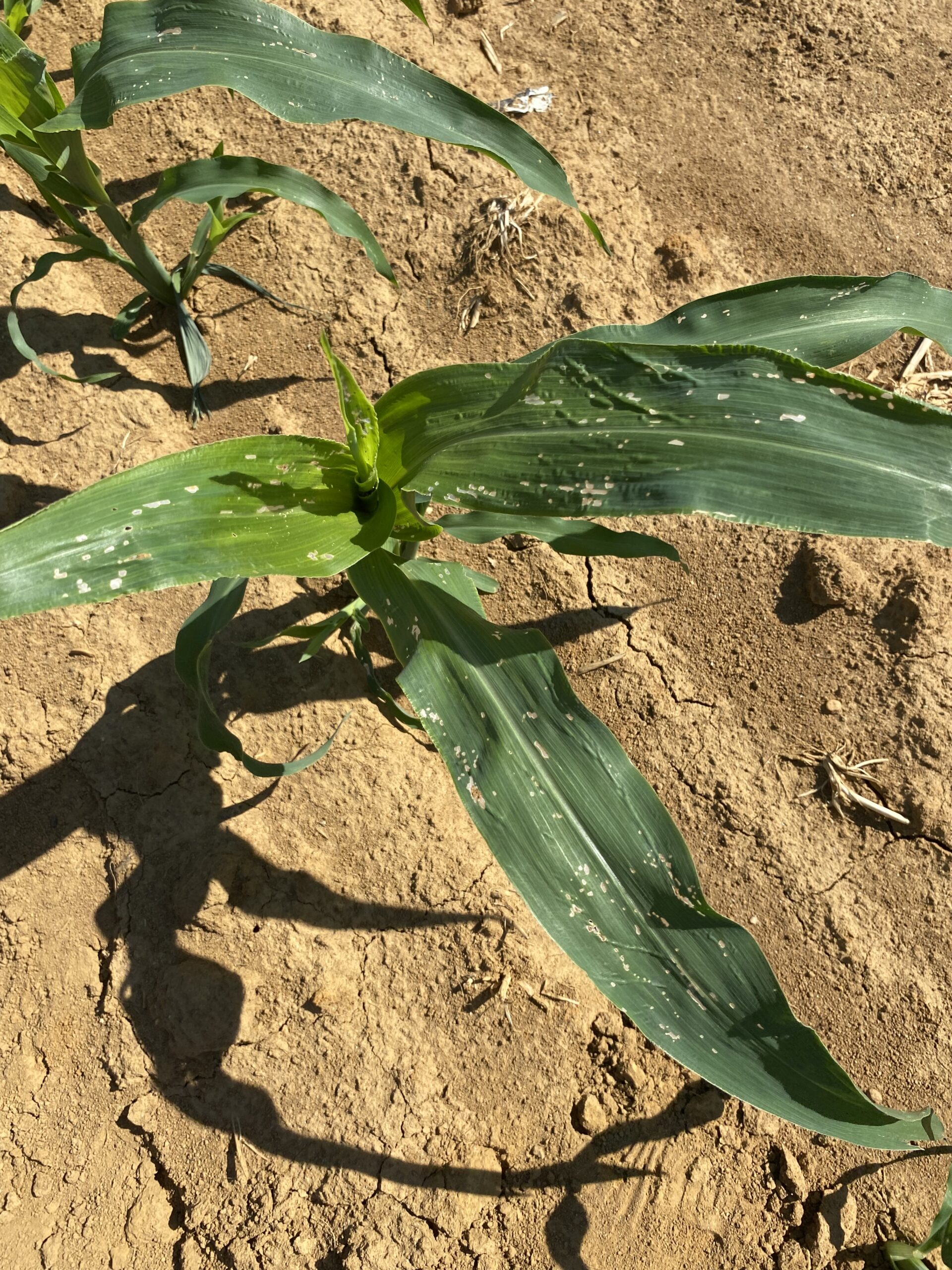
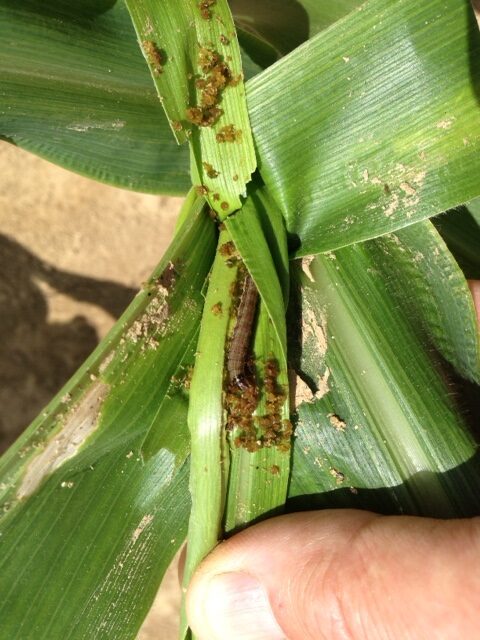
Newly hatched FAW larvae cause holes and scratches on leaves that are similar to ECB feeding, except that they tend to be more concentrated and always lead down into the whorl  (see photo at left).  As the larvae grow, the feeding becomes more destructive, with large ragged holes and obvious droppings deposited in the whorl (see photo at right)Infected plant

We will provide updates on new FAW appearances and severity as reports come in.  FAW are resistant to synthetic pyrethroids.  Effective sprays should include IRAC grp. 5 (spinosyns) or IRAC grp. 28 (diamides).  The carbamate (IRAC grp. 1A) Lannate is also still effective.  Sufficient water should be used in the applications to allow the solution to penetrate the layer of droppings that may have formed above the caterpillar.

[Read more…]

Food Safety Certification for Specialty Crop (FSCSC) Cost Share Program

This is the chance for eligible fresh fruit and vegetable growers to recover some of their expenses for implementing food safety practices on the farm.

For 2024:

  • Applications are due between July 1, 2024 and January 31, 2025
  • Eligible expenses must be between June 26, 2024 and December 31, 2024

For 2025:

  • Application is due between January 1, 2025 and January 1, 2026
  • Eligible expenses must be between January 1, 2025 and December 31, 2025

Eligible specialty crop operations can apply for FSCSC by working directly with the Farm Service Agency offices at your local FSA office for details. Applications will be accepted via mail, fax, hand delivery, or electronic means.

How the Food Safety Certification for Specialty Crops Program Works

The FSCSC program provides financial assistance for specialty crop operations that incur eligible on-farm food safety program expenses related to obtaining or renewing a food safety certification in years 2024 and 2025. This program helps offset costs to comply with regulatory requirements and market-driven food safety certification requirements.  FSCSC will cover a percentage of the specialty crop operation’s cost of obtaining or renewing their certification, as well as a percentage of their related expenses.

Program Eligibility

Eligibility requirements for FSCSC applicants are outlined below. We recommend you review these requirements before initiating your FSCSC application.

To be eligible for FSCSC, an applicant must:

  • Have obtained or renewed:
  • 2024 food safety certification issued between June 26, 2024, and December 31, 2024
  • 2025 food safety certification issued during calendar year 2025.
  • Be a specialty crop operation (growing fresh fruits and vegetables); and meet the definition of a small business or very small business.
  • A small (farm) business means an applicant that had an average annual monetary value of specialty crops the applicant sold during the 3-year period preceding the program year of more than $250,000 but not more than $500,000.
  • A very small (farm) business means an applicant that had an average annual monetary value of specialty crops the applicant sold during the 3-year period preceding the program year of no more than $250,000.
Category of Eligible Expenses Payment Amount of Eligible Costs
Developing a Food Safety Plan for First Time Certification 75% (no maximum)
Maintaining or Updating a Food Safety Plan 75% up to $675
Food Safety Certification 75% up to $2,000
Certification Upload Fees 75% up to $375
Microbiological Testing of Produce 75% up to 5 tests
Microbiological Testing of Soil Amendments 75% up to 5 tests
Microbiological Testing of Water 75% up to 5 tests
Training Expenses 100% up to $500

FSCSC payments are calculated separately for each category of eligible costs based on the percentages and maximum payment amounts.  The FSCSC application and associated forms are available online at  farmers.gov/food-safety.

You are encouraged to contact the Farm Service Agency office about FSCSC, program eligibility, or the application process. You may also call 877-508-8364 to speak directly with a USDA employee ready to provide one-on-one assistance.

Vegetable IPM Update 6/26/24

Sweet Corn

European corn borer (ECB) moths have declined in blacklight traps in the northern and central counties, and feeding is also declining as previously infested plantings enter the silk stage and are treated.   Plantings now in whorl stage are showing little feeding.

The highest nightly trap catches of ECB for the week ending 6/26/24 are as follows:

Farmingdale   1
Milltown   1
Pennington   1


Low level fall armyworm (FAW)  infestations have been detected in a few whorl stage plantings in central counties ranging from Princeton in Mercer County to Farmingdale in Monmouth County.  There are likely more of these infestations in central and southern NJ counties.  The appearance of very scattered clusters of infested plants points to a low number of moths arriving prior to the last weather front.  These individuals will have deposited eggs on small groups of plants, resulting in the feeding pattern we now see.  Many of these fields are below 2% plants infested.  It is possible, however, that some fields in the southern counties have higher infestation levels, so it’s important to check these short whorl plantings at least weekly.

Newly hatched FAW larvae cause holes and scratches on leaves that are similar to ECB feeding, except that they tend to be more concentrated and always lead down into the whorl  (see photo at left).  As the larvae grow, the feeding becomes more destructive, with large ragged holes and obvious droppings deposited in the whorl (see photo at right)Infected plant

We will provide updates on new FAW appearances and severity as reports come in.  FAW are resistant to synthetic pyrethroids.  Effective sprays should include IRAC grp. 5 (spinosyns) or IRAC grp. 28 (diamides).  The carbamate (IRAC grp. 1A) Lannate is also still effective.  Sufficient water should be used in the applications to allow the solution to penetrate the layer of droppings that may have formed above the caterpillar.

[Read more…]

Vegetable IPM Update 6/19/24

Sweet Corn

European corn borer (ECB) moths continue to be captured in blacklight traps in the northern and central counties, although catches are occurring at fewer sites.  The highest feeding levels are in Somerset and southern Hunterdon Counties.   ECB injury is declining as infested plantings pass into the tassel stage and receive the first insecticide application.  Plantings now in whorl stage are showing little feeding.  While ECB has become something of a local phenomenon in NJ, growers should not assume that feeding is below economic levels in their area.  ECB infestations will be present for another 1-2 weeks.

Look for the characteristic “shot-hole” type of feeding (photo  below at right) and consider treating when infested plants exceed 12% in a 50 plant sample.  As plantings proceed to the pre-tassel stage, ECB larvae may be found in emerging tassels (see photo at left)It is a good idea to treat individual plantings as they move into the full tassel/first silk stage one time.  This eliminates any ECB larvae that have emerged with the tassels as they begin to move down the stalk to re-enter near developing ears.


Useful insecticides for this particular application include synthetic pyrethroids (IRAC Grp 3), spinosyns (including OMRI approved Entrust) IRAC Grp 5), and diamides such as Coragen or Vantacor (IRAC Grp 28) or materials such as Besiege which include the active ingredient in Coragen.  Synthetic pyrethroids alone should NOT be used for corn earworm (CEW) protection on silking corn.  Control with these materials is very inconsistent.

The highest nightly trap catches of ECB for the week ending 6/19/24 are as follows:

South Branch   3 Farmingdale   1 Pennington   1
Califon   1 Hillsborough   1 Princeton   1
Clinton   1 Old Bridge   1

[Read more…]

Getting Ready for Your Food Safety Audits

Scheduling USDA audits GAP, Harmonized or Harmonized Plus

Anyone who has not scheduled their audit needs to be aware of the documentation needed to be sent to the New Jersey Department of Agriculture prior to the audit.  They will want to see a copy of your food safety plan, proof of your food safety training, any current water tests, training records of all personnel, ten days of supporting records (for example – cleaning and sanitizing equipment, monitoring for wildlife, approved supplier list, etc.), mock recall and a self-audit.  Why do they want the records prior to the audit?  It saves time on their end plus it will save the grower money by them spending less time on the farm.

The audits can be scheduled in two ways either call the NJDA office at 856-839-3388 or go to fvinspection@ag.nj.gov .  There is a new request form so if you have an old form contact them for the new one.  The request should be at least two weeks prior to the audit.

Need for multiple audits.

Crops may be grouped together on the initial request to be included in the audit.  The audit needs to be scheduled so the auditor can see the distinct types of harvest activities.  For an asparagus and tomatoes example, if the asparagus is being harvested during the initial audit while the tomatoes are growing but won’t be ready for harvest until a later date, the initial audit can cover both commodities but an unannounced audit would be used by the auditor to observe the harvest of the tomatoes.  Also, the auditor will want to see all crops listed on the audit request form.

It is an option for the auditee to ask for commodities to be split on different audits.   To certify two audits that occur at separate times for different commodities the auditee would need to let the auditor know the intention for two audits in the season.  There would be a separate audit done, a certificate for each audit and a website posting for each audit.  The certification dates would be separate for each audit done.

USDA Audit Rates Increasing October 1, 2024

Anyone who is getting a GAP, Harmonized or Harmonized Plus Audit through the New Jersey Department of Agriculture will see the rates increase in October.  The basic hourly rate will increase from $155.00 to $163.00.  Those that are getting a Global Food Safety Initiative (GFSI) certification will have an additional $250.00 for each audit.

Beat the Heat: Water and Sports Drinks for Hydration

Article By: The Rutgers Farm Health and Safety Working Group: Kate Brown, Michelle Infante-Casella, Stephen Komar and William Bamka

When it comes to hydration, the U.S. National Academies of Sciences, Engineering, and Medicine recommends an adequate daily fluid intake of about 15.5 cups (3.7 liters) of fluids a day for men and about 11.5 cups (2.7 liters) of fluids a day for women. Even with this guidance, the amount varies from person to person. Also, when temperatures are hotter and when workloads increase so should drinking water, to prevent dehydration and to help maintain the proper body temperature especially when sweating.

Regular intake of water throughout the day and during the evening, at recommended amounts may help prevent a person from becoming excessively thirsty and also prevent dehydration. The choice of drinking sports drinks that contain electrolytes may be considered when a person’s activities dramatically increase, when they excessively sweat, if they show signs of dehydration, and/or heat stress.

Most sports drinks are designed to replenish glucose, fluids, and electrolytes (sodium, potassium, magnesium, calcium) lost during strenuous exercise or heavy workloads. Sports drinks may contain carbohydrates in the form of sugar, usually glucose, high-fructose corn syrup, or sucrose. Some contain no sugar and are “sweetened” instead with low-calorie sweeteners. The amounts of sugar and electrolytes in sports drinks are intended to allow for quick hydration and absorption.

It is important to note, persons with diabetes should be mindful of not intaking amounts of sports drinks that are high in sugar that could raise blood sugar to unhealthy levels. Additionally, persons with high blood pressure should be mindful when drinking sports drinks that are high in sodium – most are. Persons who eat a healthy diet should have enough glucose and electrolytes to maintain their health, even during extra activities and with proper water intake. Some studies show drinking too many sports drinks, especially when not performing vigorous exercise, can increase the risk of overweight/obesity and other health issues such as type 2 diabetes, cardiovascular disease, gout and the risk of dental cavities.

Water is the best choice to stay hydrated and it is the responsibility of each individual person to be sure they drink enough water to maintain their proper health.