Organic Farm Advisory

The Plant & Pest Advisory serves NJ growers by reporting on important pests and recommending responses that are grounded in reproducible trials.

Articles in this section contain information helpful to the NJ commercial organic grower.

Sharing organic practice trial results between land-grant universities is a cost effective way to create a common knowledge base built on the strengths of individual programs. In the sidebar, find institutions with programs in organic agriculture which augment knowledge developed at the Rutgers New Jersey Ag Experiment Station.

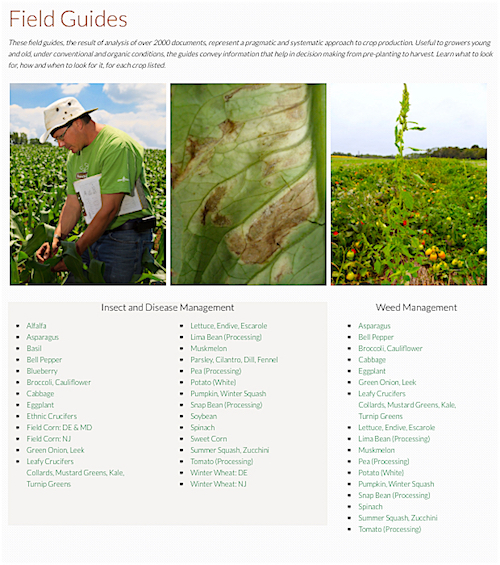
Rutgers Cooperative Extension Field Guides: These concise guides help with decision making from pre-planting to harvest. For each crop listed, learn what pests to proactively look for as the season progresses, how to look for them, and when to take action.

Field Guide List

Vegetable IPM Update 8/07/24

Sweet Corn

Fall armyworm (FAW)  infestations remain present, although in fields where growers responded with appropriate insecticides, control has been good.   Re-infestation is occurring rapidly in Cape May County fields, and is likely happening elsewhere in the southern part of the state.  Because FAW moths are highly mobile, it is important to monitor fields at least weekly for signs of infestation.   Whorl stage plants are prime targets for egg laying.  Delays in treating whorl stage infestations can lead to stunted plants and poor ear size.

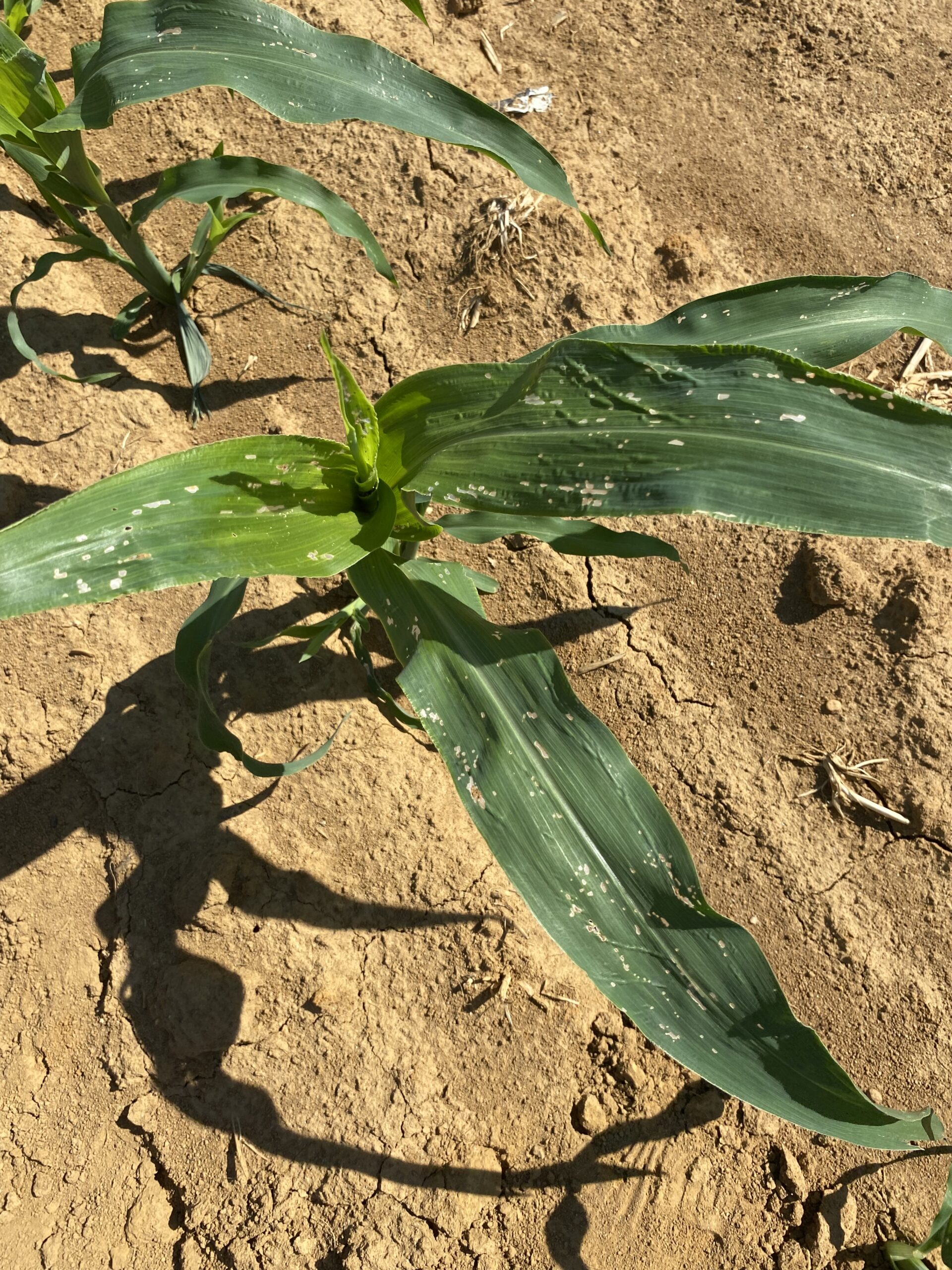
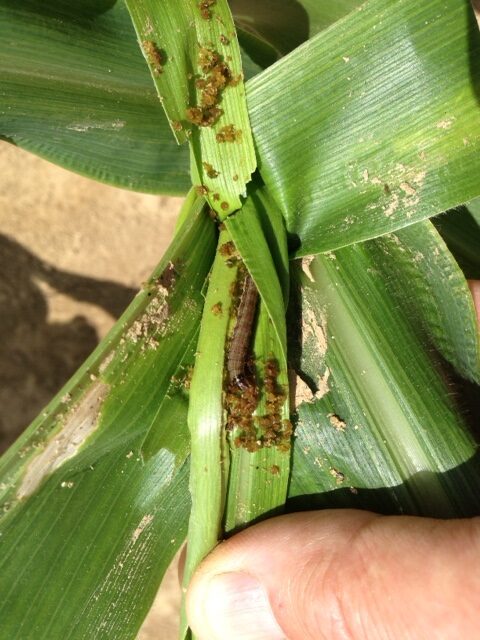
Newly hatched FAW larvae cause holes and scratches on leaves that are similar to ECB feeding, except that they tend to be more concentrated and always lead down into the whorl  (see photo at left).  As the larvae grow, the feeding becomes more destructive, with large ragged holes and obvious droppings deposited in the whorl (see photo at right)Infected plant

We will provide updates on new FAW appearances and severity as reports come in.  FAW are resistant to synthetic pyrethroids.  Effective sprays should include IRAC grp. 5 (spinosyns) or IRAC grp. 28 (diamides).  The carbamate (IRAC grp. 1A) Lannate is also still effective.  Sufficient water should be used in the applications to allow the solution to penetrate the layer of droppings that may have formed above the caterpillar.

[Read more…]

Vegetable IPM Update 7/31/24

Sweet Corn

Fall armyworm (FAW)  infestations remain present, although in fields where growers responded with appropriate insecticides, control has been good.   Because FAW moths are highly mobile, it is important to monitor fields at least weekly for signs of infestation.   Whorl stage plants are prime targets for egg laying.

Newly hatched FAW larvae cause holes and scratches on leaves that are similar to ECB feeding, except that they tend to be more concentrated and always lead down into the whorl  (see photo at left).  As the larvae grow, the feeding becomes more destructive, with large ragged holes and obvious droppings deposited in the whorl (see photo at right)Infected plant

We will provide updates on new FAW appearances and severity as reports come in.  FAW are resistant to synthetic pyrethroids.  Effective sprays should include IRAC grp. 5 (spinosyns) or IRAC grp. 28 (diamides).  The carbamate (IRAC grp. 1A) Lannate is also still effective.  Sufficient water should be used in the applications to allow the solution to penetrate the layer of droppings that may have formed above the caterpillar.

[Read more…]

Vegetable IPM Update 7/24/24

Sweet Corn

Fall Armyworm Alert!

Fall armyworm (FAW)  infestations are increasing in frequency and severity now.  While numbers are not extreme, field scouts are reporting infestation rates from 12-30% with some regularity in many parts of central and northern NJ.  Cooperating growers in Cape May County (where FAW is typically heaviest) report that FAW is now present in whorl and pre-tassel stage plantings.  Because FAW moths are highly mobile, and with southerly winds continuing to dominate, it is important to monitor fields at least weekly for signs of infestation.   Whorl stage plants are prime targets for egg laying.

Newly hatched FAW larvae cause holes and scratches on leaves that are similar to ECB feeding, except that they tend to be more concentrated and always lead down into the whorl  (see photo at left).  As the larvae grow, the feeding becomes more destructive, with large ragged holes and obvious droppings deposited in the whorl (see photo at right)Infected plant

We will provide updates on new FAW appearances and severity as reports come in.  FAW are resistant to synthetic pyrethroids.  Effective sprays should include IRAC grp. 5 (spinosyns) or IRAC grp. 28 (diamides).  The carbamate (IRAC grp. 1A) Lannate is also still effective.  Sufficient water should be used in the applications to allow the solution to penetrate the layer of droppings that may have formed above the caterpillar.

[Read more…]

Vegetable IPM Update 7/17/24

Sweet Corn

European corn borer (ECB) moth catches are very low and scattered among blacklight traps in the northern and central counties.  Larvae are absent from whorl and pre-tassel stage plantings.  Should numbers rebound later in the summer, they will be reported in table form.

Fall armyworm (FAW)  infestations are low and inconsistent in most scouted fields north of Burlington County, although a field infestation of 34% was discovered near Adelphia in Monmouth County this week.  It appears that these clusters of moths are arriving with southerly winds and remain local.  Cooperating growers in Cape May County (where FAW is typically heaviest) report that FAW has thus far been largely absent from fields.  Moths are showing up in blacklight traps occasionally, with slightly more individuals in coastal county sites. Because FAW moths are highly mobile, and with southerly winds dominating our weather lately, it is important to monitor fields at least weekly for signs of infestation.   Whorl stage plants are prime targets for egg laying.

Newly hatched FAW larvae cause holes and scratches on leaves that are similar to ECB feeding, except that they tend to be more concentrated and always lead down into the whorl  (see photo at left).  As the larvae grow, the feeding becomes more destructive, with large ragged holes and obvious droppings deposited in the whorl (see photo at right)Infected plant

We will provide updates on new FAW appearances and severity as reports come in.  FAW are resistant to synthetic pyrethroids.  Effective sprays should include IRAC grp. 5 (spinosyns) or IRAC grp. 28 (diamides).  The carbamate (IRAC grp. 1A) Lannate is also still effective.  Sufficient water should be used in the applications to allow the solution to penetrate the layer of droppings that may have formed above the caterpillar.

[Read more…]

Vegetable IPM Update 7/10/24

Sweet Corn

European corn borer (ECB) moth catches are very low and scattered among blacklight traps in the northern and central counties.  Larvae are absent from whorl and pre-tassel stage plantings.  Should numbers rebound later in the summer, they will be reported in table form.

Fall armyworm (FAW)  infestations are low and inconsistent in scouted fields north of Burlington County.  At this time, field technicians are occasionally encountering small clusters of infested whorl stage plants, indicating that individual moths had entered fields and deposited eggs.  Cooperating growers in Cape May County (where FAW is typically heaviest) report that FAW has thus far been largely absent from fields.  Moths are showing up in blacklight traps occasionally, with slightly more individuals in coastal county sites. Because FAW moths are highly mobile, and with southerly winds dominating our weather lately, it is important to monitor fields at least weekly for signs of infestation.   Whorl stage plants are prime targets for egg laying.

Newly hatched FAW larvae cause holes and scratches on leaves that are similar to ECB feeding, except that they tend to be more concentrated and always lead down into the whorl  (see photo at left).  As the larvae grow, the feeding becomes more destructive, with large ragged holes and obvious droppings deposited in the whorl (see photo at right)Infected plant

We will provide updates on new FAW appearances and severity as reports come in.  FAW are resistant to synthetic pyrethroids.  Effective sprays should include IRAC grp. 5 (spinosyns) or IRAC grp. 28 (diamides).  The carbamate (IRAC grp. 1A) Lannate is also still effective.  Sufficient water should be used in the applications to allow the solution to penetrate the layer of droppings that may have formed above the caterpillar.

[Read more…]

Note Changes in Harmonized Audits for 2024

It has come to our attention that growers are using on old self audit checklist for their 2024 audit.  According to USDA the old form was not acceptable after April 30, 2024!  The USDA released the new Harmonized GAP Standard and Harmonized Plus+ Standard Audits in March to give growers the opportunity to update their plans. There are several changes related to section numbers and deleted numbers so if you have your audit plan setup by section number check to make sure they have not changed. Also, eight questions have been added. Following is a summary of those questions:

  • G 2.4 – Approved service provider list required (the grower approves the list)
  • G 7.2 – A designated recall team is required
  • G 7.3 – Must perform a mock recall exercise annually
  • G 11.5 – Must have labels and instructions for any water treatment chemical used
  • G 11.8 – Compressed air or other gases contacting food or food contact surfaces must be maintained
  • F 6.3 – Must have a procedure for storing and handling growing media (e.g., perlite, peat, rock wool, etc.)
  • F 9.4 – Re-used water must be treated with a labeled product
  • P 5.2 – A master cleaning schedule with standard operating procedures (SOP) must be established

There are two documents for each audit: Harmonized GAP Standard (v 3.0) or Harmonized GAP Plus+ standard (v 5.0). Each audit has a corresponding checklist “Harmonized GAP Combined Checklist (v6.1)” This is the checklist a grower should be using to their self-audit. Remember an older version will not be accepted which means the audit fails.  Go to the Rutgers On-Farm Food Safety website an look under the USDA Audits tab or go to Harmonized GAP | Agricultural Marketing Service (usda.gov) to download the correct versions.