Organic Farm Advisory

The Plant & Pest Advisory serves NJ growers by reporting on important pests and recommending responses that are grounded in reproducible trials.

Articles in this section contain information helpful to the NJ commercial organic grower.

Sharing organic practice trial results between land-grant universities is a cost effective way to create a common knowledge base built on the strengths of individual programs. In the sidebar, find institutions with programs in organic agriculture which augment knowledge developed at the Rutgers New Jersey Ag Experiment Station.

Rutgers Cooperative Extension Field Guides: These concise guides help with decision making from pre-planting to harvest. For each crop listed, learn what pests to proactively look for as the season progresses, how to look for them, and when to take action.
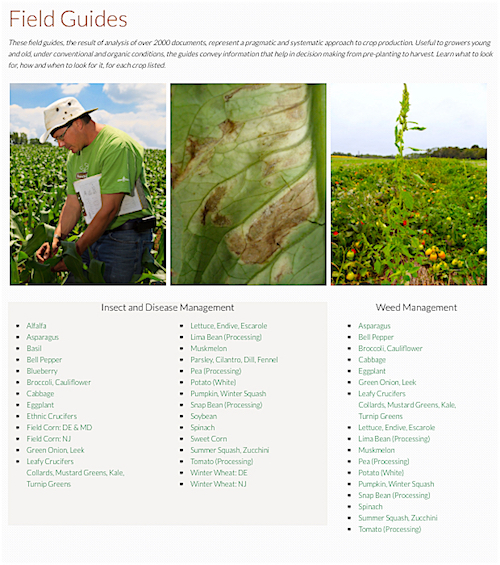
Field Guide List

Allium Leafminer Update 3/20/2026

Greetings from the Veg IPM team, and happy first day of Spring! As we are slowly transitioning into warmer weather, now is a great time to be thinking about Allium Leafminer (ALM), a pest of many bulbous crops such as onions, scallions, chives, and garlic.

Allium Leafminer (Phytomyza gymnostoma) is a small grey-bodied fly with a yellow head (A). In warm, still weather, you may see adult flies settling on foliage. The females lay eggs in neat rows, leaving behind a line of white dots on the leaves (B). As the larvae hatch and begin to feed, they will tunnel downwards, causing damage to leaves and bulbs. ALM have two generations per year; the first in early spring, and the second occurring in the fall. Crops such as chives, scallions, garlic, onions and leeks are attacked by ALM, but leeks, and scallions seem to be the most affected. 

An Allium leafminer adult (A) and the characteristic oviposition scars left behind after females lay eggs (B)

An Allium Leafminer adult (A) and the characteristic oviposition scars left behind after females lay eggs (B). Photos by Maria Cramer and Amanda Quadrel


Be on the lookout for oviposition scars on both crop alliums and wild alliums such as wild onion/garlic and ramps. You can also use yellow sticky cards to monitor for adult presence in the field. However, another way to the predict the first generation’s activity is by using growing degree days (GDDs). The first emergence of ALM adults occurs around 250 GDDs (Base temperature: 39˚F). Below is a table that shows the number of GDDs that have accumulated from January 1st to March 19th (the date this post was written), as well as the number of GDDs predicted to accumulate by March 24th.

Location  GDDS for 3/19 GDDs for 3/24 (forecast)
Northern NJ (Chester) 102 129
Central NJ (Cream Ridge) 162 202
Southern NJ (Upper Deerfield) 187 231


While ALM risk is currently low for northern and central NJ, areas in southern NJ could reach 250 GDDs by the end of next week, thus being at a higher risk for ALM activity. To find out how many GDDs have accumulated in your specific area, the NEWA website: https://newa.cornell.edu/ has a helpful GDD calculator. From the NEWA home screen, select your nearest weather station from the drop down menu or map at the center of the page. Next, scroll down to the “Weather Tools” section on the lower right side of the page, and select “DD Calculator”. Select your start date (1/01/26) and end date (typically the day you check), as well as Degree Day Type (Base 39 F) from the menu at the left of the page.  The site will automatically generate a table of the number of accumulated GDDs for the specified date range and a forecast of predicted GDD accumulations over the next five days.

If you are concerned about crop injury due to ALM, you may want to prepare for control efforts. Floating row covers, kept on until the first flight ends (around the end of May) can restrict ALM’s access to vulnerable plants. Reflective mulches may also provide some additional crop protection. Adults and larvae can be targeted through well-timed insecticide sprays. Materials labeled for ALM control include spinosyns (IRAC 5- Radiant or Entrust (OMRI approved)), pyrethroids (IRAC 3A- Mustang Maxx, Proaxis, and Warrior II), neonicotinoids (IRAC 4A- Scorpion, Venom), the insect growth regulator Trigard (IRAC 17), and diamide products (IRAC 28- Exirel, Minecto Pro). The newly registered product Vertento (IRAC 30) may also be used for ALM control. However, growers who have trouble managing onion thrips may want to save this active ingredient for thrips sprays, as there is a limit of two applications per season. The first spray application of a material should be completed 2- 3 weeks after initial detection of ALM (either oviposition scars or the fly itself). Subsequent sprays should be completed in 1–2-week intervals. Two or three sprays should provide adequate control. As always, be sure to follow label rates and application instructions for any pesticide that you plan to use.

For more pictures and detailed information on the biology and management of ALM, Cornell has an excellent fact sheet that can be found here: https://cals.cornell.edu/integrated-pest-management/outreach-education/fact-sheets/allium-leafminer. In the meantime, we will keep our eyes open for any ALM activity in our respective areas and provide updates in the next coming weeks. We are looking forward to warmer weather and a productive season! 

~Amanda Quadrel and Maria Cramer, Senior Program Coordinators- Vegetable IPM

Questions or concerns? Get in touch with us by filling out the form below:

← Back

Thank you for your response. ✨

Have a plan for managing thrips and TSWV in tomatoes and peppers in 2026

Thrips and tomato spotted wilt virus (TSWV) management were major challenges for multiple South Jersey growers in 2025, as well as in the previous few years. Several growers reported losing entire tomato plantings to the virus. Peppers were less impacted than tomatoes, but TSWV outbreaks did occasionally occur. As we move into pepper and tomato transplant production and the growing season for greenhouse tomatoes, having a multi-pronged approach for managing thrips and TSWV will give you the best chance of protecting your crop and avoiding losses. Below are key practices that can help keep thrips populations as low as possible:

Start clean. When transplants are infested with thrips prior to planting out, field infestations tend to occur early and be very difficult to control. To start clean:

  • Never produce transplants in the same greenhouse with ornamentals. Ornamentals can harbor thrips and many are asymptomatic hosts for TSWV.
  • Monitor thrips in planthouse with sticky cards and scouting (Fig. 1). There are no established thresholds for thrips in the greenhouse, but many growers use the first appearance of thrips as an action threshold.
  • Keep greenhouses and high tunnels weed-free. Weeds can host both thrips and TSWV.
  • If buying in transplants, segregate and monitor incoming transplants to ensure that they are not bringing in thrips.
  • Treat transplants with imidacloprid (e.g. Admire) or Cyantriniliprole (Verimark) before setting in the field

A yellow rectangular sticky card held to a stake with a clothespin has caught several small insects.

Fig. 1. A sticky card being used to monitor greenhouse pests. Photo by S. Rettke.

 Manage plantings to prevent the spread of thrips and TSWV from alternative hosts into tomato plantings. Thrips are attracted to pollen-producing plants, so populations can build up on plants that flower early, such as strawberries and small grains, then move into tomato plantings. Additionally, thrips can also overwinter on weeds. Using these facts, reduce the movement of thrips into tomato plantings by:

  • Controlling weeds throughout the farm, especially in and around high tunnels
  • Separating field plantings from greenhouses/tunnels, strawberry fields, and small grains
  • Separating successive field plantings as much as possible. This way, if thrips and/or TSWV get out of control in one planting, they will not move directly into the next planting.
  • Scouting for tomato spotted wilt virus symptoms (Fig. 2). Immediately rogue symptomatic plants to avoid secondary spread within the field.

Fig. 2. TSWV symptoms in tomato: a) curling and yellowing foliage symptoms, b) distortion and brown shoulder symptoms on green fruit, and c) bulls-eye symptoms on ripe fruit. Photos by M. Cramer.

Use metallized plastic and resistant varieties.

  • Use metallized plastic mulch when possible (Fig. 3). Metallized mulches reflect sunlight, disrupting thrips navigation and making it harder for them to colonize plants. These plastics are widely used in states like Florida that have historically had serious thrips problems. Because these mulches reflect solar radiation, they lower bed temperatures, and will slow down tomato growth early in the season. This should be taken into account when planning to use them.
  • Use TSWV resistant tomato and pepper varieties. While some farms have reported resistance-breaking TSWV, others continue to report that resistance is still holding up.

Fig. 3. Metallized plastic laid in the fall to control onion thrips in alliums. Photo by A. Quadrel.

Use best practices around insecticides. Thrips are difficult to manage with insecticides because they tend to hide in hard to reach parts of the plant or in the soil as well as their rapid ability to develop resistance. For example, many thrips populations in south Jersey are resistant to Radiant (IRAC 5), making this insecticide ineffective for management. Pyrethroid (IRAC 3) resistance is also widespread. Many of the insecticides labeled for thrips are only partly effective, and none are able to “knock down” high populations. To get the best efficacy out of insecticides:

  • Know what your populations are: Monitor thrips populations and treat when populations start building, but are still low.
    • Scout 5- 10 locations in field at least once a week
    • At each location in the field, pick a group of 5 consecutive plants and check 2 leaves on each plant (10 leaves total per location)
    • Count the number of thrips on the leaves (Fig. 4). Research from North Carolina shows that the species of thrips vectoring TSWV (western flower thrips) are most reliably found on the leaves rather than the flowers
    • Threshold: Action should be taken if counts are increasing towards ~ 5 thrips per 10 leaves on average
  • Rotate modes of action as much as possible. We believe that thrips populations tend to be highly localized, and thus you are managing insecticide resistance for your population of thrips specifically. The more you manage resistance, the more product options you will continue to have.
  • Monitor thrips populations after treatment to assess efficacy (some systemic products, such as Beleaf and Verimark may take several days to ~a week to impact thrips populations)

Note: The vegetable IPM program offers scouting services throughout New Jersey if you are unable to scout your plantings (you can find a description of services here). We also offer training for scouts employed by growers. Finally, private companies can also provide scouting services.

Fig. 4. Five thrips on a tomato leaf.

Plan what products you will use and when. The following table lists conventional products that can be used for tomato pest management. Choose products from a variety of IRAC groups to prevent resistance development and prolong efficacy.

IRAC group Product name Ai Efficacy

* = suppression only

Notes on use
1A Lannate Methomyl Good New EPA restrictions on annual applications (<13 lbs AI/acre/year) and mitigations for runoff and drift. Not labeled specifically for thrips in tomatoes, but can be used
1B Dimethoate Dimethoate Good Not labeled specifically for thrips in tomatoes, but can be used
4A Admire Imidacloprid Good Only labeled for tobacco thrips. For treating transplants before transplanting
5 Radiant/

Entrust

Spinetoram/

Spinosad

Excellent, except where resistant No more than 3 applications in a season. Widespread resistance issues in South Jersey
13 Pylon Chlorfenapyr Excellent Only for greenhouse tomato production– i.e., not for transplants or field production. Not to be used on tomatoes that are <1” diameter at harvest.
15 Rimon


Novaluron Good* Foliar. No more than 2 applications against thrips in a year. Can be used in greenhouses and high tunnels. Larvae only
21A Torac Tolfenpyrad Fair Foliar. No more than 2 applications in a season
23 Movento Spirotetramat ? Foliar. No more than 2 applications in a season (at 5 fl oz/A thrips rate). Larvae only
28 Harvanta Cyclaniliprole Fair* Limit of 3 applications per season (at 16.4 fl oz/A thrips rate)
28 Verimark Cyantraniliprole Fair* Tray drench just prior to planting or drip irrigation. No more than 2 applications per year. Limits when ai is being used foliarly (e.g. Exirel) as well
28 Exirel Cyantraniliprole Fair* Foliar. Recommend early in the season for new transplants. Limitations on ai use
29 Beleaf Flonicamid Excellent Only labeled for thrips when used through drip. No more than 2 applications per year
30 Incipio Isocycloseram Excellent New for 2026. No more than 2 applications per year

When using pesticides, the label is the law. Always make sure the product you use is registered in your state and for your crop(s). Follow all application restrictions.

Biological insecticides. There are many biological products that are labeled for tomatoes in the greenhouse, tunnel, and field. While we do not have efficacy information for these, some growers have reported good results in tunnels and greenhouses with Grandevo WDG (Chromobacterium subtsugae and spent fermentation media), LALGUARD M52 OD (active Metarhizium brunneum), and Bronte (inactivated Burkholderia rinojensis cells and spent fermentation media). Biological insecticides may have specific storage and handling instructions in order to achieve maximum efficacy.

In conclusion, use a multi-strategy approach for thrips and TSWV management. In particular, use resistant varieties and preventative practices to reduce thrips populations and TSWV spread on your farm. When using insecticides, time applications based on action thresholds, monitor efficacy, and rotate IRAC groups in order to prevent the development of insecticide resistance.

By: Maria Cramer, Amanda Quadrel, and Andy Wyenandt.


Assistance for Specialty Crop Farmers (ASCF) Program: Contact FSA and Reporting Due March 13, 2026

U.S. Secretary of Agriculture Brooke L. Rollins announced that the U.S. Department of Agriculture (USDA) is providing $1 billion in Assistance for Specialty Crop Farmers (ASCF) Program assistance for specialty crops and sugar, commodities not covered through the previously announced Farmer Bridge Assistance (FBA) program. These one-time bridge payments will help address market disruptions, elevated input costs, persistent inflation, and market losses from foreign competitors engaging in unfair trade practices that impede exports. Specialty crop producers have until March 13, 2026, to report 2025 acres to USDA’s Farm Service Agency (FSA).

“President Trump has the backs of our farmers, and today we are building on our Farmer Bridge Assistance program with the Assistance for Specialty Crop Farmers (ASCF) Program. Our specialty crop producers continue to feel the negative effects of four years under the Biden Administration, suffering from record inflation, a depleted farm safety net, and delayed disaster assistance,” said Secretary Rollins. “President Trump and the entire cabinet are working every day to fight bidenflation and lower prices for consumers. If our specialty crop producers are not economically able to continue their operations, American families will see a decrease in the food they rely on, wholesome and nutritious fruits and vegetables. Putting Farmers First is essential to the Make America Healthy Again movement and we are doing both at USDA by expanding market opportunities and improving the farm economy for all producers. Today’s specialty crop announcement builds on our efforts to improve markets for real food into American schools, institutions, and family dinner tables.”

The Assistance for Specialty Crop Farmers Program is authorized under the Commodity Credit Corporation Charter Act and will be administered by FSA.

Eligible Specialty Crops

ASCF-eligible specialty crops include: (A) Almond, Apple, Apricot, Aronia berry, Artichoke, Asparagus, Avocado (B) Banana, Bean (Snap or green; Lima; Dry edible), Beet (Table), Blackberry, Blueberry, Breadfruit, Broccoli (including Broccoli Raab), Brussels Sprouts (C) Cabbage (including Chinese), Cacao, Carrot, Cashew, Cauliflower, Celeriac, Celery, Cherimoya, Cherry, Chestnut (for Nuts), Chive, Citrus, Coconut, Coffee, Collards (including Kale), Cranberry, Cucumber, Currant (D) Date, Dry Edible Beans and Peas* (E) Edamame, Eggplant, Endive (F) Feijou, Fig, Filbert (Hazelnut) (G) Garlic, Gooseberry, Grape (including Raisin), Guava (H) Horseradish (K) Kiwi, Kohlrabi (L) Leek, Lettuce, Litchi (M) Macadamia, Mango, Melon (All Types), Mushroom (Cultivated), Mustard and Other Greens (N) Nectarine (O) Okra, Olive, Onion, Opuntia (P) Papaya, Parsley, Parsnip, Passion Fruit, Pea (Garden; English or Edible Pod; Dry edible), Peach, Pear, Pecan, Pepper, Persimmon, Pineapple, Pistachio, Plum (including Prune), Pomegranate, Potato, Pumpkin (Q) Quince (R) Radish (All Types), Raspberry, Rhubarb, Rutabaga (S) Salsify, Spinach, Squash (Summer and Winter), Strawberry, Suriname Cherry, Sweet Corn, Sweet Potato, Swiss Chard (T) Taro, Tomato (including Tomatillo), Turnip (W) Walnut, Watermelon

*Dry edible beans and peas covered by FBA will not be eligible for ASCF.

ASCF payments are based on reported 2025 planted acres.

Eligible farmers should ensure their 2025 acreage reporting is factual and accurate by 5 p.m. ET on March 13, 2026. Commodity-specific payment rates will be released by the end of March. Crop insurance linkage will not be required for the ASCF Program. However, USDA strongly urges producers to take advantage of the new One Big Beautiful Bill Act (OBBBA) risk management tools to best protect against price risk and volatility in the future.

More information on ASCF is available online at www.fsa.usda.gov/fba or producers can contact their local FSA county office.

Farm Safety Needs Assessment

The Rutgers Farm Health and Safety Working Group is conducting a survey to evaluate the priority needs of New Jersey farmers for training and resource development related to safety and health.  As a New Jersey farmer, you are invited to complete this survey. Click here to access the survey and learn more.  [Read more…]

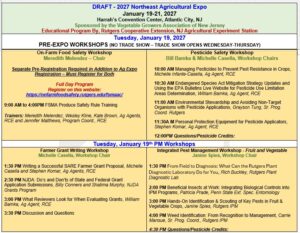
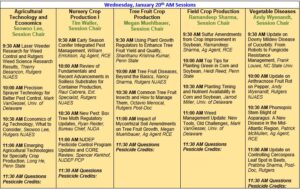
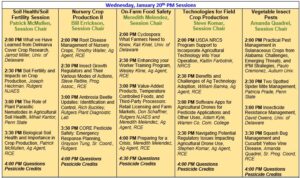
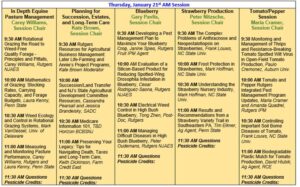
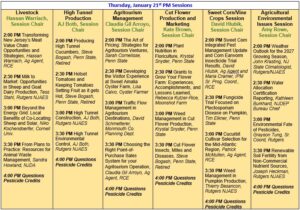
NE Agriculture Expo and Rutgers Educational Sessions Start Tuesday 1/20/26 to Thursday 1/22/26 in Atlantic City

The NE Agriculture Expo and Rutgers Educational Sessions Start Tuesday 1/20/26 at Harrah’s in Atlantic City, 777 Harrahs Boulevard. The final day of educational sessions and trade show ends on Thursday at 5pm.

The weather may be cold, but no rain or no snow in the forecast, and warm times inside the conference center to network with others in the industry.  An afternoon Hospitality Room will be available 12-5pm on Wednesday and Thursday to relax and unwind in the trade show area. Come for the social aspects, education and gain pesticide recertification credits. Check out the Rutgers Educational Program to see what topics you would like to learn about. go.rutgers.edu/2026rutgerseduprog

What’s Happening

January 20 (Tuesday)

  • Pre–trade show workshops and sessions

January 21 (Wednesday)

  • Full day of educational sessions for all commodity groups • Year of the Women Farmer Luncheon
  • Packed trade show with vendor booths sold out
  • Live charity auction with FREE food

January 22 (Thursday)

  • More sessions
  • Another day packed trade show with vendor booths sold out
  • Special appearance by Temple Grandin book signing /meet and greet, then her special session (additional cost)

Registration Options On-Site at the Regitration Counter (hallway of conference center) or On-line https://vganj.com/convention-tickets“>https://vganj.com/convention-tickets

✔️ VGANJ Membership – $100

Includes 2 Expo passes

Additional passes just $25 each

✔️ One-Day Pass – $60

Access to sessions + trade show

Register On-Line to

  • Save time at registration
  • Walk in, grab your badge
  • Enjoy FREE breakfast (8am-10am Wednesday and Thursday in Trade Show)
  • Head straight to learning, growing, and catching up with friends

This event under one roof, packed with education and energy, and celebrating New Jersey agriculture at its best.

Plus, buy your tee shirt or hoodie at the registration desk to “Support New Jersey Farmers” and tout “No Farmers No Food” – new this year.


Seed Purchasing and Use Needs Assessment Survey

Cornell University is conducting a needs assessment survey to better understand issues that growers have had with purchased seeds and how these issues are being managed.  Click HERE to access the survey.