Greetings from the Veg IPM team!
Sweet Corn
With the cooler night time temperatures, we are starting to see CEW numbers decline throughout NJ. Refer to the map below to see this week’s CEW pressure throughout the state. With max temperatures under 80 degrees, most locations will no longer need to shorten the spray interval by a day. Remember, rotation is important for avoiding resistance, so rotate between the four IRAC groups registered in silking sweet corn: 1 (carbamates), 3 (pyrethroids), 5 (spinosyns), and 28 (diamides). Corn earworm is at least partly resistant to several pyrethroids, so a spray program should not rely solely on pyrethroids, although they are useful in tank-mixes or as pre-mixed products, such as Besiege or Elevest (Group 28 + Group 3). For detailed information about resistance and potential spray programs, the University of Delaware has an excellent resource on corn earworm management.
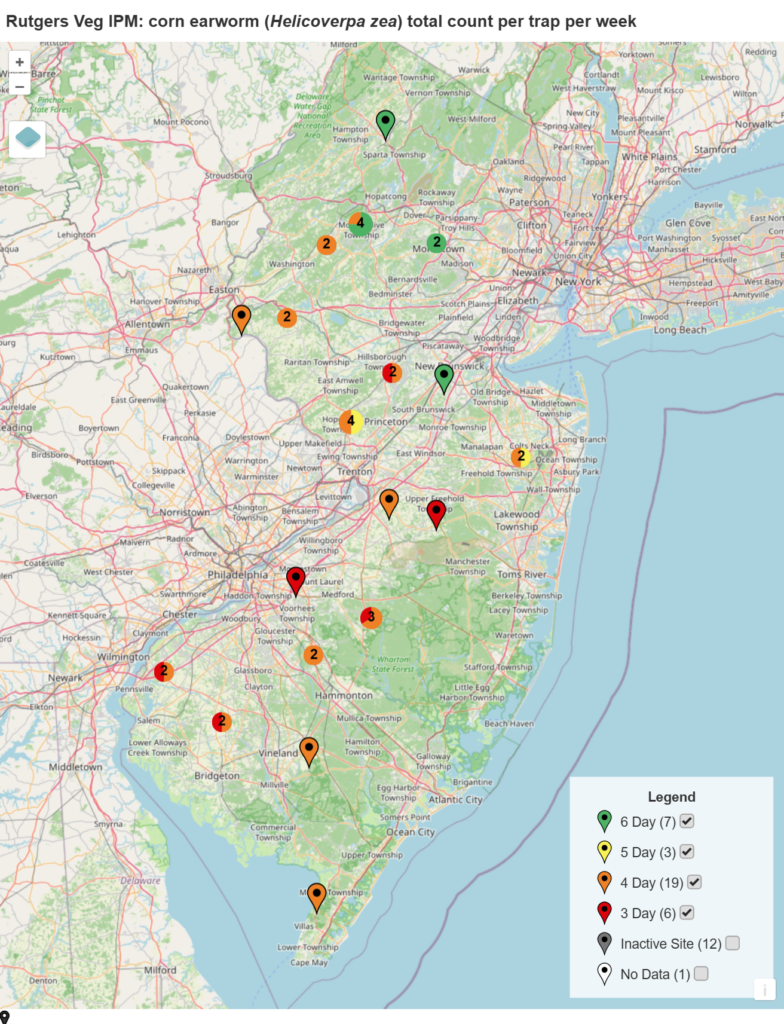
Spray intervals based on nightly pheromone moth captures for the southern part of New Jersey. Note that not all locations in the IPM program are currently trapping. This map is based on the following thresholds: 0 moths = 6-7 day schedule, 1 moth = 5 day spray schedule, 2-20 moths = 4 day spray schedule, 20+ moths = 3 day spray schedule.
Tomatoes and Peppers
Thrips and TSWV. Thrips have slowed down with lower temperatures and general declines in tomato plant health due to stress and diseases as the season has progressed. We are still seeing some spread of tomato spotted wilt virus, but it has slowed compared to earlier in the season. If management of thrips no longer makes sense economically, we encourage destroying older plantings to try to reduce populations of thrips and the reservoir of the virus on farms. See our previous article for detailed information on managing thrips and TSWV in tomatoes.
Beet armyworm. We track beet armyworm with pheromone traps deployed in south Jersey. Beet armyworm is an occasional pest of peppers, swiss chard, and beets and can cause serious damage and crop loss if outbreaks occur unexpectedly. Our traps in Salem county indicate that BAW moths are still flying, though at lower numbers with the cooler weather. We suggest scouting susceptible crops for caterpillars and damage.
Other caterpillar pests. We continue to see some pressure in tomatoes from yellow striped armyworm, tomato fruit worm (AKA corn earworm), and cabbage and soybean loopers. We suggest scouting tomatoes for worm damage and the presence of caterpillars. Giving the plant a good shake or using a beat tray can help detect the presence of caterpillars. If dealing with loopers, effective materials include Avaunt (IRAC 22, 3-day PHI) and Proclaim (IRAC 6, but note the 7-day PHI)
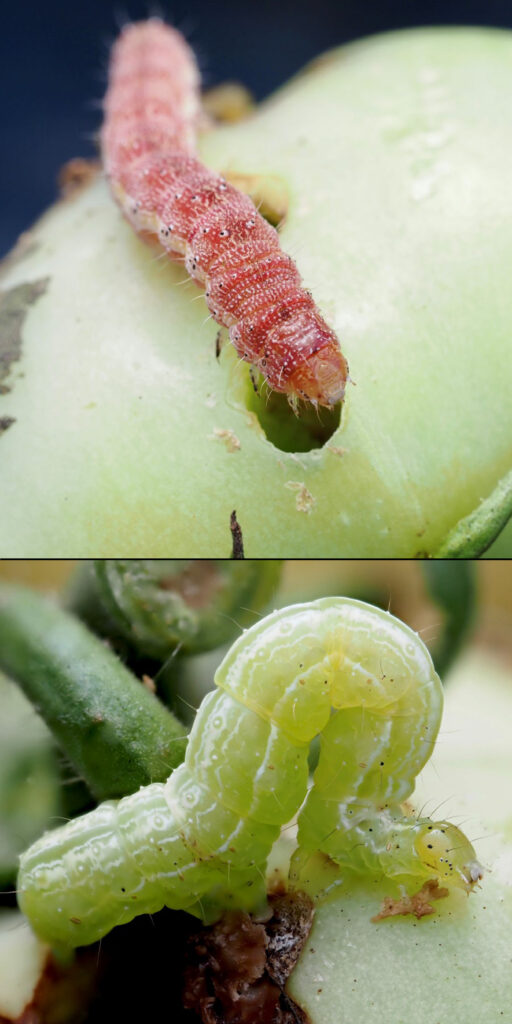
Caterpillar pests in tomato. Top: Corn earworms come in a number of colors, including this pinkish-red. Note the many hairs which are distinctive on CEW. Bottom: Soybean looper. Note that rear-end is larger than front of the caterpillar and the distinctive looping behavior. Soybean and cabbage looper look very similar, but cabbage loopers rarely feed on the fruit. Photos by Maria Cramer.
Cucurbits
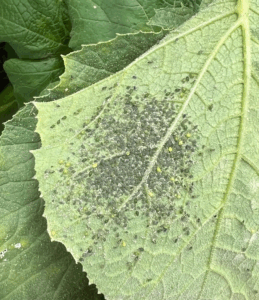
Melon aphids infesting a pumpkin leaf. Photo by Amanda Quadrel.
Pumpkin harvests are in progress, and we’ve seen relatively few issues that need management at this point in the season.
Melon aphids. In most plantings, aphid populations have been relatively low. While aphids do not cause direct damage to the crops, the honeydew they secrete can lead to unsightly sooty mold growth on fruits. Honeydew can also attract yellow jackets, which can be hazardous to crews and U-pickers. Scout for aphids and consider treating for them if you find aphid clusters in more than one site (out of a ten site sample).
Cole Crops

Caterpillar pests of cole crops. A) Diamondback moth — smooth and tapered at each end. B) Imported cabbageworm — fuzzy and not tapered. C) Cabbage looper — characteristic looping behavior. D) Cross-striped cabbage worm — distinctive stripes, usually occurs in groups. Photos A-C by Maria Cramer, photo D from iNaturalist COO.
Caterpillar pests. Scouted cole crops continue to have varying levels of caterpillar activity. Diamondback populations continue to be low at the locations we scout, with imported cabbageworm and armyworms being the primary species being found. The caterpillar threshold is 10% infestation for seedlings and 20% infestation for crops in the leafy/early cupping stage. Once heads begin to form, the threshold drops to 5%. For young caterpillars (especially imported cabbage worm), Bt products such as Dipel or Xentari are IPM friendly options. Diamondback moth has resistance to many insecticide groups, and pyrethroids (IRAC 3A) and Bt products (IRAC 11A) are not effective for their management. Besides Bt, materials approved for caterpillar control include Entrust/Radiant (IRAC 5), Proclaim (IRAC 6), Torac (IRAC 21A), Exirel (IRAC 28), and Incipio (IRAC 30). For Bt products and contact insecticides, coverage on the undersides the leaves is essential.
Diseases
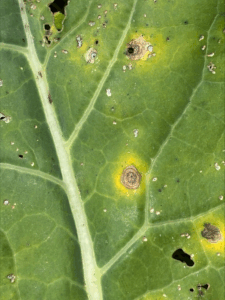
Alternaria on broccoli. Photo by Amanda Quadrel.
In some locations, we’ve also seen some low incidence of diseases such as alternaria, black rot, and downy mildew. Note that downy mildew in brassicas is not the same species that affects cucurbits. Brassica downy mildew is a disease that develops best around 50-59ºF so we will likely
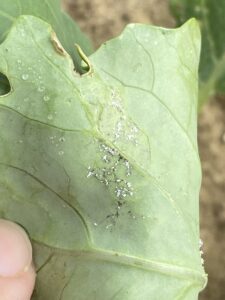
Downy mildew on a collard leaf. Photo by Renee Carter.
see more progress with the disease temperatures cool down. Downy mildew may appears as light-colored lesions on the top of the leaves and as masses of white spores on the lower surface. Scout at least 25 plants per field (5 plants in 5 locations), checking the undersides
for spores. If you have downy mildew, rotate or tank-mix chlorothalonil 6F (FRAC M05) with another product listed in the Mid-Atlantic Veg Guide for downy mildew in cole crops, rotating MOAs. Use overhead irrigation at times of the day when leaves can dry quickly to slow disease progression.
Allium leaf miner alert. Allium leaf miner was found in Southern Pennsylvania last week, indicating that a fall flight has begun. While not yet spotted by our program in NJ, it’s time to be on the lookout for ALM.
Allium Leafminer (Phytomyza gymnostoma) is a small grey-bodied fly with a yellow head (A). In warm, still weather, you may see adult flies settling on foliage. The females lay eggs in neat rows, leaving behind a line of white dots on the leaves (B). As the larvae hatch and begin to feed, they will tunnel downwards, causing damage to leaves and bulbs. ALM have two generations per year; the first in early spring, and the second occurring in the fall. Crops such as chives, scallions, garlic, onions and leeks are attacked by ALM, but leeks and scallions seem to be the most affected.
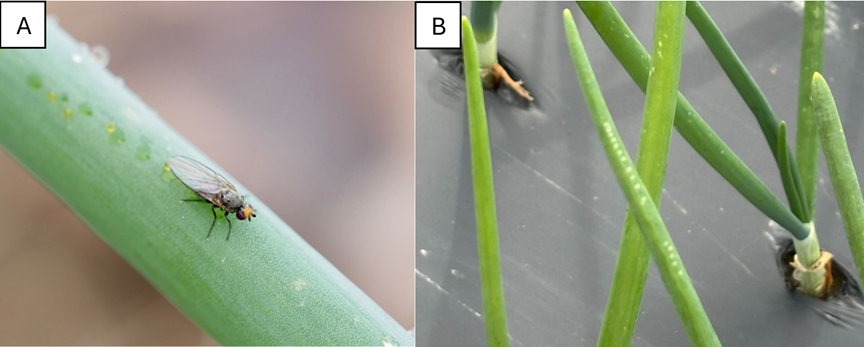
An Allium leafminer adult (A) (picture by Maria Cramer) and the characteristic oviposition scars left behind after females lay eggs (B).
If you are concerned about crop injury due to ALM, floating row covers, kept on until the adult flight ends (around the first hard frost) can restrict ALM’s access to vulnerable plants. Make sure ALM are not already infesting plants prior to placing the cover. Reflective mulches may also provide some additional crop protection. Adults and larvae can be targeted through well-timed insecticide sprays. Materials labeled for ALM control include spinosyns (IRAC 5- Radiant or Entrust (OMRI approved)), pyrethroids (IRAC 3A- Mustang Maxx, Proaxis, and Warrior II), neonicotinoids (IRAC 4A- Scorpion, Venom), the insect growth regulator Trigard (IRAC 17), and diamide products (IRAC 28- Exirel, Minecto Pro). The newly registered product Vertento (IRAC 30) may also be used for ALM control. The first spray application of a material should be completed 2- 3 weeks after initial detection of ALM (either oviposition scars or the fly itself). Subsequent sprays should be completed in 1–2-week intervals. Two or three sprays should provide adequate control. As always, be sure to follow label rates and application instructions for any pesticide that you plan to use.
As a reminder, the new 2026/2027 Mid-Atlantic Commercial Vegetable Production Guide is now available for free online (click here) or as spiral-bound hard copies that can be purchased at your local county extension office. Consult this guide for a more comprehensive list of materials that are labeled for specific crops and pests.
We want to give a huge thanks to our scouting team for keeping an eye on things for us throughout the season!
North NJ: James Johnson and Cassandra Dougherty
South NJ: Renee Carter, Mar Sherman, and Kris Szymanski
Authors: Amanda Quadrel (Northern NJ Veg IPM coordinator) and Maria Cramer (Southern NJ Veg IPM coordinator)
Questions or comments? Contact us below:



