The weather over the past few weeks has been ideal (e.g., isolated heavy rainfalls, high RH, extended dew and leaf wetness periods, and cooler temperatures) for downy mildew to develop in multiple crops. Important factors to remember are that downy mildews are obligate biotrophic (oomycete) pathogens that need a living host, and more importantly, are specific in the hosts or crops groups they can infect. Therefore, downy mildew on lettuce caused by Bremia lactucae won’t infect brassica crops, and visa versa. Downy mildew on brassica crops is caused by another downy mildew, Hyaloperonospora brassicae (formerly, Peronospora parasitica), which is broken down into a complex of distinct species with narrower host range(s). Spinach downy mildew is caused by Peronospora effusa, and of course, cucurbit downy mildew, caused by Pseudoperonospora cubensis, only causes downy mildew in cucurbit crops. It’s important to remember that downy mildews only sporulate on the undersides of infected leaves. Symptoms on the top sides of leaves often appear as an irregular chlorosis and browning with tufts of white sporangia developing on the bottom sides of leaves under ideal conditions. Conditions that favor downy mildew development in one crop also means favorable conditions for its development in other crops. The use of downy mildew resistant varieties also plays an important role in mitigating losses to downy mildew. In spinach, for example, there are over 20 races of the pathogen and there are a number of recommended varieties that carry significant resistance packages to multiple races of the pathogen. The same is true in lettuce, where multiple recommended varieties have downy mildew resistance as well as in a few cucumber varieties and crops such as broccoli and cabbage. What doesn’t change between the downy mildews are the need to regularly scout for them and be proactive in their control during favorable weather conditions. Importantly, the options for downy mildew control are often the same across crops, applying and rotating downy mildew specific fungicides as long as conditions are favorable for its development. For more information on downy mildews and their control, please see specific crops in the 2026/2027 Mid-Atlantic Commercial Vegetable Productions Recommendations Guide.
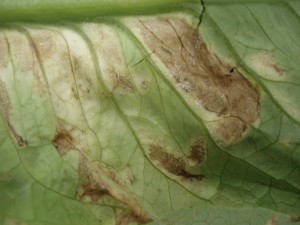
Symptoms of downy mildew on lettuce. Note the small, white tufts of sporangia developing on the lower side of the leaf.
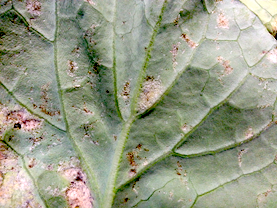
Symptoms of downy mildew on the underside of infected collard leaves.
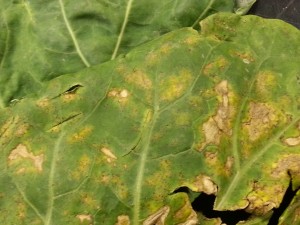
Symptoms of downy mildew on infected chinese cabbage leaf. Note the irregular chlorosis and browning of upper leaf surface. Under ideal conditions the pathogen will produce white spore masses only on the undersides of the leaf.

