Landscape, Ornamentals, Nursery, and Turf Edition

Seasonal updates on ornamental, nursery, and turf pests.
Subscriptions are available via EMAIL and RSS.


Companion Website Links:

Rutgers Turf Blog - Articles on turfgrass diseases and cultural practices for the commercial turfgrass industry. Subscription available via RSS.


Rutgers Weather Forecasting - Meteorological Information important to commercial agriculture.

ALERT-Potential for new boxwood blight infections tomorrow in Southern NJ

There is a potential for new boxwood blight infections tomorrow in Southern NJ

  • Protective fungicide applications should remain in effect or be initiated immediately for Boxwood Blight in these areas
  • If your area is not listed (throughout all of NJ please visit the USPEST.ORG Boxwood Blight Risk Model – CLICK HERE TO CHECK YOUR LOCAL PREDICTIONS
  • BWB has been observed already this season just south of us in Maryland.

Boxwood Blight risk-model information, considerations, and links:

Boxwood Blight Risk Assessment as of 5/4/2022
Region Location CODE 4-May 5-May 6-May 7-May 8-May 9-May
Southern Upper Deerfield NJ50 Low  Low  Very Low  Low  Low  Very Low 
Southern Vineland NJ73 Low  Low  Very Low  Low  Low  Very Low 
Southern Millville KMIV Very Low Low  Very Low  Low  Low  Very Low 
Southern Bridgeton D4116 Low Infection Risk- Sus. vars. Very Low  Low  Low  Very Low 
Please check your local boxwood blight risk at ___ CLICK HERE TO CHECK YOUR LOCAL PREDICTIONS
  • These advisories are general in nature and change rapidly over time and throughout the state! Someone from your business should be using this risk model daily if boxwood is important to your financial stability – In 30 seconds you can have a better idea of boxwood blight (and other pathogen) activity in your immediate area!
    • (click on the link – input area code – select closest weather station – check 7-14 prediction – click on graph / table) 

Fungicides; 

  1. You very well may have these materials already applied as ‘cover-sprays’ – But – be mindful that protectant fungicides loose efficacy the more rain (or overhead irrigation) they are subjected to, and reapplication may be warranted.
  2. ROTATE between Fungicide Resistance Action Committee (FRAC codes) to avoid this pathogen becoming resistant to specific chemicals

Format: [FRAC code]: Chemical name (Trade names * no endorsement implied) 

  • [M05]: Chlorothalonil (Daconil WS)
  • [M05 + 1] Chlorothalonil + Thiophanate methyl (Spectro 90WDG)
  • [11] Trifloxystrobin + [7] Fluopyram  (Broadform)
  • [11] Trifloxystrobin + [3] Triadimefon (Armada 50WDG)
  • [M03] Mancozeb
  • [12] Fludioxonil (Medallion WDG)
  • [3] Tebuconazole (Torque)BW

DISCLAIMER: The label is the law, always refer to it for allowable host crops, use-restrictions, application rates, reapplication intervals, re-entry intervals (REI), and mix compatibility information. Production and pesticide information on this site are for private/commercial pesticide applicators and landscape professionals only, and are NOT for home gardener use. Provided materials represent examples and do not cover all possible control scenarios. Trade-names listed do not imply endorsement and are used as examples only. Please contact your local agent or chemical sales representative for more information or to discuss additional pest management options.

Resources 

Background on the pathogen: 

Drought planning. Monitoring real time stream flow

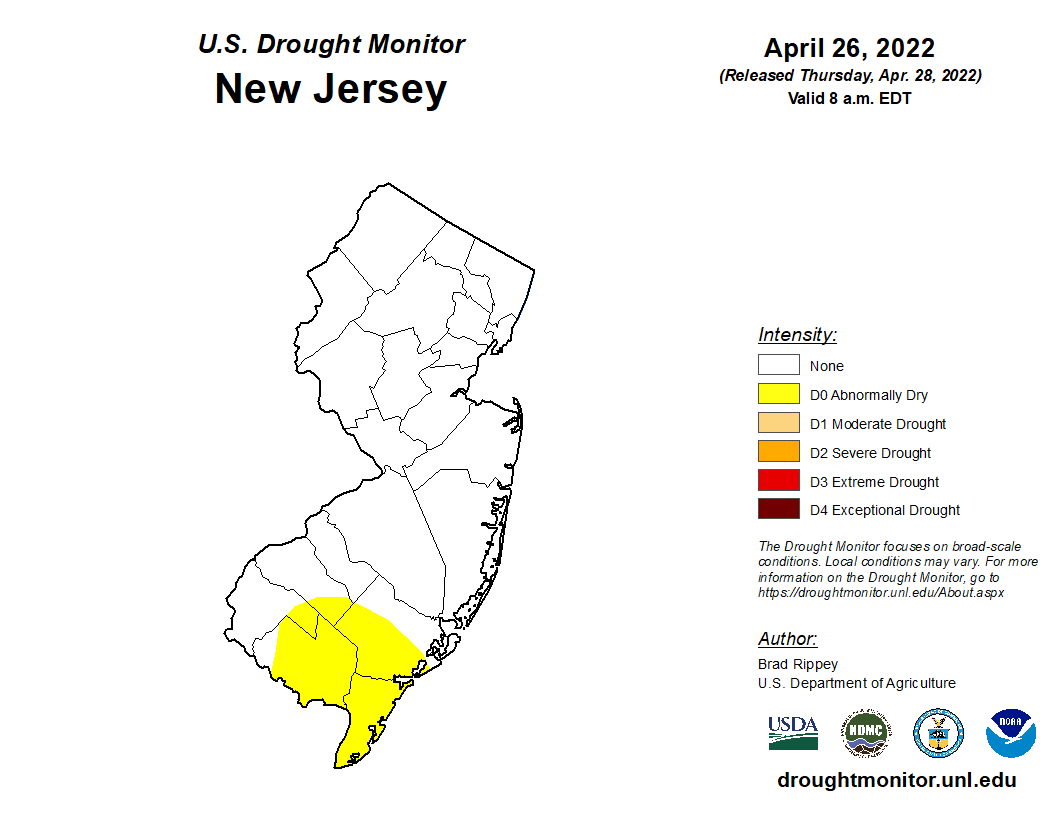
With dry conditions occurring as planting season is underway monitoring real time stream flow is a useful tool.

Non-irrigation users as well as those who rely on irrigation can use this tool to forecast short term and long term conditions that will benefit or impact when and what to plant, when to water, and how precipitation or the lack thereof will help or hurt applications of nitrogen fertilizer and herbicides that require surface moisture for activation.

Here is the link to the USGS real time stream flow readings on the National Water Dashboard for Salem County and surrounding areas. Chose stream level data and aquifer type in the legend box to see streams near your location.

At the end of March, the county was about at an inch and a half deficit for rainfall compared to the 30-year average. Despite the inches received in April, streamflow readings at nine locations in the coastal plain aquifer system of South-Central NJ are much below normal. Ten readings are below normal, and one reading on Mantua Creek in Pitman, NJ is at an all-time low for this day.

If we use the US Drought Monitor comparison slider, we can see that much of Cumberland County and parts of Salem and Gloucester are experiencing drier conditions then this time last year. Gusty winds and below average high temperatures the last three days of April stressed spring seedling flower transplants and annual crop germinations. The duration of wind significantly dried surface soil moisture limiting transplant root expansion and delayed new seeding Adventitious roots from expanding deeper into the soil. Comparing this information to last year’s crop progress and monitoring root development (moisture seeking behavior) can help producer’s estimate crop progress and response to droughty conditions going forward.

The current forecast has a good chance of rain on Wednesday and again on Friday and Saturday. After the rains, revisit the real time stream monitoring site and see if local conditions have changed. If stream discharge improves, this is a good indication sub soil has adequate moisture, and in sandy soils this will help roots to expand deeper into the soil profile.


The NJ Plastic Bag Ban and Your Retail Farm Market

The NJ plastic bag ban will impact retail farm markets starting May 4th.  Note that enforcement of this ban will vary based on your retail sales location.  Counties and municipalities may use their health or other departments for enforcement along with the DEP. Without specific guidance on how to enforce the ban in farm retail settings there will likely be variations based on location.

Some key pieces of information about the rule that may impact your market are detailed below:

Paper bags are banned only for stores that are identified as a “grocery store”.  If you are not considered a grocery store (see definition below) you may use paper bags.

Grocery stores are defined as “self-service retail establishment that occupies at least 2,500 square feet and that sells household foodstuffs for offsite consumption, including fresh produce, meat, poultry, deli products, dry foods, baked foods, prepared foods.”  We anticipate that enforcement will vary based on local jurisdiction with this definition.  If you are a retail farm market that is over 2,500 square feet, including your outdoor sales areas, it is suggested that you communicate with your municipality or county to determine if you can use paper bags or not.

The state does not define what types of plastic bags can be used for exempted items, and we have had varying guidance from DEP. Questions about the rule can be directed to singleuseplastics@dep.nj.gov Contact your municipality or county to determine how they plan to regulate exempted item bagging. DEP identifies the following items as exempt:

  • Loose items including: fruits, vegetables, nuts, coffee, grains, baked goods, candy, greeting cards, flowers, small hardware items
  • Uncooked meat, fish, or poultry
  • Food sliced or prepared to order, including soup and hot foods

You cannot sell single use bags at your store, except for pre-packaged bags such as bulk trash bags, pet waste bags, zip-lock bags, etc.

The regulation does not discuss biodegradable single-use bags  that can be decomposed by bacteria and other living organisms in a short period of time. The plastic bag ban is specific to single-use bags made from a synthetic materials. Many biodegradable bags are made from corn-based materials and have improved in their strength since they were first released a number of years ago. Should you plan on purchasing biodegradable bags make sure you can prove what materials they are made of in case of customer or regulatory questioning. The New Jersey Office of Innovation has a listing of companies that sell bags that are allowable under the ban.

Reusable bags ideally should be made of materials that can be easily cleaned and must have handles stitched onto them. Fabrics that can be washed and dried in a machine are preferred since the heat cycle in the dryer will kill any potential human pathogens that find their way onto the bags surface. If purchasing reusable bags to give to your customers be sure to look at the cleaning instructions and communicate proper handling of these bags to your customers. You are not required to provide reusable bags to your customers.

As we better understand this regulation, we will share that information with you.

*article updated on June 15, 2022

Scouting for Broad Mites in the Greenhouse

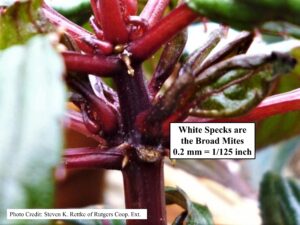
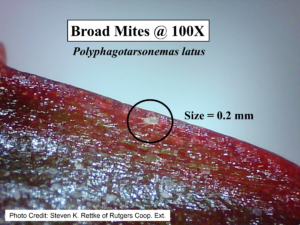
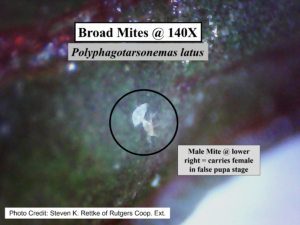
Broad mites (Polyphagotarsonemus latus) are an extremely small species of mites that affect many ornamental crops. At this point in the season they may be active in the greenhouse and should be included in all greenhouse IPM scouting programs. Broad mites are only 0.2 mm long, which is about half the size of a two-spotted spider mite. This makes them nearly impossible to spot with the naked eye during regular routine scouting and challenging to locate, even with the use of a hand lens. They have a translucent yellow-green appearance and a short but rapid life cycle ranging from 5 to 13 days.

Broad mites under microscope  Broad mites under microscope Broad mites under microscope

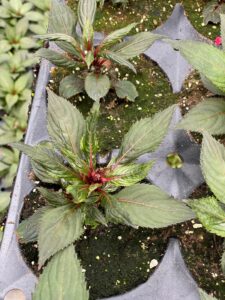
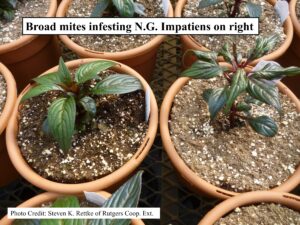
Broad mites feed on new growth and emit saliva that is toxic to the plants. This results in leaf curl, stunting, and deformity that may be mistaken for herbicide damage, physiological disorders, or a fungal pathogen. Broad mites tend to favor New Guinea impatiens, Sunpatiens, and dahlia in the greenhouse this time of year, though they may also cause damage to gerbera, ivy, lantana, standard impatiens, snapdragon, verbena, begonia, and zinnia. They can spread via plant-to-plant contact and may even hitchhike on whiteflies or aphids to reach a new destination.

Broad mite damage on Sunpatiens

Broad mite damage on Sunpatiens. Notice the stunted growth and leaf curling. Photo: W. Errickson

Control can be achieved using miticides that are labeled specifically for broad mites, as some materials that are effective against two-spotted spider mites and spruce spider mites may not work as well on broad mites. Effective materials include Akari, Avid, Dormant Oil, Judo, Magus, Pylon, SanMite, Sirocco, Summer Oil, and Triact. Always follow the instructions on the label and take note of any sensitivities for use on specific plant species. Rotating chemical classes is also very important when treating broad mites because their rapid life cycle has the potential to lead to the development of resistance in a short period of time. Biological controls involving the release of predatory mites that feed on broad mites have also demonstrated success. Predatory mite species that are effective against broad mites include Amblyseius swirskii, Neoseiulus cucumeris, and N. californicus. Broad mites can be effectively managed in the greenhouse if they are detected early and correctly identified as part of a regular IPM program.

Additional Resources

Broad Mites Fact Sheet, University of Tennessee

https://go.rutgers.edu/zg9kdzod

Broad Mites in Ornamental Crops, Michigan State University

https://go.rutgers.edu/56gic7up

Broad mites infesting plantsDealing with Broad Mite, Greenhouse Product News

https://go.rutgers.edu/6doflkwc

Broad Mite is Becoming an Increasing Problem, Greenhouse Management

https://go.rutgers.edu/1pftyvss

Spotted Lanternfly egg hatch is coming or here now – Critical knockdown of nymphs

Spotted Lanternfly nymphs will be emerging now through the first week of May for Southern and Central New Jersey – reduce their population early in the nursery industry!


Through conversations with nursery operators, state inspectors (NJDOA), and internal agent communications four shade trees represent the vast majority of nursery stock with adult SLF eggs. This means we should be targeting these trees early – treating for nymphs as they emerge from the egg masses and before they move on to more tender hosts.

The vast majority of shade trees with egg masses in NJ are:

  1. Red maple – huge proportion
  2. Birch
  3. Willow
  4. Styrax

Generally, adults are laying eggs on these four nursery crops late summer/fall, then as the nymphs emerge (April/May) they move to more tender growth, often onto understory plants, weeds, hedge rows, roses (wild and cultivated), and tender herbaceous and perennial plants (May, June, early July). This means we have a very short window to target a large percentage of nymph emergence on these four crops with Contact Insecticides. Scout these areas for nymphs over the next few weeks, and be at the ready to treat immediately

Be ready to target nymph populations early this season with contact materials 

Once the nymphs have moved on to their favored 1st-3rd instar crops (herbaceous, perennial, roses, grapes, etc.) they will then begin to move back to these four shade trees (and other woody hosts) as 4th instars (red-coloration, mid/late July) and adults (August) that will ultimately mate and lay eggs (September/October), repeating the cycle.

Systemic materials – Generally systemics are best utilized when targeting late instars and adult populations (both born at the nursery and flying in from outside), often requiring approximately 3-4 weeks prior to anticipated insecticidal activity. In the nursery setting we may already be utilizing systemic materials to treat other insect populations, offering some level of protection from the nymphs migrating away from theses four shade trees, towards their favored feeding locations. In operations where egg masses have been abundant, treating with systemic materials, when appropriate should be considered to reduce local populations in addition to targeting nymphs with contact materials.

Penn State – Spotted Lanternfly Management Guide (click here)Contains the most complete list of labeled systemic and contact insecticides for SLF

Note – applications during bloom for specific host crops should be avoided to protect pollinators. 


Additional information: 

We are collectively trying to avoid crippling load-by-load phytosanitary inspections

WE as an industry are in this together, in order to safeguard our industry please do the following:

  1. SLF Training Permits for hang-tags (click here) are required for each company driver who delivers your plants out-of-state. This training is relatively simple and you can also obtain Training materials to educate your employees (click here)
  2. Scout every plant for ANY SLF life stages – from dead adults to egg masses. REMOVE life stage prior to shipment and train employees to know the various appearances of SLF egg masses. Use this guide – SLF EGG MASS GUIDE – USE FOR TRAINING (click here to download) (print and hang up / distribute to personnel)


Nursery Pest Updates and Scouting next two weeks – initiate Red-headed flea beetle systemics now for Central and Southern NJ

This post covers three topics:

  1. Control and timing of applications for Red-headed flea beetle (RHFB)Systemic materials should be used now to target emerging adults in May. 
    1. Please refer to this resource for timing and material selection: RHFB timeline using GDD, material selection, print-out ready (click here)
    2. Combination of resources from Danny Lauderdale (NC State), Brian Kunkel (UDel.), Tim Waller (RU)
  2. Seasonal reminders:
    1. Protectant, broad-spectrum ‘cover-sprays’ should be initiated ASAP or as plastic is removed / crops can be accessed
    2. SLF egg masses: We are all in this together should be remembered when it comes to checking loads for SLF.
      1. SLF EGG MASS GUIDE – USE FOR TRAINING (click here to download, hang up for employees)
      2. Refer to this post “Don’t let Spotted Lanternfly Impact Spring Shipping” for additional information 
  3. Pest Scouting for 100-200 Growing Degree-days (approx. next two weeks in Southern and Central NJ). 
    1. Refer to this post “Obtaining your local growing degree-days” for additional information 

Growing degree-days as  4/12/22 (~Next two weeks)

Projected GDD50 accumulation as of 4/13/2022 Note: Growing degree-day values utilize daily average air temperatures with a minimum temperature threshold (a.k.a. ‘base’) of 50F = GDD50 (max. temp. threshold set at 95F). These values are accumulated from a biofix date, such as January or March 1st in the NE USA. Provided GDD50 are scouting ranges and should be truthed.
Region Location Station 13-Apr 1-May 1-Jun
South Upper Deerfield NJ50 116 236 660
Central Howell / Freehold NJ10 114 200 553
North High Point NJ59 35 67 313
Forecast: NOAA NCEP Coupled Forecast System model version 2 (CFSv2) forecast system (3.5 months) (USPEST.ORG)


Crop type Common Name Scientific Name GDD Min (50F) GDD Max (95F) Reference Developmental / Target Stage
Conifer Pine engraver (Ips bark beetle) Ips spp. 100 150 4 1st adults active
Conifer Balsam twig aphid Mindarus abietinus 100 150 4 Stem mothers present (control target)
Conifer European pine sawfly Neodiprion sertifer 100 195 4 1st larvae active
Andromeda Andromeda lace bug Stephanitis takeyai 115 279 RU Nymphs (1st generation)
Azalea Azalea lace bug Stephanitis pyrioides 118 372 RU Nymphs (1st generation)
Conifer Larch casebearer Coleophora laricella 120 150 4 Egg hatch
Elm, Service berry Woolly elm aphid Eriosoma americana 121 246 2 (6) Control target
Birch Birch leafminer Fenusa pusilla 123 290 RU Adults – egg laying
Many Gypsy moth Lymantria dispar 145 200 4 Egg hatch, 1st larvae
Holly Holly leaf miner Phytomyza ilicis 147 265 RU Adults – egg laying
Many Cankerworms, inch-worms, loopers (many) 148 290 2 Larvae treatment
Yews, Rhododendrons, many Black Vine Weevil Otiorhynchus sulcatus 148 400 2 Pupation / Adult emergence
Lilac, ash, privet, many Lilac / Ash Borer Podosesia syringae 148 299 2 Adult flight
Dogwood, many Dogwood Borer Synanthedon scitula 148 700 2 Adult activity
Conifer Hemlock woolly adelgid Adelges tsugae 150 150 RU Eggs and 10% hatch
Conifer Spruce needleminer Endothenia albolineana 150 200 4 1st larvae active
Conifer Spruce spider mite Oligonychus ununguis 150 175 4 1st egg hatch
Conifer Balsam gall midge Paradiplosis tumifex 150 300 4 Adults laying eggs
Witchhazel, River birch Spiny witchhazel gall aphid Hamamelistes spinosus 171 6 Control target
Birch Birch Leafminer Fenusa pusilla 175 215 4 1st adults active
Birch Birch leafminer Fenusa pusilla 190 290 RU Larvae (1st generation)
Conifer Spruce spider mite Oligonychus ununguis 190 363 RU Immatures/Adults
Rhododendron Rhododendron gall midge Clinodiplosis rhododendri 192 363 RU Larvae
Honeylocust Honeylocust pod gall midge Dasineura gleditchiae 192 229 RU Larvae
Privet Privet thrips Dendrothrips ornatus 192 618 2 Typical treatment window
Holly *Native holly leafminer Phytomyza ilicicola 192 298 2 Egg hatch
Holly Holly leafminer Phytomyza ilicis 192 290 RU Egg hatch
Willows, Cottonwood, Poplar Imported willow leaf beetle Plagiodera versicolora 192 448 RU Larvae/Adults
Larch Larch sawfly Pristophora erichsonii 192 299 2 Typical treatment window
Andromeda Andromeda lacebug Stephanitis takeyai 192 303 RU Adults
Rhododendron Rhododendron borer Synanthedon rhododendri 192 298 2 Typical treatment window
Conifer Cooley spruce gall adelgid Adelges cooleyi 200 310 4 1st galls visible – Spruce
Spruce Spruce budworm Choristoneura fumiferana 200 300 5 Larvae
Conifer Douglas fir needle midge Contarinia pseudotsugae 200 400 3 Adults emerge from soil
Lilac, ash, privet, many Lilac / Ash Borer Podosesia syringae 200 299 RU Adults – 1st Treatment
References RU Rutgers Cooperative Extension – Landscape IPM Notes
Daily GDD50 =                                                                                                             (Max + Min temp.) / 2 – 50 (min temp. threshold)                             (Simple average growing degree-day, min. 50F, max 95F) 2 http://ccetompkins.org/resources/using-growing-degree-days-for-insect-management
3 https://extension.psu.edu/ipm-basics-for-christmas-trees#section-2
4 https://www.canr.msu.edu/ipm/agriculture/christmas_trees/gdd_of_conifer_insects
5 https://www.agriculture.nh.gov/publications-forms/documents/landscape-pests.pdf
6 https://extension.umd.edu/ipm/pest-predictive-calendar-landscapenursery
7 https://www.canr.msu.edu/ipm/agriculture/christmas_trees/gdd_of_landscape_insects
Unv. Del. Coorespondance with Dr. Kunkel (University of Delaware)-evolving GDD ranges
Compiled by – Timothy J. Waller, Ph.D. – Rutgers Cooperative Extension, Cumberland County Nursery Crops – twaller@njaes.rutgers.edu

Please Download these resources: (The scouting guide is for you to print and keep on hand…these are just updates)

Nursery and Landscape Pest Scouting Guide 2022 PDF (note this contains conifer pests as well)

Conifer Pest Scouting Guide 2022 PDF

Contact if seeing insects at different times: twaller@njaes.rutgers.edu (or call the Cumberland County Extension Office – 856-451-2800)