Frost is common in the north-eastern US, however, frost events during bloom, specifically in orchard crops can be economically devastating. Often the cause is a few hours of temperatures below the injury threshold temperature for the developing buds as cooler nights result in the rapid loss of thermal energy. Fortunately, there are several passive methods or low-tech strategies, that can help maintain a slightly higher orchard floor temperature, has the potential to prevent substantial crop loss. [Read more…]
April 6, 2021 Steven K. Rettke
Eastern Tent Caterpillar: The Landscape Harbinger of Spring
Throughout much of NJ during this week, the growing degree days (GDD) will be increasing consistently. By the end of the week, many areas will exceed 90 GDD, which means the eastern tent caterpillars will begin to hatch. Not all eggs will hatch at once since a staggered hatching period will potentially increase survival rates if the weather happens to cool again.
The photographs of the eastern tent caterpillar’s life cycle included in this blog were all taken during the spring of 2016 at the same site in Freehold, NJ. They are placed in chronological order covering a time span of 10 weeks from 1st egg hatch on 3/23/16 to late pupation on 6/2/16. In 2016, central NJ experienced a relatively warm early spring that enabled the speedy first hatching.
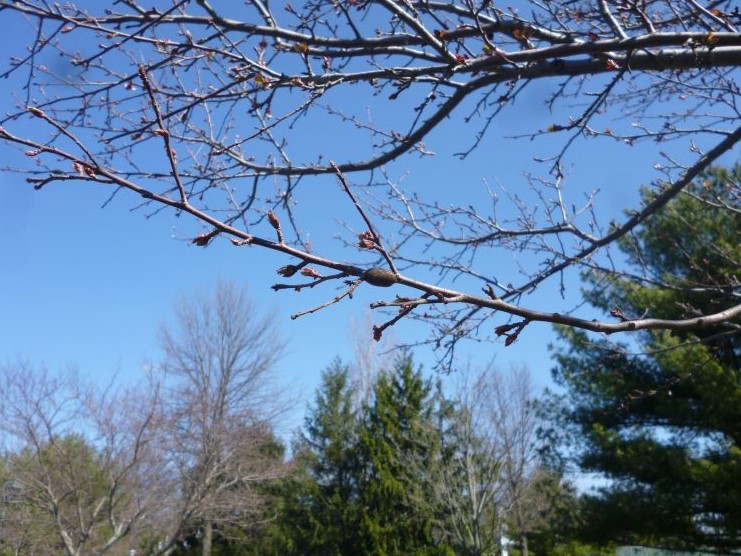
Date: 3/23/16 (No hatch). Do you see it? One inch long Tent Cat egg mass overwinters encircling 2-3 year old twigs. (Photo Credit: Steven K. Rettke, Rutgers Coop. Ext.)
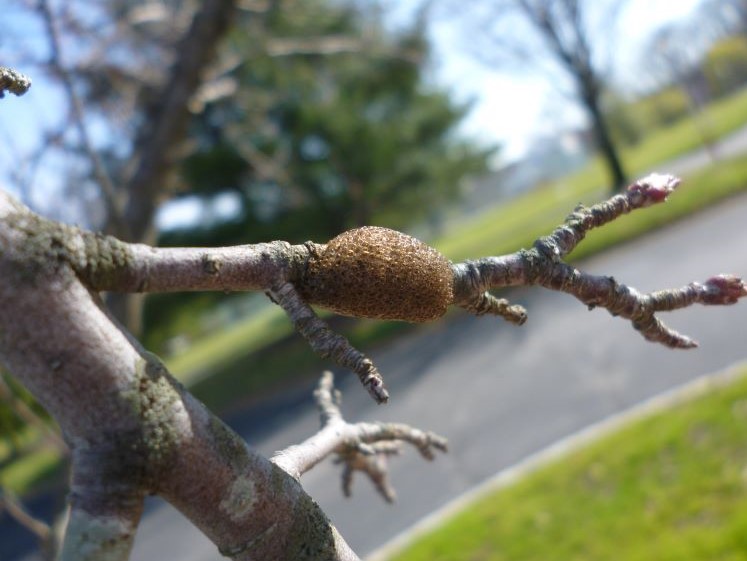
Date: 3/23/16 (No Hatch). Close-up of the Tent Cat egg mass. It has the appearance & feel of styrofoam. (Photo Credit: Steven K. Rettke, Rutgers Coop. Ext.)
March 29, 2021 Tim Waller
Nursery Pest Scouting Guide: 60-150 Growing Degree-days & Boxwood Blight Information
Pest Scouting:
Please print or download the two resources of this post (click on them):
- Printable Pest Scouting 60-150 GDD
- Expanded Pest Scouting Guide 60-150 GDD with CLICKABLE LINKS with links
- (Zoom in and click directly on the links within this document)
The information provided in the downloads gives scouting ranges (in growing degree days, base 50F) for specific insect pests harming nursery crop production and maintenance. Additionally, forecasting predictions (GDD50 accumulation) for calendar dates of multiple regions of New Jersey (S,N,C) are provided.
To determine your local growing degree-days, please review this post “Obtaining your local growing degree-day information”
Scouting Ranges:
- This document supports scouting, it does not replace it. Keeping good notes on pest development will help dial in scouting and treatment efforts at your local level.
- It is important to note that these GDD50 are not exact, rather provide a range of GDD and subsequent calendar dates that can be used to scout for, and treat for, insect pests.
- The pests listed here will be listed again in future scouting range announcements as they undergo further developmental life stages or are vulnerable to management options.
- If you need more information, OR you are regularly seeing specific pest development stages at growing degree-days different than those listed here, please contact Tim Waller at twaller@njaes.rutgers.edu
GREAT RESOURCE from Steve Rettke: “Landscape Pest Notes: Some Early Spring Insects/Mites”
| Projected GDD50 accumulation as of 3/29/2021 | ||||||
| Region | Location | April 1st | May 1st | June 1st | July 1st | August 1st |
| Southern | Upper Deerfield (NJ50) | 75 | 185 | 591 | 1269 | 2111 |
| Central | Howell / Freehold (NJ10) | 61 | 142 | 490 | 1111 | 1906 |
| Northern | High Point (NJ59) | 24 | 30 | 242 | 695 | 1301 |
| Forecast: NOAA NCEP Coupled Forecast System model version 2 (CFSv2) forecast system (3.5 months) (USPEST.ORG) | ||||||
| Pest Scouting – Growing Degree-day Ranges | (60-150 GDD50) | |||||
| CROP TYPE | Common Name | Scientific Name | GDD Min (50F) | GDD Max (95F) | Reference | Developmental / Target Stage |
| Many | Southern red mite | Oligonychus ilicis | 69 | 157 | RU | Spring hatch |
| Conifer | Eastern pine shoot borer | Eucosma gloriola | 75 | 200 | 4 | 1st adults active |
| Malus, Prunus, many | Eastern tent caterpillar | Malacosoma americanum | 90 | 190 | 2 | Larvae treatment before tents apparent |
| Many | Gypsy moth | Lymantria dispar | 90 | 448 | RU | Larvae treatment (early instars) |
| Conifer | Cooley spruce gall adelgid | Adelges cooleyi | 90 | 180 | 4 | 1st adults active – Douglas fir |
| Conifer | Balsam twig aphid | Mindarus abietinus | 100 | 150 | 4 | Stem mothers present (control target) |
| Conifer | Pine engraver (Ips bark beetle) | Ips spp. | 100 | 150 | 4 | 1st adults active |
| Conifer | European pine sawfly | Neodiprion sertifer | 100 | 195 | 4 | 1st larvae active |
| Pieris | Andromeda lace bug | Stephanitis takeyai | 115 | 279 | RU | Nymphs (1st generation) |
| Azalea | Azalea lace bug | Stephanitis pyrioides | 118 | 372 | RU | Nymphs (1st generation) |
| Conifer | Larch casebearer | Coleophora laricella | 120 | 150 | 4 | Egg hatch |
| Conifer | Nantucket pine tip moth | Rhyacionia frustrana | 121 | 448 | RU | 1st generation egg hatch |
| Birch | Birch leafminer | Fenusa pusilla | 123 | 290 | RU | Adults – egg laying |
| Many | Gypsy moth | Lymantria dispar | 145 | 200 | 4 | Egg hatch, 1st larvae |
| Holly | Holly leaf miner | Phytomyza ilicis | 147 | 265 | RU | Adults – egg laying |
| Many | Cankerworms, inch-worms, loopers | (many) | 148 | 290 | 2 | Larvae treatment |
| Lilac, ash, privet, many | Lilac / Ash Borer | Podosesia syringae | 148 | 299 | 2 | Adult flight |
| Yews, Rhododendrons, many | Black Vine Weevil | Otiorhynchus sulcatus | 148 | 400 | 2 | Pupation / Adult emergence |
| Dogwood, many | Dogwood Borer | Synanthedon scitula | 148 | 700 | 2 | Adult activity |
| Conifer | Spruce spider mite | Oligonychus ununguis | 150 | 175 | 4 | 1st egg hatch |
| Conifer | Spruce needleminer | Endothenia albolineana | 150 | 200 | 4 | 1st larvae active |
| Conifer | Balsam gall midge | Paradiplosis tumifex | 150 | 300 | 4 | Adults laying eggs |
| References | RU | Rutgers Cooperative Extension – IPM Notes | ||||
| 2 | http://ccetompkins.org/resources/using-growing-degree-days-for-insect-management | |||||
| 3 | https://extension.psu.edu/ipm-basics-for-christmas-trees#section-2 | |||||
| 4 | https://www.canr.msu.edu/ipm/agriculture/christmas_trees/gdd_of_conifer_insects | |||||
| 5 | https://www.agriculture.nh.gov/publications-forms/documents/landscape-pests.pdf | |||||
| 6 | https://extension.umd.edu/ipm/pest-predictive-calendar-landscapenursery | |||||
| 7 | https://www.canr.msu.edu/ipm/agriculture/christmas_trees/gdd_of_landscape_insects | |||||
Boxwood Blight risk-model information, considerations, and links:
| Boxwood Blight Risk Assessment as of 3/29/2021 | |||||||
| Region | Location | CODE | 29-Mar | 30-Mar | 31-Mar | 1-Apr | 2-Apr |
| Southern | Upper Deerfield | NJ50 | Very Low | Very Low | Very Low | Very Low | Very Low |
| Central | Howell / Freehold | NJ10 | Very Low | Very Low | Very Low | Very Low | Very Low |
| Northern | High Point | NJ59 | Very Low | Very Low | Very Low | Very Low | Very Low |
| Please check your local boxwood blight risk at (https://uspest.org/risk/boxwood_app) | |||||||
Considerations:
- These advisories are general in nature so someone from your business should be using this risk model (CLICK HERE) if boxwood is important to your financial stability. In 30 seconds you can have a better idea of boxwood blight (and other pathogen) activity in your immediate area!
- Treatment considerations and additional links (CLICK HERE)
Become a Boxwood Blight Advocate to receive quarterly updates (through the Horticultural Research Institution)
March 28, 2021 Steven K. Rettke
Landscape Pest Notes: Some Early Spring Insects/Mites
The accumulation of heat units (Growing Degree Days (GDD)) is increasing rapidly across many areas of New Jersey as we soon enter into the early weeks of April. If past histories or present-day monitoring indicate the need for interventions, then the best control windows for an increasing number of insect/mite pests are beginning to occur. The following is an incomplete listing of a handful of some of our early season landscape pests that may need to be scouted & possibly controlled. The insect/mite pests included here are: Hemlock Rust Mites; White Pine Weevils; Native Holly Leafminers; European Pine Sawflies; Honeylocust Spider Mites; White Pine Aphids; and Eastern Spruce Gall Adelgids.
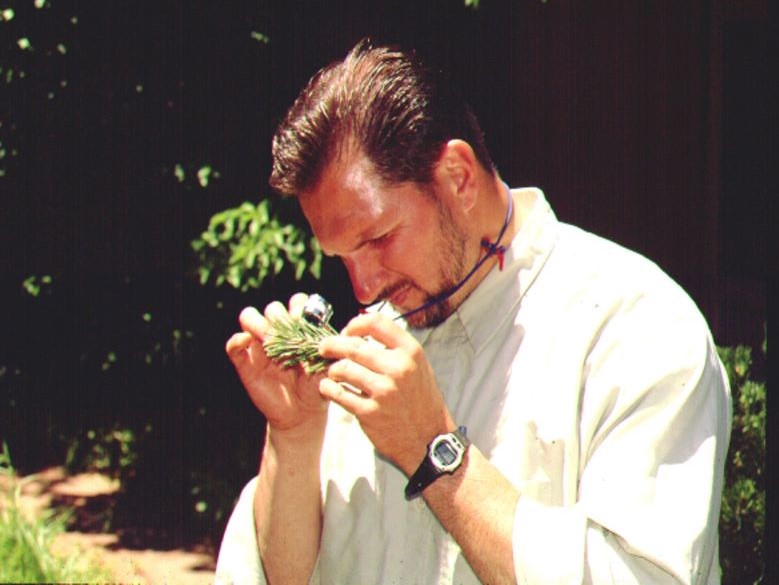
As our landscapes start to “wake-up” with warming temperatures, the insect & mite pests will begin activity. (Photo Credit: Steven K. Rettke, Rutgers Coop. Ext.)

When monitoring indicates controls are warranted, then pesticides can prevent early spring pests from building-up. (Photo Credit: Steven K. Rettke, Rutgers Coop. Ext.)
March 23, 2021 Steven K. Rettke
Control of Nuisance Fungi in Landscape Mulch
Overview:
When used properly, mulches and composts can improve soils and provide many beneficial effects to plant health and vigor. Undesirable nuisance fungi, however, may also occur when different types of mulches or composts are used under certain conditions. Some of the more common examples of these nuisance fungi include the shotgun or artillery fungus (Sphaerobolus), slime molds (Physarum), stink horns (Mutinus), bird’s nest fungi (Crucibularium), toadstool mushrooms, and several plant pathogens. Although these nuisance fungi are mostly natural decomposers of organic matter and most of them are harmless, this blog discusses how the various nuisance fungi sometimes associated with mulches and composts can be controlled or minimized.
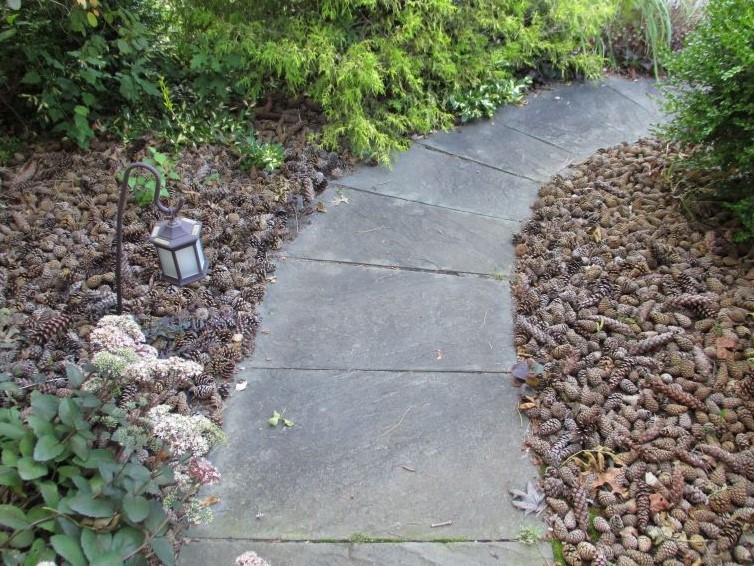
Organic landscape mulches & composts under certain conditions can promote nuisance fungi. (Photo Credit: Steven K. Rettke, Rutgers Coop. Ext.)
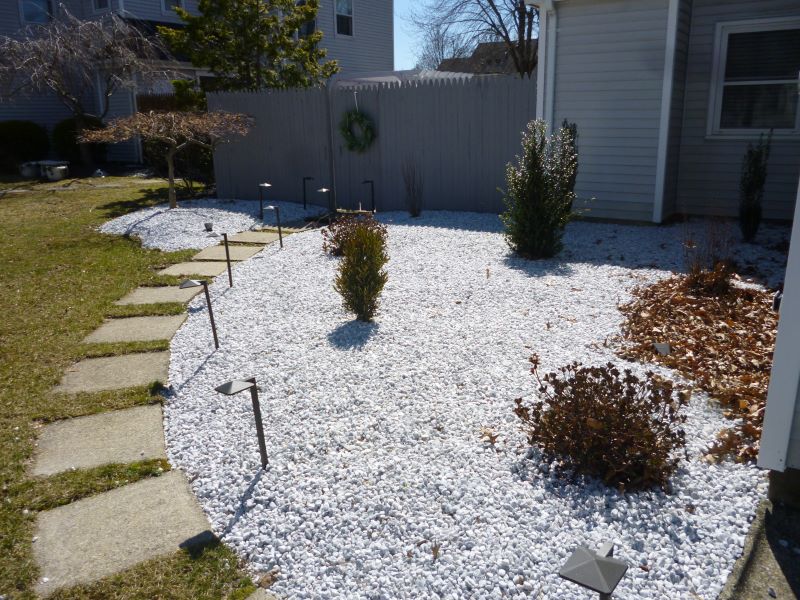
Although stone mulch will certainly eliminate any growth of nuisance fungi, it does not benefit plant health. (Photo Credit: Steven K. Rettke, Rutgers Coop. Ext.)
March 22, 2021 Tim Waller
Nursery Pest Scouting Guide: 25-60 Growing Degree-days (Southern NJ will hit approx. 45 GDD by Friday)
Please print or download the two resources of this post (click on them):
- Printable Pest Scouting Guide 25-60 GDD
- Expanded Pest Scouting Guide 25-60 GDD with CLICKABLE links
- (Zoom in and click directly on the links within this document)
The information provided in the downloads gives early season scouting ranges (in growing degree days, base 50F) for specific insect pests harming nursery crop production and maintenance. Additionally, forecasting predictions (GDD50 accumulation) for calendar dates of multiple regions of New Jersey (S,N,C) are provided.
To determine your local growing degree-days, please review this post “Obtaining your local growing degree-day information”
Scouting Ranges:
- This document supports scouting, it does not replace it. Keeping good notes on pest development will help dial in scouting and treatment efforts at your local level.
- It is important to note that these GDD50 are not exact, rather provide a range of GDD and subsequent calendar dates that can be used to scout for, and treat for, insect pests.
- The pests listed here will be listed again in future scouting range announcements as they undergo further developmental life stages or are vulnerable to management options.
- If you need more information, OR you are regularly seeing specific pest development stages at growing degree-days different than those listed here, please contact Tim Waller at twaller@njaes.rutgers.edu
| Projected GDD50 accumulation as of | ||||||
| NJ – Region | Location | March 1st | April 1st | May 1st | June 1st | July 1st |
| Southern | Upper Deerfield (NJ50) | 0 | 48 | 157 | 564 | 1241 |
| Central | Howell / Freehold (NJ10) | 0 | 26 | 107 | 455 | 1076 |
| Northern | High Point (NJ59) | 0 | 5 | 11 | 224 | 676 |
| Forecast: NOAA NCEP Coupled Forecast System model version 2 (CFSv2) forecast system (3.5 months) (USPEST.ORG) | ||||||
| Pest Scouting – Growing Degree-day Ranges | (25-60 GDD50) | |||||
| CROP TYPE | Common Name | Scientific Name | GDD Min (50F) | GDD Max (95F) | Reference | Developmental / Target Stage |
| Conifer | Eastern spruce gall adelgid | Adelges abietis | 25 | 100 | 3 | Spring control of overwintering stage |
| Conifer | Northern pine weevil | Pissodes approximatus | 25 | 100 | 4 | 1st adults active |
| Conifer | Zimmerman pine moth | Dioryctria zimmermani | 25 | 100 | 3 | 1st larvae active |
| Conifer | Cooley spruce gall adelgid | Adelges cooleyi | 25 | 120 | 3 | Spring control of overwintering stage |
| Conifer | White pine weevil | Pissodes strobi | 25 | 220 | 4 | 1st adults active |
| Shade trees | European fruit lecanium | Parthenolecanium corni | 35 | 145 | 2 | Spring control of overwintering stage |
| Many, evergreen | Euonymus scale | Unaspis euonymi | 35 | 120 | 2 | Spring control of overwintering stage |
| Conifer | European pine sawfly | Neodiprion sertifer | 35 | 145 | 1 | Hatched larvae |
| Conifer | Fletcher scale | Parthenolecanium fletcheri | 35 | 148 | 2 | Spring control of overwintering stage |
| Conifer | European pine shoot moth / borer | Rhyacionia buoiana | 50 | 220 | 4 | 1st larvae active |
| Maples | Maple bladdergall mite | Vasates quadripedes | 58 | 148 | 2 | Spring control of overwintering stage |
| Honeylocust | Honeylocust plant bug | Diaphnocoris chlorionis | 58 | 246 | 2 | Nympths / adults active |
| Conifer | Pine tortoise scale | Toumeyela parvicornis | 58 | 148 | 2 | Cralwer activity |
| Conifer | Pine bark adelgid | Pineus strobi | 58 | 618 | 2 | Spring control of overwintering stage |
| Conifer | Balsam twig aphid | Mindarus abietinus | 60 | 100 | 4 | Egg hatch |
| References | RU | Rutgers Cooperative Extension – IPM Notes | ||||
| 2 | http://ccetompkins.org/resources/using-growing-degree-days-for-insect-management | |||||
| 3 | https://extension.psu.edu/ipm-basics-for-christmas-trees#section-2 | |||||
| 4 | https://www.canr.msu.edu/ipm/agriculture/christmas_trees/gdd_of_conifer_insects | |||||
| 5 | https://www.agriculture.nh.gov/publications-forms/documents/landscape-pests.pdf | |||||
| 6 | https://extension.umd.edu/ipm/pest-predictive-calendar-landscapenursery | |||||
(Please note: we will be providing pest GDD ranges regularly throughout the season for our green industries)
Important notes about growing degree-day models:
- These models do not replace scouting. They should guide scouting efforts and pest management programs, once the vulnerable life stage or economic threshold of a pest is recorded. Observations at a local level for specific pests is critical to IPM efforts and further refinement of degree-day-based predictions.
- GDD50 values for pest development are not exact, rather they should be viewed as a range.
- The growing degree-day model (GDD50) is general by design. Some insect pests have specific formulas for their growth and development (some examples here). However, the GDD50 model is useful for many pests and plant species.
- Many GDD50 target values were developed in other parts of the country and should be ‘ground truthed’ at a local level. Blind applications of pesticides, without truthing pest development, may not deliver desired outcomes.
