Tree Fruit Edition

Seasonal updates on insects, diseases, weeds, maturity dates and cultural practices impacting only tree fruit.
 
Subscriptions are available via EMAIL and RSS.

Integrating Management for Key Orchard Pests


By: Robert McDougall and Anne L. Nielsen

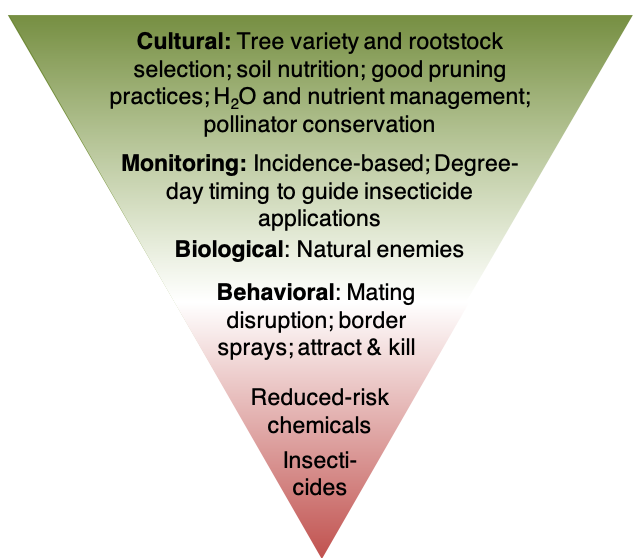
Integrated Pest Management (IPM) is the practice of using biological information to efficiently and effectively control pests while reducing reliance of pesticides. IPM is typically depicted as a pyramid of tactics that build on each other moving from least toxic at the bottom to most disruptive at the top. But in practice, IPM for insects in tree fruit relies primarily on application of synthetic insecticides guided by degree-day timing or trap counts. We want to flip the “IPM pyramid” around to emphasize that insecticides are the last tool for pest management and build upon other biologically-based practices.

Graphic describing management practices for orchard pests

By Anne Nielsen

The least disruptive means of pest control are cultural measures, those that seek to prevent pests from becoming problematic in the first place. These can include measures such as planting resistant cultivars, practicing good hygiene to prevent pest entry and maintaining diverse plantings in crop margins to encourage natural biological control agents (e.g. other insects that eat pests). In tree fruit, cultural control may include rootstock resistant to wooly apple aphid or removal and burning of pruned limbs and dying trees (for borer or scale management) which removes infested plant material and habitat for other pests.

For curative action, a central component of IPM programs depends on monitoring programs to identify pest species, occurrence and seasonality, and abundance. This is achieved primarily through direct sampling of plant tissue or baited traps. Regardless of the monitoring method, it must be conducted frequently, weekly at best. Monitoring can also establish biofix dates to start accumulating degree-days that when applied to models predict life stages of insects based on available heat units for development.

Upon identification of key pests within the orchard, the next action can take on a wide range of forms depending on the pest. This can include biological control measures, such as enhancing or introducing a natural enemy of the pest into the system in the hope of controlling it. Interactions between natural enemies and pests occur naturally within an orchard, but the strength of the interaction can be weakened through chemical insecticides and lead to outbreaks of pests, particularly aphids, mites, thrips, and scales. Implementation of reduced input or non-chemical methods can protect populations of natural enemies such as predators or parasitoids within the orchard and prevent a pest from becoming actionable. An example of a biological control program currently under investigation is controlling the Brown Marmorated Stink Bug with the Samurai Wasp, a tiny stingless Asian wasp which lays its eggs in BMSB eggs, preventing them from hatching and producing more Samurai Wasps instead of stink bugs.

The next IPM tool is behavioral management which changes the behavior of the insect so that less insecticide can be used. Insects, like other animals, have predicable behaviors, that once understood can be exploited for management. Two common approaches include altering insect behavior with pheromones (ie. mating disruption or attract-and-kill) or exploiting dispersal behaviors to apply targeted management (ie. border sprays). Mating disruption uses a species’ own sex pheromone to reduce mating within the orchard. This is accomplished by placing multiple dispensers containing pheromone throughout the orchard. This changes the behavior of male moths that are searching for females and results in fewer females laying eggs within the orchard (and cleaner fruit at harvest). For many insect species, including Oriental Fruit Moth and borers, no additional insecticide is needed (based on monitoring trap thresholds). Mating disruption for Oriental Fruit Moth in peaches can cost the same if not less than insecticide management and is highly effective. Mating disruption technology against borers is becoming increasingly necessary as further use restrictions change for Lorsban.

The behavioral tactic attract-and-kill places high doses of pheromone, usually an aggregation pheromone, on select trees to attract males and females (and sometimes nymphs) to a tree where they can then be killed with an insecticide. It is not believed to bring additional insects into the orchard, rather it brings those that are already there into one area. A second type of behavioral control is the use of border sprays. Many insects are often found in greater numbers in the edges of orchards because their dispersal is arrested due to visual cues provided by trees on the orchard edge. A border spray is usually defined as spraying the outer rows of orchard trees with insecticide. This tactic has shown to be very successful for controlling brown marmorated stink bug in peaches and apples, and reduces insecticide sprays by 25% relative to alternate row middle applications. Plum curculio also exhibits this behavior, and Rutgers is currently investigating whether it can be effectively controlled by spraying just the outer two rows of orchards during movement into the orchard.

IPM practices have evolved considerably in the past few decades and orchards are managed safer and more efficiently each year. Some of the IPM tactics described above may already be part of your orchard management practices. But as production cost increases are not instep with fruit prices, tactics that rely less on insecticide inputs will help protect orchard viability.

Tree Fruit IPM Report for April 21, 2020

Evaluating Freeze Damage in Tree Fruit: The subfreezing temperatures on the morning of April 17 Caused injury at varying levels across the state. Lows ranged from 27-30 in southern counties. Much is the damage is now visible. Any physiological damage that is not visible now will appear as the season progresses. A helpful guide for evaluating fruit damage can be in the Intermountain Tree Fruit Production Guide.

Tree Fruit Phenology: Tree Fruit Phenology remains advanced, but development is slowing. In southern counties all peach orchards are late bloom to early Shuck Split. Redhaven was at approximately full bloom on March 30, and was at Petal Fall by April 14. Peach bloom has been very long this year. Plums are past shuck fall. Pears are late bloom/Petal Fall. Red Delicious is pink to 50% bloom. Cherries are at 50% bloom. [Read more…]

New Jersey Statewide Tree Fruit Twilight Meeting – Updated

Reminder – updated meeting link

April 15, 2020 5:00 PM – 8:00 PM

Please join us for this informational event co-hosted by Megan Muehlbauer, Agricultural Extension Agent of Hunterdon County and Hemant Gohil, Agricultural Extension Agent of Gloucester County

See flyer for details Twilight 041520_Final

Meeting Information:
Meeting link: https://rutgers.webex.com/rutgers/j.php?MTID=m9462e629379ff2f781c6a29e3883ae68
To join by phone dial: 173 243 2 68
Enter meeting number (access code): 796 342 632


“Ask the Ag Agent” 7:00PM Weekly – Every Wednesday – Farmer Video Conference/Call-In Forum

By, William Bamka, Stephen Komar, Michelle Infante-Casella and Meredith Melendez

“Ask the Ag Agent” weekly 1-hour sessions for farmers will be hosted by Rutgers Agricultural Agents working with commercial farmers, on Wednesday April 15th and continue each Wednesday. The online conferencing/call in events will begin at 7:00PM with an open forum to discuss ag-related questions about production, marketing, regulations and any other topics farmers wish to discuss. All are welcome.

To access via WebEx on a computer go to https://go.rutgers.edu/rc9n3kxt

Join by phone
+1-650-429-3300 USA Toll
Access code: 799 743 872

Tree Fruit IPM Report for April 14, 2020

Special Announcement! : The long awaited update to the NJ Commercial Tree Fruit Production Guide is available. We have updated the pesticide tables to include new products, pesticide safety, and efficacy. We hope to have the text sections updated for 2021.

Tree Fruit Phenology:

Tree Fruit Phenology remains advanced, but development is slowing. In southern counties all peach orchards are just past full bloom to petal fall. Redhaven was at approximately full bloom on March 30, and was late bloom on 4/7. Peach bloom has been very long this year. Plums are past petal fall and Pears are in bloom. Red Delicious is pink. Cherries are in bloom. [Read more…]

Marketing Tip: Consider Pre-Bagging Produce at Farm Markets

By, Michelle Infante-Casella and Meredith Melendez, Agricultural Agents

Farm marketers can learn from recent behaviors observed in supermarkets and other food outlets as we start the produce season in New Jersey. Besides facilitating social distancing and having employees and customers wear masks and other protective gear, farm owners and workers can help ease shopping anxiety by pre-bagging items.Person grabbing an orange from a bag with a glove

To date there is no scientific evidence to support the transmission of COVID-19 through food, but customer buying patterns have shown that packaged produce is selling better than loose produce. Customers are fearful of virus transmission from many different sources regardless of the science. Most people are very suspicious when touching every object around them whether it be door handles, shopping carts, checkout counters, credit card machines and also on the list – loose fruits and vegetables on shelves that may have been handled by other people. These fears are certainly understandable.

Some food stores are reporting bagged items are selling faster than loose items. The public sentiment is wrapped produce has a barrier that acts as a safety measure against contamination. Produce items in pre-packaged containers, such as bagged lettuces, bagged broccoli, bagged cucumbers, bagged peppers, packaged tomatoes and other items wrapped in plastic have increased in sales over their unpackaged counterparts. In addition, items in highest demand tend to be more shelf-stable produce like potatoes, apples, onions, unpeeled carrots, winter squashes and cabbage.

The media has been publicizing milk dumping from tanker trucks, in-season produce fields being plowed, and issues with food distribution across the country due to issues from COVID-19. Consumers are questioning many issues right now. Is the U.S. food supply safe? Will there be enough food to go around? Will the food stores be closing? Is it safe to buy fresh produce? Should I worry when I see empty store shelves?

To ensure a domestic food supply in the future, it is more important than ever for customers to buy local and US farm products. This is a message the entire agriculture industry can share with the public.

Some questions about food and COVID-19 can be answered by reading the U.S. Food & Drug Administration’s website https://www.fda.gov/food. This is also a good site to send your customers to help answer their questions. Resources specific for the agricultural community are listed on the Rutgers On-Farm Food Safety COVID-19 website.

In summary, farm market proprietors may want to keep produce displays well stocked with plenty of bagged and packaged produce items. This will also help facilitate having customers in the market for shorter periods. Customers can just pick up bags and go rather than pick through a pile and taking extra time to bag their own items. In addition, pricing bags ahead of time, that don’t need to be weighed, can also quicken check out times. Shoppers are in a hurry to get in and out of stores to ease fears of potential virus transmission. Making it as easy as possible to help facilitate shopping and check out may go a long way to lessen customer anxiety in current times. Keep engaged with customers for suggestions on what they may need from your market.

Farmers and farm markets will be playing a major role in food distribution and food security in the near future and beyond. Thank you to all farmers, farm workers, and other essential workers in this time of crisis.