Soil Fertility from Non-Commercial Nutrient Sources

All essential plant nutrients cycle through the ecosystem of soil, water, air, plant, microbe, and animal.  Agronomic information about the composition and beneficial use of waste materials and how the nutrients can be recycled can help growers reduce the need to purchase soil fertility inputs.  Many different types of non-commercial nutrient sources are available in New Jersey.  Examples include horse manure with bedding, shade tree leaves, lawn clippings, wood chips, food waste, coffee grounds, eggshells, wood ash and more.

With 43,000 horses in New Jersey, there is an abundance of horse manure produced.  One horse can produce about 65 pounds of manure plus bedding per day.  The quantity of horse manure is substantial on a statewide basis.  Unfortunately, sometimes horse manure goes to landfills when it should be used to build and sustain soil fertility.

The Soil Profile Newsletter 2023 issue posted at Rutgers NJAES explains how to build and maintain soil fertility harnessing the nutrient supplying ability of horse manure and many other types of non-commercial materials.  The chemical composition and soil fertility value of each material is presented for beneficial use.  Available on the web at Rutgers NJAES ‘The Soil Profile’: https://njaes.rutgers.edu/soil-profile/pdfs/sp-v28.pdf

New Peach Varieties – ‘Felicia’, ‘Evelynn’ and ‘Anna Rose’

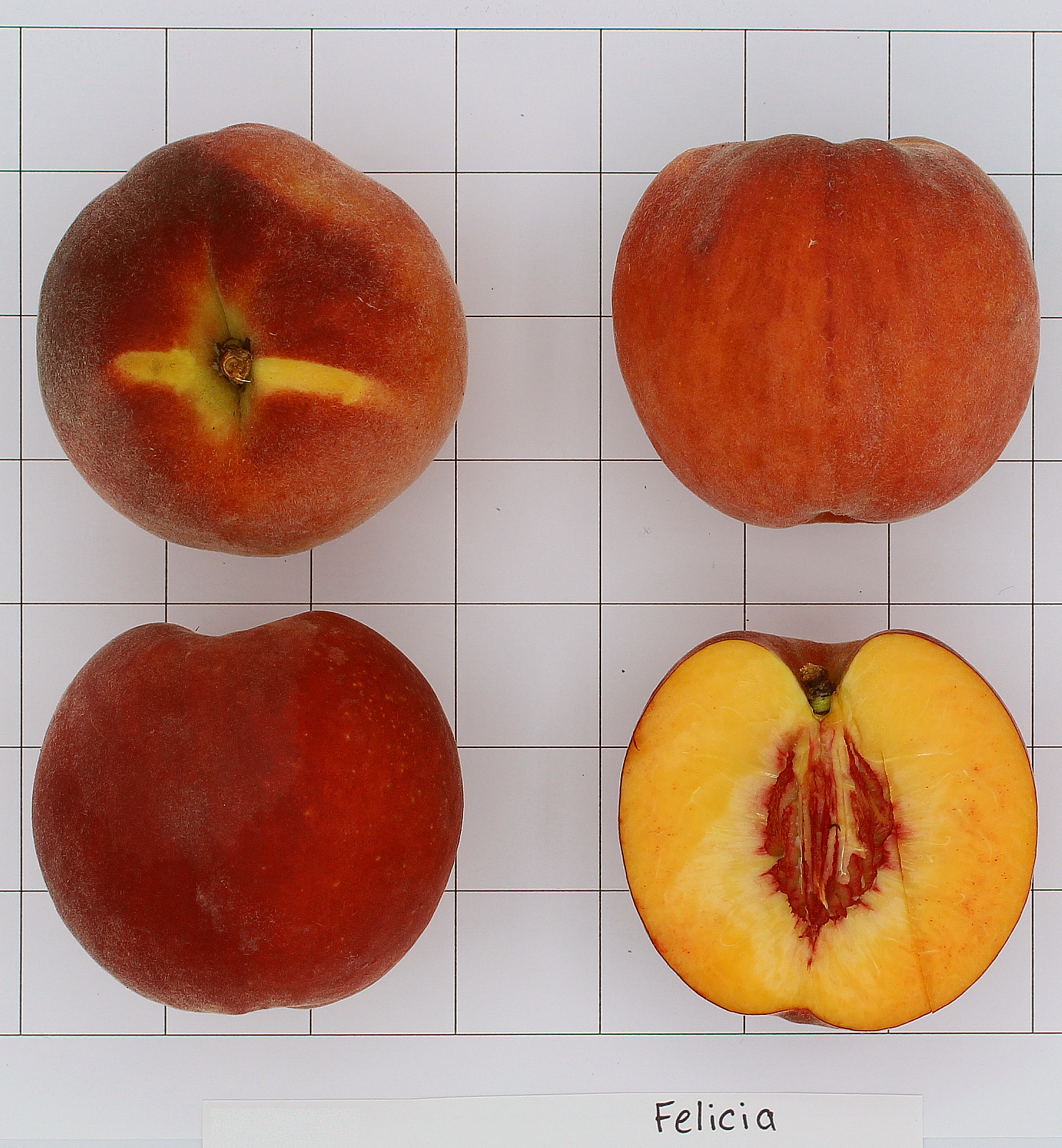
Felicia peach The Rutgers/NJAES stone fruit breeding program, led by Joe Goffreda, continues to create, and release exciting new peach varieties. We, in collaboration with growers, also continue to develop the varieties by evaluating their performance in plantings in commercial orchards and at Rutgers Agricultural Research and Extension Center. During this key time of the season, historically Redhaven season, it is important for our area to capture a substantial market share with premium fresh peaches. We are glad to feature some new and improved peach options for this season.

Felicia is a recent release from Rutgers University. It is a very attractive freestone yellow-fleshed peach variety. It has attractive red to dark red skin, little pubescence, with traces of red in the flesh. It ripens a few days before Redhaven; however, unlike Redhaven, it retains firmness for longer while maintaining the balance of sweetness and acidity (Table 1). Fruit is large and firm-fleshed, which is essential for post-harvest handling. It has low susceptibility to bacterial spot.

Though Redhaven is still the standard, yellow-fleshed, traditional peach in this season, it has a few challenges. For example, fruit can ripen faster than it changes skin color. That means it requires experience to start picking. Felicia is a good choice if one is planning a replacement for Redhaven. [Read more…]

Farm Credit East Report on Grants & Incentives Available for Northeast Agriculture Businesses

One of the most frequent calls over the past few years has been, “I want to start a farm/business/value-added product (etc.).”

That is usually followed up with, “What grants/funding sources are available?”

After rattling off a list of a few common sources of funding for new farmers there’s an added caveat that I don’t know the current status of those programs or what restrictions they have regarding new farming ventures. There are more programs out there with available funding, but there’s no comprehensive list of all grant programs supporting agricultural businesses, until now.

Farm Credit East has just released a report “identifying federal, regional and state grants, loan guarantees, and other incentives available to assist Northeast producers of all types and sizes.”

“Grants can be a great resource to provide additional funds needed to take on larger projects,” said Chris Laughton, Farm Credit East Director of Knowledge Exchange. “Unfortunately, they’re often under-utilized because they can be time consuming and involve quite a bit of paperwork.”

The report, from Farm Credit East Knowledge Exchange, includes funding opportunities available in the eight states served by Farm Credit East. Programs are categorized by their main focus:  beginning farmers; conservation, environment and forestry; energy; fisheries and aquaculture; organic; rural business development; and research, education and promotion.

The report titled Grants and Incentives for Northeast Agriculture is available at FarmCreditEast.com or by contacting Chris Laughton at (800) 562-2235 or Chris.Laughton@farmcrediteast.com for more information.

Farm Credit East also has grant writing assistance services. Information is available on their grant writing page.

[Source:  https://www.farmcrediteast.com/en/about/NewsRoom/press-releases/230717FundingforNortheastAgriculturalProducers]

What Can Summer Cover Crops Do for Soil Health and Future Crops?

Plants floweringNow that some of our spring planted crops have finished, rather than leaving fields fallow or replanting fields that may have had some issues with plant diseases or insect pests, consider replanting with a summer cover crop. It is not too late to take advantage of summer cover crop benefits. What do summer cover crops do for soil health or future crop improvements? See below:

1. Increase Soil Organic Matter– One of the best attributes of having organic matter in the soil is improvement in soil structure. Adding organic matter improves tilth, water infiltration, water holding capacity, nutrient holding capacity and reduction of soil crusting. Also, as important is the increase in beneficial soil microbes and earthworms. Beneficial microbes can compete with pathogens and help release nutrients. Earthworms can cycle nutrients and improve pore spaces in the soil.
2. Reduce Soil Erosion – Just like with winter cover crops, summer cover crops can also reduce wind and water erosion in fields, especially those with slopes. During summer rainfall events, that can be significant if resulting from tropical storms, runoff may not just include soil loss, but also fertilizer and chemical movement. Therefore, keeping cover on a field during non-production times in any season is an excellent practice.
3. Nitrogen Cycling in the Soil – Nitrogen is often the most limiting nutrient for crop production, since it is so readily lost through nitrification and leaching. Storing nitrogen through plant cycling is an excellent way to improve fertility management. Whether it is a grass or non-leguminous cover crops N is still kept in the mix by the cover crop taking up residual N that wouldPerson holding plant to show root system otherwise be lost. The cover crop plant takes up the nitrogen and after the crop is incorporated it decomposes, thus releasing the N for subsequent crops to use. If legume cover crops are planted, they have the ability to “fix” nitrogen from the atmosphere and through the same decomposition process will provide N for subsequent crops. Be sure to inoculate legume seed just prior to planting with Rhizobium bacteria in order to gain the maximum N fixation benefits.
4. Reduce Weeds – When fields are left fallow after crops are harvested, weed growth can occur. If left to produce seeds, these weeds will multiply in subsequent crops. Therefore, managing the field by planting cover crops between cash crops is a great weed management option. As the cover crop grows, it will suppress the germination and growth of weeds through competition and shading. Some cover crop species can also suppress weeds biochemically, either while they are growing or while they are decomposing, which may prevent the germination or growth of other plants (allelopathy). Research has shown some cover crops like wheat, barley, oats, rye, sorghum, and sudangrass may suppress weeds. In some cases, it has also been reported that residues and leachates from crimson clover, hairy vetch, and other legumes have shown weed suppression.
5. Impacts on Plant Diseases – Cover crop residues could possibly be beneficial when it comes to plant pathogens, or can in some cases increase plant disease organisms. Some cover crop species are in the same plant families as cash crops and may be susceptible to the same disease organisms. Therefore, carrying the pathogen to the next crop. This is why paying attention to crop rotations is so important. In other cases, the cover crop residue can improve soil health in order to produce a better environment for beneficial microbes. By improving soil health, water infiltration, air pore space and other positive attributes, some soil pathogens may not survive as well, as in the case of water molds and water fungi. Some cover crops, like sorghum-sudangrass and sunnhemp, have been reported to reduce nematodes in soils. There are multiple positive factors from cover crops that can combat plant diseases.
6. Impacts on Insects – Like with plant diseases, cover crops can be susceptible to the same insect pests as cash crops. However, they may also attract beneficial insects into an area. Insect pests should be monitored in cover crops, just like in cash crops in order to not let populations get out of control and then move into nearby fields after the cover crop is killed.

For more resources on the us e of cover crops check out these resources: Cover Crops for Sustainable Crop Rotations – SARE

2023 Spotted Lanternfly Tracking Survey

Rutgers NJAES Wine Grape Extension, in association with Penn State Extension Grape and Wine Team, is calling on those who own, operate, or manage a farm or vineyard in the New Jersey region to participate in a survey that aims to track the spread and severity of nymph and adult spotted lanternfly populations during the 2023 season. The data collected will provide insights into the distribution patterns of both nymph and adult SLF within and outside vineyards, enabling growers and researchers to better understand this invasive pest’s potential impact on agriculture in the Mid-Atlantic region. [Read more…]

North Jersey Fruit and Vegetable Twilight Meeting II

North Jersey Fruit and Vegetable Twilight Meeting II

 June 7, 2023

4:45 PM – 7:30 PM

Terhune Orchards*

330 Cold Soil Road

Princeton, NJ 08540

*Park in the main lot and meet in the Winery Tasting Room


4:45 PM   Registration/ Light Dinner at the Terhune Orchards Tasting Room

The meeting will commence as a walking tour of high tunnel cherries, blueberries, strawberries, apples and asparagus.


5:00 PM   Orchard Weed Management

Thierry E. Besançon, Associate Extension Specialist in Weed Science, Rutgers NJAES


5:20 PM   Early/Mid-Season Insect Management in Tree Fruit

Anne Nielsen, Associate Extension Specialist in Entomology, Rutgers NJAES


5:40 PM  Control of Bacterial Canker in Sweet Cherry and Summer Fungicide Program for Apples

Norm Lalancette, Associate Extension Specialist in Tree Fruit, Rutgers NJAES


6:00 PM   Vegetable IPM Program Updates

Kris Holmstrom, Vegetable IPM Program Associate, Rutgers NJAES


6:20 PM   Blueberry IPM Program Updates and Spotted Wing Drosophila

Carrie Mansue, Blueberry IPM Sr. Program Coordinator, Rutgers NJAES


6:40 PM   Tree Fruit IPM Program Updates

Kaitlin Quinn North Jersey Fruit IPM Program Associate, Rutgers NJAES


7:00 PM   Pesticide Safety Updates

Pat Hastings Extension Pesticide Safety Education Program Coordinator, Rutgers NJAES


The following NJ Pesticide Recertification Credits will be awarded
1 Unit CORE,    4 Units 1A,    4 Units 10,    4 Units PP2

Please RSVP to Kim Crommelin at 908.788.1338 or kfrey@co.hunterdon.nj.us by June 6, 2023