Fruit Crops Edition

Seasonal updates on diseases, insects, weeds impacting tree fruit and small fruit (blueberry, cranberry, and wine grape). Fruit Pest Alerts are also available via this category feed.
 
Subscriptions are available via EMAIL and RSS.

Agritourism and On-Farm Direct Marketing Webinar Series Begins Tuesday, May 4th

Rutgers Cooperative Extension is working with other extension professionals in the northeastern states to deliver weekly, one-hour webinar programming for agritourism and on-farm direct market operators each Tuesday in May until the first week in June. We are announcing the first session and will post the registration information for more sessions soon. Registration is being handled through the University of Vermont. See information below to join the first webinar. 

Session 1: Getting Ready for Pick-Your-Own — Do’s and Don’ts for the Upcoming Season
Tuesday, May 4, 4:00-5:00pm Eastern time
No charge but you must register in advance.
Register for FREE HERE
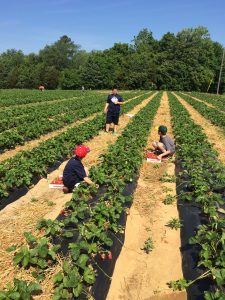
People picking berries
Join growers and ag service providers from the Northeast for an interactive discussion about what is working and what is not as we prepare to open our farms to visitors for the upcoming pick-your-own season. The berries are ripening and the Covid-19 pandemic is evolving – what does that mean for PYO visitor management this season? What did you do last year that you’ll continue and what will be different this season?

Featuring:
-Deb Colitas from Valley Fruits & Veggies in the Lehigh Valley of PA
-Claudia Schmidt from Penn State Extension
-Lisa Chase from University of Vermont Extension
-And YOU! Come ready to share your PYO questions and experiences managing visitors.

This is the first agritourism/on-farm direct marketing zoom session in a series that will cover several topics for farms open to visitors through the evolving COVID-19 pandemic. Other sessions will be held on consecutive Tuesdays on May 11, 18, 25, and June 1. For more programs and information see the Rutgers NJAES Events Calendar

Session 2: Agritourism Operation Checklists and Self-Assessment During the Pandemic, When: May 11, 2021 7:00-8:00 PM Eastern Time – Register HERE

Session 3: What to Do when Something Goes Wrong, Incident Response and Media Relations, When: May 18, 2021 7:00-8:00 PM Eastern Time – Register HERE

Session 4: Liability Insurance, When: May 25, 2021 12:00-1:00 PM Eastern Time – Register HERE

To request a disability-related accommodation to participate in this program, please contact Christi Sherlock at 802-476-2003 or Christi.Sherlock@uvm.edu for assistance.

Tree Fruit IPM Report for 4/27/21

Peach:

Oriental Fruit Moth: First generation timings are updated below: Growers that have utilized mating disruption for OFM can focus on PC; GPA; and catfacing insect pests as described below. If you have not placed mating disruption dispensers yet they can still be deployed for later generations, but this generation must be treated with insecticides at the first generation timings. [Read more…]

Ask the Expert Series Orchard Edition – V (virtual)

Please Join us for an Interactive Discussion on Orchard Soil Fertility and Tree Fruit Nutrition.  Expert Panelists Dr. Robert Crassweller, Extension Specialist, Horticulture, Penn State Uni., Dr. Joseph Heckman, Extension Specialist, Soil Fertility, Rutgers NJAES. and Dr. Megan Muehlbauer, Extension Agent, RCE of Hunterdon County will be discussing orchard soil fertility and tree nutrition. [Read more…]

USDA Expands and Renews Conservation Reserve Program (CRP)

In an effort to boost enrollment and address climate change, the USDA will open enrollment in the Conservation Reserve Program (CRP) with higher payment rates, new incentives, and a more targeted focus on the program’s role in climate change mitigation. [Read more…]

Recordings of Webinar – Ask the Expert Series Orchard Edition

Please use the below links to view or listen to the recordings from the last two sessions of Ask the Expert – Orchard Edition. 

Tree Fruit Meeting –III (April 7): https://go.rutgers.edu/tdi8pllm

Topics: Apple Thinning Using Plant Growth Regulators: Apple fruit thinning with plant growth regulators, crop load management, return bloom, Fruit growth model and Cornell Carbohydrate Models as tools for Thinning and update on PGR’s Available for 2021

Speakers: Jon Clements, Tree Fruit Extension Educator, Uni. of Massachusetts and Mr. Win Cowgill, Professor Emeritus, Rutgers University, and owner Win Enterprises International, LLC

Tree Fruit Meeting – IV (April 21): https://go.rutgers.edu/eu5ps890

Topics: 2021 Tree Fruit Insect Pest – What’s the Buzz in the Orchard

Speakers: Arthur Agnello, Professor, Entomology, Cornell University, and Anne Nielsen, Extension Specialist in Entomology, Rutgers University.

Scheduling a USDA Harmonized and Harmonized Plus+ Audit

Before scheduling an audit review the standards to understand what is required.  Go to https://www.ams.usda.gov/services/auditing/gap-ghp/harmonized and download the latest versions dated February 8, 2021.  There have been changes since the 2018 version so review carefully.  Compare the new version with your written food safety plan and make the necessary changes.  If you need technical assistance or want to discuss parts of the audit email “Ask the Experts” at onfarmfoodsafety@njaes.rutgers.eduThe on-farm food safety team can be contacted at the same address to schedule a walkthrough to assess your readiness for an audit if requested.

Once the food safety plan is complete and you are ready for an audit email fvinspection@ag.nj.gov to schedule the audit.  You will receive an agreement to review and check which audit and audit sections you want audited.  You will be asked to send certain documents for review prior to the on-site audit.  This reduces the amount of time the auditors are on the farm for Covid considerations.  The auditors want to see at least 10 days of records prior to the audit.

Again, this year the Harmonized and Harmonized Plus+ audits in New Jersey will be reimbursed 100% through the USDA Risk Management Agency.  Once the audit is finalized, USDA will generate a bill to the auditee which summarizes the cost breakdown of the audit, and then showing a credit for that same amount. A note will be added to the bill stating, “Cost of your 2021 USDA Harmonized GAP Audit covered by a bill credit made possible through a grant from the USDA Risk Management Agency Agricultural Management Assistance Program”.  For more details and frequently ask questions visit the AMS website mentioned above and look under resources.

Once the audit is complete it will be reviewed by USDA personnel and a certificate will be sent to the grower.  Also, the farm name, address, date and commodities audited will be posted on the USDA AMS website.