Cranberry Early-Season Insect Pests – May 2026

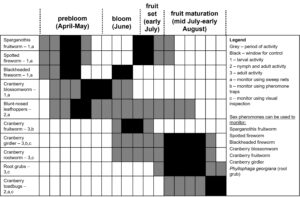
From now until bloom, growers should scout their beds using sweep net sampling for lepidopteran pests (blackheaded fireworm, spotted fireworm, Sparganothis fruitworm, and cranberry blossomworm), and blunt-nosed leafhoppers. Table 1 shows the activity periods of the major insect pests of cranberries in New Jersey. Bars show the period when scouting (in grey) and management (in black) of the pest is most important.

Table 1. Activity of insect pests in cranberry.

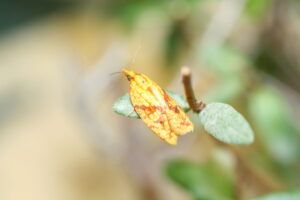
Blackheaded Fireworm – Blackheaded fireworm eggs overwinter on the bed and usually hatch by around mid-May. It is important to catch the first generation, if possible, because the second generation occurs during bloom and is typically much more destructive. Blackheaded fireworm larvae can be detected by sweep net sampling and it is a good idea to look along the edges of beds where vines first begin to grow. Remember: blackheaded fireworm is much easier to control if detected during the early part of the season.

Spotted Fireworm – This insect overwinters as a 2nd instar larva. They complete two generations a year. Larvae feed between uprights they have webbed together. First-generation larvae injure the foliage causing it to turn brown as if burned. In New Jersey, first generation adult moths emerge the first week of June, followed by a second-generation of adult emergence in early August. Eggs are laid in masses on weedy hosts. Larvae from second-generation adults emerge in mid-August and may feed on fruit. Populations of spotted fireworm are regulated by their natural enemies, in particular Trichogramma wasps that parasitize the eggs.

Sparganothis Fruitworm – This insect is a serious pest in most cranberry-growing states.  Sparganothis fruitworm completes two generations a year and overwinters as an early-instar larva. Larvae from the 1st generation feed on foliage. In New Jersey, first generation adult moths emerge from mid-June through the first weeks in July; pheromone traps are commonly used to monitor adult flight and population size. Second-generation eggs are laid on cranberry leaves, and larvae will feed on fruit.

Cranberry Blossomworm – Adults lay their eggs in October in cranberry beds. The eggs overwinter and hatch over a period of several weeks. Early instars can be found during the first week of May. Larvae go through 6 instars to complete development. Because the first instars feed during the day (and at night), scouting can be done during the daytime using sweep nets to estimate larval abundance. Larvae turn nocturnal during the later instars; thus, night sweeping (9 pm – 1 am) is recommended for sampling. Larvae complete their development by June-July. Older instars are very voracious and capable of destroying 100 blossoms within a 3-week period. There is a pre-pupal stage that lasts until the end of August and a pupal stage that lasts until October. Adults emerge from the end of August to the end of October.

Lepidopteran Pests Monitoring and Control – Use sweep netting for monitoring early lepidopteran pests (pre-bloom) (Figure 1). A sweep set consists of 25 sweeps and 1 sweep set is recommended per acre (this may vary depending on the size of bogs). The action threshold for false armyworm, blossomworm, other cutworms, and gypsy moth (we use a combined threshold from adding all these caterpillars per sweep) is an average of 4.5 caterpillars in sets of 25 sweeps. For brown and green spanworms is an average of 18 per sweep set. The action threshold for blackheaded fireworm and Sparganothis fruitworm is an average of 1.5 per sweep set. We recommend the use of reduced-risk materials such as the insect growth regulator (IGR) Intrepid, the spinosyn insecticide Delegate or any of the diamide insecticides Altacor, Exirel or Verdepryn if populations exceed action thresholds. These are reduced-risk, softer insecticides that are very effective against lepidopteran pests. Remember to rotate insecticides with different modes of action to prevent onset of insecticide-resistant pest populations.

Figure 1. Monitoring insect pests in cranberry beds.

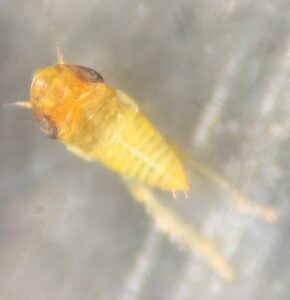
Blunt-nosed Leafhoppers –There is continuing concern among New Jersey cranberry growers of a potential increase in blunt-nosed leafhopper populations because of changes in pest management strategies (e.g., adoption of new reduced-risk products and decreased applications of broad-spectrum insecticides). This leafhopper is of particular concern because it can transmit the phytoplasma that causes cranberry false blossom disease. It has one generation a year. The adults are found in highest numbers during July, although nymphs or adults may be found from the end of May until October. Eggs are laid in July-August. The eggs overwinter and hatch in May. The nymphs go through 5 instars to complete development.

Leafhopper Monitoring and Control: Blunt-nosed leafhopper nymphs can be sampled using sweep nets (as described above for lepidopteran pests) (Figure 1). Nymphs before bloom are small; thus, you may need to freeze the samples (to kill them), and then count the number of nymphs under a microscope or using a magnifying lens. There is no established threshold for this pest.

If blunt-nosed leafhopper nymphs are present in beds, we recommend application of a broad-spectrum insecticide, such as Bifenthrin, Sevin, Orthene, or Diazinon (no aerial applications allowed). Broad-spectrum insecticides will disrupt biological control particularly the natural enemies (predators and parasitoids) of Sparganothis fruitworm, so their use should be restricted only to areas of concern. Alternatively, growers can use Closer (sulfoxaflor). In our insecticide trials, Closer has shown good-to-excellent leafhopper control. This insecticide cannot be used when bees are active (i.e., between 3 days prior to bloom and until after petal fall).

When Plants Get Sick, Pests Thrive: The Unseen Battle in Cranberry Bogs

Our research on how cranberries respond to phytoplasma infection—and its effects on above- and belowground herbivores—was recently featured on the Theobald Smith Society’s website in the article When Plants Get Sick, Pests Thrive: The Unseen Battle in Cranberry Bogs

Phytoplasma infection, which causes false blossom disease in cranberries, is transmitted by the blunt-nosed leafhopper (Limotettix vaccinii). Our findings show that infection increases cranberry susceptibility to herbivores both above and below ground by increasing plant nutrient levels and suppressing plant defenses. This work highlights the complex—and often harmful—interactions among plants, pathogens, and insect herbivores in agricultural ecosystems.

Sparganothis Fruitworm Degree-Day Update: As of June 23, 2025

By: James Shope and Cesar Rodriguez-Saona

As of June 23, Sparganothis fruitworm has accumulated 1,225 degree-days (DD) since the April 15 biofix, based on our degree-day model. This suggests that flight activity has surpassed 90%, with peak flight likely occurring around June 19, 2025. The model reflects average conditions across multiple beds, so some variation may occur depending on the variety. We will continue to provide updates as the season progresses. If needed, an insecticide application is recommended two weeks after peak trap catches—around July 3.

Videos on Blunt-nosed Leafhoppers and False Blossom Disease

In collaboration with Washington State University and the Western IPM Center, we produced three YouTube videos focusing on blunt-nosed leafhoppers and false blossom disease.

Ben-Zvi, Y., Rodriguez-Saona, C., Kraft, L., Ben-Zvi, E. Blunt-nosed leafhoppers and cranberry false blossom disease: I. Biology and symptoms. Western IPM, extension video series. https://www.youtube.com/watch?v=nEujE6nNF58

Ben-Zvi, Y., Rodriguez-Saona, C., Kraft, L., Ben-Zvi, E. Blunt-nosed leafhoppers and cranberry false blossom disease: II. Grower interviews. Western IPM, extension video series. https://www.youtube.com/watch?v=Lpvwl9QzIEM

Ben-Zvi, Y., Rodriguez-Saona, C., Kraft, L., Ben-Zvi, E. Blunt-nosed leafhoppers and cranberry false blossom disease: III. Current research. Western IPM, extension video series. https://www.youtube.com/watch?v=9vh-eKUt_5U

Blunt-nosed Leafhopper in Cranberries – May 2025

New Jersey cranberry growers are increasingly concerned about the rising populations of blunt-nosed leafhoppers (BNLH). This increase is likely linked to shifts in pest management strategies, including the adoption of reduced-risk insecticides and reduced use of broad-spectrum products, as well as the expansion of high-yielding cranberry varieties. BNLH is particularly troubling because it transmits a phytoplasma—a type of bacterium—that causes false blossom disease (Figure 1). Symptoms of this disease include stunted growth, deformed and sterile flowers that point upward, and a characteristic branching of upright shoots known as witches’ broom.

Figure 1. Healthy cranberry (left) and phytoplasma-infected cranberry (right). Drawing by Lindsay Lindhult.

Life Cycle

The blunt-nosed leafhopper (BNLH) has one generation per year (Figure 2). Its eggs overwinter embedded in cranberry stems and begin hatching in early May. Nymphs pass through five instars over the course of about 2 months. Adults emerge in early July, peak in mid to late July, and decline by the first week of August. These adults are characterized by their distinctive blunt heads and vary in color from light yellowish-gray to dark brown. Egg-laying occurs between July and August.

Damage

Nymphs and adults feed on cranberry plant juices using their piercing-sucking mouthparts. While this direct feeding causes little visible damage, BNLH is an important pest because it serves as a vector for the phytoplasma that causes false blossom disease.

Management

At this time of year eggs should be hatching and early-instar nymphs should be active (Figure 2).

Figure 2. Life cycle of blunt-nosed leafhopper. Drawing by Lindsay Lindhult.

Here are some guidelines to consider when managing BNLH in cranberries:

Identify Infestation Sites: The key to effective BNLH control is identifying infestation sites. The most reliable method for monitoring this insect is by using a sweep net. Before bloom, use sweep nets to collect nymphs. Because nymphs are small and difficult to see, bag and freeze the samples to kill them, then count the nymphs using a microscope or magnifying lens.

Sweep net Monitoring: Perform sweep sets of 25 sweeps each. The recommended number of sweep sets is:

  • 1 per 1–10 acres
  • At least 10 sweep sets per 10–20 acres
  • 1 sweep set per 2 acres for areas larger than 20 acres

Lack of Economic Thresholds: Establishing an economic threshold for BNLH is difficult, as the proportion of false blossom infected individuals within BNLH populations is unknown and may vary by cranberry variety and location. Notably, higher infection rates have been observed in newer varieties, even when BNLH populations are low.

Control Measures: Control measures should be based on BNLH population trends relative to previous years, the history of insecticide applications, and the cranberry variety grown. If BNLH populations are increasing compared to prior seasons and the beds have not been treated for BNLH in the past 2–3 years, treatment should be considered.

Treatment Options: If treatment is necessary, consider the following options to manage BNLH:

  • Timing: The best time for insecticide treatment is before bloom to target young nymphs.
  • Insecticide Options:

Organophosphates: Diazinon (diazinon), Orthene (acephate)

Carbamates: Sevin (carbaryl)

Pyrethroids: Fanfare or Brigade (bifenthrin), Danitol (fenpropathrin)

Neonicotinoids: Assail (acetamiprid), Actara (thiamethoxam). Note: Use neonicotinoids with caution before bloom due to their potential negative effects on pollinators. These systemic insecticides can accumulate in pollen and nectar, posing a risk to bees.

Sulfoximine: Closer (sulfoxaflor). Although effective in small plot trials at the P.E. Marucci Center, more data are needed to confirm efficacy on larger commercial scales.

  • Be aware that, while not scientifically proven, there are claims that Orthene and Sevin may reduce pollinator activity by repelling bees.
  • Rotate insecticides with different modes of action to prevent the development of resistance in BNLH populations.

Integrating Classical Biological Control for Spotted-wing Drosophila

Join eOrganic for a research update on the organic management of Spotted-wing Drosophila! The webinar takes place at 11AM Pacific, 12PM Mountain, 1PM Central, 2PM Eastern Time. It’s free and open to the public, and advance registration is required!

Register now at https://oregonstate.zoom.us/webinar/register/WN_XlcU6SgxSJau46kmRXol1Q

About the Webinar

Spotted-wing Drosophila organic pest management research team members will discuss the impact of current organic management practices on parasitoid populations. The webinar will focus on the release of parasitoids, the impact of entomophilic nematodes, and the non-target effects of pesticides on parasitoids attacking Spotted-wing Drosophila.

Presenters

  • Philip Fanning, University of Maine
  • Cesar Rodriguez-Saona, Rutgers University
  • James Brown, UC Berkeley
  • Ben Johnson, University of Maine