Blunt-nosed Leafhoppers in Cranberries – 2024

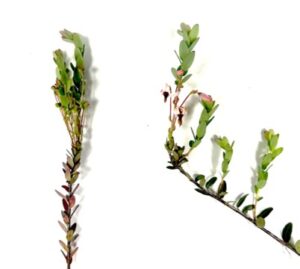
New Jersey cranberry growers are increasingly concerned about rising blunt-nosed leafhopper (BNLH) populations. This rise is attributed to changes in pest management strategies, such as the adoption of new reduced-risk products and decreased use of broad-spectrum insecticides, as well as the expansion of high-yielding varieties that seem more susceptible. BNLH is particularly worrisome because it transmits a phytoplasma, a type of bacteria, that causes false blossom disease. Symptoms of false blossom disease include stunted growth, erect sterile flowers (Figure 1), and distinctive branching of upright shoots, known as witches’ broom.

False blossom infected cranberry with erect flowers (left) and uninfected cranberry (right). Photo credit: Beth Ferguson.

Life Cycle

BNLH has one generation per year. Its eggs overwinter and begin hatching in early May. Nymphs go through five instars in about a month. Adults appear in early July, peak in mid-late July, and their numbers diminish by the first week of August. These adults have a distinctive blunt head and range in color from light yellowish-gray to dark brown. Eggs are laid between July and August.

Damage

Nymphs and adults feed on cranberry plant juices using their piercing-sucking mouthparts. This direct injury is not noticeable. However, they are significant as vectors of the phytoplasma that causes false blossom disease.

Management

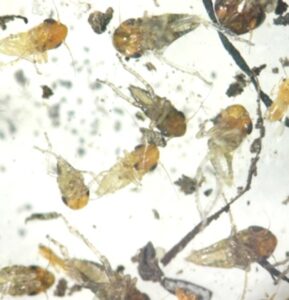
At this time of the year, we are observing early-instar nymphs, mostly 2nd instars but also 3rd instars (Figure 2).

Blunt-nosed leafhopper nymphs. Photo credit: Beth Ferguson

Here are some guidelines to consider when managing BNLH in cranberries:

  1. Identify Infestation Sites: The key to BNLH control is locating infestation sites. The best way to monitor for this insect is with an insect sweep net. Before bloom, use sweep nets to monitor nymphs. Since nymphs are small, freeze the samples to kill them, then count the nymphs under a microscope or with a magnifying lens.
  2. Sweep-net Monitoring: Perform sweep sets of 25 sweeps each. The recommended number of sweep sets is:
  • 1 per 1–10 acres
  • At least 10 sweep sets per 10–20 acres
  • 1 sweep set per 2 acres for areas larger than 20 acres
  1. Lack of Economic Thresholds: Managing BNLH is challenging because they vector a phytoplasma causing false blossom disease. Establishing economic thresholds is difficult due to the unknown proportion of infected individuals in the population, which can vary by variety. Higher infection rates have been observed in newer varieties even when BNLH populations are low.
  2. Control Measures: Consider control measures based on BNLH numbers relative to previous years, history of insecticide application, and cranberry variety. If BNLH populations are increasing compared to previous years and the beds have not been treated for BNLH in 2-3 years, growers should consider treatment.
  3. Treatment Options: If treatment is necessary, consider the following options to manage BNLH:
  • Timing: The best time for insecticide treatment is before bloom to target young nymphs.
  • Insecticides: Organophosphates: Diazinon (diazinon), Orthene (acephate); Carbamates: Sevin (carbaryl); Pyrethroids: Fanfare or Brigade (bifenthrin), Danitol (fenpropathrin); Neonicotinoids: Assail (acetamiprid), Actara (thiamethoxam). Note: Do not use before bloom due to potential negative effects on bees, as these systemic insecticides can accumulate in pollen and nectar. Sulfoxaflor: Closer (sulfoxaflor). Although effective in small plot trials at the P.E. Marucci Center, more data are needed to confirm efficacy on larger commercial scales.
  • Be aware that, while not scientifically proven, there are claims that Orthene and Sevin may reduce pollinator activity by repelling bees.

Spotted-wing Drosophila National Impact Survey

Help us Protect your Crops Against Spotted-wing Drosophila.

What are we doing?

We are conducting a national survey to better understand the impact of research conducted by land-grant university faculty on spotted wing drosophila (SWD) mitigation across the United States.

Why are we doing this?

To advance research efforts focused on developing more effective and efficient SWD management tools to meet your needs.

How do you participate?

By clicking the link

https://ufl.qualtrics.com/jfe/form/SV_9B5kHcjLIRgW9gO


Upcoming Webinar on Organic Approaches for Management of Spotted-wing Drosophila

A team of researchers across the United States is studying approaches to management of spotted-wing drosophila in organic fruit crops, with funding from the USDA-Organic Research and Extension Initiative. Their annual project webinar will be held on Wednesday February 7, 2024 at 2-3:30 pm Eastern Time. Please join the team members for this event that will update attendees on recent research and the emerging results from studies underway in various berry crops. Presenters will focus on recent efforts to release the classical biological control agent Ganaspis brasiliensis at organic sites nationwide, and will include Dr. Jana Lee (USDA ARS), Dr. Kent Daane (UC Berkeley), and Dr. Philip Fanning (University of Maine).

The webinar is free, but you must register in advance to get the link for this presentation. To register, please visit this link: oregonstate.zoom.us/webinar/register/WN_efBnBYi8QDSzu2NOGopQBg#/registration


Diazinon Shortage and Future Production

This article has been adapted from an article written by Dr. Christelle Guédot, University of Wisconsin-Madison, and published in the Cranberry Crop Management Journal – Volume 36 (August 02).

Every 15 years, the Environmental Protection Agency (EPA) performs registration reviews to reevaluate pesticides to assess environmental and occupational risk. In March 2023, the EPA announced that it would accelerate the review process of Diazinon and other pesticides that were due to conclude in 2026. As part of the review process of Diazinon, EPA reached an agreement with the pesticide registrants to develop voluntary mitigation measures by the registrants several years ahead of the normal registration review process to reduce occupational risk. This has led registrants to start implementing these measures this summer and resulted in the shortages observed this summer. For more information about this agreement between EPA and the registrants reached in April, please see https://www.epa.gov/pesticides/epa-reaches-agreement-early-mitigation-measures-initiative-organophosphate-pesticide.

While there was some uncertainty surrounding the supply and forecast of production of the different formulations of Diazinon from Adama and Loveland Products this summer, an official statement was received from Adama stating that they will continue to produce AG500 into 2024 and that they will cease production of Diazinon 50W. For AG500, new labels that will contain occupational risk mitigation measures and endangered species language are expected to be approved by the end of 2023 and should be in place through 2026 when the EPA will complete the registration review process. As for AG600, Loveland Products have informally indicated to the Cranberry Institute that they do not intend to produce Diazinon AG600 any longer. Once stocks of Diazinon 50W and AG600 run out, Diazinon will only be produced and available from Adama in the AG500 formulation. For more information about use pattern of Diazinon AG500, a link to the label can be found at https://s3-us-west-1.amazonaws.com/agrian-cg-fs1-production/pdfs/Diazinon_AG5001t_Label.pdf. It is expected that EPA will announce the notice of the agreed upon mitigation measures later this year and that an interim or final decision will be reached in 2026 under the regular review process timeline.

Sparganothis Fruitworm Degree-Day Update: As of June 22, 2023

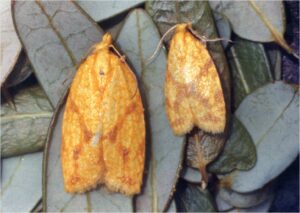
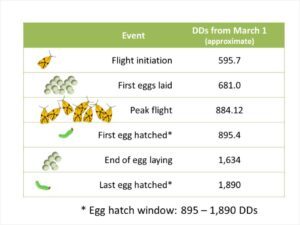
Based on our degree-day (DD) model for Sparganothis fruitworm, peak flight is expected at around 884 DD (see chart). As of June 22, Sparganothis fruitworm has accumulated 827 DD (using April 15 as biofix; a biofix more realistic to New Jersey practices). Based on the April 15 biofix, egg laying should have been initiated. However, I do not expect peak flight and those eggs to start hatching until mid-next week. Larval injury to fruit usually begins after the eggs hatch. If treatment is required (based on pheromone trap counts), sprays should be done 10-14 days after peak moth captures, ca. 7-11 July. If Sparganothis fruitworm pressure has been high, it may be advisable to treat 3 weeks after the moth flight began (i.e., around 1-4 July) and again 10 days later. When bees are present your option is to use an insect growth regulator such as Confirm or Intrepid. Our “standard” recommendation has been, however, to wait until bees are removed to apply an insecticide. Your post-bloom options include Altacor, Delegate, Exirel, or Intrepid. The timing of insecticide application is critical; so, if needed, do not wait too long to manage this pest.

Degree-day model for Sparganothis fruitworm

Degree-day model for Sparganothis fruitworm

Managing Blunt-nosed Leafhoppers in Cranberries – 2023

Blunt-nosed leafhoppers (BNLH) are important pests of cranberries in NJ because they vector a phytoplasma that causes false blossom disease. BNLH has one generation a year. It overwinters as eggs, which begin to hatch in early May. The nymphs will go through five instars in about a month. The adults begin to appear by the end of June and are most abundant in mid-July. Numbers of this species start to diminish by the end of July. The adults have a characteristic blunt head and vary from light yellowish-gray to dark brown. Eggs are laid in June-July. Nymphs and adults get their food by sucking the plant juices of the cranberry vines with their piercing-sucking mouthparts. At this time of the year, we are observing early-instar nymphs, mostly 1st instars but also 2nd instars (Figure 1).

Blunt-nosed leafhoppers

Figure 1. Blunt-nosed leafhoppers early-instar nymphs. Photo credit: Paolo Salazar-Mendoza.

Here are some guidelines to consider when managing BNLH in cranberries:

  1. The most important point in BNLH control is locating the sites of infestation. Monitoring for this insect is accomplished best with an insect sweep net. Nymphs should be monitored before bloom using sweep nets (this time of year). Nymphs before bloom are small (Figure 1); thus, ideally, you may need to freeze the samples (to kill them), and then count the number of nymphs under a microscope or using a magnifying lens.
  2. To monitor, perform sweep sets of 25 sweeps each. The recommended number of sweep sets is: 1 per 1–10 acres, at least 10 sweep sets per 10–20 acres, and 1 sweep set per 2 acres for more than 20 acres.
  3. A challenge for managing BNLH is the fact that they vector a phytoplasma that causes false blossom disease. For this reason, it is difficult to establish economic thresholds for this pest because we do not know the proportion of individuals that are infected in the population. Moreover, this proportion can vary depending on the variety. For instance, we have observed higher incidence of infection in the newer varieties even when populations of leafhoppers are low.
  4. Control measures should be considered based on the number of BNLH relative to previous years, history of insecticide application, and the variety. If BNLH populations are increasing compared to previous years and the beds have not been treated for BNLH for 2-3 years, growers should consider treatment.
  5. If treatment is necessary, we have a few options to manage BNLH. The best timing for insecticide treatment is before bloom to target the young nymphs. We recommend the use of organophosphates such as Diazinon (diazinon) and Orthene (acephate), carbamates like Sevin (carbaryl), and pyrethroids like Fanfare (bifenthrin) and Danitol (fenpropathrin). Although not proven scientifically, there are claims that Orthene and Sevin can reduce pollinator activity by repelling bees. The neonicotinoids Assail (acetamiprid) and Actara (thiamethoxam) also work well against nymphs, but we do not recommend their use before bloom due to potential negative effects on bees; neonicotinoids are systemic insecticides that can accumulate in the pollen and nectar. Closer (sulfoxaflor) is a new registered insecticide in cranberries with a similar mode of action as the neonicotinoids but that belongs to a different class of insecticides. We have tested Closer in small plot trials at the P.E. Marucci Center and shown that it is effective against BNLH nymphs; however, more data are needed to confirm its efficacy at larger scales in commercial farms.