April is National Sexual Harassment Awareness Month – Farm Workers at Risk

From MorningAgClips.com posting (4/7/22) <https://www.morningagclips.com/free-training-tools-available-to-address-sexual-harassment-of-farmworkers/> from 4/5/22 press release from Equitable Food Initiative <https://equitablefood.org/latest-news/free-training-tools-available-to-address-sexual-harassment-of-farmworkers/>

Free training tools available to address sexual harassment of farmworkers

Equitable Food Initiative supports awareness initiatives during Harassment Prevention Month

WASHINGTON — Equitable Food Initiative, the workforce development and certification organization that partners with growers, farmworkers, retailers and consumer advocacy groups, has collaborated with Pacific Northwest Agricultural Safety and Health Center (PNASH), a part of the University of Washington Department of Environmental and Occupational Health Sciences, to support the development of a worksite training and toolkit, ¡Basta! Preventing Sexual Harassment in Agriculture.

April is National Sexual Harassment Awareness and Prevention Month, and EFI is using the time to shine a light on this important topic. Several studies have found that 75%-80% of female farmworkers have experienced sexual harassment at work, compared to 50% in non-agricultural office settings as reported by the Equal Employment Opportunity Commission.

The EFI website offers statistics, facts and study citations on harassment at work, links to access the ¡Basta! Preventing Sexual Harassment toolkitwhich features videos in both English and Spanish, and educational materials that can be used in workplaces (posters, shareable graphics and a detailed fact sheet). The information and resources can be found at equitablefood.org/harassment, and all are provided free of charge.

“Development of the ¡Basta! toolkit was catalyzed by female farmworkers in Eastern Washington who brought the issue of sexual harassment to PNASH,” explained Dr. Jody Early, a professor at University of Washington who worked on the project. “This is the first program created by and for agricultural stakeholders to address the prevention of sexual harassment, and we tailored it to the needs of Latino/a/x farmworkers, growers and supervisors.”

The PNASH team worked for six years and engaged more than 48 different stakeholders in the development – including farmworkers, grower associations, health care advocates, human rights organizations, state and federal agencies, farmworker rights groups, private businesses and nonprofits like Equitable Food Initiative.

“This can be a difficult topic, but it’s essential that we address it industrywide,” said LeAnne Ruzzamenti, director of marketing communications for EFI. “We know that harassment happens more frequently among farmworkers, we know that it goes unreported, and we know that agriculture workplaces include characteristics that make women more vulnerable to it.”

EFI’s certification program goes beyond a simple audit and introduces workforce development solutions along with training in communication, conflict resolution, problem-solving and collaboration. Third-party evaluation studies have found that the program fosters culture shifts on farms that result in respectful and trusting workplaces where women and indigenous workers report reduced harassment and discrimination.

“EFI’s mission is to improve the lives of farmworkers by bringing everyone in the system together to address the fresh produce industry’s most pressing problems,” Ruzzamenti continued. “I can’t think of a more important goal than creating safer and healthier workplaces through a zero-tolerance approach to harassment.”


About EFI
Equitable Food Initiative is a nonprofit certification and skill-building organization that seeks to increase transparency in the food supply chain and improve the lives of farmworkers through a team-based approach to training and continuous improvement practices. EFI brings together growers, farmworkers, retailers and consumers to solve the most pressing issues facing the fresh produce industry. Its unparalleled approach sets standards for labor practices, food safety and pest management while engaging workers at all levels on the farm to produce Responsibly Grown, Farmworker Assured® fruits and vegetables. For more information about Equitable Food Initiative, visit equitablefood.org.

View a list of EFI-certified farms at equitablefood.org/farms.

–Equitable Food Initiative

Crop progress report. April showers needed

The U.S. Drought monitor release March 31, 2022 for the period ending March 29, 2022 had all of NJ experiencing abnormally dry conditions, and all of south Jersey experiencing moderate drought conditions.

New Jersey Year to Date Precipitation Departures as determined by NOAA indicates year to date mean aerial precipitation for south Jersey of 7.5 to 9.1 inches as of April 1, is about 2 inches below normal for this time of year. https://www.weather.gov/marfc/NJPrecipitationYTD

Follow this link to review moisture conditions in mid-April last year and pre herbicide considerations.  https://plant-pest-advisory.rutgers.edu/soybeans-planted-already-weather-and-pre-herbicide-considerations/

Follow this link to review recommended spray tank ingredients to combat difficult to control weeds before they germinate or before they are more than a few inches tall. https://plant-pest-advisory.rutgers.edu/a-spray-tanks-last-check-list-visual-aide-for-corn-and-soybean-weed-management/


Map released: Thurs. March 31, 2022
Data valid: March 29, 2022 at 8 a.m. EDT

https://droughtmonitor.unl.edu/CurrentMap/StateDroughtMonitor.aspx?NJ

The U.S. Drought monitor map March 29, 2022


The World Agricultural Supply and Demand Estimates Report

April 8, tune in to this live stream 12:05 pm EDT on the World Agricultural Supply and Demand Estimates (WASDE) prepared and released by the World Agricultural Outlook Board (WAOB).

The WASDE report is released monthly, and provides annual forecasts for supply and use of U.S. and world commodities of interest to NJ producers like wheat, coarse grains, and oilseeds. The report also covers U.S. supply and use of sugar, meat, poultry eggs and milk.

On April 8, the Secretary of Agriculture briefings on World Agricultural Supply and Demand Estimates (WASDE) report and the Crop Production report will be livestreamed for the first time at 12:05 pm EDT on USDA’s National Agricultural Statistics Service (NASS) youtube channel.

To watch, book mark this youtube channel link entitled Agricultural Statistics Board Briefing and take note of the commentary in the left hand tool bar. https://www.youtube.com/playlist?list=PLm8HaeFw1A1h0onChnDCLkYgMSxEnpsOk

For more information about the WASDE process and data, visit the WASDE FAQs page.

Resources to Increase, Expand Meat and Poultry Processing Capacity

WASHINGTON, March 25, 2022 – The U.S. Department of Agriculture (USDA) has announced they are launching a Meat and Poultry Processing Capacity Technical Assistance Program (MPPTA) to provide technical assistance to meat and poultry grant applicants and grant-funded projects.

“Processors and applicants involved with the Meat and Poultry Inspection Readiness Grant (MPIRG) program and the Meat and Poultry Processing Expansion Program (MPPEP) can access this technical assistance. USDA also announced it is now accepting applications for $23.6 million in competitive grant funding available through the MPIRG program.”

For more information, please read the press release at

https://www.usda.gov/media/press-releases/2022/03/25/usda-announces-more-resources-increase-and-expand-meat-and-poultry

In-Person Private Applicator Exam Scheduled

Rutgers Office of Continuing Professional Education has announced an in-person session of the Private Applicator exam, exclusively for our farmers and growers, to be hosted on Wednesday, April 6 at the Burlington County office of Rutgers Cooperative Extension at 2 Academy Drive, Westampton, NJ 08060.

Each session (10:00 am and 12:30 pm) can accommodate up to 30 people, so if the demand is there, 2 sessions will be held that day. Only private applicator exams will be offered for this in-person testing event.

All examinees must be preregistered by the end of the day Monday, April 4 (details below), no walk-ins are allowed and no refunds will be given. If you register for April 6 and do not come to take the exam you will have to re-register and pay again.

All examinees must be registered ahead of time in PACER. Growers should register for an online exam, pay the $50 fee online, and then contact Jill Sullivan by phone at 848-932-7443 or by email by the end of the day on Monday, April 4 to say they want to take the exam in-person. Jill will provide registered growers with the time of the exam and location. This will also allow Jill time to create the exam answer sheets for Wednesday, April 6 and create a registration list.

For those who need help registering in PACER, there will be a second date announced for later in April, again at the Burlington County RCE office. Jill has created a registration document that you can print out, complete, and fax to Jill at 732-932-1187 or complete the information requested in the MSWord document and then email the completed form to Jill at pacer@njaes.rutgers.edu and she will register the grower and then call for the sensitive information (SSN and credit card information). The registration form is currently available through your local RCE office.

Thanks to Melissa Bravo, RCE of Salem County, for inquiring for an in-person test opportunity for our growers, to OCPE for accommodating this request and offering this opportunity for our growers, and to Burlington County RCE for hosting these exams.

Weed Science Webinar Series

Weed Science Webinar Series

USDA – ARS and the Weed Science Society of America (WSSA) are co-hosting 10 webinars on weed science and research. Beginning April 5, presentations will be given by ARS weed science research experts.

The webinars will occur every Tuesday from 2-3p.m. Eastern Time (ET) and include an interactive Q&A session.

Register Here Today!

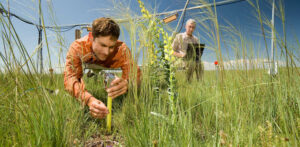
Two people conducting research in a field

Weed Science Webinar Series Schedule

April 5
ARS Weed Science: Past, Present, and Future: Steve Duke, Principal Scientist at the National Center for Natural Products Research at the University of Mississippi, Steve Young, National Program Leader – Weeds and Invasive Pests, WSSA Representatives and ARS Administrators

Meeting Information:

Zoom Meeting Link

Webinar ID: 831 3320 1055

Passcode: 825921

Please download and import the following iCalendar (.ics) files to your calendar system.

Theme I: Tactics

April 12
Integrated Weed Management in Cropping Systems: Marty Williams, Ecologist at the Global Change and Photosynthesis Research Unit in Urbana, IL

April 19
Non-Crop Systems: Advancements in Weed Biocontrol Tools: Melissa Smith, Research Ecologist at the Invasive Plant Research Laboratory in Fort Lauderdale, FL

April 26
New Technology for Weed Identification and Control: Steven Mirsky, Research Ecologist at the Sustainable Agricultural Systems Laboratory in Beltsville, MD

Theme II: Mechanisms

May 3
Role of Plant Physiology in Weed-Crop Competition: Dave Horvath, Research Plant Physiologist at the Sunflower and Plant Biology Research Unit in Fargo, ND

May 10
Molecular Basis for Controlling Invasive Plants: Matt Tancos, Research Plant Pathologist at the Foreign Disease-Weed Science Research Unit in Fort Detrick, MD

May 17
Addressing Herbicide Resistance with Alternative Chemistries: Scott Baerson, Molecular Biologist at the Natural Products Utilization Research Unit in Oxford, MS

Theme III: Impacts

May 24
Spread and Distribution of Invasive Plants: John Madsen, Research Biologist at the Invasive Species and Pollinator Health Unit in Albany, CA

May 31
Climate Change Effects on Weeds and Management: Dana Blumenthal, Ecologist at the Rangeland Resources & Systems Research Unit in Fort Collins, CO

June 7
Restoration for Managing Invasive Plants: Roger Sheley, Ecologist at the Range and Meadow Forage Management Research Unit in Burns, OR